Xitang
Xitang is a canal town in Jiashan County, about 10 kilometres north of the county seat and close to the Shanghai border, in the Jiaxing prefecture. It is the nearest of the big Zhejiang water towns to Shanghai and the one with the loosest feel. Families still live along the canals, small bars and guesthouses fill the lanes, and young Chinese travellers come for long evenings by the water.
Its old names were Xutang and Xietang. In the Spring and Autumn period this was border country between the states of Wu and Yue, and the town still calls itself the root of Wu and the corner of Yue. A local legend credits the Wu general Wu Zixu with digging the first channels here. By the Yuan and Ming the town was a prosperous market for rice, kilns and pottery.
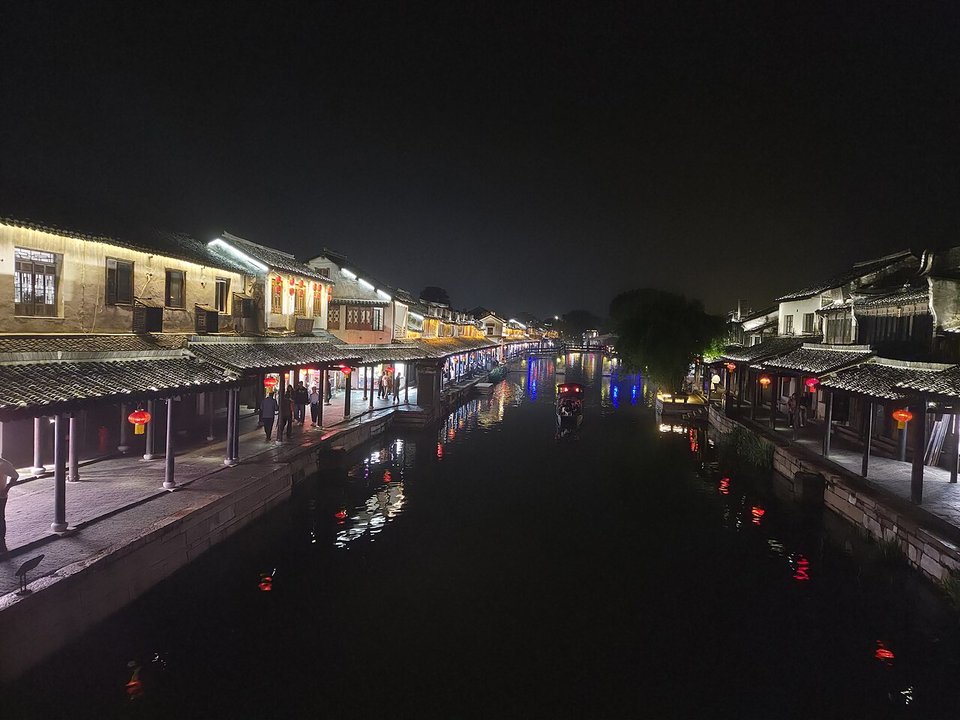
The covered corridors
What sets Xitang apart from other water towns is its covered walkways. Along the canals the house fronts carry tiled roofs out over the street, joined into one continuous arcade. Chinese Wikipedia puts the total length at close to a thousand metres. The town calls them the misty rain corridors, and on a wet day you can walk most of the old centre without an umbrella. Some stretches have long benches on the water side where people sit and watch the boats.
Nine waterways cross the town and 27 stone bridges span them, according to Chinese Wikipedia. The Songzi Laifeng Bridge, whose name wishes sons and phoenixes on those who cross it, is the pier for the hand rowed boats.
Shipi Lane and the old houses
Of the town's narrow lanes, the best known is Shipi Lane, the stone skin lane, which runs between two old family houses. English Wikipedia gives its length as 68 metres and its width as about a metre, narrowing to 0.8 metres at the entrance, with walls 6 to 10 metres high on either side and 166 stone slabs for paving. It dates from the late Ming or early Qing.
Zhejiang lists a group of Xitang buildings as a provincial protected site. They are the Wang family house, the Wolong and Wufu bridges, the Sheng Tang hall, the temple of the grain transport king, known locally as the temple of the seven masters, the Zhong Jiefu pharmacy, the Ni family house, which was the ancestral home of the Shanghai official Ni Tianzeng, and the Yuan family house.
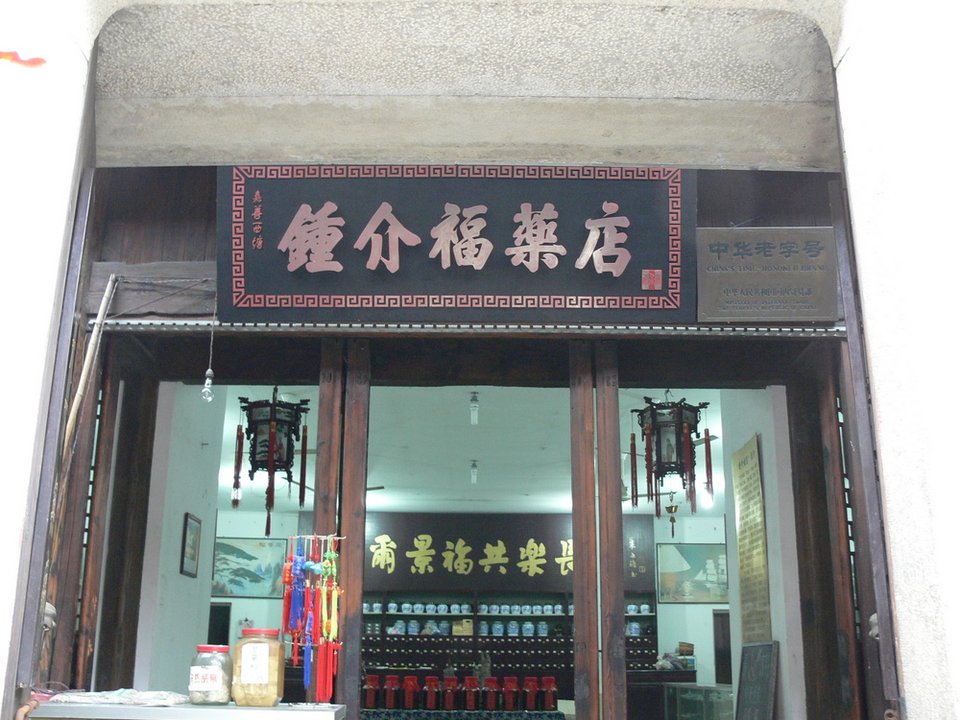
The ticket also covers small sights such as the Zui Garden on Tawan Street, a family garden of Ming origin with five tiny courtyards and a brick bridge only one person wide, the Xiyuan garden, the Zhang Zhenggen root carving gallery and a button museum. The button museum makes sense once you know that Xitang's factories turn out tens of billions of buttons a year, enough that it calls itself China's button town.
Film, music and costume
The final scenes of Mission Impossible III were filmed in Xitang, and Jay Chou shot a music video here. Since November 2013, when the lyricist Vincent Fang started it, a Hanfu culture week has drawn people in traditional Han dress every year. On those days the lanes are full of silk robes and cameras. The town was named a historic town of China in 2003 and a 5A scenic area in 2017.
Ticket and hours
Xitang sells one ticket for the scenic area. The scenic area's official Weibo and a September 2025 Jiaxing Bendibao notice both give the price as 95 yuan, valid for one day. If you register your face with the ticket at the gate you can go in and out several times the same day. Children under 1.2 metres and people over 70 enter free. Students, people aged 6 to 18, people aged 60 to 69 and children from 1.2 to 1.5 metres pay half.
Bendibao lists the small sights as open 7:30 to 17:30 on weekdays and 7:30 to 18:30 at weekends. The streets themselves stay open after that and the town is lively at night. On some holiday evenings the town has sold a cheaper night ticket. During the 2026 Dragon Boat holiday, sales ran to 21:00 with a 60 yuan ticket after 17:00.
Typhoons close the town. In July and August 2026 Xitang shut twice for typhoon warnings and suspended its boats, reopening when the alerts were lowered. In summer, check the scenic area's notices before you travel. The ticket hotline is 0573 84567890.
Getting there
Jiaxing Bendibao suggests a train or bus to Jiashan and then a bus of about 20 minutes to Xitang. From Jiaxing South it is about 30 minutes by road. There are also direct buses from Shanghai South station or the Shanghai long distance bus station, a ride of about two hours. From Hangzhou, buses leave from the Jiubao terminal.
Pairing it
For a polished contrast in the same prefecture, see Wuzhen. South Lake in Jiaxing city fills a half day on the way.
Frequently asked questions
Can I just walk in without a ticket?
The town is lived in, and ticket checks are at the entrances. The ticket covers the small sights inside, so buy one if you want to see the gardens and museums.
Is Xitang busy?
Very, on weekends and holidays, especially in the evening. A weekday is calmer.
How long do I need?
Half a day for the lanes and sights. Stay a night for the evening lights and a quiet morning.
Sources
Facts in this article were checked against the following sources, retrieved 22 October 2026.
- 西塘镇 (嘉善县), Chinese Wikipedia
- Xitang, English Wikipedia
- Jiaxing Bendibao, Xitang ticket information, September 2025
- Jiaxing Bendibao, Xitang listing
- Xitang scenic area official Weibo
- Xitang Dragon Boat holiday ticket notice, June 2026
- Jiaxing travel guide on this site
Photos are from Wikimedia Commons under the licences shown in each caption.