Wuzhen
Wuzhen is a canal town in Tongxiang, in the Jiaxing prefecture of northern Zhejiang, roughly in the middle of the triangle formed by Hangzhou, Suzhou and Shanghai. It is the most managed of the Jiangnan water towns. A single company runs the two ticketed scenic zones, restored the houses, wired the canals for light and filled the old buildings with inns, restaurants and museums. People who want a town left as it was tend to dislike it. People who want an easy, clean, beautiful canal town at night tend to love it.
The town is old. Chinese Wikipedia records that the Liang crown prince Xiao Tong came here to study with his tutor Shen Yue in 503, and that the town produced 64 successful palace examination candidates over the centuries. For most of its history it was two towns facing each other across the market river. Wu on the west bank belonged to Huzhou prefecture and Qing on the east bank to Jiaxing. They were joined as Wuzhen after 1949.
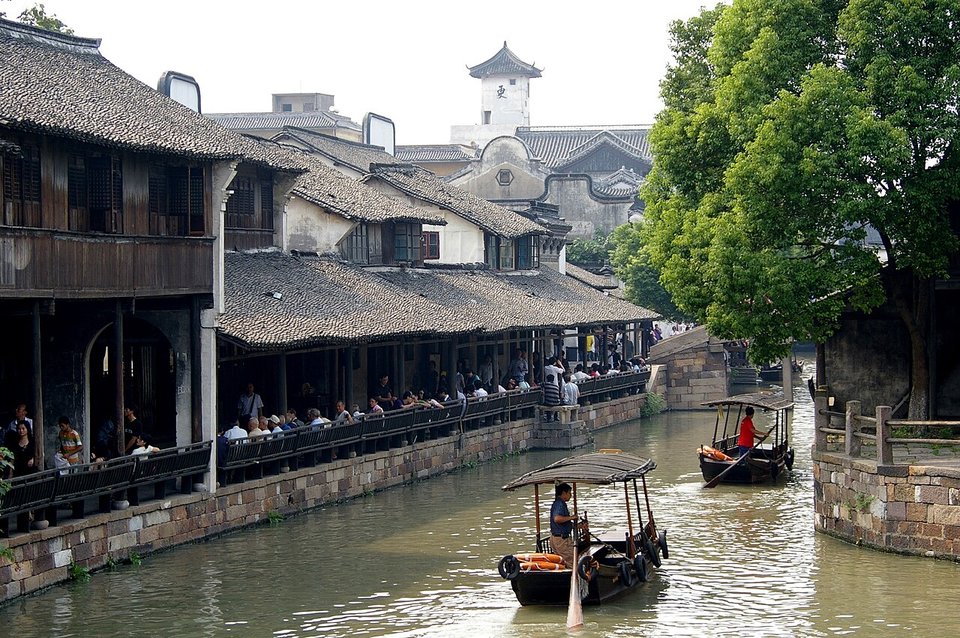
Dongzha and Xizha
Wuzhen has four old quarters, named after the four gates. The east zone, Dongzha, and the west zone, Xizha, are the ticketed scenic areas. The north and south quarters are ordinary streets where people still live.
Dongzha is the smaller and older of the two zones as a tourist site. It runs along the East Market River and is the place for daytime sightseeing. Here are the craft workshops, where blue printed cloth is made by the old methods, the old pawnshop, a traditional pharmacy, and the former homes of the town's two writers. The official site describes Dongzha as the zone with more of the original residents' daily life.
Xizha is much larger, 4.92 square kilometres across twelve islands according to the operator. Its houses were restored with modern plumbing and turned into guesthouses and hotels, and in the evening the canals are lit and the zone stays open late. Xizha has the Mu Xin Art Museum, a soy sauce workshop with rows of fermentation vats and the long stretches of waterside houses that appear in most photographs of Wuzhen.
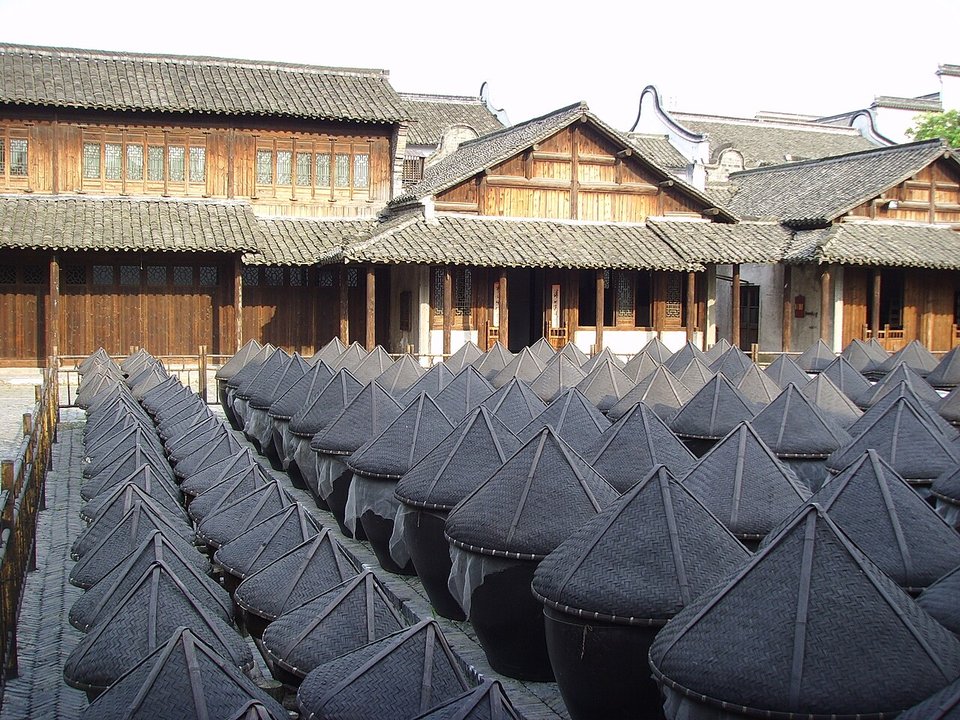
If you have one day, a common plan is Dongzha in the morning and Xizha from mid afternoon into the evening. If you can stay a night, sleep in Xizha and see Dongzha the next morning before the tour groups arrive.
Mao Dun and Mu Xin
The novelist Mao Dun, whose real name was Shen Yanbing, was born in Wuzhen on 4 July 1896 and lived here until he left for school in 1910. His family home on Guanqian Street in Dongzha is a mid nineteenth century Jiangnan house of about 650 square metres. It opened as a museum in 1985 and became a national protected site in 1988. Next door is the Lizhi Academy, rebuilt in the 1860s and now part of the memorial. His novel The Lin Family Shop is set in a town like this one.
Mu Xin, the painter, poet and essayist, was born in Wuzhen, lived abroad for many years and came home in 2005 at the town's invitation. He lived in his restored family house, Wanqing Xiaozhu at 186 Caishenwan in Dongzha, until his death on 21 December 2011. The house opened as his memorial in May 2014. The Mu Xin Art Museum in Xizha, designed by a pupil of I. M. Pei according to English Wikipedia, has been open since November 2015.
Other things to look for
The Xiuzhen Taoist temple on Guanqian Street was founded in 998 and rebuilt for the scenic area, with an old opera stage across the square. The paired Tongji and Renji bridges form the view the town calls the bridge within a bridge, where each arch frames the other. Local products include blue printed cloth, Sanbai rice spirit and Gusao biscuits.
The town also hosts big events. The World Internet Conference has met here every year since the first session in November 2014, and the Art Wuzhen contemporary art exhibition has used venues across Xizha since 2016. Hotel prices jump during these events.
Tickets
The official Wuzhen tourism site lists Dongzha at 110 yuan, Xizha at 150 yuan and a combined ticket for both at 190 yuan. Concession tickets are 55, 75 and 130 yuan for full time students, children between 1.2 and 1.5 metres, teenagers aged 6 to 18 and people aged 60 to 69. Children under 1.2 metres or aged 6 and under go free, and so do people aged 70 and over with ID.
Tickets are valid once on the day of use. The combined ticket is normally a one day ticket, but guests staying in Xizha can buy a two day version at check in, seeing Xizha on the first day and Dongzha the next. Hotel guests pay for entry once and then get a pass to come and go during their stay.
Hours
The official site lists Dongzha ticket sales from 7:00 to 18:00 in summer and 7:00 to 17:30 in winter, and Xizha from 9:00 to 22:00. Combined tickets are sold until 16:00 at Dongzha and until 14:30 in summer or 14:00 in winter at Xizha. Museums and small sights inside Xizha keep shorter daytime hours, so see them before dark. Xizha boats are priced per boat for a private hire or per seat on a shared boat that leaves when full. Check the day's notice for boat times and prices.
Getting there
Wuzhen is about an hour by road from Jiaxing and is also served by direct buses from Hangzhou, Shanghai and cities in Jiangsu to the Wuzhen bus station. Qunar's guide says city bus 350 runs from the bus station to the scenic area in about 20 minutes, and that Tongxiang high speed station is about 35 kilometres away, so most rail travellers finish the trip by taxi or bus. For a quieter water town in the same prefecture, see Xitang. In neighbouring Huzhou, Nanxun is free to walk and much less busy.
Frequently asked questions
Dongzha or Xizha if I only have time for one?
Xizha, ideally from late afternoon into the evening. Dongzha is better for the writers' houses and craft workshops.
Do I need to stay overnight?
It is optional. Xizha is at its best after the day visitors leave and early the next morning.
Is Wuzhen worth it if I have seen Zhouzhuang?
It is more polished and bigger at night. If you have already seen Zhouzhuang and want something different, Nanxun is a better contrast.
Sources
Facts in this article were checked against the following sources, retrieved 22 October 2026.
- Wuzhen official site, ticket policy
- Wuzhen official site, visitor questions
- Wuzhen official site, Dongzha notice with sales hours
- 乌镇镇, Chinese Wikipedia
- Wuzhen, English Wikipedia
- Qunar, Wuzhen practical notes
- Jiaxing travel guide on this site
Photos are from Wikimedia Commons under the licences shown in each caption.