Hengdian World Studios
Hengdian World Studios is a film town in Hengdian, a small town in Dongyang in the east of Jinhua prefecture. It is one of the largest outdoor film backlots in the world, a spread of full scale sets that copy palaces, old streets and whole city quarters from two thousand years of Chinese history. Film crews use the sets for free. The company earns its money from hotels, equipment, costumes and, above all, tourists, who according to Chinese Wikipedia bring in about 90 percent of its income.
How a village became a backlot
The studio was built by the Hengdian Group, founded by the local entrepreneur Xu Wenrong. The first set was Guangzhou Street, put up in August 1996 for the director Xie Jin's film The Opium War. The next year came the Qin Palace for Chen Kaige's The Emperor and the Assassin. Hong Kong Street followed in 1998, along with the first large indoor stage, and a Jiangnan water town set in 1999.
The most expensive set is the Ming and Qing Palace, a near full scale copy of most of the main buildings of Beijing's Forbidden City, with a Tiananmen and old Beijing streets, built for about 600 million yuan. A copy of the Old Summer Palace was partly opened in 2015, and Legend of Bund, a recreation of 1920s to 1940s Shanghai, opened for trial operation in August 2019. In 2010 the studios became a national 5A scenic area.
English Wikipedia lists 30 outdoor bases and 130 indoor stages. Chinese Wikipedia estimates that about a third of the costume dramas made in China each year are shot here. International productions have used the sets too, among them The Forbidden Kingdom and The Mummy, Tomb of the Dragon Emperor.
The main sets for visitors
Each set is a separate park with its own ticket, and you will not see them all in one day. Most visitors choose two or three.
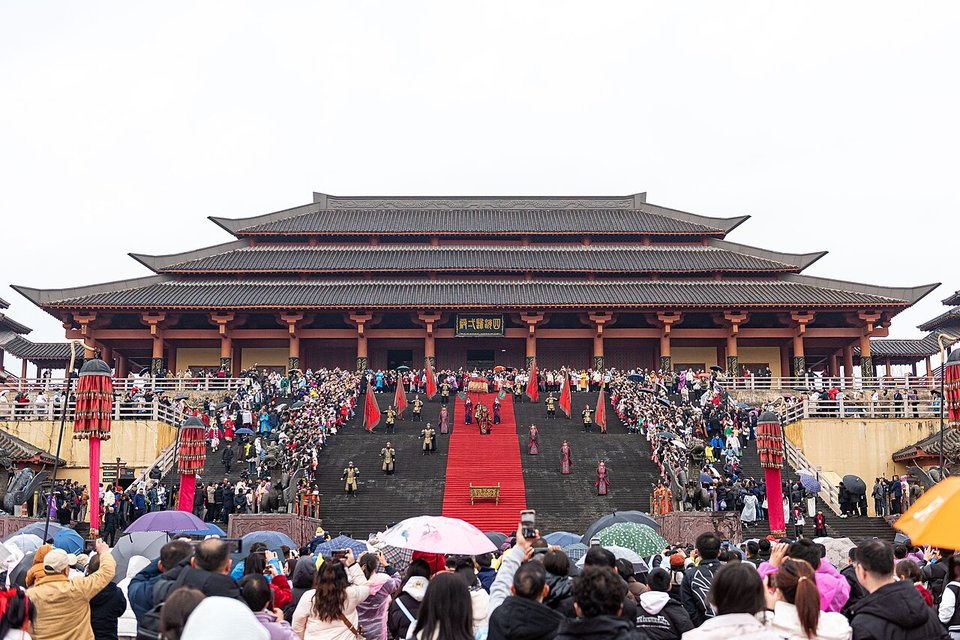
The Palace of Emperor Qin is the most dramatic, a vast walled compound whose main hall, the Unification Hall, has been dressed and redressed by the crews that have worked in it. Zhang Yimou used it as the palace of the First Emperor in Hero. The Ming and Qing Palace is the place to stand in front of what looks like the Forbidden City without the Beijing crowds. Guangzhou Street and Hong Kong Street together recreate southern Chinese port streets of the nineteenth and early twentieth centuries.
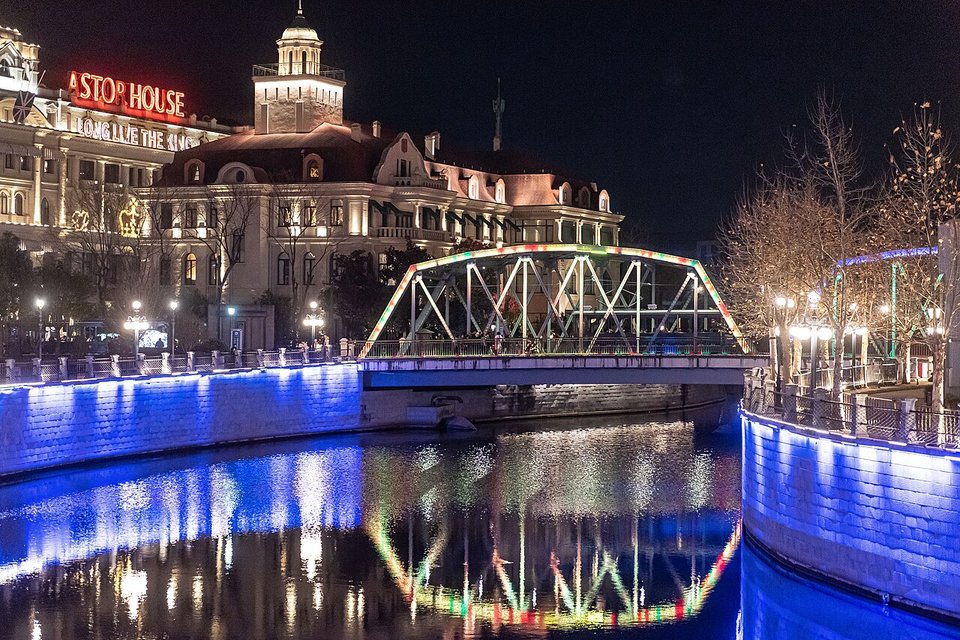
Legend of Bund is a newer set that copies the Shanghai waterfront, with the Garden Bridge, Suzhou Creek and old department stores, and it is lit up in the evening. The Qingming Riverside set recreates the Song capital from the famous scroll painting.
The sets run regular shows such as battles, court ceremonies and stunt displays, and the official site calls Hengdian a capital of tourism performances with 20 large shows. Pick up the day's show schedule at the gate and plan your route around it.
Watching a shoot
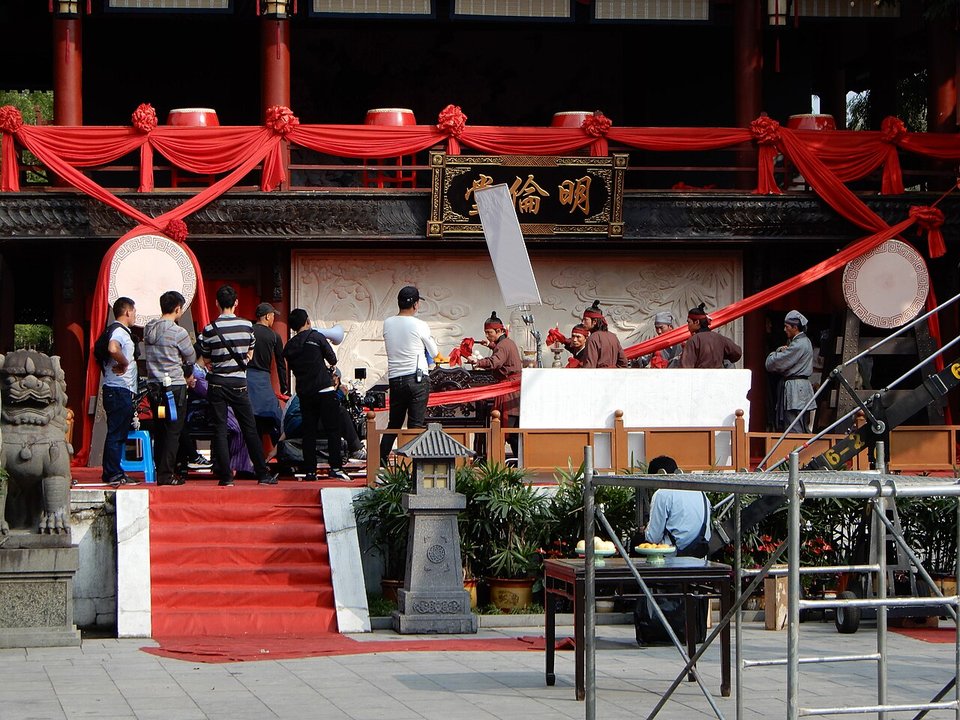
Crews are working somewhere in the studio almost every day, and you may stumble on a scene being filmed. Do not walk into a set that is roped off, and ask before taking photographs of actors.
The extras
Hengdian runs on extras. Chinese Wikipedia says more than 140,000 people registered as extras in 2024, with over 10,000 based here, and that day rates ranged from 120 to 400 yuan depending on the part. They are known as Hengpiao, the Hengdian drifters, and some have gone on to work behind the camera. The 2015 film I Am Somebody tells their story with a cast of real Hengdian extras.
Tickets and hours
The official site lists a gate price of 190 yuan per park in 2026. Booking at least one day in advance online brings the adult price to 185 yuan, seniors born in 1965 or earlier to 133 yuan, students and teachers to 152 yuan, and children born between 2012 and 2018 and people with disabilities to 95 yuan. Tickets are checked against your ID and are for personal sightseeing only.
Hours differ by park and season, and some parks with evening shows stay open late. The official park pages, as indexed in October 2026, list the Ming and Qing Palace on regular days from 8:30 to 17:00, with ticket checks ending at 16:30, or 16:00 from 1 September. Check the day's notice for each set you plan to visit.
Getting there
Since 6 September 2024 Hengdian has had its own station on the Hangzhou to Wenzhou high speed line. The Jinyidong light rail line stops under it and runs one more stop to Mingqinggong station by the Ming and Qing Palace. The same line connects Jinhua city, Yiwu and Dongyang, so the studios work as a day trip from Jinhua or Hangzhou. For quieter sights in the prefecture, see Zhuge Bagua Village and Shuanglong Cave.
Frequently asked questions
Is one ticket enough for all of Hengdian?
No. Each set is a separate park. Online multi park packages exist, so compare them with single tickets.
How many days do I need?
One day covers two or three sets. Film fans often stay two days.
Can I see real filming?
Often, though it is never guaranteed and crews keep visitors away from active sets.
Sources
Facts in this article were checked against the following sources, retrieved 22 October 2026.
- Hengdian World Studios official site, ticket prices
- Hengdian World Studios official site, Ming and Qing Palace
- 横店影视城, Chinese Wikipedia
- Hengdian World Studios, English Wikipedia
- Jinhua travel guide on this site
Photos are from Wikimedia Commons under the licences shown in each caption.