Nanshan, Sanya: Visiting the Guanyin of the South Sea
The Nanshan Cultural Tourism Zone (南山文化旅游区) is the large Buddhist park about 40 kilometres west of downtown Sanya, built around a 108-metre statue of Guanyin standing on an islet in the sea. Recent listings give the adult ticket as 129 yuan from October to April and 108 yuan from May to September, with a 30-yuan sightseeing cart that almost everyone should buy, because the walk from the gate to the statue alone takes thirty to forty minutes in tropical sun. Opening hours are usually given as 8:00 to 17:00 with last entry at 16:30. Allow four to five hours, and pair it with Tianya Haijiao on the same western day. The five-day plan is in the Sanya travel guide.
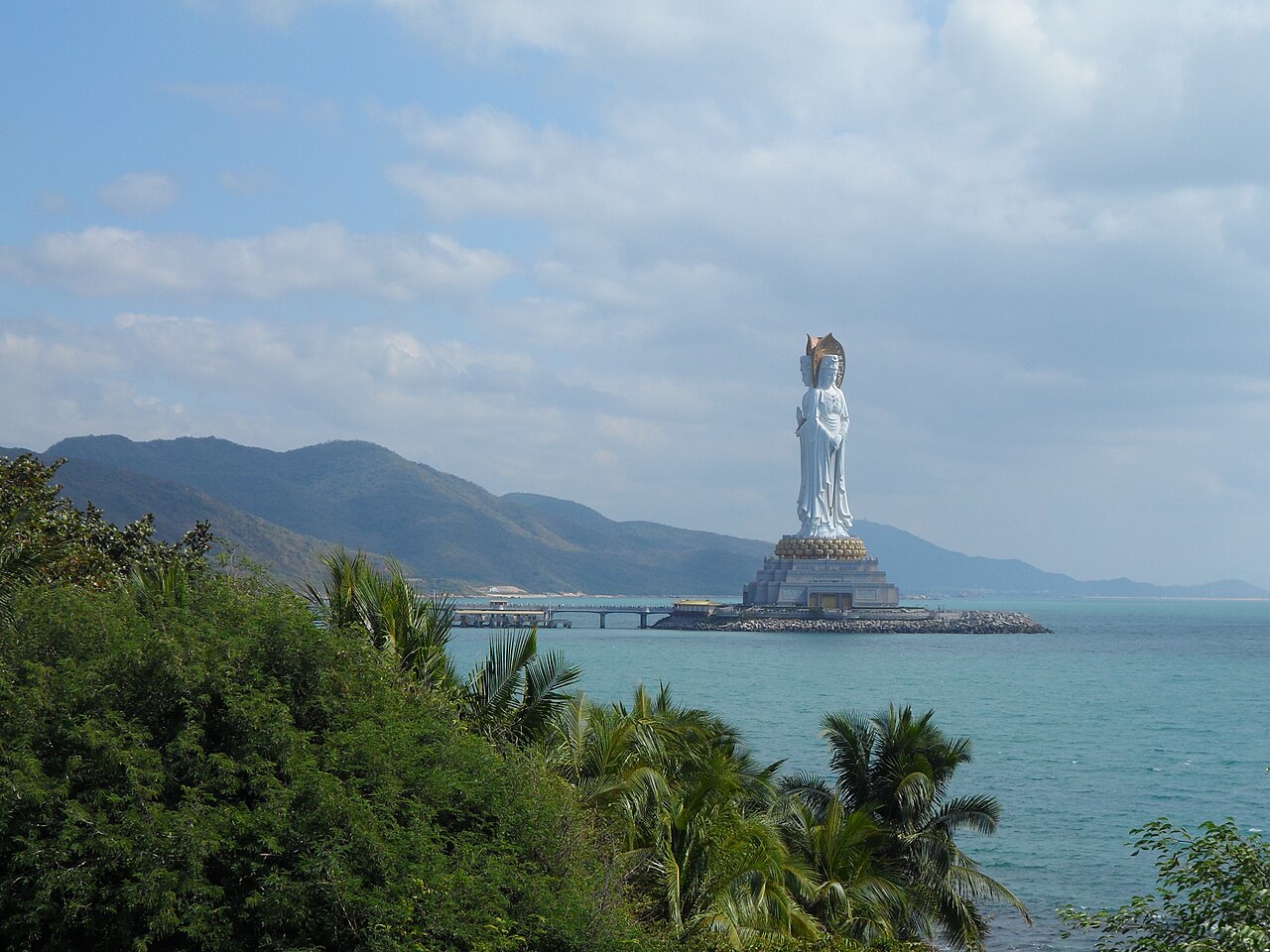
A modern Buddhist site
Nanshan is new. In 1993 the national religious affairs authority and the Hainan provincial government approved a temple and a 108-metre Guanyin statue at the foot of Nanshan mountain, facing the sea. Work on the statue began in 1999, and it was consecrated on 24 April 2005. The zone became a national 5A scenic area in 2007.
The statue has one body and three faces, looking out to sea in three directions, and stands on Jingang Islet, joined to the shore by the Puji Bridge. Buddhist tradition holds that Guanyin made twelve great vows, the second of which was to dwell forever in the South Sea, and that is the source of the name, Guanyin of the South Sea. The statue is taller than the Statue of Liberty, and from the shore it is hard to judge its size until you see people walking at its base.
Nanshan Temple, in the hills behind, was also built in the 1990s, in a Tang-influenced style. It is a working temple with monks, and many Chinese visitors come to pray and burn incense as well as to sightsee.
Tickets and the cart
From recent public listings:
- Adult ticket: 129 yuan from 1 October to 30 April, 108 yuan from 1 May to 30 September. Booking online usually saves about ten yuan.
- Half price for children 1.2 to 1.4 metres tall, people aged 60 to 69 and full-time students, with documents.
- Free for children under 1.2 metres, people over 70, soldiers and people with disabilities, with documents.
- Sightseeing cart: 30 yuan, hop on and off at the stops in a loop.
- Hours: about 8:00 to 17:00, last entry 16:30, with indoor halls closing from about 16:45.
The cart is the most important purchase of the day. The zone is large, the main sights are far apart, and walking between them in 30-degree heat wears people out. Some halls and exhibitions inside charge extra; you don't need them.
A sensible order
- Enter early, ideally at 8:00. The light is softer, the heat is lower and tour coaches start arriving mid-morning.
- Take the cart to the Guanyin first. Walk across the Puji Bridge to Jingang Islet, see the base of the statue and the halls beneath it, and look back toward the mountain.
- Ride on to Nanshan Temple. Climb the steps to the main halls. Dress respectfully: shoulders and knees covered.
- Have a vegetarian lunch. Nanshan's vegetarian restaurants are well known, and lunch here is part of the visit for many Chinese families. Prices are higher than in town.
- See the gardens and smaller halls only if you still have energy, then leave by mid-afternoon.
Getting there
Nanshan is on the coast road west of Sanya toward Yazhou. A taxi or ride-hail from downtown takes about forty minutes to an hour depending on traffic. Tour buses and day packages also run from Sanya, often combined with Tianya Haijiao. If you go independently, book a car back in advance or note the last bus times; the gate area can be quiet after the 17:00 close.
The usual pairing is Tianya Haijiao in the morning and Nanshan from around midday, or the reverse. Don't try to add Wuzhizhou Island on the same day: it is in Haitang Bay on the opposite side of the city.
Heat and comfort
Most of the zone is outdoors with limited shade.
- Wear a hat, sunglasses and sunscreen, and reapply after lunch.
- Bring water. Drinks inside cost more.
- Wear comfortable shoes. Even with the cart, there is walking at every stop.
- With older relatives or children, plan shade breaks rather than trying to see everything.
If someone in your group flags after the statue and the temple, stop. The zone has more halls and gardens than anyone needs to see.
Etiquette
- Keep your voice down in the temple halls, and don't climb on railings or statues for photos.
- Ask before photographing people who are praying.
- Follow the photography signs inside halls.
- Incense is sold on site. Light it only in the designated burners.
Is Nanshan worth a day?
It is worth it if you want a cultural day between beach days, or if you are travelling with family who will appreciate the temple and the statue. It is weaker if your trip is all about the sea, or if commercial religious parks leave you cold. The Sanya guide suggests choosing between Nanshan and Wuzhizhou if you are short of time; choose Nanshan for culture, Wuzhizhou for diving.
Frequently asked questions
How much is the Nanshan ticket?
Recent listings give 129 yuan from October to April and 108 yuan from May to September, plus 30 yuan for the cart.
How tall is the Guanyin statue at Nanshan?
108 metres. It stands on an islet in the sea, linked to the shore by a bridge.
How long should I spend at Nanshan?
Four to five hours with the cart, including lunch.
Can I visit Nanshan and Tianya Haijiao on the same day?
Yes. Both are west of Sanya on the same road. Do one in the morning and the other in the afternoon.
Sources
- Nanshan Cultural Tourism Zone, Chinese Wikipedia: https://zh.wikipedia.org/wiki/南山文化旅游区
- Nanshan ticket and visitor notes, Zhunaqu, 2026: https://bk.zhunaqu.com/article/628
- Nanshan ticket listings, CNCN: https://m.cncn.com/piao/15761