Taiyuan Travel Guide: Jinci, Tianlongshan, the Shanxi Museum and the Twin Pagodas
Taiyuan, the capital of Shanxi, is worth three days for one reason: it holds some of the best early buildings and sculpture in China within half an hour of the centre. Spend a morning at Jinci for its Song clay figures, an afternoon at the Tianlongshan Grottoes in the hills above it, and a half-day in the Shanxi Museum, which is free if you book. The city's old name was Jinyang, its walls first went up in 497 BC, and the Tang dynasty was launched from here, which is why locals call it the Dragon City. Metro Line 1 links the airport and Taiyuan South station; the main sights are southwest and southeast of town.
Getting in and where to stay
Taiyuan South is the high-speed station, with trains north to Datong and south toward Xi'an. Metro Line 1 runs from Taiyuan South to Wusu Airport in about 20 minutes, and Lines 1 and 2 cross at Dananmen in the centre. The metro runs from about 6:00 to just before 23:00.
Stay in the centre near Dananmen or along the Fen River on the Shanxi Museum side. Jinci, Tianlongshan and Mengshan are all southwest in Jinyuan District; buses reach Jinci, but for Tianlongshan and Mengshan a taxi or ride-hailing car is much easier.
Places worth visiting
Jinci: Song clay maids and a cross-shaped bridge
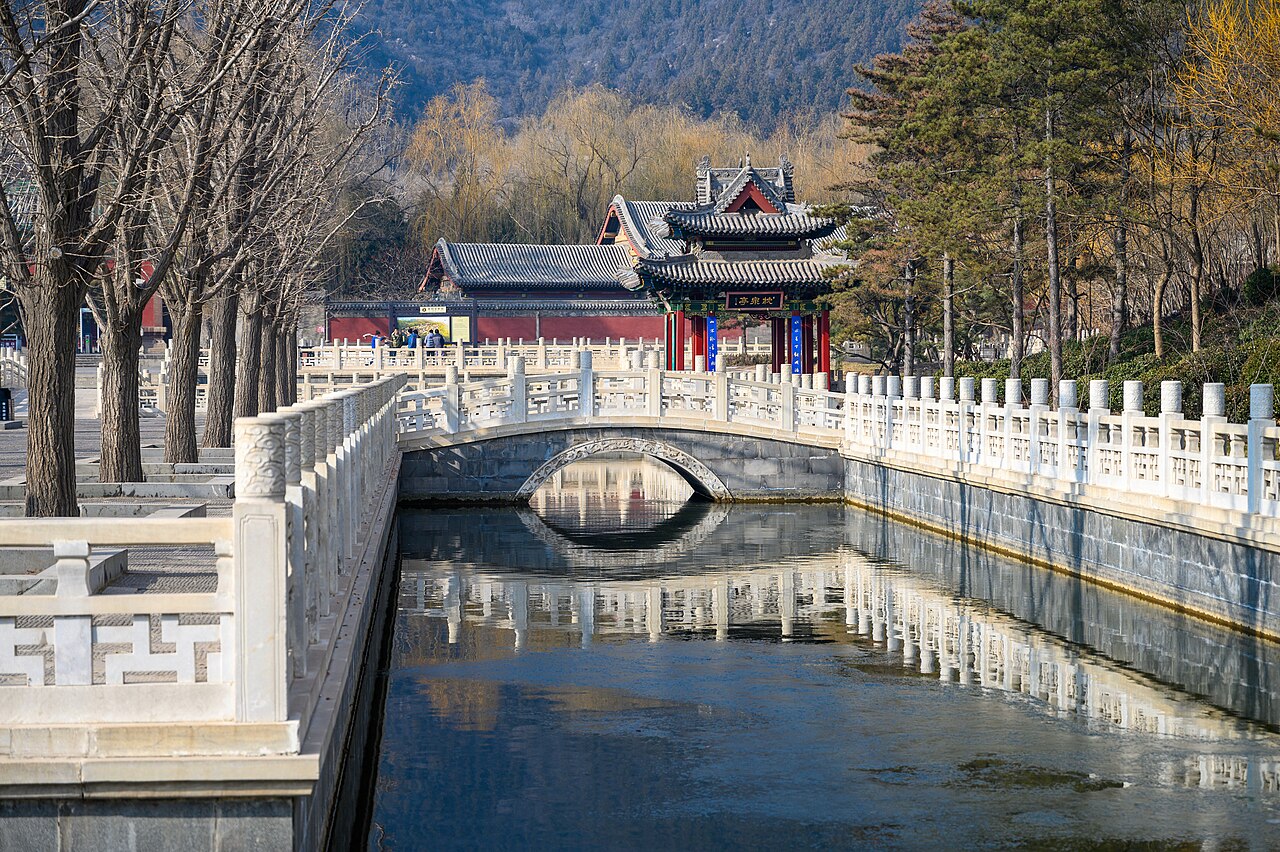
Jinci, about 25 km southwest of the centre at the foot of Xuanweng Mountain, began as a shrine to Tang Shuyu, founder of the Jin state. Li Daoyuan already described it in the Northern Wei, and later dynasties kept building: a Sui pagoda, a Jin hall of 1168, Ming and Qing additions. Walk the central axis. The Sacred Mother Hall, built under Song Renzong (1023–1032), holds 43 painted clay figures, 41 of them original Song work: Yi Jiang on her throne and 42 attendants, each with a different face and task. In front, the Fish Pond Flying Bridge is a rare cross-shaped bridge. The other "wonders" are the Zhou cypress, leaning about 40 degrees, and the Never Aging Spring, still feeding the Jin River.
The museum had more than 4.37 million visitors in 2024, so come early. For 8–31 October 2026 it is open 08:30–17:30 with the last tickets at 17:00. Ticket prices, buses and the free park around the museum are on the Jinci page.
Tianlongshan Grottoes: a cliff that lost its statues
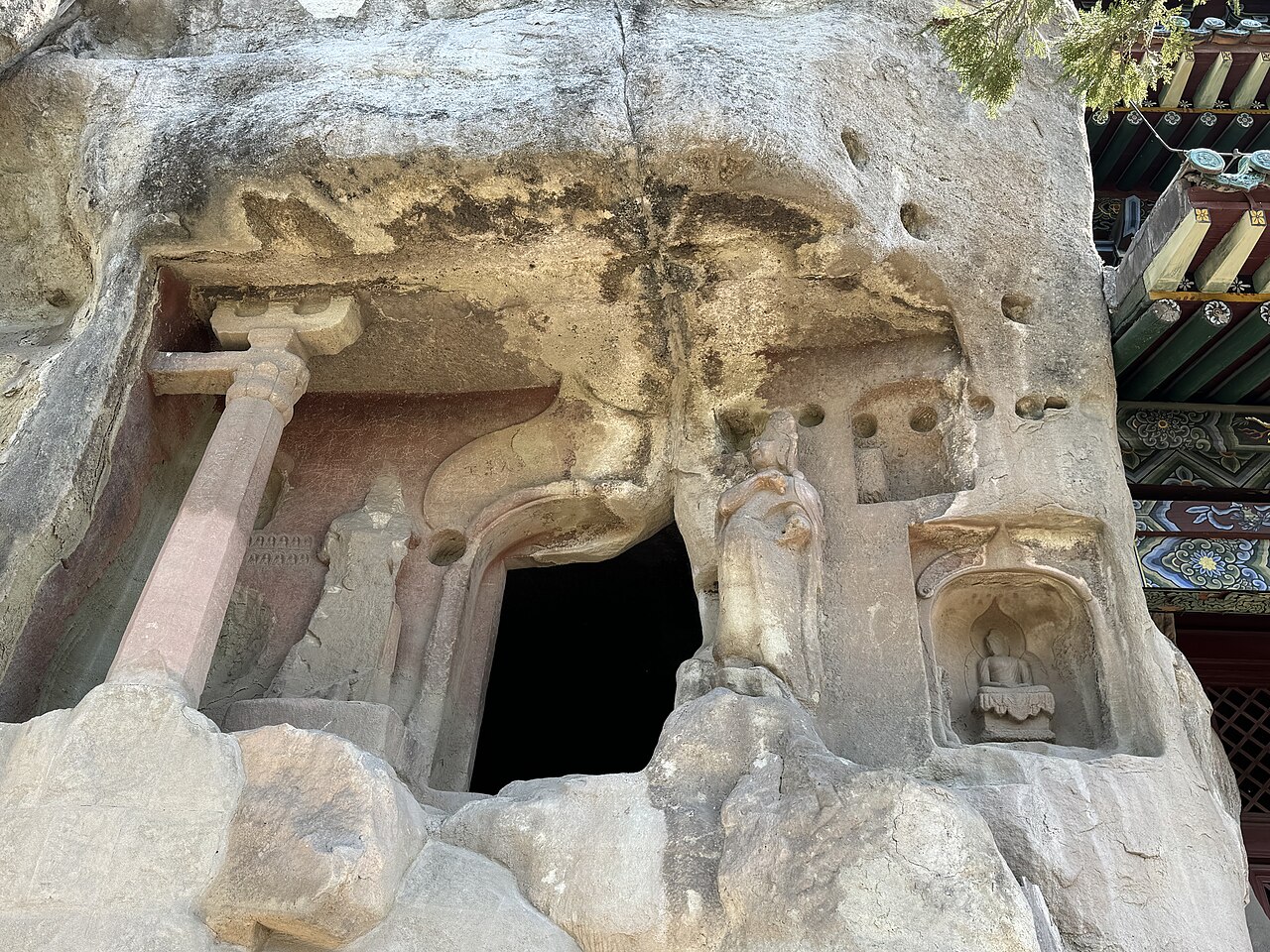
More than twenty caves line about 500 m of south-facing cliff on Mount Tianlong, above Jinci. They were cut from the end of the Northern Wei through the Northern Qi, Sui and Tang, and you can watch the figures fill out from lean Eastern Wei forms to round Tang ones. In the 1920s the site was stripped, with the Japanese dealer Yamanaka Sadajirō's firm among the main buyers; surveys count more than 240 heads and figures removed, at least 150 of them now abroad. A Tang Buddha head returned from a Japanese auction in 2020 is now in Beijing, and a digital hall on the mountain puts the lost pieces back in their niches on screen.
For 8–31 October 2026 the Tianlongshan Grottoes Museum is open 08:30–17:30, last tickets at 16:30. The road is steep and winding, and private cars may face controls in season.
Mengshan Giant Buddha
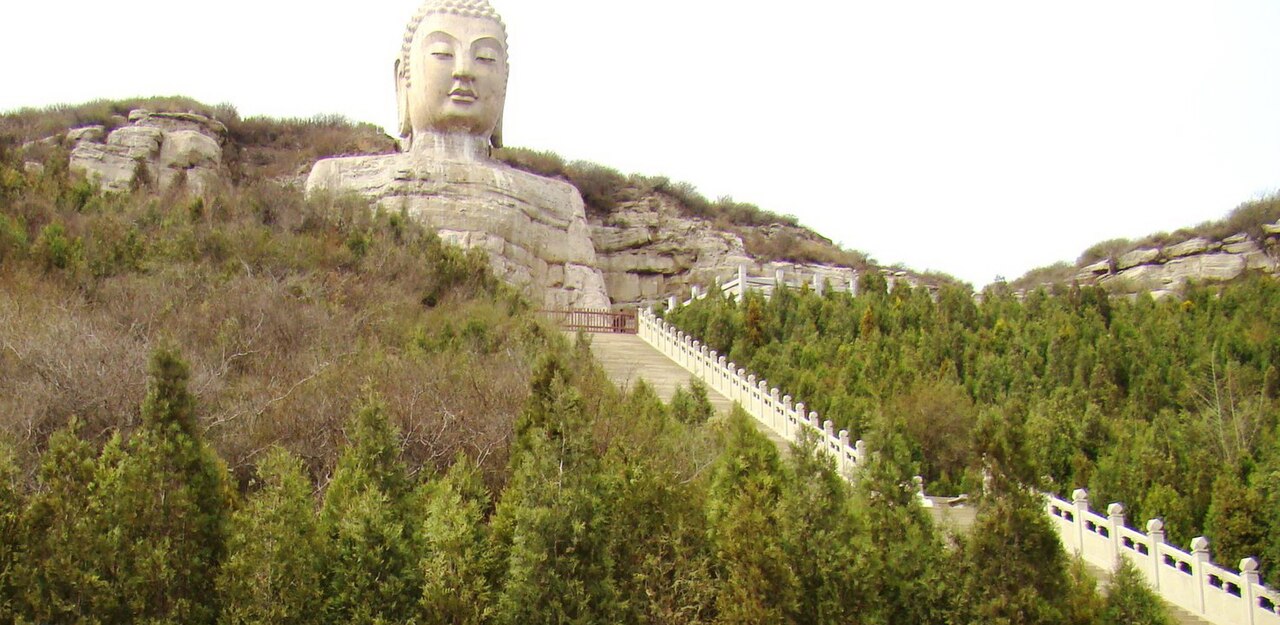
Northwest of Sidi village in Jinyuan District, the Northern Qi emperor Wenxuan founded Kaihua Temple in 559 and had a Buddha carved from the cliff a kilometre behind it. Tang Gaozu came to see it, and so did Gaozong with Empress Wu. It was wrecked at the end of the Yuan and forgotten until a place-name survey found it in 1980. Measurements differ: about 40 m as it stands, 46 m with the later base, while a Tang source gives 200 chi, roughly 59 m. The original head was lost. The present 12 m head is a restoration begun in 2006, styled on Northern Qi Buddhas found locally, which is why it looks newer than the body.
Yongzuo Temple and the twin pagodas
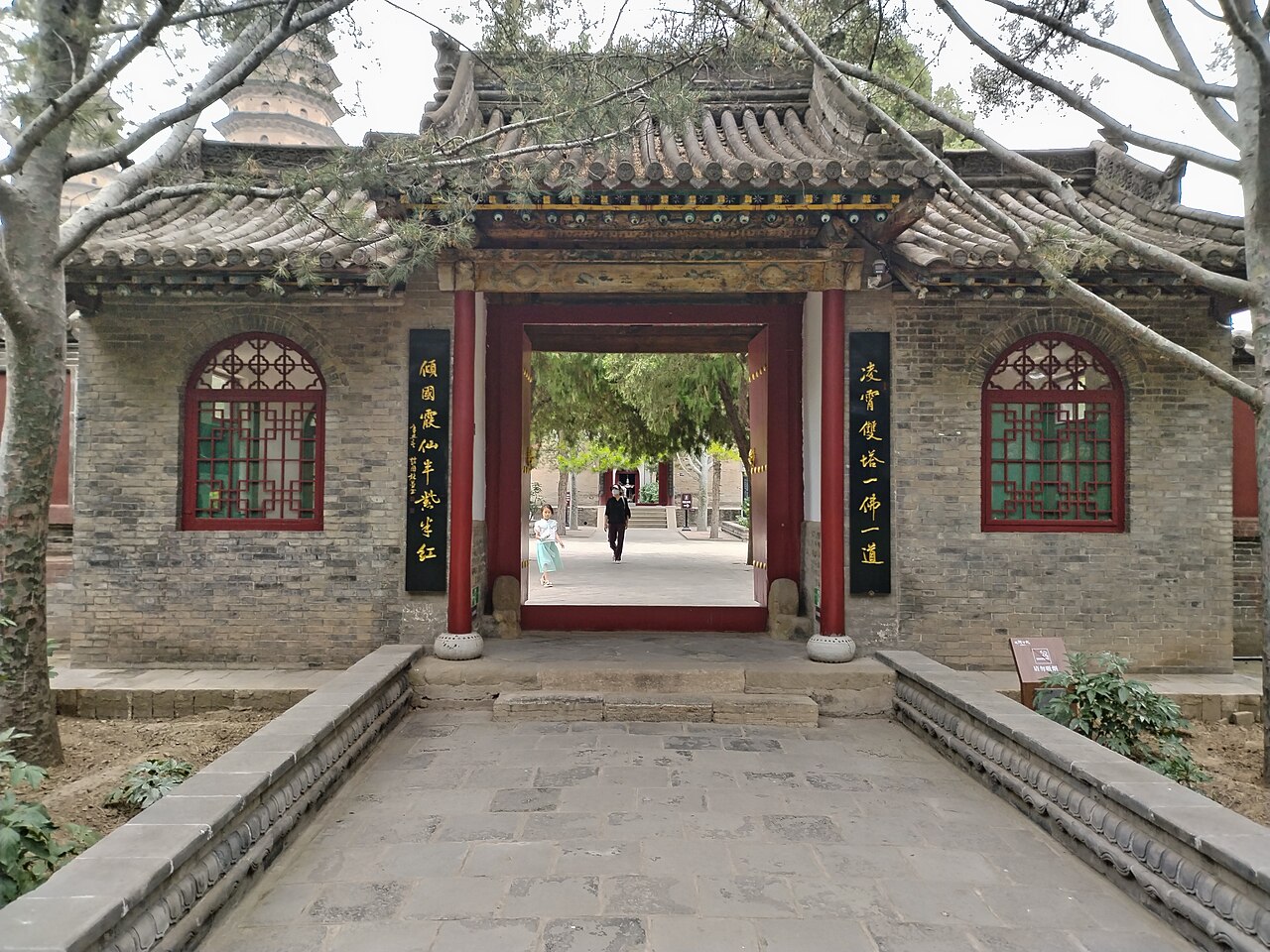
The two brick pagodas on the southeast edge of town are the city's emblem. Each is octagonal, thirteen storeys and 54.76 m tall, with spiral stairs inside, and they stand 46 m apart. The temple was founded in 1597 and enlarged from 1608 by Zhu Michun, Prince of Jin. Its stele corridor keeps more than 260 carved stones, and in late spring more than 6,000 peony plants bloom, among them Ming-era "Violet Fairy" (Zixiaxian) stems. Climbing the pagodas may run on time slots.
Shanxi Museum
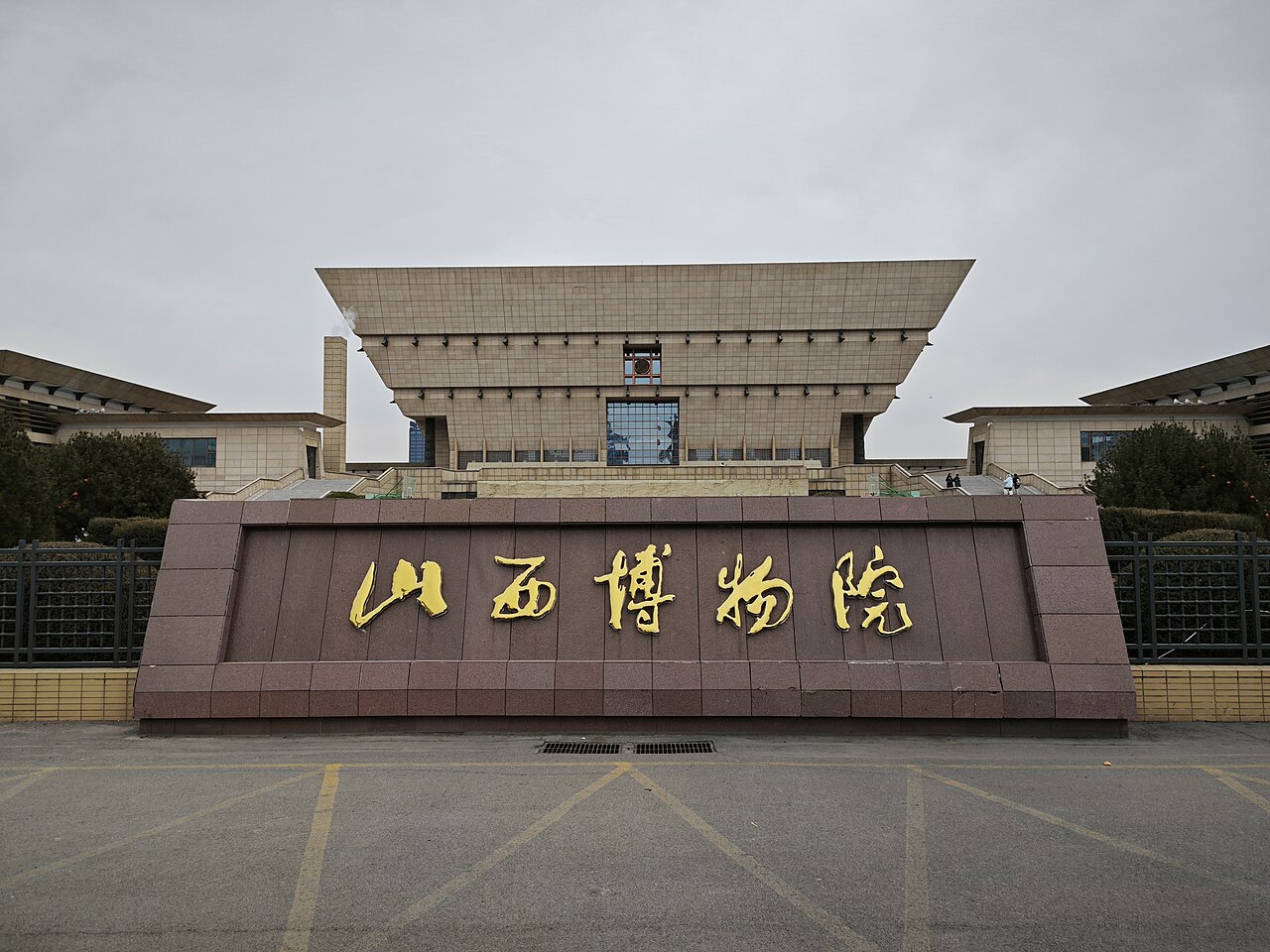
On Binhe West Road by the Fen River, the museum's main building is shaped like a ding cauldron. It opened in 2004 and holds nearly 660,000 objects. The Jin state bronzes from Qucun-Tianma, the Houma covenant tablets, the mounted-procession murals from Lou Rui's tomb and the carved sarcophagus of Yu Hong are what most people come for; give it at least half a day. Entry is free with a booking on the museum's official WeChat account, which opens three days ahead at 20:00 and again at 08:00 on the day. Since 1 September 2026 you enter with the original ID you booked with. It is normally closed on Mondays except public holidays.
Chongshan Temple
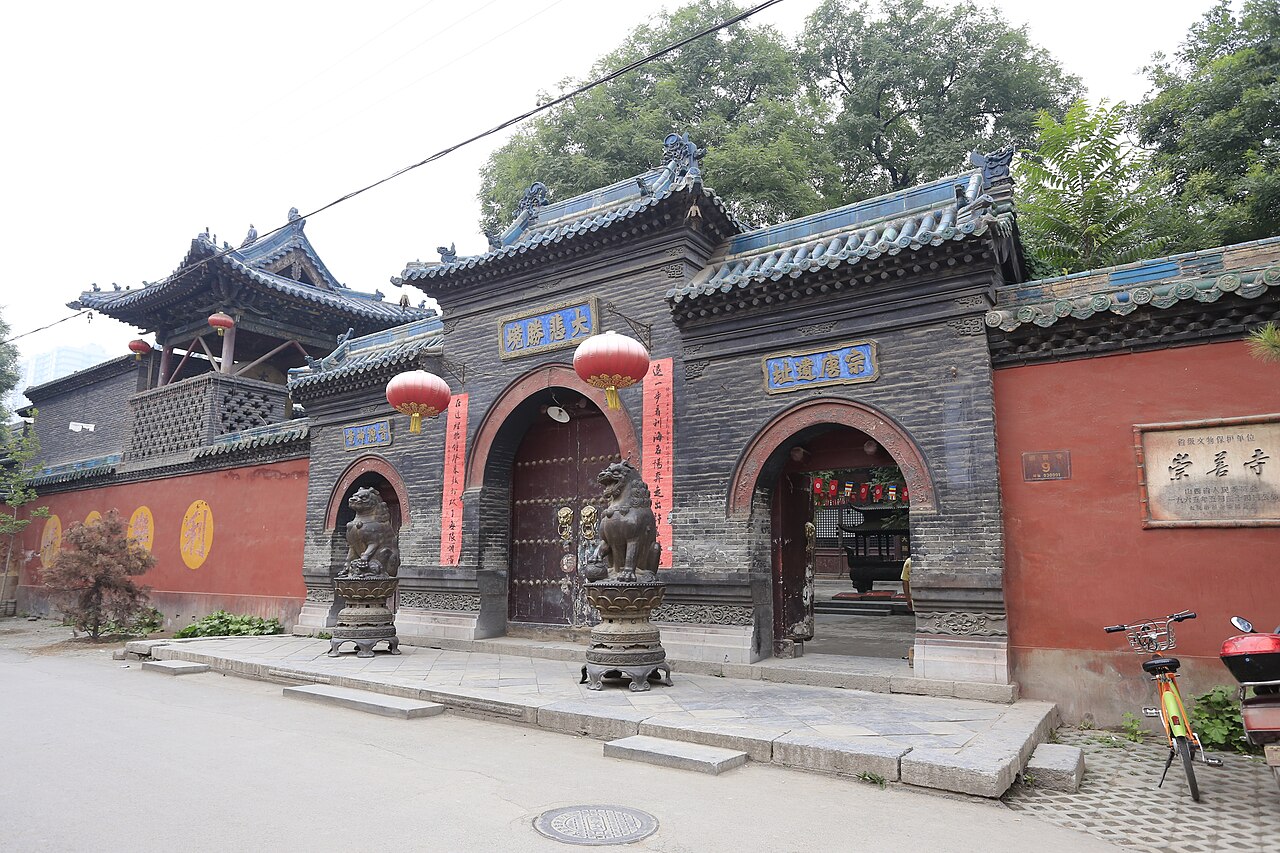
A quiet temple in the southeast of the old city. The Prince of Jin rebuilt it in 1381 in memory of his mother, and it was a huge complex until a fire in 1864. Only the Ming Great Compassion Hall survived, a seven-bay, double-eaved hall with giant thousand-armed Guanyin figures as old as the building. In 1882 governor Zhang Zhidong turned the burnt front courts into the Confucian Temple, a few steps away.
When to come
Summers are milder than on the North China Plain, with July averaging about 24°C, and May to October is the comfortable window. Autumn's dry, clear light is best for old timber halls; late spring brings the Yongzuo peonies. Winters are long and dry, with January averaging around −5°C, and spring is windy. Bring sunscreen and lip balm.
Eating in Taiyuan
Start with knife-cut noodles (daoxiao mian), shaved from a block of dough straight into the pot, and add Shanxi aged vinegar. Guoyou rou is pork fried with wood-ear mushrooms and garlic shoots. Tounao is a Taiyuan-only breakfast, a thick yellowish broth with mutton and yam served with a pickled chive and a flatbread, said to have been invented by the scholar Fu Shan. It is mostly a cold-season breakfast, and shops open early. Mutton offal soup (yang zasui) is the other cold-weather staple.
How to arrange the route
Day 1, in town. Shanxi Museum in the morning, Chongshan Temple and the Confucian Temple after lunch, Yongzuo's twin pagodas in late afternoon.
Day 2, the southwest hills. Jinci from opening time, then a taxi up to Tianlongshan for the afternoon, watching its earlier last-ticket time.
Day 3, Jinyang. Mengshan Giant Buddha in the morning, then the Jinyang ancient city area. Or take the train north to Datong for Yungang, two hours away.
Eastern Taihang trips go to Yangquan, the Wutai temples to Xinzhou, and Yellow River towns to Lvliang.
What to cut if short on time
With one day, do Jinci in the morning and the Shanxi Museum in the afternoon (book ahead, and avoid Mondays). With two, add Tianlongshan. Mengshan and Chongshan are the first to drop.
Things to confirm before you go
- Shanxi Museum booking slot, Monday closure and holiday hours.
- Jinci and Tianlongshan hours, which change by season; the October 2026 figures above run to 31 October.
- Ticket prices for Jinci, Tianlongshan and Mengshan on the official accounts.
- Road controls on Tianlongshan during holidays.
Frequently asked questions
How many days do I need in Taiyuan?
Three days covers the six sights at an easy pace. Two is enough for Jinci, Tianlongshan and the museum.
Is the Shanxi Museum free?
Yes, but you must book through its official WeChat account and bring the ID you booked with.
Can I visit Jinci and Tianlongshan on the same day?
Yes, if you start at Jinci at opening time and reach Tianlongshan by early afternoon; its last tickets are earlier than Jinci's.
Sources
The facts in this article were checked against the following sources, retrieved September 2, 2026, and rechecked on October 21, 2026.
- Taiyuan (city) https://zh.wikipedia.org/wiki/太原市
- Jinci https://zh.wikipedia.org/wiki/晋祠
- Tianlongshan Grottoes https://zh.wikipedia.org/wiki/天龙山石窟
- Mengshan Giant Buddha https://zh.wikipedia.org/wiki/蒙山大佛
- Yongzuo Temple https://zh.wikipedia.org/wiki/永祚寺
- Shanxi Museum https://zh.wikipedia.org/wiki/山西博物院
- Chongshan Temple https://zh.wikipedia.org/wiki/崇善寺
- Jinyang ancient city https://zh.wikipedia.org/wiki/晋阳古城
- Shanxi scenic-area autumn hours from 8 October 2026 (ifeng) https://feng.ifeng.com/c/8x245IRMlL1
- Shanxi Museum entry change from 1 September 2026 https://news.517cd.net/article/29989.html
- Taiyuan Metro Line 1 https://zh.wikipedia.org/wiki/太原地铁1号线
The Mengshan Buddha's height has two accounts, both given above; the Tianlongshan cave count varies by source, hence "more than twenty".
All photos are from Wikimedia Commons, used under CC licenses; re-use requires attribution.
- taiyuan-city.jpg from File Shuang Ta Si (Twin Pagodas) Temple Introduction (10111245134).jpg, by Gary Todd, CC0
- taiyuan-jinci.jpg from File Jinci Temple 74094-Taiyuan (49222882987).jpg, by xiquinhosilva, CC BY 2.0
- taiyuan-tianlongshan.jpg from File 天龙山石窟第10窟-北齐时期.jpg, by Patrick20242023, CC BY-SA 4.0
- taiyuan-mengshan.jpg from File Mengshan Giant Buddha, Taiyuan.jpg, by 如沐西风 (original Dereklamnc1104), CC BY-SA 3.0
- taiyuan-shuangta.jpg from File 永祚寺 二门.jpg, by HerryCFPL, CC BY 4.0
- taiyuan-bowuyuan.jpg from File Shanxi Museum 2025.jpg, by 1969社论, CC BY-SA 4.0
- taiyuan-chongshan.jpg from File Taiyuan Chongshan Si 2013.08.27 15-07-31.jpg, by Zhangzhugang, CC BY-SA 3.0
- taiyuan-jinyang.jpg from File 20250607 Road in Jinyang.jpg, by Yumeto, CC BY-SA 4.0