Turpan Travel Guide: Jiaohe, the Emin Minaret, the Flaming Mountains and How to Beat the Heat
Turpan is an oasis in one of the hottest and lowest basins on earth, about an hour by high-speed train from Urumqi. It has been a Silk Road stop for two thousand years. The core is a ring of sights 10–50 km apart. There are two ruined adobe cities, Jiaohe and Gaochang, a 44 m mud-brick minaret, the red Flaming Mountains with Buddhist caves cut into their gorges, and grape valleys watered by underground karez channels. Summer highs pass 40°C (Turpan's record is 49.1°C), so the rule is ruins at dawn, shade at noon and the mountains in the evening. Hire a car for the day.
Getting in and where to stay
Turpan North station is on the Lanzhou–Xinjiang high-speed railway, about an hour from Urumqi, with Turpan Jiaohe Airport nearby. The old Turpan station, on the conventional lines, is far from town. From Turpan North, a tourist bus loop serves the main sights, including the Flaming Mountains; one full loop takes about 80 minutes. A day with a hired car and driver is still the easiest way to fit Jiaohe, Gaochang and the mountains together.
Stay in the city (Gaochang District) for air-conditioning, restaurants and the night market. There is no reason to sleep out at the sites.
Places worth visiting
Jiaohe Ancient City
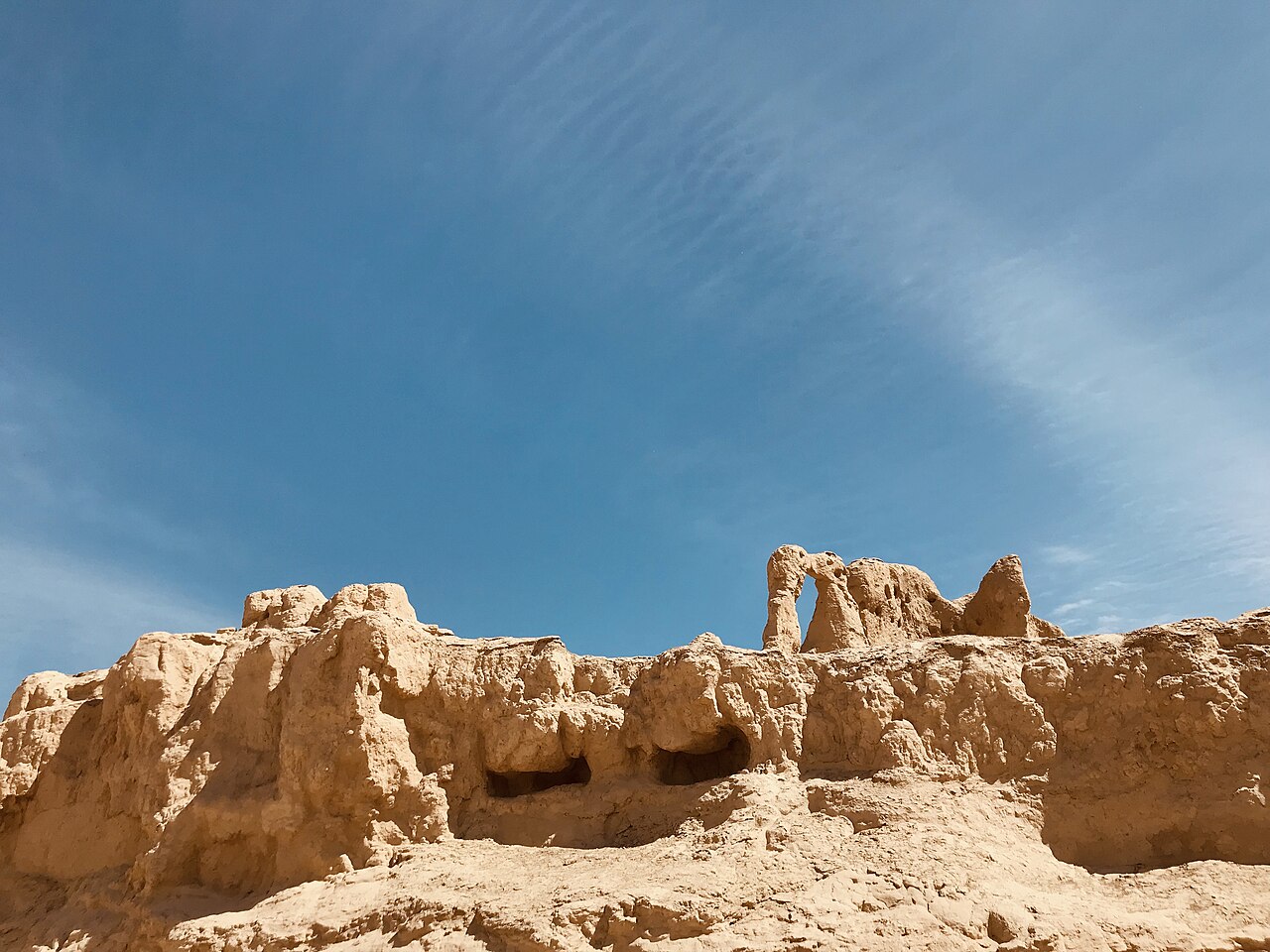
Ten kilometres west of town, Jiaohe (Yarghul to local Uyghurs) stands on a leaf-shaped plateau between two river gorges. Much of the city was carved down into the earth rather than built up. From 108 BC to 450 AD it was the capital of the Nearer Jushi kingdom, and the Hou Hanshu explains the name: the river splits and surrounds the town. It later came under Gaochang and the Tang. It is part of the 2014 Silk Roads World Heritage listing. The main street runs up the spine of the plateau to a large temple complex at the north end. There is almost no shade, so be at the gate at opening and allow two hours. In 2026 listings the ticket is ¥70, plus a ¥25 shuttle.
Gaochang and the Bezeklik caves
East of town at the foot of the Flaming Mountains, Gaochang (Qocho) was founded in the 1st century BC and grew into the capital of the Gaochang kingdom and later the West Uyghur kingdom, until wars in the 14th century destroyed it. Its inner and outer walls and palace mounds are much larger and more ruined than Jiaohe; the Astana tombs lie nearby. Listed tickets are ¥70 plus a ¥30 shuttle. In the Mutou Valley gorge nearby, the Bezeklik Thousand Buddha Caves hold 77 rock-cut caves from the 5th to 14th centuries. Most date from the Uyghur kingdom, and many murals were cut away and taken abroad in the early 20th century.
Flaming Mountains
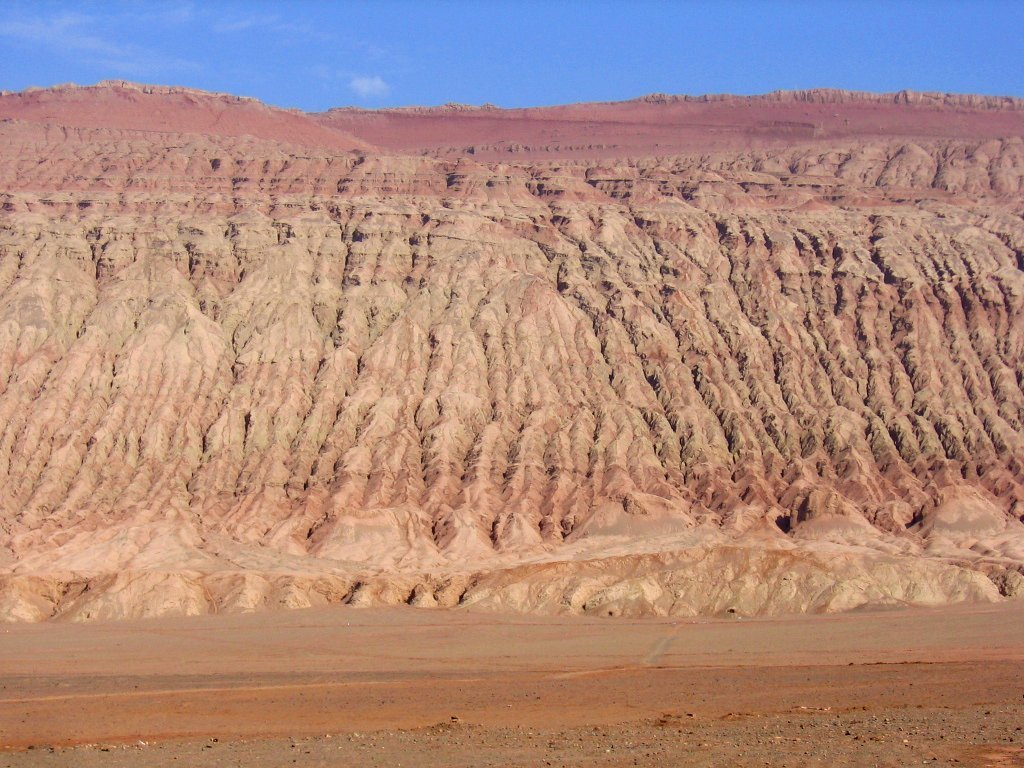
Bare red sandstone hills about 100 km long run east to west across the basin, averaging 500 m high. Their gullies look like flames in low sun, which is why Journey to the West gave them a fire that only a magic fan could put out. The scenic stop has a giant thermometer tracking ground temperature, which is the photo everyone takes. Listed entry is ¥40. Come in the late afternoon, for better colour and slightly less heat; high-season hours run to about 20:00, later in midsummer.
Emin Minaret
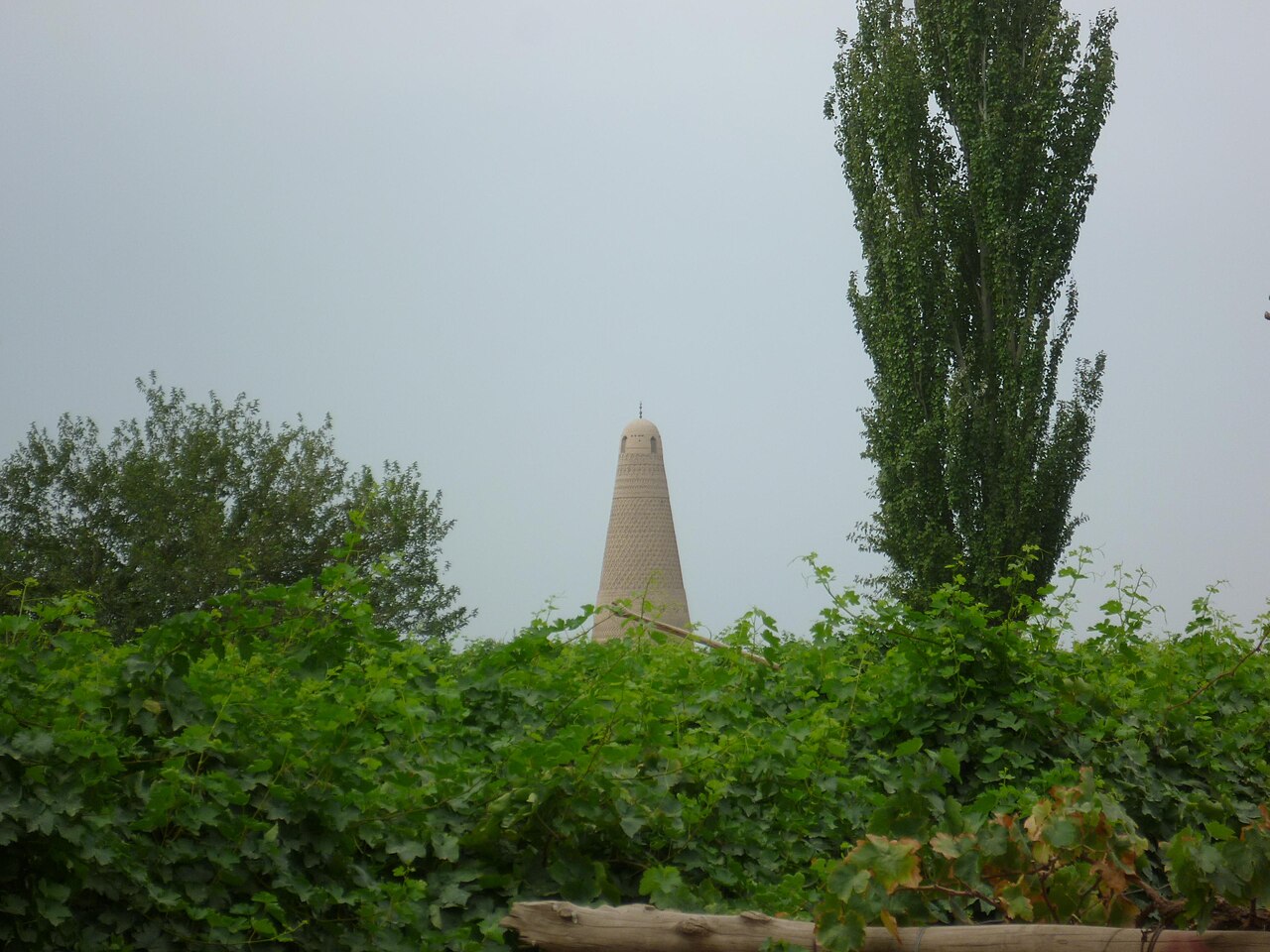
At 44 m, this is the tallest minaret in China. It was begun in 1777 and finished a year later, honouring Emin Khoja, the Turpan leader who sided with the Qing against the Dzungars. Its tapering shaft of sun-dried bricks is laid in geometric and floral patterns such as stylised flowers and rhombuses, and the mosque beside it is still a religious space. On the southeastern edge of town, it is best in the early morning or late light. The 2026 listed ticket is ¥45.
Grape Valley and the karez
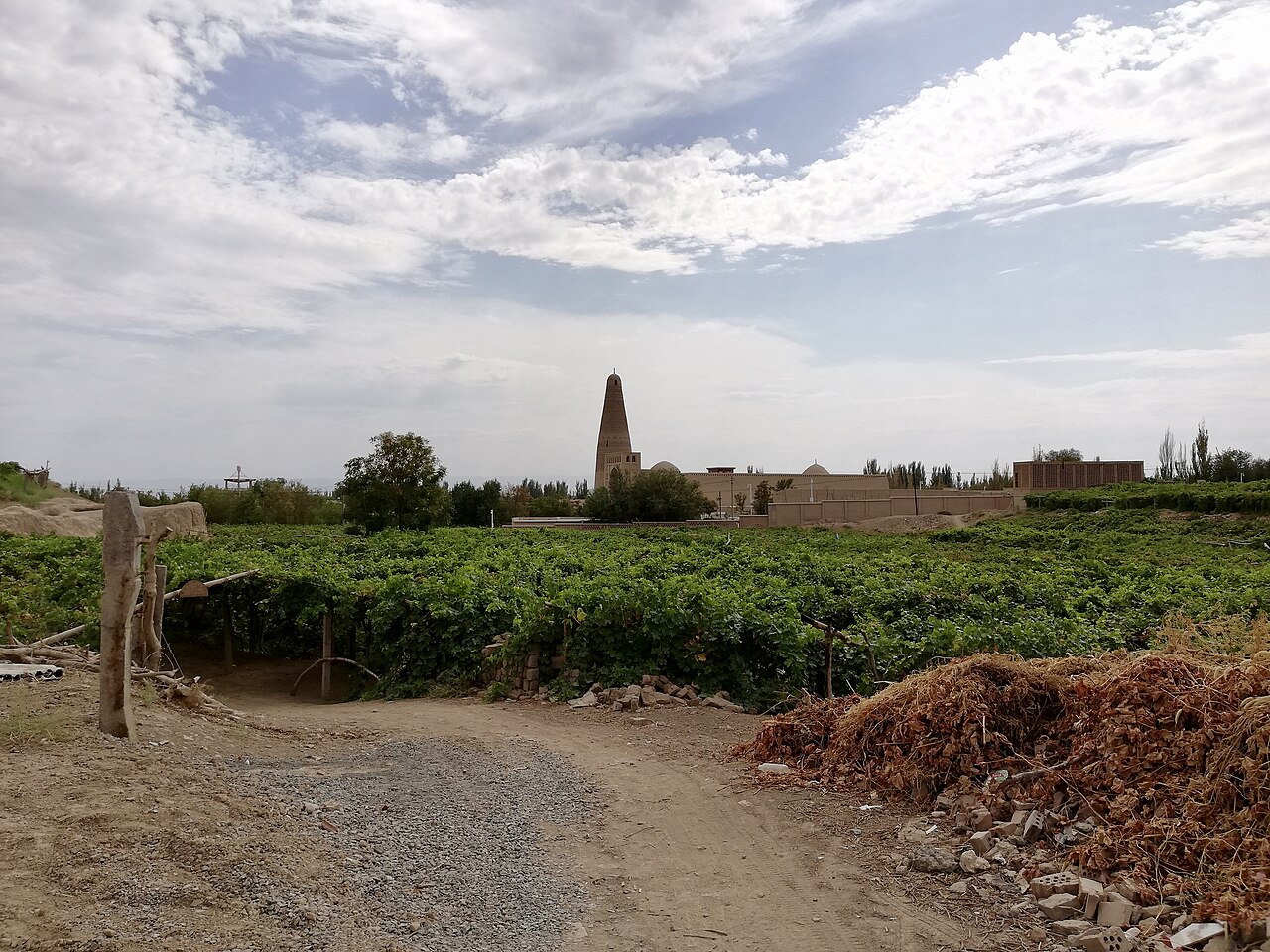
Turpan is China's biggest raisin producer, and Grape Valley, northeast of town, is where you shelter at midday under vine pergolas and see the raisin-drying houses with their lattice brick walls. Entry was free in 2026 listings, with ¥23 for the internal shuttle. The water comes from karez: hand-dug tunnels that carry snowmelt underground from the mountains so it does not evaporate. A karez museum or park (about ¥40) shows how they work and is a cool place for an hour.
When to come
April–May and September–October are best. Late August to September is grape season, and Turpan holds its annual grape festival around this time. In summer, start at dawn and spend 12:00–16:00 indoors or under vines. Winters are cold and quiet but sunny.
Eating in Turpan
Uyghur food: polo (rice pilaf with lamb and carrots), laghman noodles, kebabs and naan, with grapes and melons in season. The night market in town comes alive after sunset, when the heat breaks. Drink far more water than you think you need.
How to arrange the route
- Day 1: Jiaohe at opening; lunch and a rest; Grape Valley or a karez museum in the afternoon; Emin Minaret at sunset; night market.
- Day 2: Gaochang early, Bezeklik, Flaming Mountains in the late afternoon.
- Day 3: back to Urumqi, or east on the high-speed line toward Hami and Dunhuang.
For wind-carved yardang landscapes, Karamay is a separate trip.
What to cut if short on time
On a day trip from Urumqi, do Jiaohe early, then lunch, Grape Valley and the Emin Minaret. Cut Gaochang and Bezeklik first; they need a second morning. Never put the Flaming Mountains in the noon slot.
Things to confirm before you go
- Opening hours and current tickets (listed prices above are from June 2026).
- Shuttle fees inside each site.
- Car-and-driver price for the loop, agreed in advance.
- Water, hat and sun cover; heat illness is the real danger.
Frequently asked questions
How many days do I need in Turpan?
Two days covers the main sights at a sensible pace. A long day trip from Urumqi can manage Jiaohe, Grape Valley and the minaret.
Jiaohe or Gaochang if I only have time for one?
Jiaohe. It is closer to town, more complete and easier to read.
Is it possible to visit in summer?
Yes, with dawn starts and a long midday break. Spring and autumn are far more comfortable.
Sources
The facts in this article were checked against the following sources, retrieved September 16, 2026, and rechecked on October 21, 2026.
- Turpan https://en.wikipedia.org/wiki/Turpan
- Turpan (Chinese) https://zh.wikipedia.org/wiki/吐鲁番市
- Jiaohe ruins https://en.wikipedia.org/wiki/Jiaohe_ruins
- Emin Minaret https://en.wikipedia.org/wiki/Emin_Minaret
- Flaming Mountains https://en.wikipedia.org/wiki/Flaming_Mountains
- Gaochang https://en.wikipedia.org/wiki/Gaochang
- Bezeklik Thousand Buddha Caves https://en.wikipedia.org/wiki/Bezeklik_Thousand_Buddha_Caves
- Gaochang District tourism information, scenic tickets (June 2026) http://gcq.tlf.gov.cn/gcq/c124143/202606/e4eeea2ef9534c97aaf80ee3c802a6ab.shtml
- Turpan city reply on tourist transport (September 2026) https://www.tlf.gov.cn/tlfs/c106287/202609/11c1c7b4c0fe456b82d965b93b8c3a02.shtml
Ticket prices are from 2026 listings; check the official notice before you go.
All photos are from Wikimedia Commons, used under CC licenses; re-use requires attribution.
- turpan-jiaohe.jpg from File:Jiaohe City(Yarkhoto),Turpan,Xinjiang HY1.jpg, by Hiroooooo, CC BY-SA 3.0
- turpan-emin.jpg from File:Emin Minaret Turpan.jpg, by Radosław Botev, CC BY 3.0 pl
- turpan-flaming.jpg from File:Turpan-flaming-mountains-d02.jpg, by Colegota, CC BY-SA 2.5 es
- turpan-grapes.jpg from File:Turpan Emin Minaret grapes.jpg, by Kubilayaxun, CC BY-SA 4.0