The Grand Bazaar at Erdaoqiao, Urumqi's Busiest Evening
The Xinjiang International Grand Bazaar fills a block of Jiefang South Road in Tianshan District, Urumqi, in the Erdaoqiao area that has been the city's Uyghur and Hui trading quarter for well over a century. The present complex of red brick halls, arcades and a tall minaret-style tower opened in 2003. A newer outdoor pedestrian street and food court have been built around it since 2018. Walking in is free, the open areas stay open late, and the busiest time is after dark.
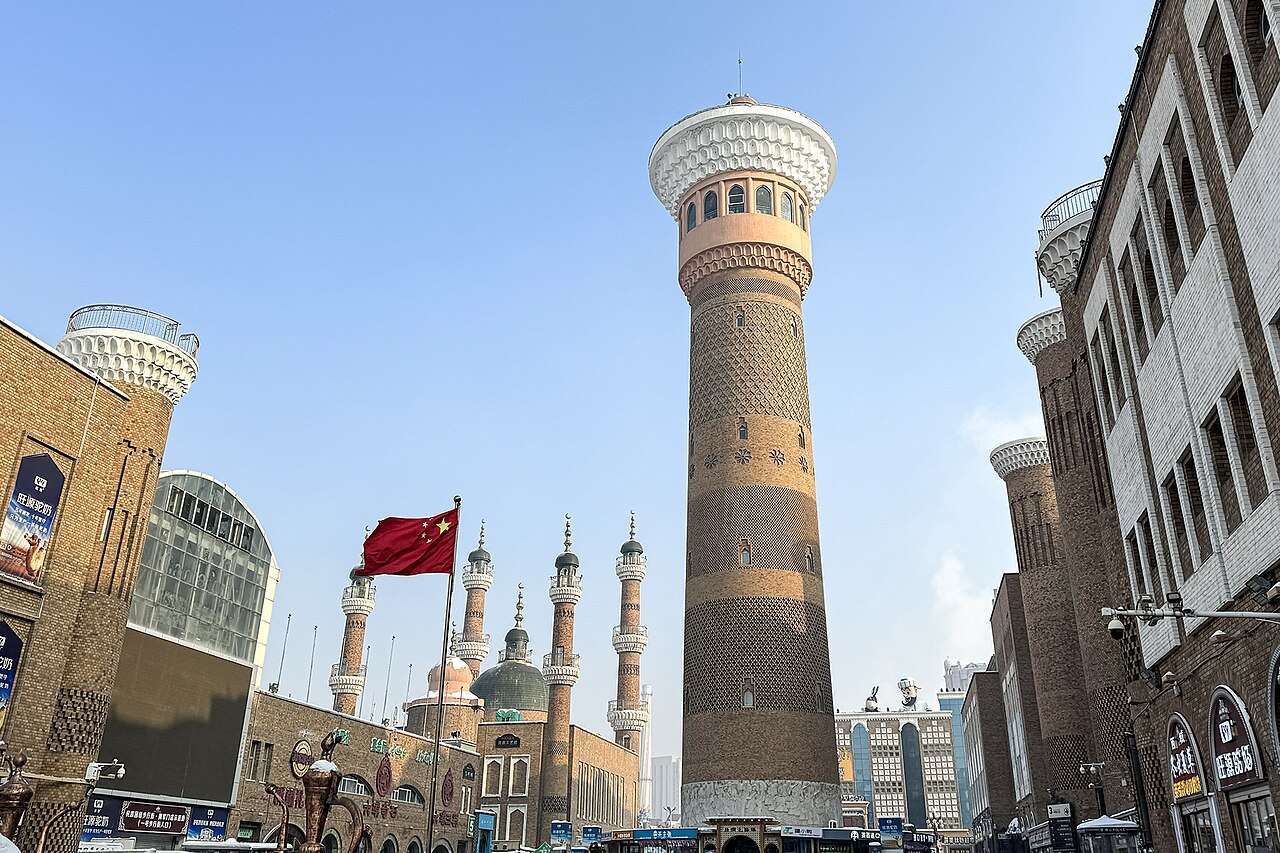
Erdaoqiao before the bazaar
The word bazaar comes from Persian, and Uyghur, Kazakh, Kyrgyz and Uzbek all use it for a market. Chinese Wikipedia's account of the site starts in the Qianlong reign, when farmers and herders traded outside the south gate of Dihua, the Qing name for Urumqi. A wooden bridge called Erdaoqiao, the Second Bridge, was built on the road there in the late Qing. People of several nationalities settled around it, and after the 1881 Treaty of Saint Petersburg, often called the Treaty of Ili in China, Russian firms set up trading houses close by.
The district kept trading through the twentieth century. A state department store opened at Erdaoqiao on New Year's Day 1959. A formal Erdaoqiao market followed in 1982, and in 1985 the city approved it as a specialist market for ethnic goods. By the early 2000s the old streets were crowded and run down. The city cleared many of the low houses and planned a single folk-culture street, and the Grand Bazaar was its centrepiece.
The 2003 complex
Groundbreaking was on 28 April 2002. The bazaar was finished in June 2003 and opened for business on 28 August that year. It was jointly funded by a Xinjiang developer and a Hong Kong investment company and designed by the Xinjiang Architectural Design and Research Institute, with Wang Xiaodong as chief architect. Carrefour opened its first store in northwest China here in February 2004.
The design mixes Islamic arches, domes and arcades with the stacked, irregular spaces of the old Kashgar houses and the straight lines of Chinese building. The outer walls are fired brick in earthy red and white, laid in geometric patterns, and the windows are small pointed or horseshoe arches. The total floor area is about 90,000 square metres. Chinese Wikipedia counts at least 3,300 shops and more than 6,000 people working in the complex, selling jewellery, clothes, musical instruments, copperware, spices, carpets, jade and dried fruit.
The Silk Road tower
The tower in the central square is the tallest point of the complex, at more than 70 metres. Its top borrows from the Kalyan minaret in Bukhara, and the shaft takes the Emin Minaret in Turpan and the Lukqun minaret in Shanshan County as models, with the religious meaning toned down. The walls carry brick ornament and reliefs on the theme of the Twelve Muqam, the classical Uyghur music cycle. A lift goes up inside, with an observation deck near the top and copies of Kizil cave murals on the highest floor. The tower charges its own ticket, and 2026 listings quote different prices, so check at the door. If you are going to Turpan, the original Emin Minaret is worth comparing.
The pedestrian street and food
The outdoor Grand Bazaar pedestrian street was built after a 2018 upgrade and runs for 775 metres around the complex. It is divided into three zones, one for intangible heritage crafts, one for local products and one for food. The food zone has more than 70 stalls and over 3,000 seats, serving lamb skewers, offal soup, grilled fish, roasted goose eggs and yogurt poured over sticky rice dumplings. A two-storey naan house shows dozens of regional breads and lets visitors try making one. The street was named one of China's ten food tourism streets in 2023.
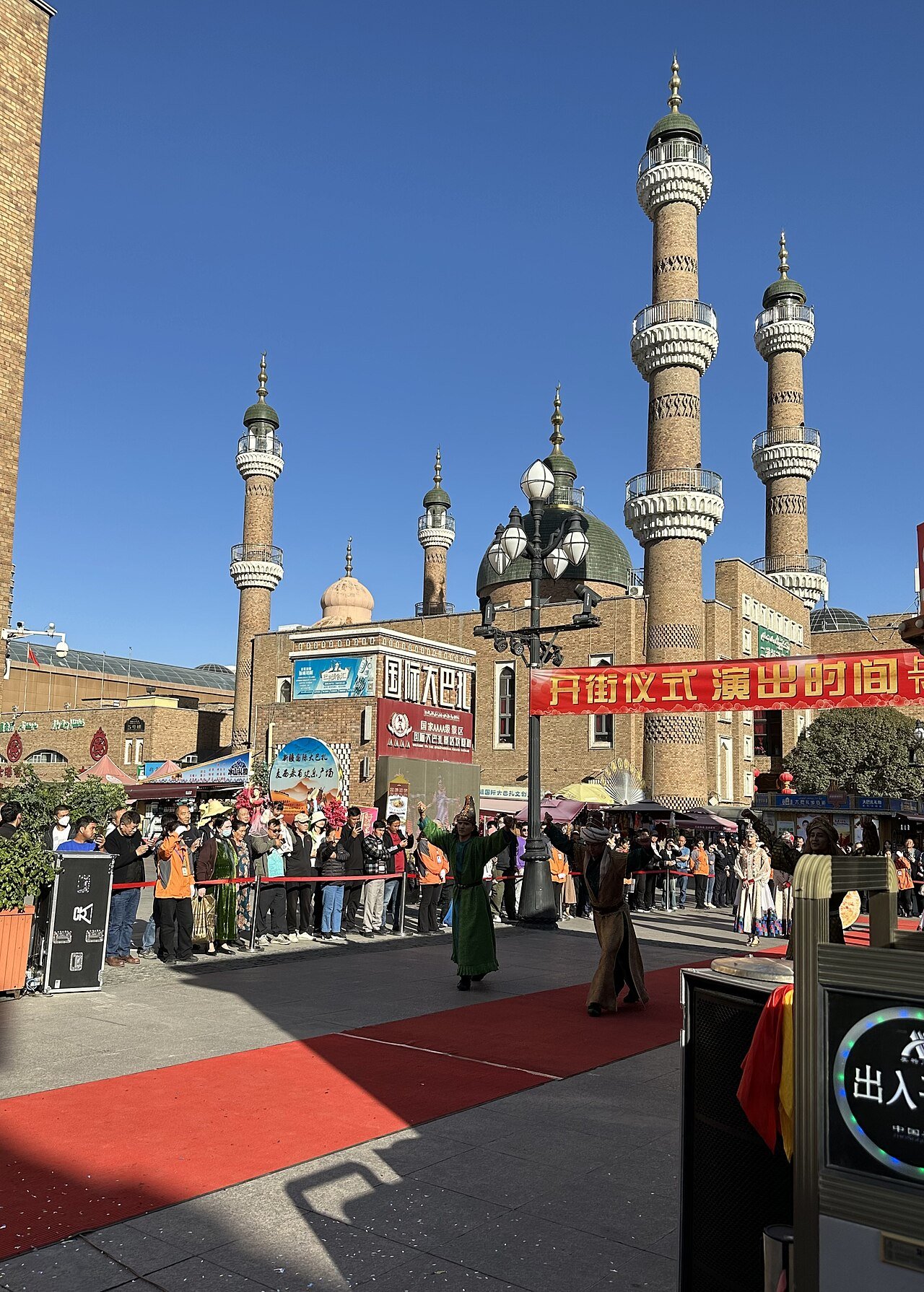
A theatre in the complex seats about a thousand people for dinner shows, and in most seasons except winter it stages a song-and-dance production called Silk Road, Thousand-Year Impression. The pedestrian street also holds an opening ceremony twice a day with music and dancing. Schedules change with the season, so check the day's times at the bazaar.
Visiting
Several 2026 listings describe the open areas as accessible all day. Most shops trade from mid-morning to about 22:00, and food stalls stay open later in summer. Urumqi keeps Beijing time officially, but daily life runs late, and the light lasts long into the evening from spring to autumn. Arriving around sunset gives you the tower in daylight and the street once the lights are on.
The nearest metro stop is Erdaoqiao on Urumqi Metro Line 1, a few minutes' walk away. Many city buses stop at Erdaoqiao or at a stop named for the bazaar. Expect bag and ID checks at the entrances, as at most public places in Xinjiang.
Shops set their own prices. Bargaining is normal for carpets, jade and knives. Check whether a knife can legally travel with you before you buy one, because rules for carrying blades on trains and planes in China are strict.
How it fits a Urumqi stay
The Urumqi guide pairs the bazaar with Red Hill for an afternoon and evening in town. It also makes a gentle evening after a day at Tianchi. If your route continues to Kashgar, the Sunday Bazaar there is an older and more local market, so you can keep your Urumqi shopping short.
Frequently asked questions
Is the Grand Bazaar free?
Yes. Entry to the complex and the pedestrian street is free. The Silk Road tower and the dinner show charge separately.
What is the best time to visit?
Late afternoon into evening, when the food street is busiest and the buildings are lit.
How do I get there by metro?
Take Line 1 to Erdaoqiao station and walk a few minutes to Jiefang South Road.
Is it the same as the Erdaoqiao market?
The Grand Bazaar is the 2003 complex inside the wider Erdaoqiao trading district, which has older markets and food streets around it.
Sources
Facts in this article were checked against the following sources, retrieved 11 October 2026.
Photos are from Wikimedia Commons under the licences shown in each caption.