Jiaoshan
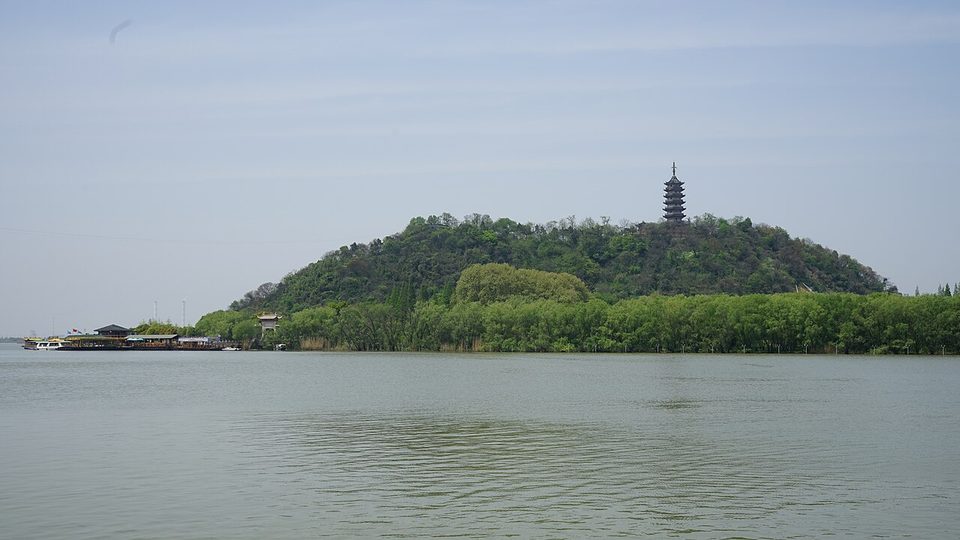
Jiaoshan is a wooded hill that rises 71 metres out of the Yangtze northeast of central Zhenjiang. It is still an island, reached by a short ferry. Where Jinshan, the city's other famous hill, is all temple roofs and crowds, Jiaoshan keeps its monastery tucked into the trees and puts its treasures into stone, with one of the finest collections of carved inscriptions in southern China. An old saying sums up the pair. Jinshan wins by cleverness and Jiaoshan by plainness, Jinshan suits moonlight and Jiaoshan suits rain.
The hermit and the temple
The hill takes its name from Jiao Guang, a recluse who lived here at the end of the Eastern Han. It has had other names over the centuries, among them Fuyu, the floating jade, and Shizi, the lion. Between its east and west peaks rises a smaller summit called Biefeng.
Dinghui Temple sits at the foot of the hill, its halls half hidden under the trees, which gave rise to the saying that on Jiaoshan the hill wraps the temple. Chinese sources date its foundation to 194, the first year of the Xingping reign, when it was called Puji. It was a Chan monastery under the Song and was known as Jiaoshan Temple under the Yuan. The Kangxi emperor gave it its present name in 1703 during one of his southern tours. Dinghui is listed among the national key Buddhist temples of the Han Chinese areas.
The stele forest and the crane inscription
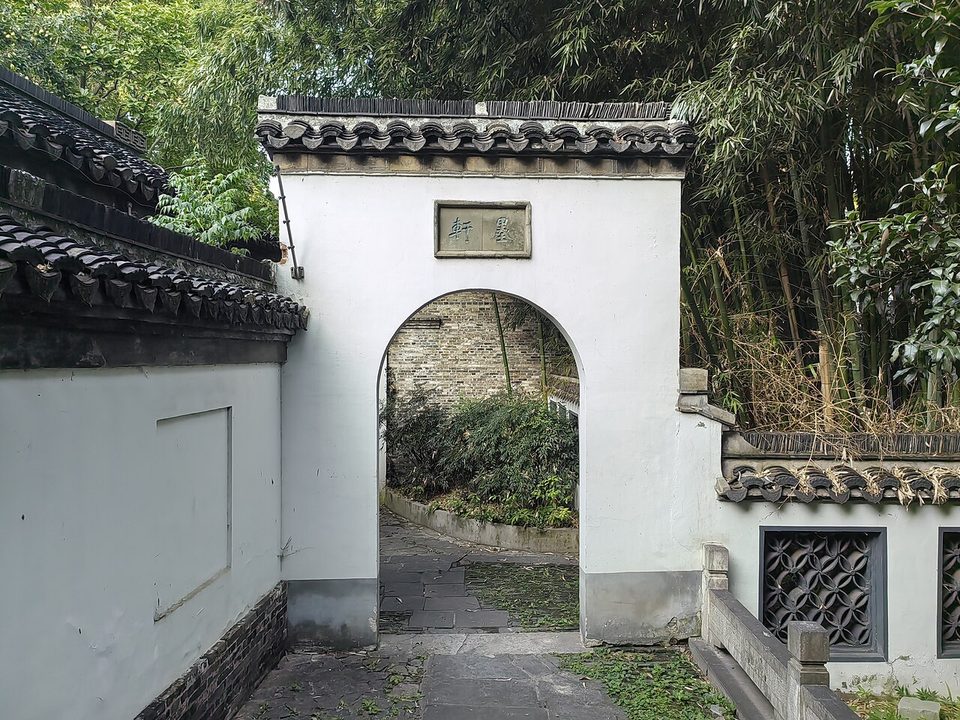
East of the temple, in a courtyard complex called Baomo Xuan, stands the Jiaoshan Stele Forest. Chinese Wikipedia counts more than four hundred carved tablets, the largest collection in Jiangnan. Scholars began cutting inscriptions on the hill from the Song onwards. Fighting in the late Qing and the Cultural Revolution destroyed or scattered much of the collection, and from 1960 the city gathered surviving and donated stones back. The stele forest became a major national protected site in 1988, and the Zhenjiang Jiaoshan Stone Inscription Museum opened there in October 1991.
The star piece is the Yiheming, the Inscription for Burying a Crane, a cliff carving once cut on the rock face of the hill's western foot. It is signed with two pen names, a recluse of Huayang who composed it and a woodcutter of Shanghuang Mountain who wrote it out. Song writers credited it to Wang Xizhi. The Song antiquarian Huang Bosi argued that it was the work of the Daoist scholar Tao Hongjing, who died in 536, and most later critics agree. The Song poet and calligrapher Huang Tingjian called it the ancestor of large characters. The writing mixes the weight of clerical script with running script and reads from left to right, an oddity in Chinese calligraphy.
The stone has had a strange life. Under the Tang it was split by lightning and fell into the river in five pieces, where it lay for about three hundred years. A Song prefect raised one piece at low tide in the Qingli era and built a pavilion for it, and four more pieces came up during works in the Xining era. In the early Ming the fragments fell into the river again. In the winter of 1713 Chen Pengnian paid for a three-month search in the low water and recovered five fragments about three li downstream. They were set into a wall of Dinghui Temple and moved to the stele forest in 1962, where they remain. Other highlights include a Tang carving of verses from the Diamond Sutra, inscriptions by Mi Fu, a Song record of Lu You viewing the crane inscription in the snow and the full Qing set of Chengjiantang carved model calligraphy.
The pagoda and the forts
The Wanfo Pagoda on the summit is a 1990s rebuilding. According to the pagoda's history, an official named Zhou Wenying was stranded by wind in 1298, vowed to build a pagoda if he crossed safely, and paid for one that took nine years. It was destroyed in the early Ming. In 1995 the abbot Mingshan, then in his eighties, began raising funds for a new one. Building started in May 1998 and finished in September 1999. The pagoda is 42 metres tall with seven storeys on an octagonal plan, and its name board is by Zhao Puchu. The top gives a wide view over the river.
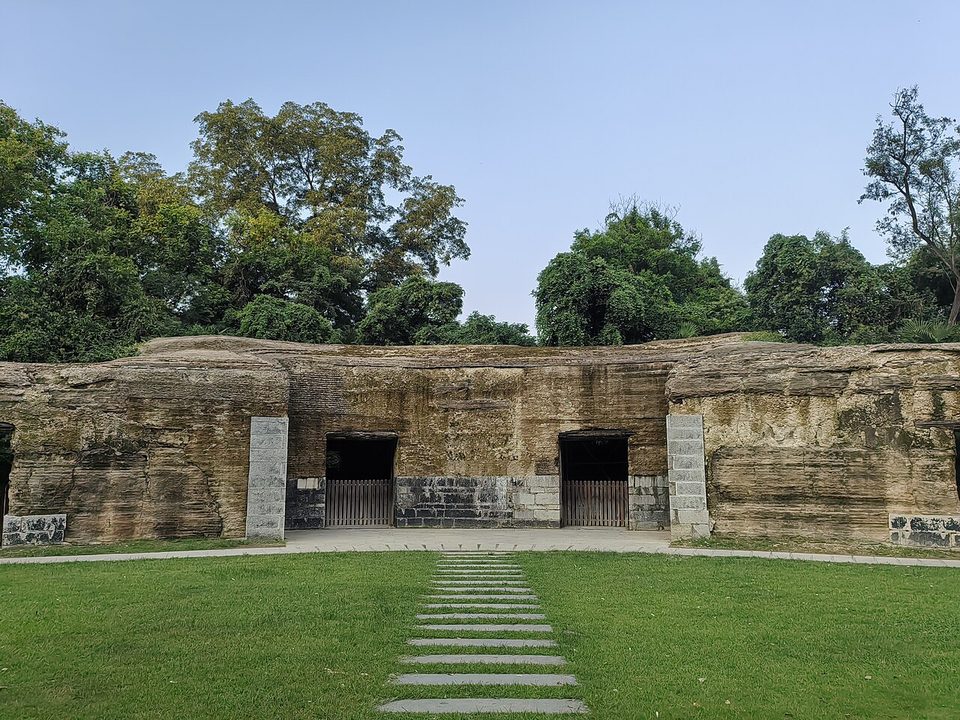
Elsewhere on the island stand the remains of the Jiaoshan batteries. The Zhenjiang historical city research society notes that guns were placed here by 1724, in the second year of the Yongzheng reign, and that the defences were strengthened in 1840. In July 1842, during the Yangtze campaign of the First Opium War, a hidden battery guarding the channel opened fire on a British survey boat. A British officer's account, quoted by the society, describes the steamer Phlegethon silencing it and sailors later carrying off bronze guns as trophies. New batteries were built in 1874, when a crisis with Japan over Taiwan set off a round of Yangtze defence works, and Sun Yat-sen inspected the forts in 1912. The site has been a Jiangsu provincial protected site since 1982.
When to go
Jiaoshan is green and shaded, which helps on hot days. Bendibao notes an osmanthus festival in September and a Jiaoshan international calligraphy festival in October. Rain suits the hill, as the old saying claims, and the stele courtyards stay usable in wet weather.
Tickets, hours and getting there
Zhenjiang Bendibao lists the address as No. 83 Dongwu Road in Jingkou District and the hours as 8:00 to 17:00 all year. Ferries run from 8:00 to 16:15 about every twenty minutes. The last ferry onto the island leaves at 16:15 and the last ferry back at 17:00, and visitors leaving after 17:00 exit through the east gate. Bendibao gives a low-season ticket of 50 yuan in January, February, June, July, August and December, and a high-season ticket of 65 yuan in March, April, May, September, October and November, and other listings say the ticket includes the ferry. Tickets are booked through the official channel. Check the day's notice for hours, ferry times and prices.
Taxis and city buses reach the ferry gate from central Zhenjiang and Zhenjiang station on the Shanghai to Nanjing line. Plan three to four hours on the island.
Pairing it
The city guide suggests choosing between Jiaoshan and Beigu Hill for a second Zhenjiang day. On a first day, see Jinshan Temple and walk the old Xijin Ferry street in the evening, then come to Jiaoshan the next morning while the ferry is quiet.
Frequently asked questions
Do I need to take a boat?
Yes. Jiaoshan is an island and the ferry is the normal way in.
Is the Yiheming the original?
The five fragments in the stele forest are the original stone recovered from the river in 1713.
Jinshan or Jiaoshan?
Jinshan for the famous temple and legends, Jiaoshan for calligraphy, trees and a quieter monastery.
Sources
Facts in this article were checked against the following sources, retrieved 21 October 2026.
- 焦山, Chinese Wikipedia
- 焦山碑林, Chinese Wikipedia
- 瘗鹤铭, Chinese Wikipedia
- 万佛塔 (镇江), Chinese Wikipedia
- 焦山炮台遗址, Chinese Wikipedia
- Zhenjiang historical city research society, on the origin of the Jiaoshan batteries
- Zhenjiang Bendibao, Jiaoshan hours, ferry and tickets
- Zhenjiang travel guide on this site
Photos are from Wikimedia Commons under the licences shown in each caption.