Xijin Ferry, Zhenjiang's Old Yangtze Crossing
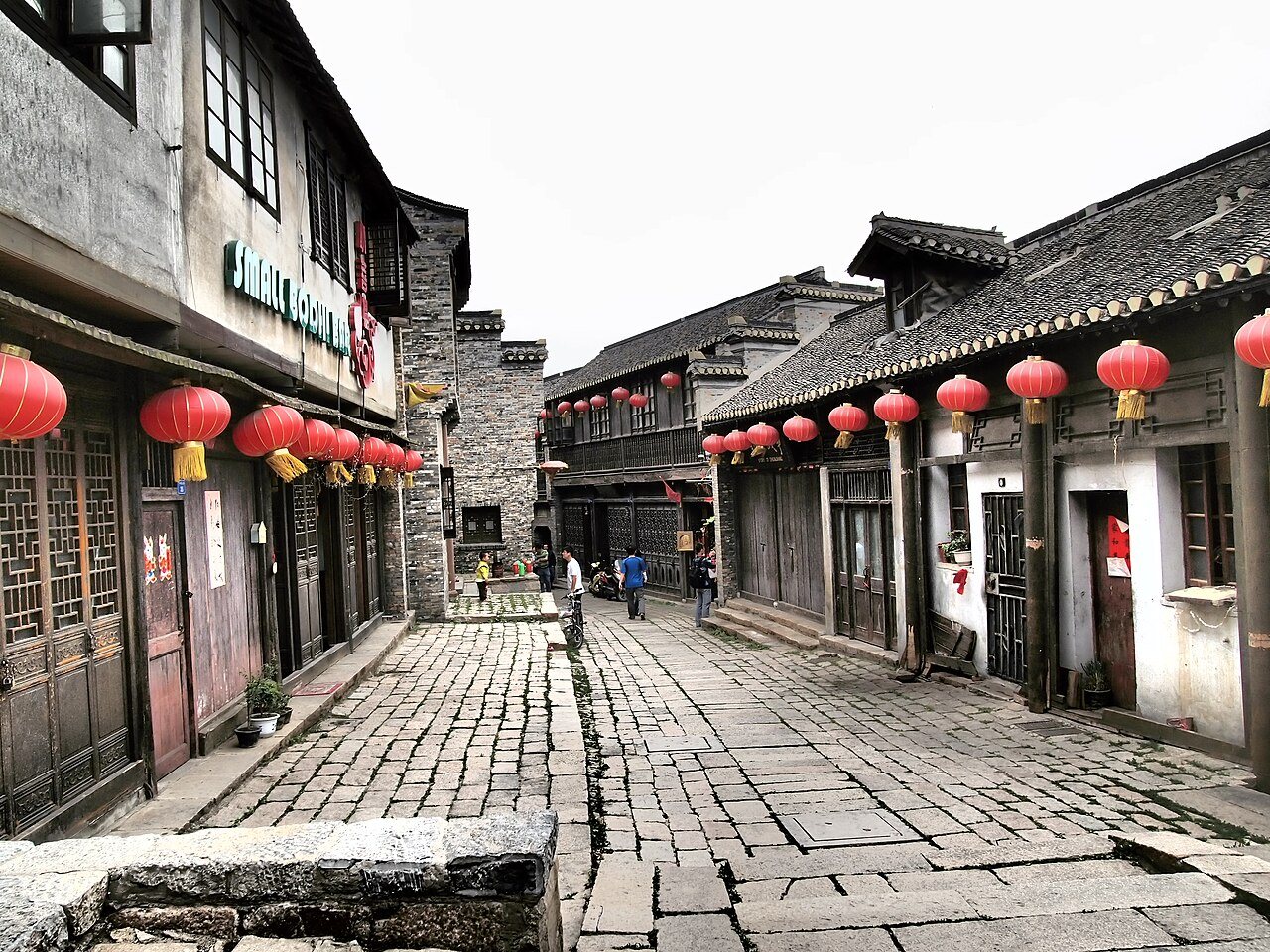
Xijin Ferry Ancient Street climbs the slope of Yuntai Hill in the west of Zhenjiang, on the line of a crossing over the Yangtze that was used for well over a thousand years. The street is short, less than 500 metres, yet it packs in a Yuan dynasty pagoda that you walk beneath, stone steps worn by centuries of travellers, Qing shophouses and the colonial buildings of the former British concession. It is the natural partner to a morning at Jinshan Temple, and it is at its best in the late afternoon and early evening.
A crossing with many names
The ferry has changed names with the dynasties. It was called Suanshan Ferry in the Three Kingdoms period and Jinling Ferry in the Tang, and only from the Song did the name Xijin, West Ferry, stick. For centuries this was where travellers between the Grand Canal and the lands south of the Yangtze waited for boats across the river toward Guazhou on the north bank. Chinese Wikipedia lists Li Bai, Meng Haoran, Zhang Hu, Wang Anshi, Mi Fu, Su Shi and Lu You among the poets who waited here or landed here, and Marco Polo is also said to have passed through. Zhang Hu's short poem on the Jinling Ferry, written on a night of waiting, is the best known of their verses.
The Yangtze shore has since shifted north, so the old landing now sits well back from the water. In 2006 the street was listed as a national protected site as part of the Grand Canal, and it had already received a UNESCO Asia-Pacific heritage conservation award in 2001.
The Zhaoguan Stone Pagoda
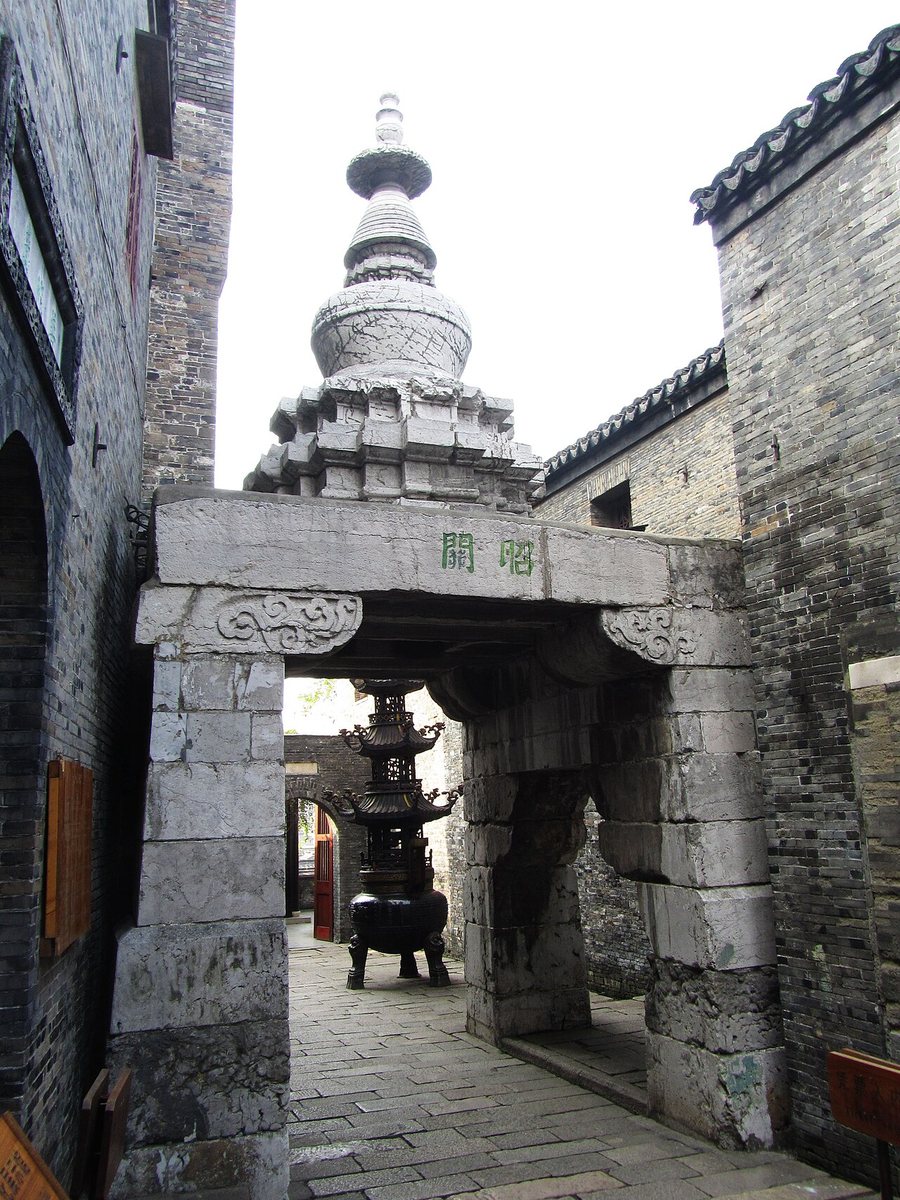
Near the top of the street, the lane passes under the Zhaoguan Stone Pagoda, a Tibetan-style stupa set on a stone gateway. It was begun by a man named Liu Gao in the Yuan dynasty and finished in 1311, and it was repaired in 1582 by the prefect of Zhenjiang. Its name comes from the two characters Zhaoguan carved over the east and west openings. The idea was that anyone who walked beneath it was paying respect to the Buddha.
The pagoda stands on four stone pillars that carry a square slab, with a double base, a drum-shaped body and thirteen bands for the thirteen heavens. Chinese Wikipedia calls it the oldest surviving over-street stone pagoda in China and one of only three lama-style pagodas left in Jiangsu. During restoration in 2000, two mandalas with images of Yellow Jambhala and Guanyin were found in a chamber inside, and they are now rated first-class cultural relics. The pagoda became a national protected site in 2006.
Along the street
Below and around the pagoda the lane passes the Guanyin Cave, where people waiting for a boat once prayed for a safe crossing, and the site of the Lifesaving Society, a Qing charity that rescued people from the river. Other stops include the Waiting Pavilion, the Taoist Tiezhu Palace, the Chao'an Temple, the reconstructed Yuntai Pavilion with views over the rooftops, and a museum built over the remains of the Yuan dynasty Yushan wharf. Most of the houses along the way are Qing two-storey buildings of brick and timber, now home to cafés, teahouses and craft shops.
The British consulate hill
On the slope above the street stands the former British consulate. Britain built a consulate on Yuntai Hill in 1864 as part of its Zhenjiang concession. It was burned during anti-foreign rioting in the late 1880s and rebuilt in 1889 and 1890 with an indemnity paid by the Qing. The five brick and timber buildings have the deep verandas of colonial architecture from British India and Southeast Asia. After the concession was returned to China in 1929, the British withdrew, and since 1958 the buildings have housed the Zhenjiang Museum. The site has been a national protected site since 1996. Nearby, former offices of the concession police and of foreign oil companies such as Standard Oil and Texaco line the lower slope.
How to walk it
Start at the lower end in the late afternoon and walk uphill, which follows the old route from the riverside to the town. Pass under the pagoda, then detour up to the museum on consulate hill if it is still open. Come back down the street at dusk, when the lanterns go on, and finish with dinner nearby. Zhenjiang pot-lid noodles and crystal pork are the local dishes to look for.
The street is a public historic district, while the museum and some small sites inside may have their own ticket or booking rules and opening hours, so check the day's notice. The street is a short taxi ride from Jinshan and from central Zhenjiang.
Before you go
- The stone steps are uneven and can be slippery when wet.
- Weekend evenings are busy, so arrive before dusk for photos.
- Combine it with Jinshan Temple in the morning.
- See the Zhenjiang travel guide for a two-day plan.
Frequently asked questions
How long does Xijin Ferry take?
An hour for the street itself, or two to three hours with the museum and a meal.
Is it still a working ferry?
No. The Yangtze has moved north, and the old landing now lies inland.
What is the Zhaoguan Pagoda?
A Yuan dynasty Tibetan-style stupa built over the lane, finished in 1311, that walkers pass beneath.
What else is close by?
Jinshan Temple is a short taxi ride away, and the Zhenjiang Museum sits on the hill above the street.
Sources
Facts in this article were checked against the following sources, retrieved 18 October 2026.
- Xijin Ferry Ancient Street, Chinese Wikipedia
- Zhaoguan Stone Pagoda, Chinese Wikipedia
- Former British Consulate in Zhenjiang, Chinese Wikipedia
- Zhenjiang Museum, Chinese Wikipedia
- Zhenjiang travel guide on this site
Photos are from Wikimedia Commons under the licences shown in each caption.