Mount Yuelu, Changsha: Aiwan Pavilion and the Summit View
Mount Yuelu is the wooded ridge on the west bank of the Xiang River, the highest ground in central Changsha at 300.8 metres, and the half-day most Changsha itineraries start with. It is where the city walks in spring and looks at maples in late autumn, where a Jin-dynasty temple, a Song-dynasty academy and a Qing pavilion stand within a few hundred metres of one another, and where the whole of Changsha — river, island and towers — spreads out below the summit. Entry is free but now needs a reservation, the climb fits an afternoon, and it links directly with Yuelu Academy at its foot and Orange Isle across the water; the wider plan is in the Changsha guide.
What kind of mountain this is
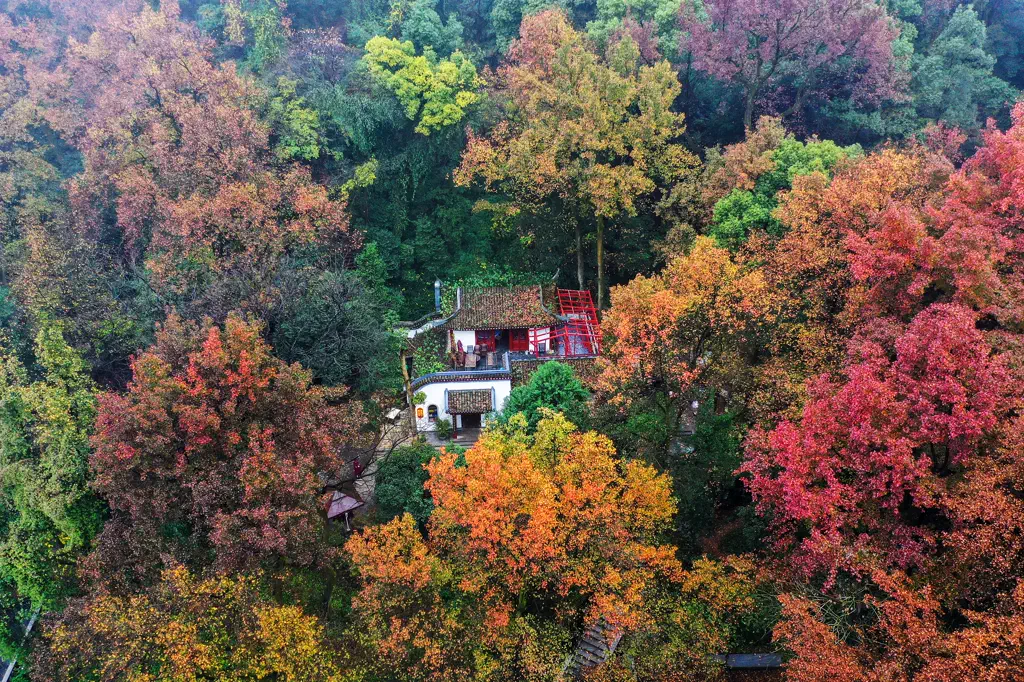
Mount Yuelu is the last, lowest spur of Mount Heng, the Southern Sacred Peak, one of its seventy-two peaks and the stretch of it that reaches down into the city. The Northern and Southern Dynasties "Record of the Southern Sacred Peak" describes the range running eight hundred li, with Huiyan as its head and Yuelu as its foot — the name means "the foot of the Yuelu ridge" — and the mountain has been protected ground for a long time: the State Council made it a national key scenic area in 2002, and it now forms a single 5A scenic area with Orange Isle under one reservation system.
The density of what is on the slope is the point. A single walk passes a Western Jin Buddhist temple, a Sui pagoda, a Tang stele, a Song academy, a Ming Taoist palace and a Qing pavilion, with the tombs of several 1911-revolution figures among the trees. This is a mountain you read as much as you climb.
Getting there and which gate to use
Mount Yuelu has two main approaches, and choosing between them decides your day.
The south gate sits by Hunan University, at the foot of the slope beside Yuelu Academy. This is the walking entrance: you pass the academy and the ancient Lushan Temple on the way up, and the path is shaded the whole way. The east gate is on the city side near Hunan Normal University and goes more directly to the ridge and the summit viewpoint. Metro Line 4 runs along the river with stops for Hunan Normal University and Hunan University, the two gates; Line 2 crosses the river at Juzizhou (Orange Isle) and meets Line 4 at Yingwanzhen, which is the easiest interchange if you are coming from the city centre or the railway station.
Whichever gate you pick, the mountain is free to enter but the 5A area now runs on timed reservations through the official "Yuelu Mountain–Orange Isle" WeChat account. Quotas are released a few days ahead and fill quickly at weekends and on holidays, so reserve before you travel, not on the morning.
Walking the mountain
The south gate and the academy slope
From the south gate the path climbs past Yuelu Academy — the great courtyard building of 976 that still belongs to Hunan University — and then into the woods. Ten minutes above the academy is the Aiwan Pavilion, and a little further on the Lushan Temple, so the first stretch is the historical one. Allow an hour to the ridge if you stop as you go.
Aiwan Pavilion
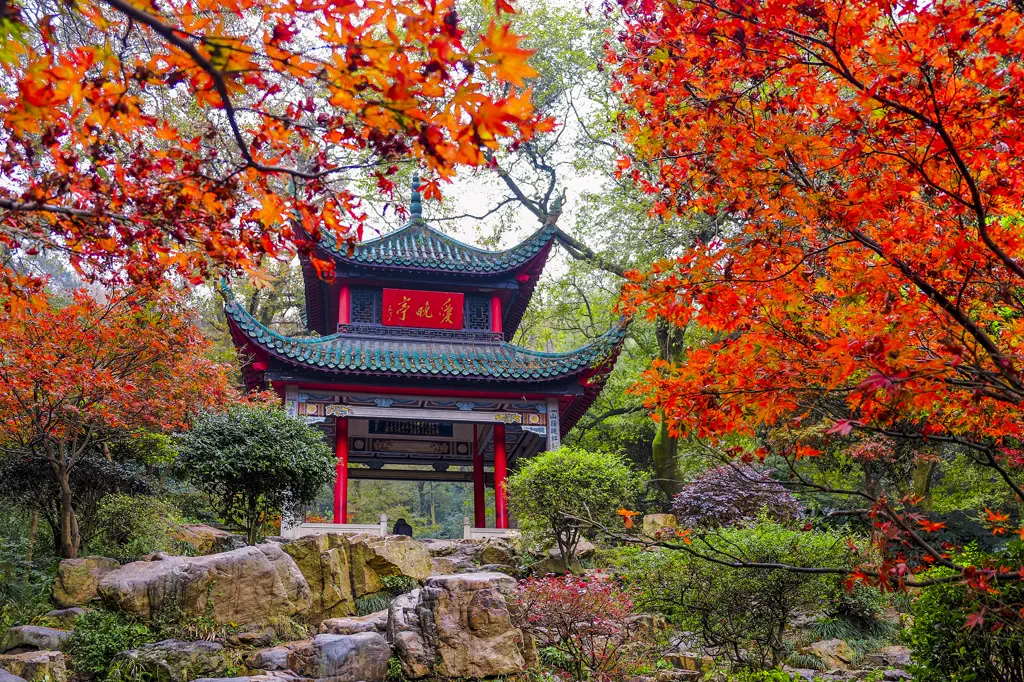
Aiwan Pavilion is the mountain's single most photographed building: a square Qing pavilion of red pillars and grey-green tiles, sitting in a hollow ringed with maples. It was built in 1792 by Luo Dian, the head of Yuelu Academy, and first called the Red Leaf Pavilion; the governor-general Bi Yuan renamed it after the line in Du Mu's poem "stopping the carriage to love the maple woods at dusk, frost leaves redder than spring flowers" — Aiwan, "loving the dusk." It counts among China's four famous pavilions, and in the early twentieth century it was a meeting place for Mao Zedong's New Citizens' Study Society. Late November, when the maples turn, is the crowd; on an ordinary morning you can often have it almost alone.
Lushan Temple, the pagoda and the stele
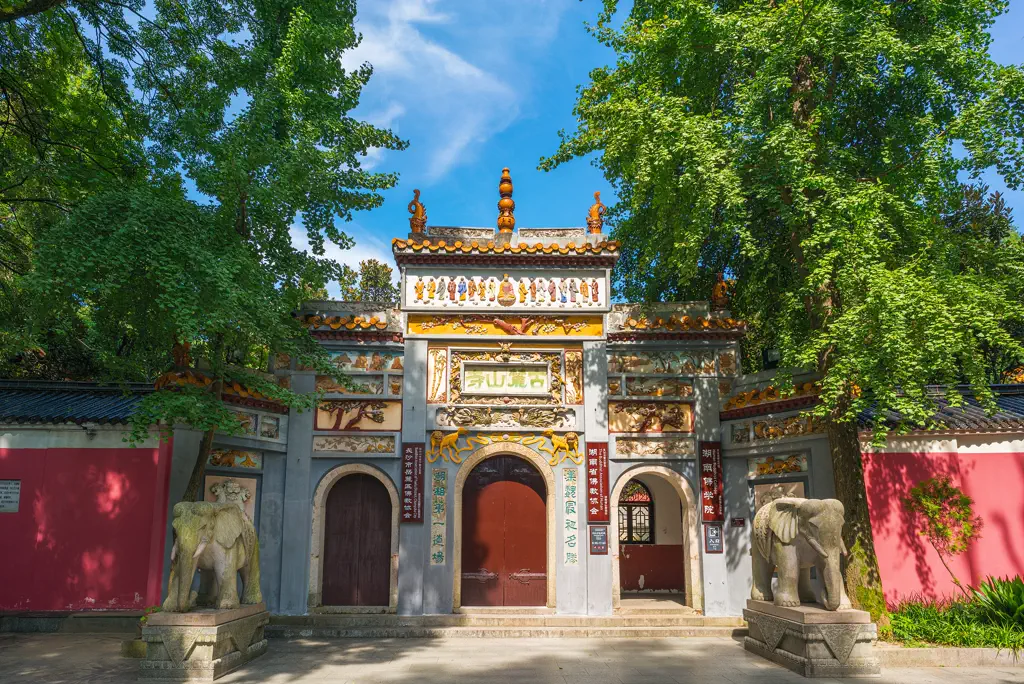
Lushan Temple is the old heart of the mountain. Founded in the Western Jin, in 268, it is counted the first Buddhist monastery in Hunan, and the temple's own line calls it "the first shrine of Hunan." Around it stand the relics that give the mountain its weight: the Sarira Pagoda, a stone pavilion-pagoda raised in the Sui, and the Lushan Temple Stele, carved in the Tang and written by the great calligrapher Li Yong — the tablet is a copybook text studied by calligraphers ever since. The temple still works as a temple, and the walk down from it to the academy is the most pleasant part of the mountain.
The summit and the view
Above the ridge the path passes the tombs of Huang Xing and Cai E, the two Hunan leaders of the 1911 revolution, before the top. The summit itself carries the Yunlu Palace, a Ming Taoist temple, and a viewing platform on the east side reached by the shuttle road or on foot. The reward is the classic Changsha picture: the Xiang running north, Orange Isle down its middle, and the towers of the city behind. Late afternoon, when the light softens and the river catches it, is the time to be up there.
Tickets, the shuttle and the cable car
Entry to the mountain is free with the reservation. What costs money is everything that moves you and everything inside:
- The park shuttle bus up the road is 20 yuan a person each way, the easy way to the ridge or the summit viewpoint from the east gate.
- The cable car — rebuilt and reopened in 2025 — is a separate ticket, in the region of 30 yuan one way and around 50 yuan for the round trip on recent listings.
- Yuelu Academy, at the foot, is ticketed separately at 40 yuan full price (20 yuan concession), and the ticket includes the Chinese Academy Museum beside it.
Figures for the shuttle and the cable car change between seasons and after works; treat them as the going rate and check the notice on the day.
Eating near the mountain
The student streets at the foot — around Hunan University and Hunan Normal University — are where to eat before or after the climb, with cheap Hunan rice noodles, griddle cakes and tea shops. For a full Changsha table, head back across the river towards Pozi Street and Taiping Street in the old town, where the snack density is highest. Bring water for the climb; the mountain shops are few and priced for tourists.
How to arrange the half-day
The most efficient version: reserve an early slot, enter by the south gate, see Yuelu Academy first thing, walk up past Aiwan Pavilion and Lushan Temple, take the ridge slowly, and be at the summit viewpoint by late afternoon for the river light. Come down by the east gate or take the shuttle if your legs are done, then cross to the city for dinner. If you want the maples, plan the trip for the second half of November; if you want blossoms and green, aim for April.
Things to confirm before you go
- The 5A area runs on timed reservations through the official WeChat account; slots open a few days ahead and sell out at weekends and holidays.
- Shuttle and cable-car prices, and the cable car's opening, change with the season and with maintenance — confirm on the day.
- The climb is steady rather than steep, but the summit road is long in summer heat; start early in July and August.
- Late November maple weekends are the busiest of the year; go on a weekday if you can.
- Yuelu Academy has its own ticket and its own, slightly shorter, opening hours than the mountain.
Frequently asked questions
Is Mount Yuelu free?
Yes. Entry to the mountain is free, but you must reserve a timed slot in advance through the official "Yuelu Mountain–Orange Isle" WeChat account. The shuttle bus, the cable car and Yuelu Academy are all charged separately.
How long does it take to climb Mount Yuelu?
About an hour from the south gate to the ridge if you keep moving, and two to four hours for a full visit with the academy, Aiwan Pavilion, the temple and the summit. Most people spend half a day.
Which gate should I use for Mount Yuelu?
Use the south gate, by Hunan University, to walk up past Yuelu Academy, Aiwan Pavilion and Lushan Temple; use the east gate for the shortest route to the summit viewpoint. The two connect over the top, so you can walk up one and down the other.
When is the best time to see the maple leaves?
Late November, when the maples around Aiwan Pavilion turn. It is also the busiest fortnight of the year, so a weekday visit is far calmer than a weekend.
Sources
Facts in this article were checked against the following sources, retrieved 13 September 2026.
- Mount Yuelu, Chinese Wikipedia
- Aiwan Pavilion, Chinese Wikipedia
- Lushan Temple, Chinese Wikipedia
- Hunan Today / VOC reporting on the rebuilt Mount Yuelu cable car (2025)
- Mount Yuelu–Orange Isle scenic area visitor information Photos are from the Ctrip sight page for Mount Yuelu and are credited to that page.