Dujiangyan Irrigation System: A Day Trip from Chengdu
Dujiangyan is a working irrigation system on the Min River, about an hour north-west of Chengdu. The Qin governor Li Bing built it around 256 BC, and without a high dam it still divides the river, controls floods and waters the Chengdu Plain. The site is a riverside park of walkways, temples and bridges, and an adult ticket costs 80 yuan. From March to October it opens 08:00 to 18:00. Plan on three to five hours on site, plus travel. Most independent visitors take the intercity train from Chengdu's Xipu station. UNESCO listed it in 2000 together with Mount Qingcheng. If you have only one day outside the city, choose this.
The Chengdu travel guide shows where a day trip fits.
How the system works
Three parts work together, and the walk takes you to each one:
- Fish Mouth (Yuzui). A long, low embankment in the middle of the river, shaped like a fish's head. It splits the Min into an outer river, which carries floods and sand away, and an inner river, which flows towards the plain. Its shape sends more water into the inner river in the dry season and more into the outer river in floods.
- Feishayan (Flying Sand Weir). A low spillway on the inner river. In high water it spills the extra flow, and much of the sand and gravel, back into the outer river.
- Baopingkou (Bottle-Neck Channel). A narrow channel cut through the rock of Yulei Hill. It limits how much water can reach the plain, and from here canals spread across the Chengdu Plain.
Signs on site explain each step. It is worth reading them in order, because seeing the water in all three places makes the design clear.
Tickets and hours
- Entry: 80 yuan for adults, with discounts for eligible groups. Real-name booking through the official Qingcheng-Dujiangyan scenic area channels. Bring your passport.
- Hours: 08:00 to 18:00 in peak season (2 March to 31 October), 08:00 to 17:30 the rest of the year.
- Extras: an electric shuttle inside the site between the north gate area and Fish Mouth costs 10 yuan one way or 15 yuan return. Ferries and other transport cost extra.
Book ahead for weekends and national holidays.
Getting there from Chengdu
Train. Intercity trains on the Chengdu-Dujiangyan (Chengguan) line leave from Xipu station, which also has a metro stop, and from some other Chengdu stations. Get off at Dujiangyan station. Some trains continue to Lidui Park station, closer to the scenic area. Check the timetable on 12306. From Dujiangyan station, local buses, taxis and a scenic shuttle (20 yuan one way, 35 yuan return) reach the gates.
Coach or tour. Tours often combine Dujiangyan with Mount Qingcheng or a panda centre, which saves effort but leaves little time at each.
Taxi or car hire. Possible, but traffic leaving Chengdu can be slow on weekend mornings.
Allow about one to one and a half hours door to door each way.
A walking route
The usual circuit makes a loop. Starting from the south side:
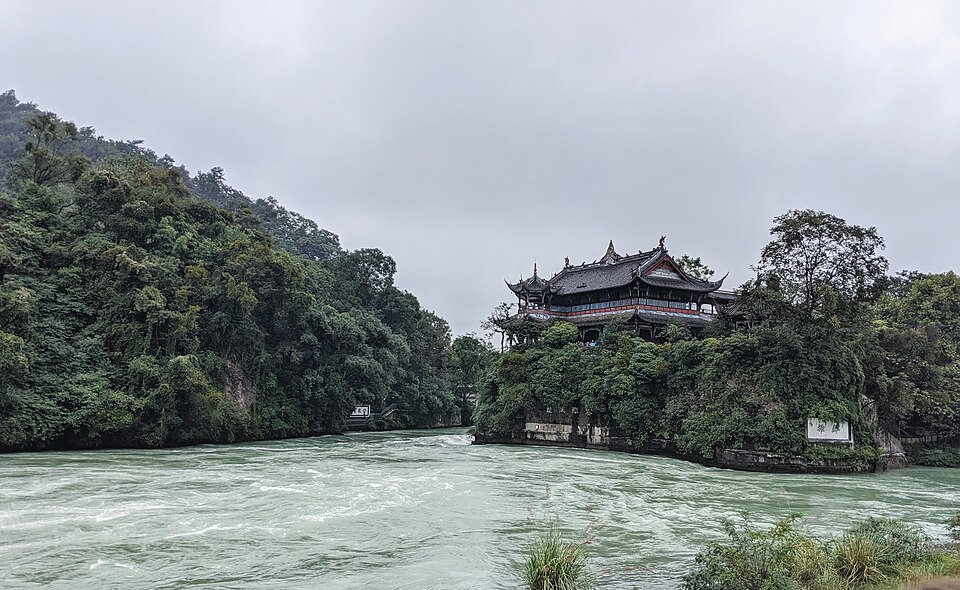
- Lidui Park and Fulong Temple. The temple sits on the rock beside Baopingkou and looks down on the water racing through the channel. It is the classic first view.
- Baopingkou. Stand above the bottleneck to see how much water is forced through.
- Feishayan. Follow the river upstream along the inner river.
- Fish Mouth. Walk or take the shuttle to the tip of the dividing embankment.
- Anlan Suspension Bridge. A long rope bridge across both channels. It sways, and on holidays it is busy.
- Erwang Temple. A hillside temple to Li Bing and his son, with many steps. It has a good view over the whole system.
Allow three to four hours at a steady pace. Use the shuttle to shorten it. The path has steps, stone surfaces and spray. Wear shoes with good grip.
When to go
- Summer: the river is high and loud, and the water at Baopingkou is at its most impressive. It is also hot and crowded.
- Spring and autumn: pleasant walking weather. Around early April (the Qingming period), the annual "water-releasing festival" ceremony draws big crowds.
- Winter: lower water and fewer visitors. The engineering is easier to see, but it is less dramatic.
Weekday mornings are calmest at any time of year.
Dujiangyan or Mount Qingcheng?
Both are part of one UNESCO listing and are a short drive apart, but they are very different days. Dujiangyan is history and engineering on a mostly level walk. Qingcheng is a Daoist mountain with stone steps. If you have one free day, choose Dujiangyan. If you have two, do one each day. Doing both in one day means an early start and a rushed visit to each.
Panda Valley and other panda centres near Dujiangyan are separate sites with their own tickets. They are an alternative to the Chengdu panda base, not part of the irrigation site.
Things to confirm before you go
- Your booking and passport.
- The train times out and back, especially the last train to Chengdu.
- High-water or storm notices, which can close riverside paths.
- Shuttle and bridge operating status.
Frequently asked questions
How do I get from Chengdu to Dujiangyan?
Take an intercity train from Xipu station to Dujiangyan station, then a bus, taxi or scenic shuttle to the gate. Allow about one to one and a half hours each way.
How much is the Dujiangyan ticket?
80 yuan for adults. The shuttle inside the site costs extra.
Can I visit Dujiangyan and Mount Qingcheng in one day?
You can, but it is rushed. Two separate days are better. If you can only do one, choose Dujiangyan.