Huayan Temple: Liao and Jin Halls in Datong's Old City
Huayan Temple stands just inside the west gate of Datong's walled old city, south of Qingyuan Street. It was founded in 1038 as an imperial monastery of the Liao, the Khitan dynasty that made Datong its western capital, and it takes its name from the Huayan, or Avatamsaka, Sutra. Two of its halls are genuine Liao and Jin buildings, among the largest timber halls of that age anywhere in China. Chinese Wikipedia calls it one of only three surviving Liao monasteries in the country. It was in the first group of national heritage sites listed in 1961, and it is the place to start an old-city day before the Nine-Dragon Screen and the city wall.
A temple that faces the sun
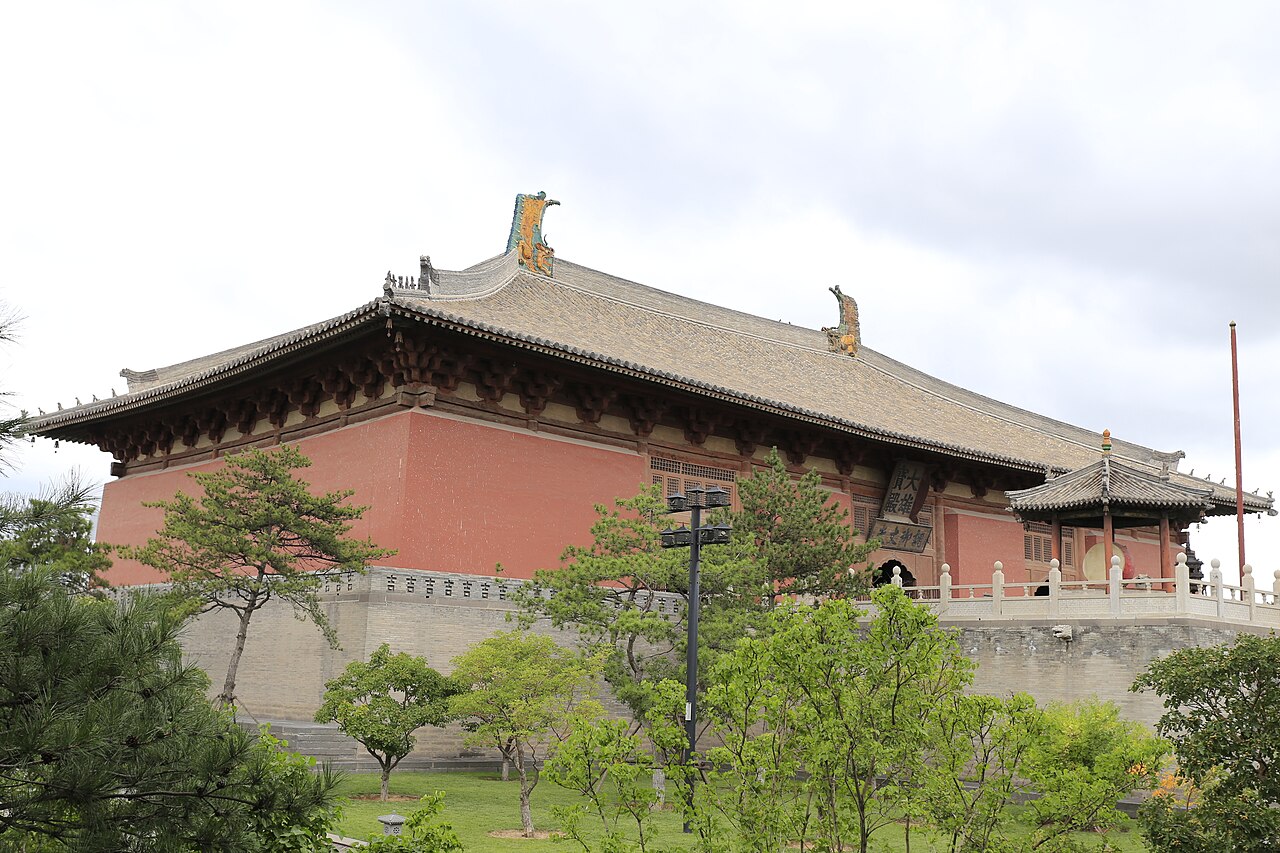
The first thing to notice is the direction. Most Chinese temples face south. Huayan faces east, with its halls lined up on an east to west axis, and Chinese sources link this to the Khitan custom of honouring the rising sun.
The history is a run of fires and rebuilding. Jin troops took Datong in 1122 and much of the temple burned. Chinese Wikipedia quotes a record that only the refectory, kitchens, a pagoda and the sutra repository survived. The Jin rebuilt the main hall in 1140. Under the early Ming the temple was confiscated, and the main hall served as a granary. In the Wanli reign it was split into two temples with separate gates, the Upper Temple to the north and the Lower Temple to the south. In 1649, when Qing troops under Dorgon took Datong after a long siege and massacred its people, only the two great halls were left standing. The architect Liang Sicheng surveyed the temple in 1933. In 2008 the city rebuilt the missing halls, gates and a pagoda from Liao and Jin records, so most of what surrounds the two old halls is modern.
The Mahavira Hall
The Upper Temple's main hall stands on a platform about four metres high. It is nine bays wide, with a single-eave hipped roof and about 1,559 square metres of floor, and Chinese Wikipedia describes it as the largest surviving ancient Buddhist hall in China. The eaves reach out 3.6 metres. The glazed chiwen ornaments at the ends of the main ridge are 4.5 metres tall, the largest glazed ridge ornaments on any old building in the country. Inside, the builders left out twelve columns to open up space in front of the altar.
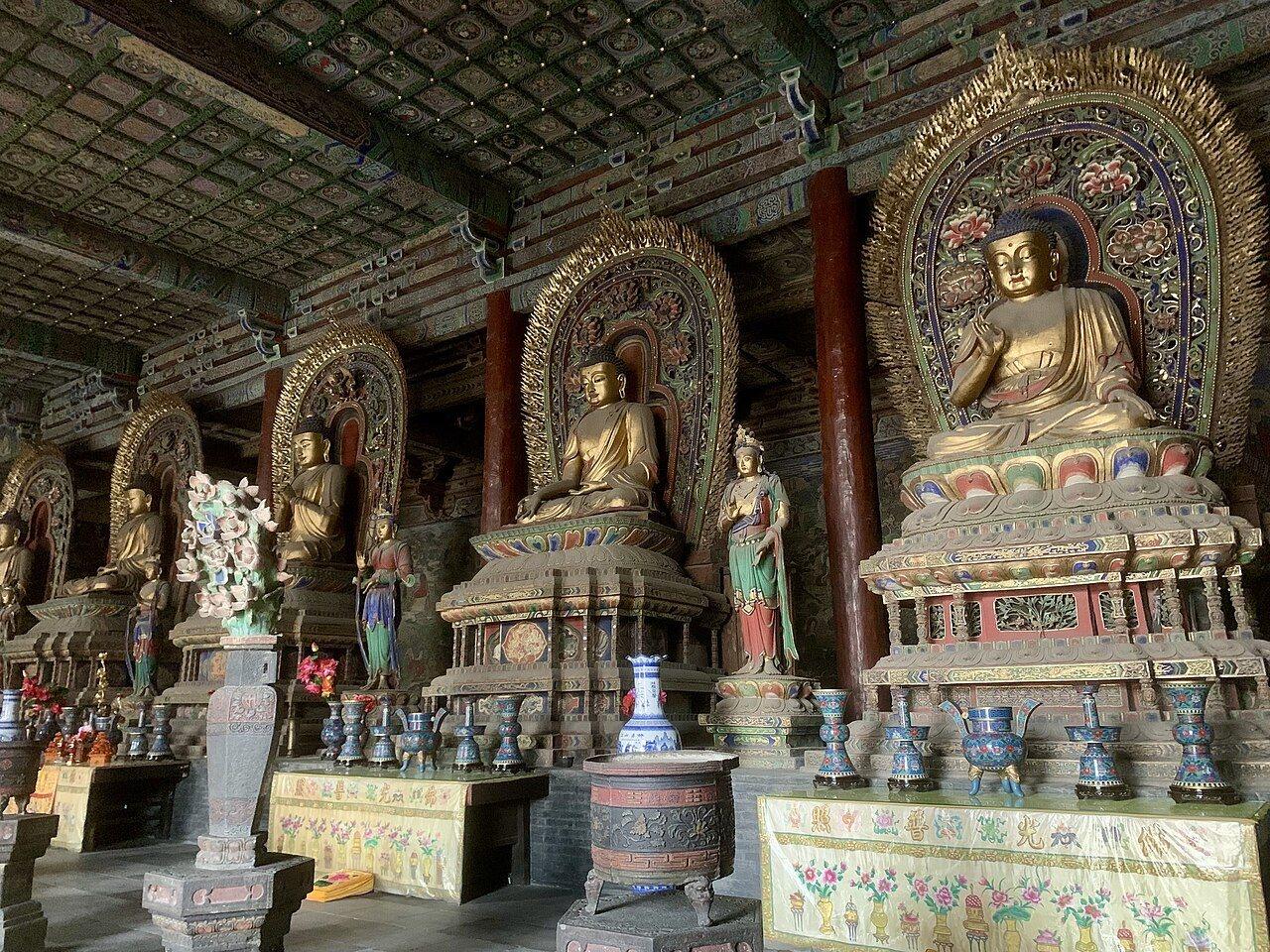
The five seated Buddhas on the altar are Ming. The three in the centre are carved wood and the two at the ends are clay. Rows of guardian deities stand along the side walls, leaning forward as if they were officials at an audience. The murals covering the walls were painted in the Qing, in the Guangxu reign, and Chinese Wikipedia gives them a height of 6.4 metres and an area of 887.25 square metres. The ceiling is divided into roughly a thousand painted panels added in the Ming. Repairs between 1997 and 2000 followed a partial roof collapse in 1993.
The Bhagavat Sutra Repository
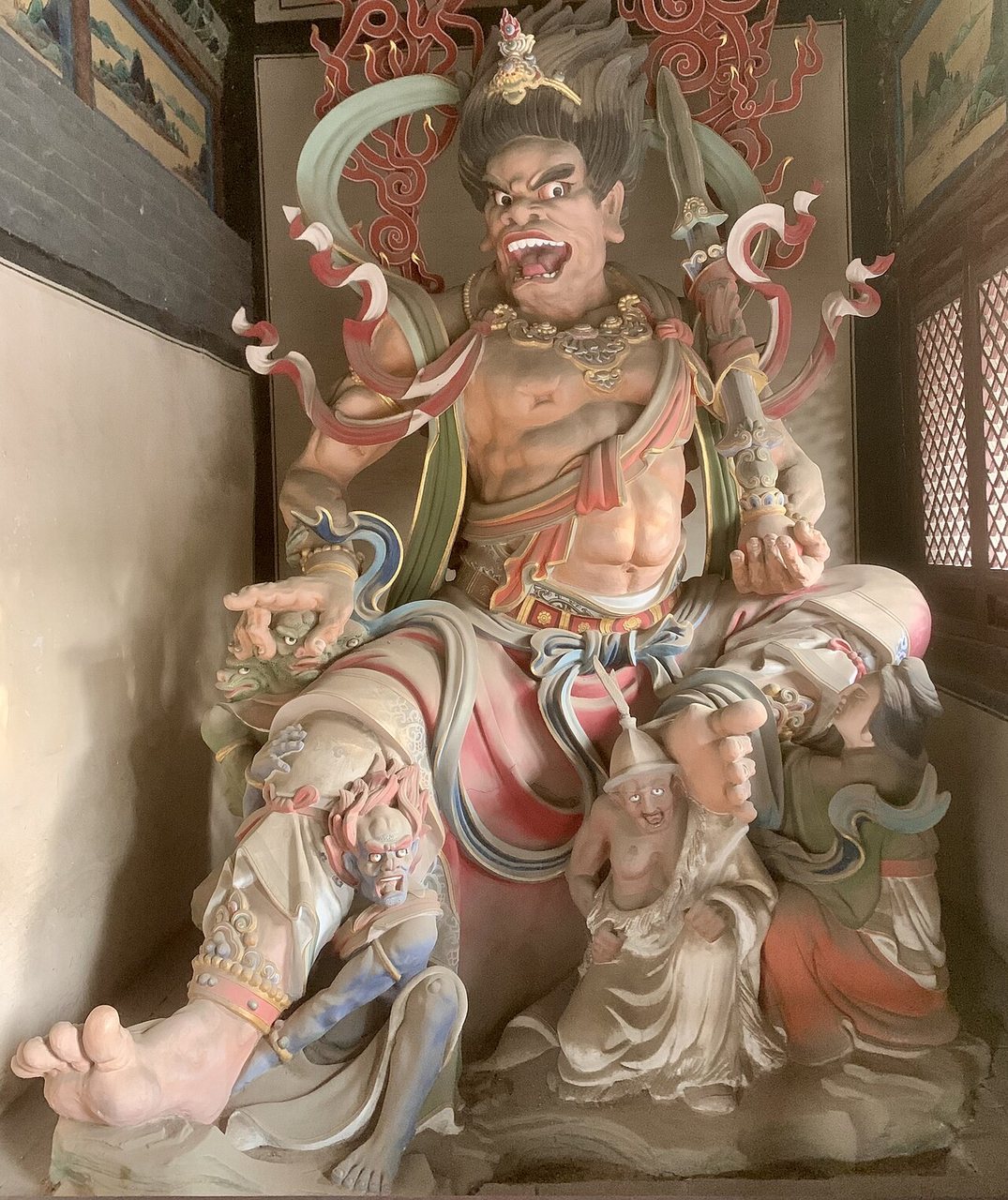
The Lower Temple's hall, the Bojia Jiaozang Hall, is the older building, put up in 1038 and still a Liao structure. It is five bays wide on a platform about three metres high, with gently sloping eaves. Chinese Wikipedia counts 29 Liao statues inside, English Wikipedia 31. They centre on the Buddhas of past, present and future. The figure people come to see is a bodhisattva to the left of the Dipankara Buddha with palms pressed together and lips parted in a smile that shows its teeth.
Round the walls run 38 bays of two-storey wooden sutra cabinets made like miniature buildings, and above the rear window a small pavilion bridges the gap between them. Chinese Wikipedia says this is the only surviving Liao model of timber architecture in China, and Liang Sicheng called it unique in the land. English Wikipedia says the cabinets still hold more than 18,000 volumes of Ming and Qing scriptures.
Tickets and hours
Local reports give the ticket as 50 yuan in the main season and 40 yuan from 1 November to 31 March, with half-price tickets for students and young people. Main-season hours run about 08:30 to 18:00, winter hours 08:30 to 17:00, and during holidays the city has kept its old-city temples open into the evening. Check the day's notice.
Getting there
The temple is on Xiasipo Street inside the old city's west gate, Qingyuan Gate. It is walkable from most old-city hotels, and taxis know it by name. Shanhua Temple, another Liao and Jin monastery in the old city with its own ticket, pairs well with it, and the Yungang Grottoes are 16 kilometres west.
How long and when
Allow one and a half to two hours, more if old buildings are your interest. Morning is good, since the halls face east. The cabinets in the Sutra Repository reward a slow look.
Things to confirm before you go
- The season price and closing time.
- Which halls are open; the Upper and Lower Temples are separate sections.
- Any photography rules inside the old halls.
Frequently asked questions
Is Huayan Temple worth it after Yungang?
Yes, for a different art. Yungang is stone carving of the fifth century; Huayan is timber architecture and clay sculpture of the eleventh and twelfth.
What is the smiling bodhisattva?
A Liao figure in the Bhagavat Sutra Repository, palms together with lips parted, which is the most admired statue in the temple.
How much is the ticket?
About 50 yuan in the main season and 40 yuan in winter, by local reports.
Are all the buildings old?
No. The Mahavira Hall and the Sutra Repository are Jin and Liao. Most of the rest, including the wooden pagoda, was rebuilt from 2008.
Sources
Facts in this article were checked against the following sources, retrieved 7 October 2026.
- 华严寺 (大同), Chinese Wikipedia
- Huayan Temple (Datong), English Wikipedia
- Winter ticket prices for Yungang, Huayan and Shanhua temples, Pinyue
- Extended opening at Datong heritage sites, Datong government
Photos are from Wikimedia Commons under the licences shown in each caption.