Yungang Grottoes: Tanyao Caves, Cave 20 and How to Book
The Yungang Grottoes are cut into the south face of Wuzhou Hill about 16 kilometres west of central Datong. They were carved for the Northern Wei court, which ruled northern China from Pingcheng, today's Datong, between 398 and 494. UNESCO counts 252 caves and niches and 51,000 statues across a carved area of 18,000 square metres, stretched along about a kilometre of cliff. The site was inscribed as a World Heritage site in 2001 and is one of China's three great early Buddhist cave sites, with the Mogao Caves at Dunhuang and the Longmen Grottoes in Luoyang, where the same court moved after leaving Datong.
Three phases of carving
The first phase is the best documented. After the Emperor Taiwu's persecution of Buddhism, his successor restored the religion, and around 460 the monk Tanyao, head of the clergy, asked Emperor Wencheng to open five caves at Wuzhou Hill, each with one great image. The Book of Wei records the request and gives the tallest figures as seventy and sixty Chinese feet. These are Caves 16 to 20, now called the Tanyao Caves. Chinese Wikipedia sets out the widely held view that each main figure stands for one Northern Wei emperor, binding worship of the Buddha to worship of the throne.
The second phase, from about 471 to 494, was also run by the court. It produced the paired Caves 5 and 6, 7 and 8, and 9 and 10, with Caves 11 to 13, and the style changed. Faces become more Chinese and robes look like the dress of southern Chinese officials, reflecting Emperor Xiaowen's reforms. When the court moved to Luoyang in 494, imperial money left with it. The smaller caves west of Cave 20 were paid for by officials and families until carving stopped around 525.
The Tanyao Caves
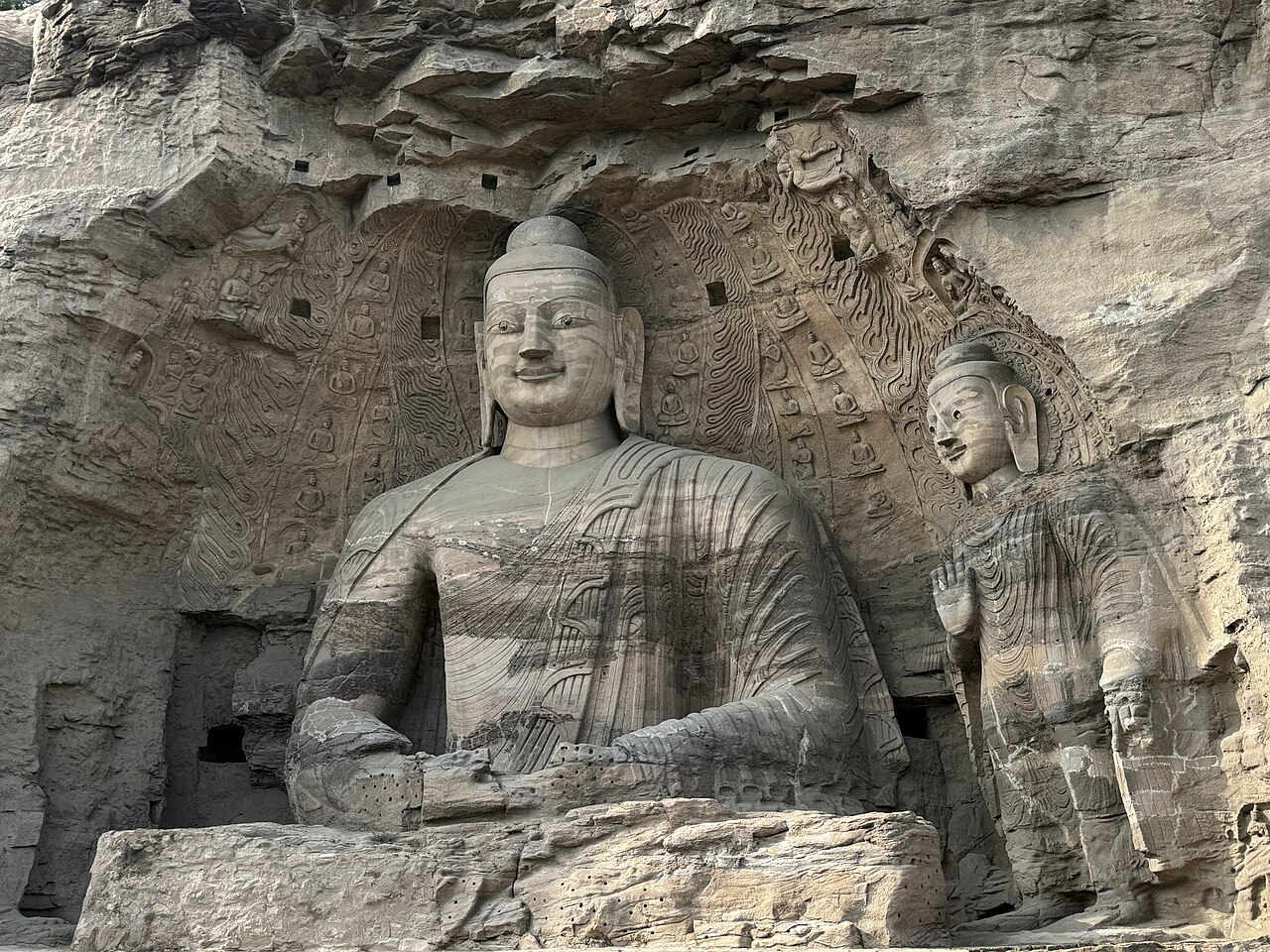
Cave 20 is the image on every postcard. It was a closed cave with a front wall, a door and a window like the other four, until the front collapsed. Chinese Wikipedia links the fall to soft mudstone in the hill and a strong earthquake centred on the Datong basin in 512. The seated Buddha has been in the open ever since, with broad shoulders, a high topknot and a heavy robe over one shoulder that shows its Gandharan roots. In 1992 excavators found more than 130 carved blocks of the lost western standing Buddha buried in front of the cave, cut away for a repair that the earthquake interrupted.
The others are just as large inside. Cave 19 is the biggest of the five, with a seated Buddha 16.8 metres tall. Cave 18 has a standing Buddha about 15.5 metres high whose robe is covered with a thousand small Buddhas. Cave 17 holds a cross-ankled Maitreya of 15.5 metres, and Cave 16 a standing Buddha of 13.5 metres in the newer Chinese style of dress.
Caves 5 and 6 and the middle group
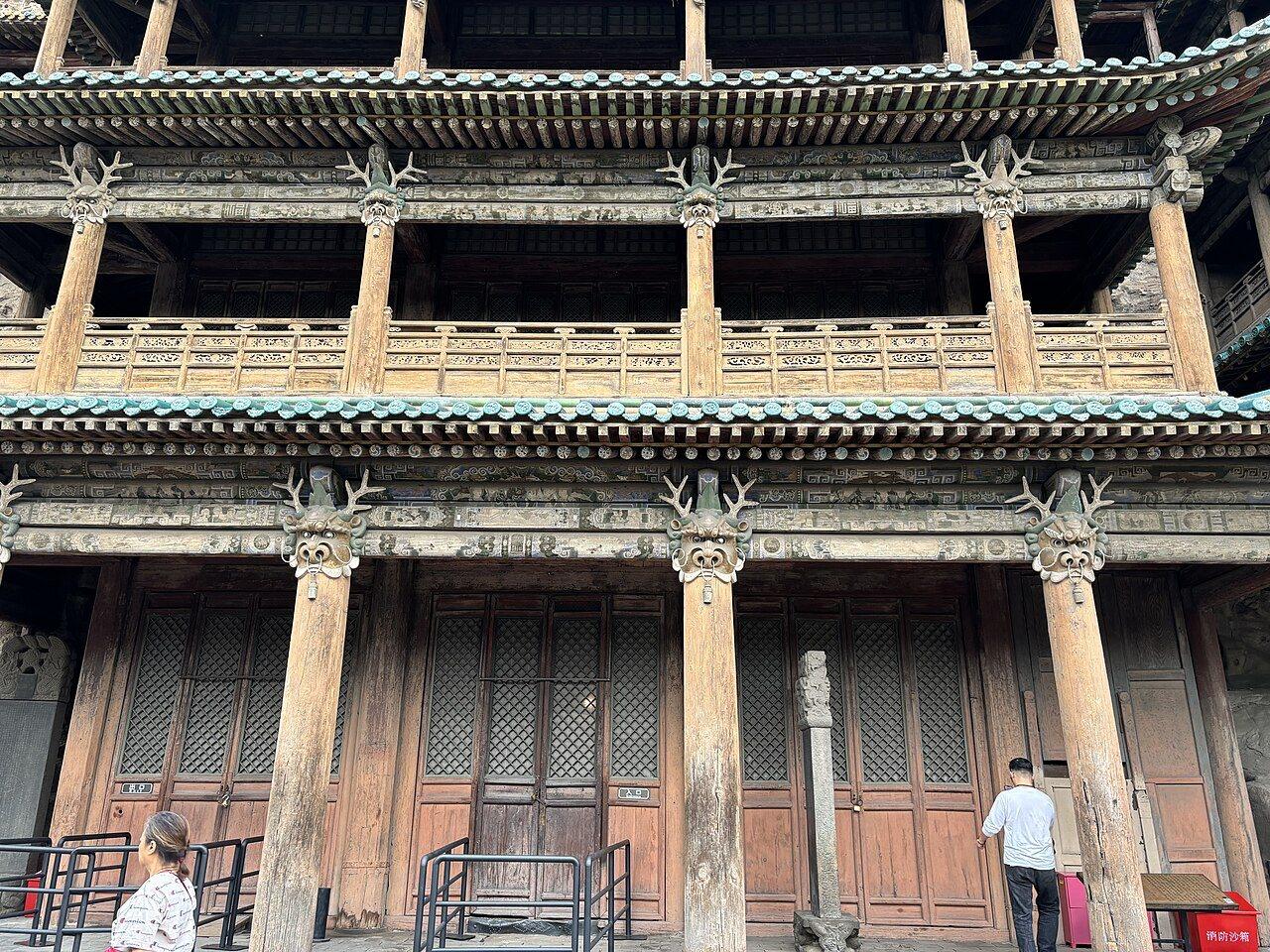
Caves 5 and 6 sit behind four-storey timber fronts; English Wikipedia dates the present buildings to 1621. Cave 5 holds the largest figure at Yungang, a seated Buddha 17 metres tall. Cave 6, about 20 metres from floor to ceiling, is the most richly carved. A two-storey pillar about 15 metres high rises in the middle, and its faces and the surrounding walls tell the life of the Buddha in relief. Everything was once painted, and English Wikipedia notes the caves have been repainted as many as twelve times. Caves 7 to 13 continue the story, with musicians on the walls of Cave 12 and a Maitreya more than 12 metres tall in Cave 13. Cave 3, the largest cave in plan, holds a Buddha and two bodhisattvas that Chinese sources date to the Sui or Tang.
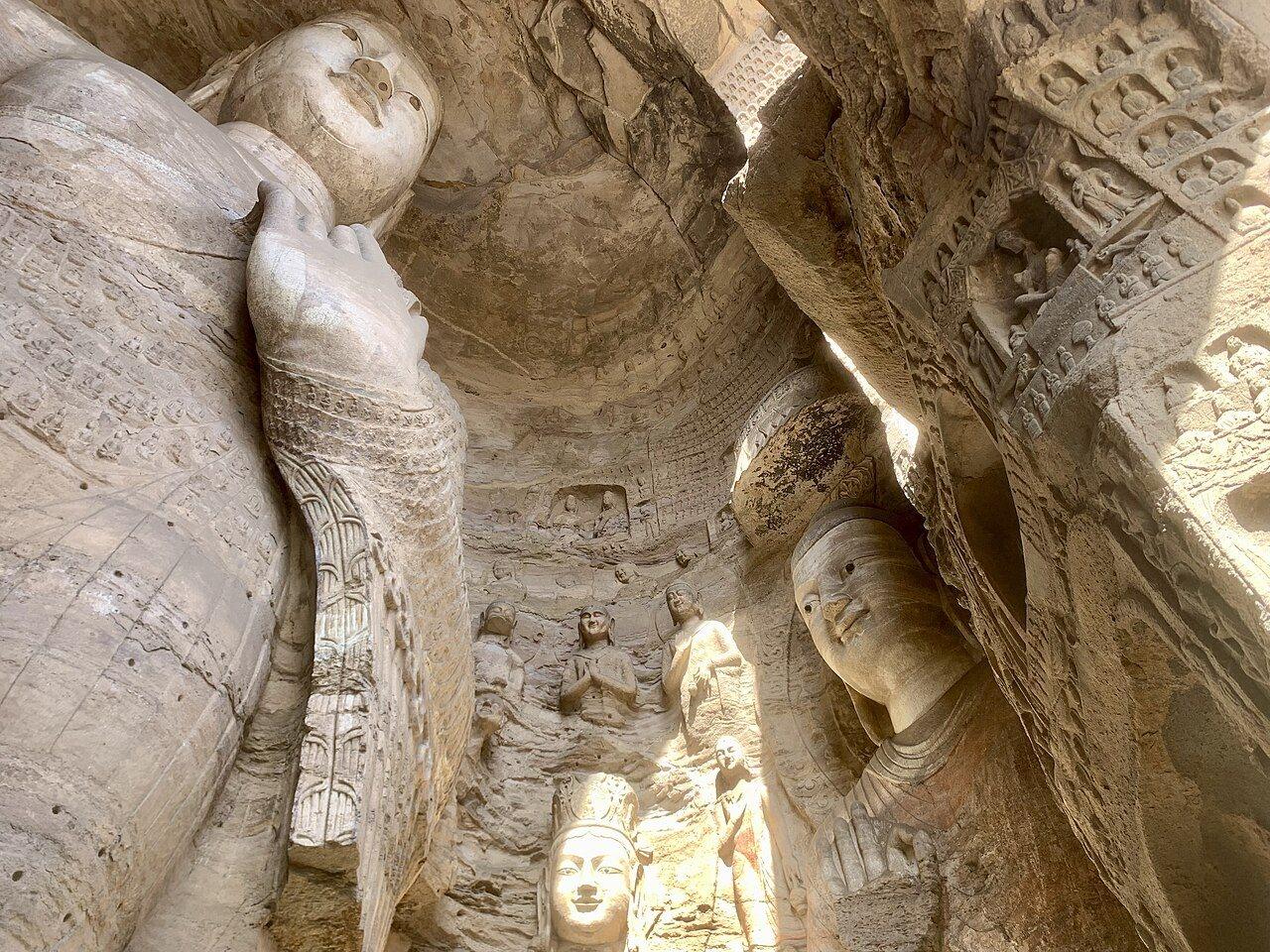
The sandstone weathers easily. Wind-blown dust, coal-town pollution and water seepage have all done damage, and Qing repairers who pinned clay over broken figures with wooden stakes left holes when the clay fell away. Conservation since the 1950s has sealed cracks and planted trees against dust storms. Red Guards damaged carvings during the Cultural Revolution. The 2024 video game Black Myth: Wukong used Shanxi sites, Yungang among them, and visitor numbers rose sharply after its release.
Current closures
A notice from the scenic area for the October 2026 holiday said Caves 5, 16 and 18 were temporarily closed for conservation and that the Yungang Grottoes Museum and the Su Bai Memorial Hall were not open. Closures rotate as work moves along the cliff. Check the official account before you go if one cave matters to you.
Booking, tickets and hours
All visitors book online in advance under their real name, between one and fifteen days ahead; same-day booking is not possible. Use the "Yungang Shiku Wenlv" or "Yungang Yanjiuyuan" WeChat mini-programs or authorised platforms such as Trip.com, Meituan and Douyin. Foreign visitors can also use self-service ticket machines on the second floor of the visitor centre and enter with a passport. Children up to six or under 1.2 metres enter free without booking, as do visitors aged 60 and over.
The main-season ticket, from 1 April to 31 October, is 120 yuan, with 60 yuan for students and young people aged 6 to 18. From 1 November to 31 March the price has dropped to 100 yuan, and winter hours have been 08:30 to 16:30. Holiday hours stretch; during the 2026 National Day week the site opened from 06:30 with ticket checks until 18:00. Check the day's notice.
Getting there
City bus 3 runs from central Datong to its terminus at the Yungang Grottoes stop. The scenic area also runs direct shuttle buses from the old city, Datong South station and other points, with times in the mini-program. A taxi covers the 16 kilometres from the old city. The car park is large, and a landscaped path leads from the far parking areas to the gate.
How long and when
The scenic area suggests three to four hours for the main route, from Tanyao Square along the processional avenue past Lingyan Temple to the caves, and five to six hours if you add the exhibitions. Arrive before 09:00 or after 15:00 on busy days. Hire an audio guide in the visitor centre basement, which offers English and seven other languages, or book an official guide at the counters on Tanyao Square. Flash photography, laser pointers, drones, incense and pets are banned.
Things to confirm before you go
- Your booking date, at least one day ahead.
- Which caves are closed for conservation that week.
- Shuttle or bus times back to the city.
- Audio guide availability in your language.
Frequently asked questions
How much is the Yungang Grottoes ticket?
120 yuan from April to October and 100 yuan in winter, with half-price tickets for students and young people.
Can I buy a ticket on the day?
No. Booking must be made one to fifteen days ahead on the official mini-programs or authorised platforms.
How long do I need at Yungang?
Three to four hours for the caves. Allow longer if you want the exhibitions or the western small caves.
Which caves should I prioritise?
The Tanyao Caves 16 to 20 and the twin Caves 5 and 6, subject to current closures.
Sources
Facts in this article were checked against the following sources, retrieved 7 October 2026.
- UNESCO World Heritage Centre, Yungang Grottoes
- Yungang Grottoes, English Wikipedia
- 雲岡石窟, Chinese Wikipedia
- National Day 2026 visitor guide to Yungang, Shanxi Evening News
- Winter ticket prices for Datong sites, Pinyue
Photos are from Wikimedia Commons under the licences shown in each caption.