Nine-Dragon Screen: The Prince of Dai's Glazed Wall
The Nine-Dragon Screen on Heyang Street in Datong's old city is a free-standing wall of glazed tiles, 45.5 metres long, 8 metres high and just over 2 metres thick. It was built between 1392 and 1396 for the palace of Zhu Gui, the thirteenth son of the first Ming emperor, who was made Prince of Dai and sent to guard Datong. It is the oldest and largest of China's surviving nine-dragon walls, more than three hundred years older than the two in Beijing and roughly twice the size of the one in Beihai Park. It takes a short visit, and it fits well between Huayan Temple and a walk on the city wall.
A prince's wall
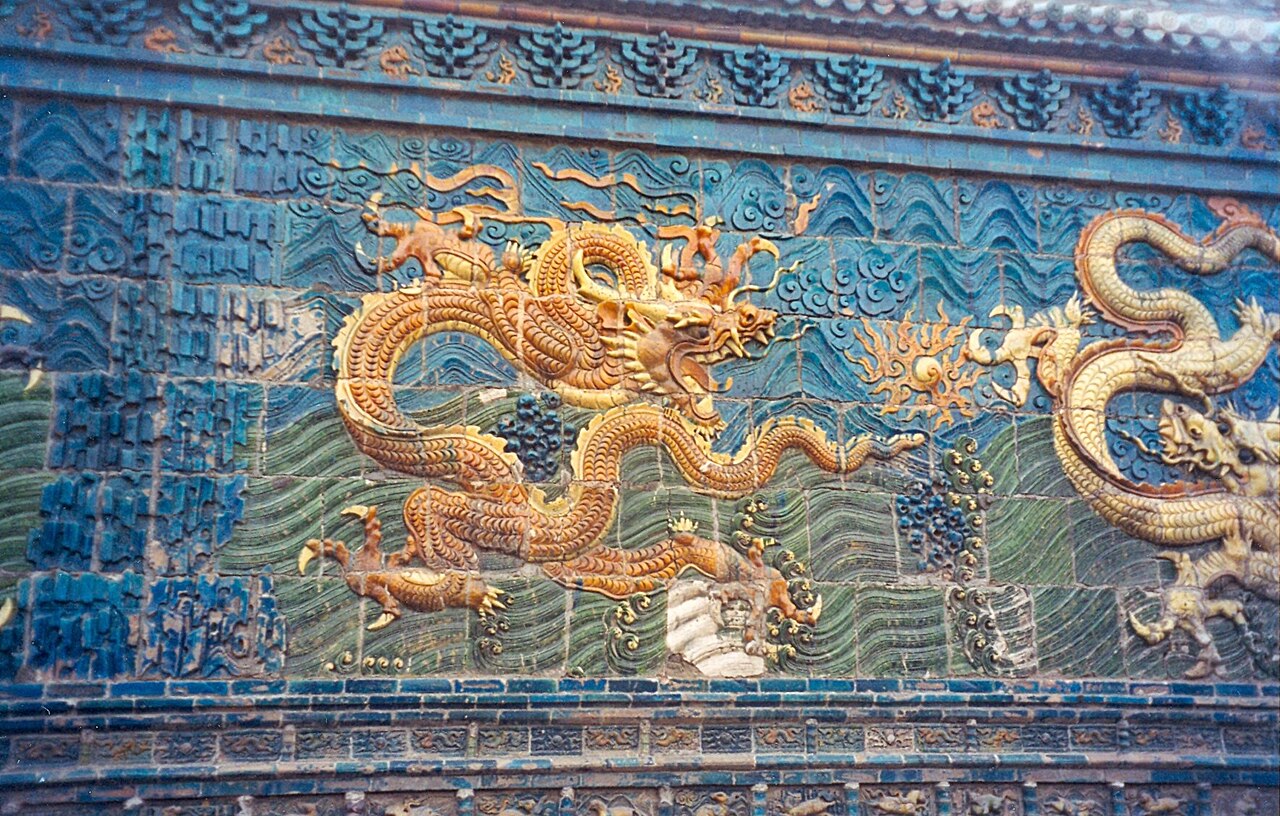
Zhu Gui received the title in 1391, moved to Datong the next year and began building. The screen is usually described as the spirit wall that stood opposite the palace gate, blocking the view in. Chinese Wikipedia notes that some scholars read it instead as a decorative street-front structure that separated the palace from the houses around it. Either way, its purpose was display. A son of the emperor could use dragons, but under Ming ritual rules a prince's dragons had four claws, and the five-clawed dragon was kept for the emperor. Count the claws when you stand in front of it.
Reading the wall
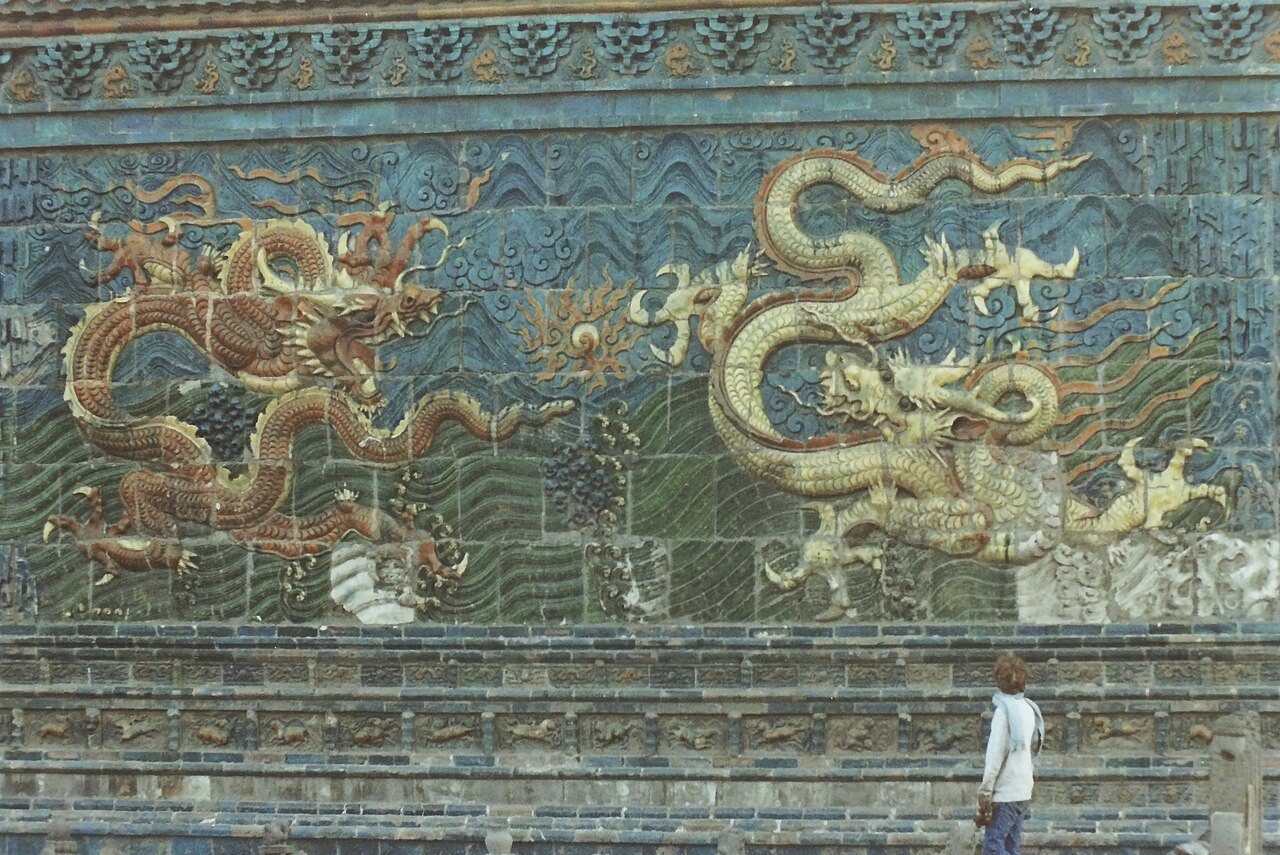
The screen has three parts, a tiled roof, the wall body and a Sumeru base. The roof carries lotus patterns and small running dragons. On the body nine large dragons twist over waves and clouds, each in a different pose, and the base has its own reliefs of flowers and animals. In the Qing and Republican periods people in Datong had a custom of washing the black dragon, the second from the right, to bring rain in a drought.
The local legend about how it was made is still told. In this story the prince saw the nine-dragon wall at his brother's palace in Beiping and demanded a bigger one within a month. He summoned a glaze maker named Wu and his two sons from Wujiayao in Huairen County. On the way home they rescued a dying little snake, and in the end they modelled the dragons on it. When the wall was dedicated, the story goes, two real dragons came down in a thunderstorm.
The 1954 move
The prince's palace was destroyed in the wars at the end of the Ming, and the screen survived on its own. In August 1954 the city took it apart to make way for a road and rebuilt it 28 metres to the south. Gaps were filled with grey brick, and Chinese Wikipedia says the move damaged the wall, with some pieces put back in the wrong places. Look for the plain grey patches among the glaze. The screen became a national heritage site in 2001, and in 2011 the city began rebuilding the Ming palace behind it.
A city of dragon walls
Datong calls itself a city of dragon walls. Chinese Wikipedia counts nine surviving examples in the city, and this one is the most famous. If you enjoy glazed tile work, the others are worth asking about locally, since access to them varies.
Tickets and hours
The screen had been free to visit for a time. Under an official notice from the city's ancient architecture institute, charging resumed on 15 July 2025, at 10 yuan full price and 5 yuan half price. Children aged 6 and under or 1.2 metres and under, people aged 60 and over with ID, and several other groups enter free. Half price applies to young people aged 6 to 18 and full-time students up to undergraduate level. Regular hours are not posted in that notice. On public holidays the city has opened it late, for example from 08:00 to 23:00 during the 2026 May Day holiday. Check the day's notice.
Getting there
The screen is on Heyang Street in the east of the old city, the street named for the east gate, Heyang Gate. It is walkable from most old-city hotels, and the Yungang Grottoes are a taxi ride west.
How long and when
Half an hour is enough for most people. Daylight shows the glaze colours best. On some holidays it stays open into the evening.
Things to confirm before you go
- The ticket price and any free days.
- Opening hours for your date, especially in the evening.
- Whether the rebuilt palace behind the screen has its own entry.
Frequently asked questions
Is the Datong Nine-Dragon Screen free?
Not since 15 July 2025. The full ticket is 10 yuan, with free entry for people aged 60 and over and small children.
Why do the dragons have four claws?
The screen was built for a prince, and Ming rules kept five-clawed dragons for the emperor.
Is it older than the Beijing nine-dragon walls?
Yes, by more than three hundred years. The Beihai wall dates from 1756 and the Forbidden City wall from 1771.
Is the screen in its original place?
No. It was moved 28 metres south in 1954.
Sources
Facts in this article were checked against the following sources, retrieved 7 October 2026.
- 大同九龙壁, Chinese Wikipedia
- Nine-Dragon Wall, English Wikipedia
- Notice on resuming ticket charges at the Nine-Dragon Screen, Datong 12345
- Extended opening at Datong heritage sites, Datong government
Photos are from Wikimedia Commons under the licences shown in each caption.