Grain Transport Governor's Office Site
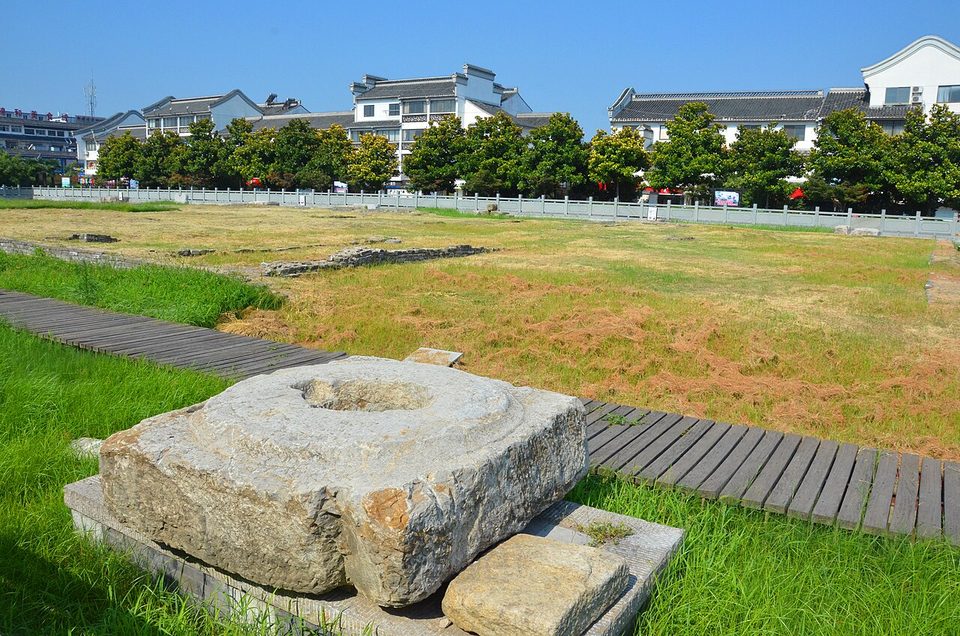
For more than four centuries the grain that fed Beijing passed under the eyes of one official in Huai'an. The Governor-General of Grain Transport, the caoyun zongdu, ran the shipment of tax rice up the Grand Canal from the south to the capital, and his headquarters stood in the middle of the old walled town, today's Huai'an District. The buildings are gone. The foundations, dug out in 2002, lie open in a square, and beside them stands the China Canal Museum, the first museum in the country devoted to the grain transport system.
What the governor did
Under the Ming and Qing the canal was the empire's lifeline. Southern provinces paid part of their land tax in grain, and fleets of state barges moved it north to feed the court, the officials and the garrisons in Beijing. The governor in charge ranked at the very top of the civil service, first rank second class or second rank first class, and Huai'an was the natural place to sit. It is where the canal meets the Huai River, the traditional line between north and south, and the city guide notes that the first canal here was dug in 486 BC.
A site with a long record
The ground has held government offices since the Southern Song. Chinese Wikipedia traces an official building here to 1170. Under the Yuan it housed the Huai'an circuit administration and was rebuilt in 1293. In the early Ming it became the Huai'an prefectural office in 1368 and then the headquarters of the Huai'an Guard in 1370. In 1579 the censor Ling Fangyi moved the prefecture to a new site and installed the Grain Transport Governor here, and the governor stayed for almost three hundred years.
The compound sat on the town's central axis, with the Northern Song drum tower now called Zhenhuai Tower and the south gate to the south and the prefectural office to the north. Records describe about 20,000 square metres of buildings with 213 rooms and three memorial arches. Along the axis stood the main gate, a second gate, the great hall, a second hall, the Daguan Tower and the Huaihe Jie Tower, with offices, a study, shrines and a lookout pavilion to each side. A pair of lions of white alum stone, said to have been shipped from Persia under the Yuan, guarded the front gate. The great hall measured 28.8 metres by 22.8 metres, five bays wide on 34 large columns.
How it disappeared
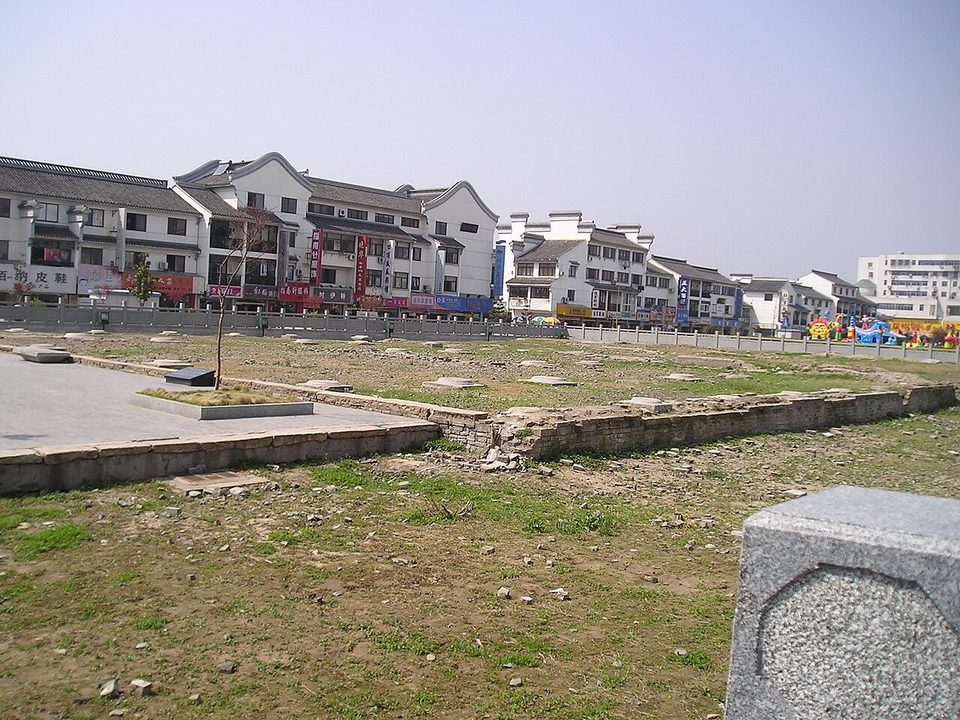
The end came in two steps. In 1860 the Qing abolished the post of Southern River Governor and moved the Grain Transport Governor into the river governor's former offices at Qingjiangpu, about 15 kilometres away. The old compound was left to decay. In October 1945 the New Fourth Army took the town, pulled down the great hall and shipped its timber to Yancheng to be used in making weapons. The ground became the Ye Ting sports field. Only the platforms and column bases survived underground.
In August 2002, during redevelopment of the old town, archaeologists uncovered the Ming and Qing foundations, with Song and Yuan layers about three metres below. The site became a provincial protected site, and the city laid out the remains as an open park in Caoyun Square, where you can trace the plan of halls and courtyards on the ground.
The China Canal Museum
The museum stands inside the site. Building started in 2008 and it opened on 1 May 2011. It was designed by the School of Architecture at Southeast University in Nanjing, and the scholar Xu Jialu wrote its name board. Chinese Wikipedia gives a floor area of 8,680 square metres with five galleries covering about 6,000 square metres. Its galleries tell the history of grain transport on the canal. The governor's office and the museum together were named a national 4A scenic area in 2012.
Tickets and hours
A Huai'an Bendibao guide from August 2026 lists opening hours of 8:30 to 17:30 and an adult ticket of 60 yuan, with an offer price of 50 yuan at the time, and a Chinese-language guide for 60 yuan. Half price applies to children over 1.4 metres, young people aged 6 to 18, full-time students and visitors aged 60 to 69. Children up to 6 or 1.4 metres, visitors aged 70 and over, people with disabilities and serving military enter free. Older listings mention a Monday closure, and the museum has posted temporary closure notices in the past, so check the day's notice or the museum's official account before you go.
Getting there and pairing it
The site is in Caoyun Square in the centre of the old Huai'an town, now Huai'an District, a short walk from Zhenhuai Tower and the shopping streets. From Huai'an East station, taxis and ride-hailing take you there. Plan one to two hours.
The site fits the city guide's first day. Start early at the Zhou Enlai Former Residence, walk over to the governor's office and the museum in the late morning, climb Zhenhuai Tower if it is open, and finish at Hexia Ancient Town, the canal port whose salt and grain merchants grew rich on the same system. Further south, the Xijin Ferry in Zhenjiang preserves an old Yangtze crossing close to where the canal met the river.
Frequently asked questions
Are there any original buildings?
No standing ones. The site shows the excavated foundations and column bases. The museum holds the story.
Is the site the same as the museum?
They share one scenic area. The ruins lie in the square and the museum building stands within the site.
Is it worth it for non-specialists?
The open foundations are quick to see. The museum helps make sense of Huai'an, Hexia and the canal towns of Jiangsu.
Sources
Facts in this article were checked against the following sources, retrieved 21 October 2026.
- 总督漕运公署遗址, Chinese Wikipedia
- 中国漕运博物馆, Chinese Wikipedia
- 漕运总督, Chinese Wikipedia
- Huai'an Bendibao, China Canal Museum guide, August 2026
- China Canal Museum, official site notices
- Huai'an travel guide on this site
Photos are from Wikimedia Commons under the licences shown in each caption.