Hongcun Village, Huangshan: A Village Built Around Water
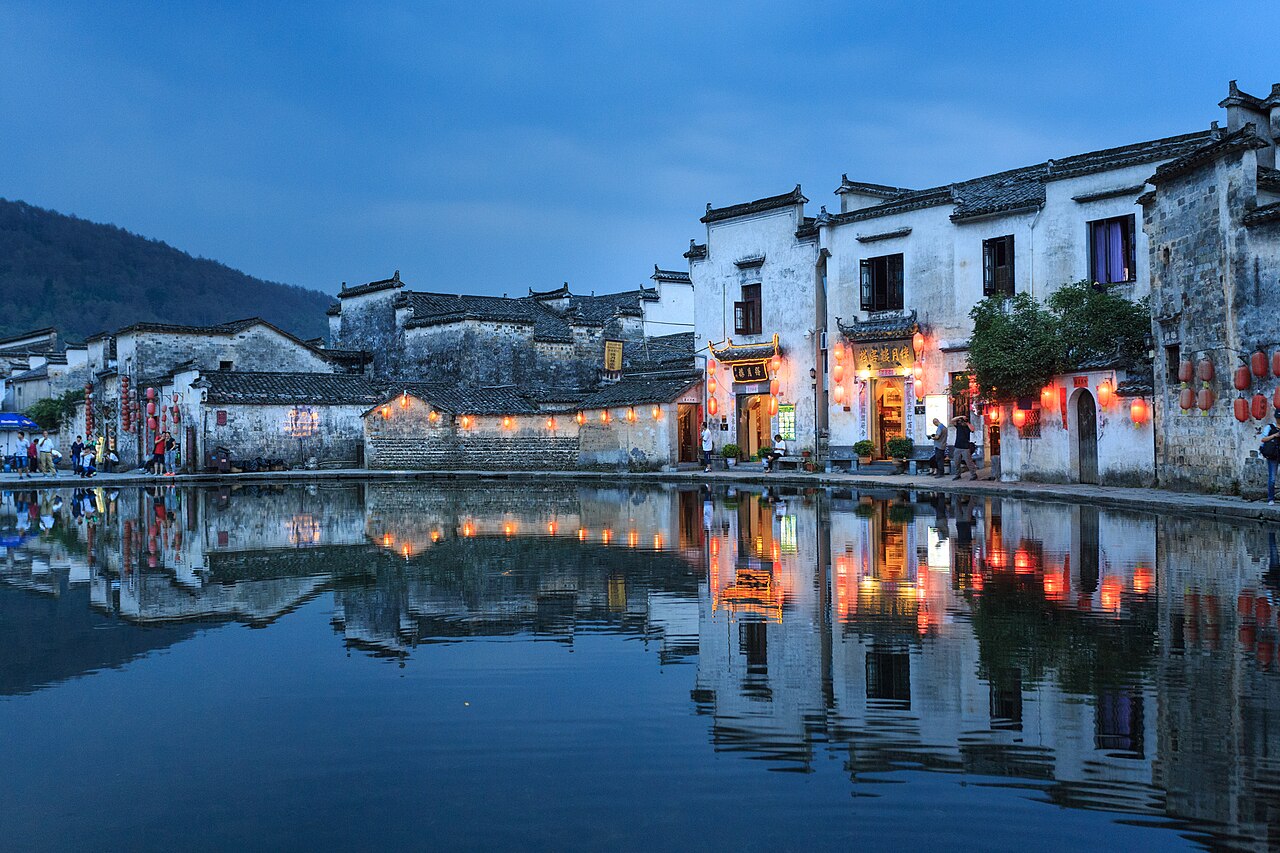
Hongcun (宏村) is the Huizhou village you have seen in photographs: whitewashed houses with black-tiled horse-head gables reflected in a crescent lake, with hills behind. It is in Yi County, about ninety minutes by direct bus from Huangshan North high-speed station, and together with neighbouring Xidi it has been a World Heritage site since 2000. Public listings for 2026 give a 104-yuan ticket valid for about three days with re-entry, and opening hours of roughly 07:30 to 17:30. The village gets crowded by mid-morning, so arrive early or stay the night. A two-to-three-hour loop covers the water channels, the Moon Pond, Chengzhi Hall and the South Lake. It is the morning half of the village day in the Huangshan travel guide.
How to see it without the crowds
Hongcun is the busier of the two villages. Tour groups arrive from about 9:00, and the banks of the South Lake fill with art students on folding stools, sketching the same view. There are three ways around it:
- Arrive on the first bus or earlier by car, and do the lake first, while it is still and the light is soft.
- Stay overnight in a village guesthouse, which gives you the lake at dawn and dusk, when the day visitors have gone. Some seasons there is also an evening ticket for the lake after dark.
- Reverse the usual loop. Most groups enter and head straight for the Moon Pond. Walk the outer lanes first and arrive at the centre later.
Remember that people live here. Doors that are not marked as open to visitors are private homes.
The water system
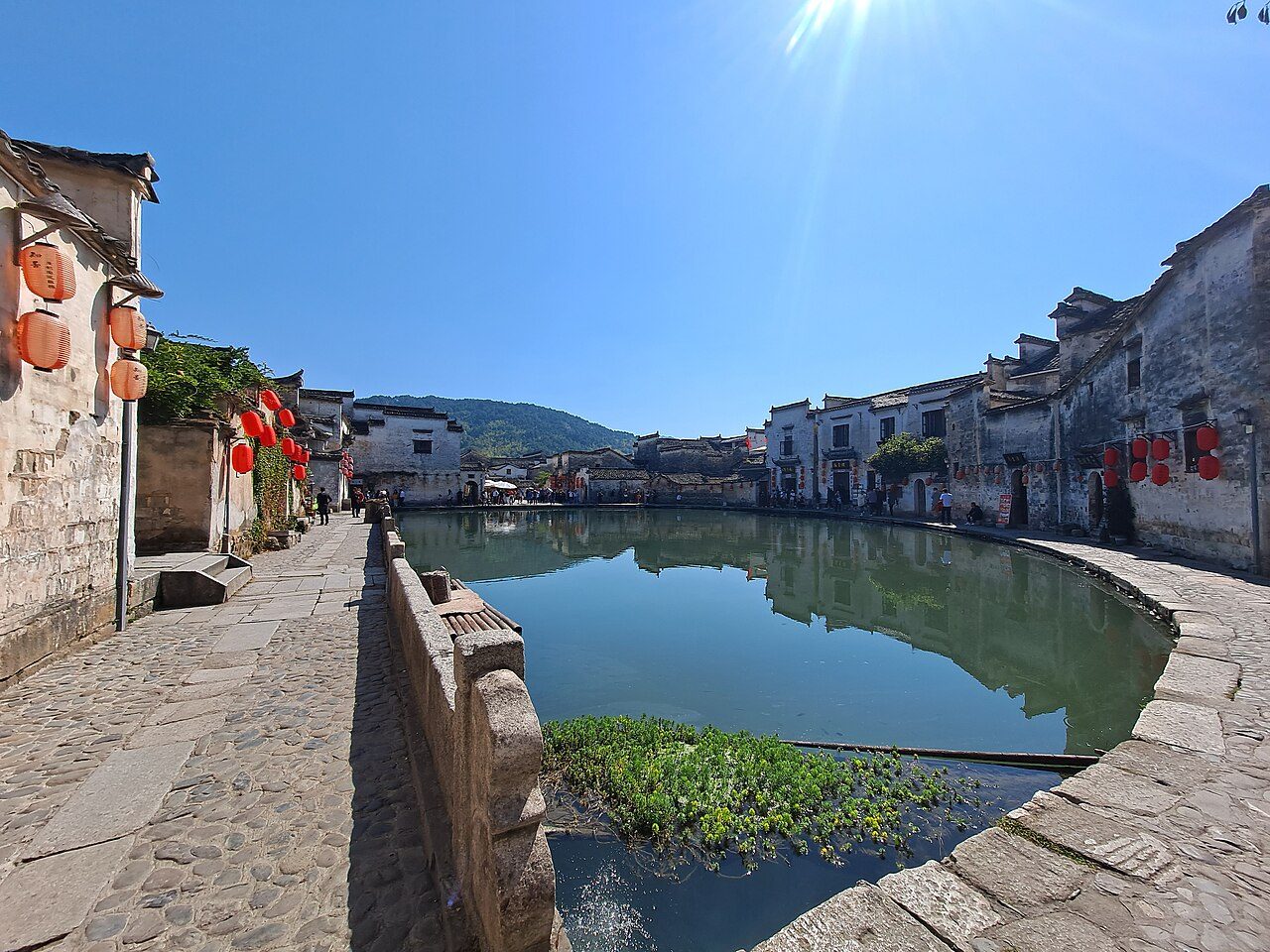
What sets Hongcun apart is water. The Wang clan founded the village in 1131, in the Shaoxing reign of the Southern Song, under Leigang Hill about eleven kilometres northeast of the county seat. It was first written with a different character for "hong", changed in the Qing to avoid the personal name of the Qianlong Emperor. In the Ming Yongle years the clan elders hired a geomancer to replan it and bring river water inside. Villagers cut a channel close to a metre wide that winds through the lanes past individual front doors. It supplied water for washing and cooking, fought fires and cooled the streets in summer. The channel widens into the half-moon Moon Pond at the centre of the village, then flows on to the bow-shaped South Lake at the southern edge.
Locals describe the whole plan as an ox. Leigang Hill is the head, two old trees at the village entrance are the horns, the Moon Pond is the heart, the South Lake is the stomach, the channels are the intestines, the houses are the body and four bridges over the stream are the legs. You may not see the animal, but following the water is the easiest way to understand the layout, and the channels still flow today.
A walking loop
- Enter by the village gate near the two old trees and walk along the lake shore while it is quiet.
- Nanhu Academy, on the north shore of the South Lake. Six private schools stood here at the end of the Ming, merged into one academy in 1814. The view across the lake from here is the classic Hongcun frame.
- Follow the water channel north through the lanes toward the centre.
- The Moon Pond, ringed by houses. Lexu Hall, on its north side, is the Wang clan's ancestral hall and the only Ming building left in the village.
- Chengzhi Hall, a few lanes away, for the woodcarving.
- Loop back along the outer lanes to the lake.
Chengzhi Hall: the reason to slow down
Chinese Wikipedia counts one Ming building, 102 Qing buildings and 34 from the Republican period still standing in Hongcun. Chengzhi Hall is the largest. The salt merchant Wang Dinggui built it in 1855, late in the Qing, on about 2,100 square metres with some sixty rooms around nine courtyards. Its beams and brackets are carved with fishing, woodcutting, farming and reading, scenes from the Romance of the Three Kingdoms, and a hundred children celebrating the Lantern Festival. Look for the gilding still left on some carvings.
The house also kept a room for smoking opium and another for mahjong. Those rooms say as much about how late Qing merchants lived as the carvings do.
Scenes from the film Crouching Tiger, Hidden Dragon were shot in the village. The lake scenes are easy to recognise.
Tickets and hours
Public listings for 2026 commonly give:
- Hongcun ticket: 104 yuan, valid for about three days with re-entry.
- A combined Hongcun and Xidi ticket, if you plan both.
- Hours: about 07:30 to 17:30, with an evening ticket in some seasons.
Online travel platforms often sell the same ticket below the gate price. Touts at stations who offer "cheap" tickets are usually selling the ordinary online price. Confirm the current price, combo options and hours on the official notice for your date.
Getting there
- From Huangshan North high-speed station: direct buses leave the tourist transport hub next to the station roughly hourly through the day. The ride is about ninety minutes and passes Xidi on the way.
- From Tunxi: a taxi or ride-hail takes a little over an hour.
- From Tangkou, at the foot of Mount Huangshan, a few direct buses run each day.
- To Xidi: about half an hour by local bus or car.
The last buses back leave in the late afternoon. Note the time when you arrive.
Hongcun or Xidi?
They are close enough that most people see both in one day. If you only have time for one, choose Hongcun for water, reflections and the famous view, and Xidi for deeper lanes, the memorial archway and fewer crowds. A common order is Hongcun early in the morning before the groups, then Xidi after lunch.
Nearby, with a second day
Tachuan village, about two kilometres away, is known for its autumn colours in late October and November. The Mukeng bamboo forest is another short trip. Both are good reasons to stay in Yi County overnight.
Things to confirm before you go
- The ticket price, validity and any Hongcun and Xidi combo on the official notice.
- The last bus back to Huangshan North or Tunxi.
- Whether an evening entry is running on your date.
- Your guesthouse booking if you plan to stay overnight.
Frequently asked questions
How long do you need in Hongcun?
Two to three hours for the main loop. Stay overnight if you want the lake at dawn or after dark.
How do I get to Hongcun from Huangshan North station?
Direct buses run from the tourist transport hub beside the station, about ninety minutes each way.
How much is the Hongcun ticket?
Public listings for 2026 give 104 yuan, valid for about three days. A combined ticket with Xidi is also sold.
Is Hongcun a World Heritage site?
Yes. It was inscribed with Xidi in 2000 as the Ancient Villages in Southern Anhui.
Sources
Facts in this article were checked against the following sources, retrieved 6 October 2026.
- 宏村, Chinese Wikipedia
- Hongcun, English Wikipedia
- UNESCO World Heritage Centre, Ancient Villages in Southern Anhui
- Huangshan North Station to Hongcun bus timetable
Photos are from Wikimedia Commons under the licences shown in each caption.