Huizhou Ancient City, Shexian: A Half Day in the Old Prefecture
The Huizhou Ancient City (徽州古城) is the old centre of Shexian, about twenty-five kilometres northeast of Tunxi, and for the Ming and Qing it was the seat of Huizhou Prefecture, the region whose merchants and scholars gave Hui culture its name. Walking the streets is free. So is the town's landmark, the eight-legged Xuguo Stone Arch of 1584, which straddles a street in the centre. The paid sites, including the rebuilt prefectural Yamen, Doushan Street's houses and Yuliang Dam, are sold singly or on a combo ticket, recently around 95 to 100 yuan. Give it half a day, finish at Yuliang Dam for the late light, and eat dinner back on Tunxi Old Street. It is day three in the Huangshan travel guide.
Why come to Shexian
Hongcun and Xidi show how Huizhou families lived in their villages. Shexian shows where the region was governed from. The county dates back to the Qin dynasty, and the town's streets, gates, arches and the river wharf at Yuliang trace the life of a prefectural capital whose merchants traded salt, tea and timber across the lower Yangtze. Chinese travel writing often lists it with Langzhong, Lijiang and Pingyao as one of the country's four best-known ancient towns. It is usually far quieter than any of them.
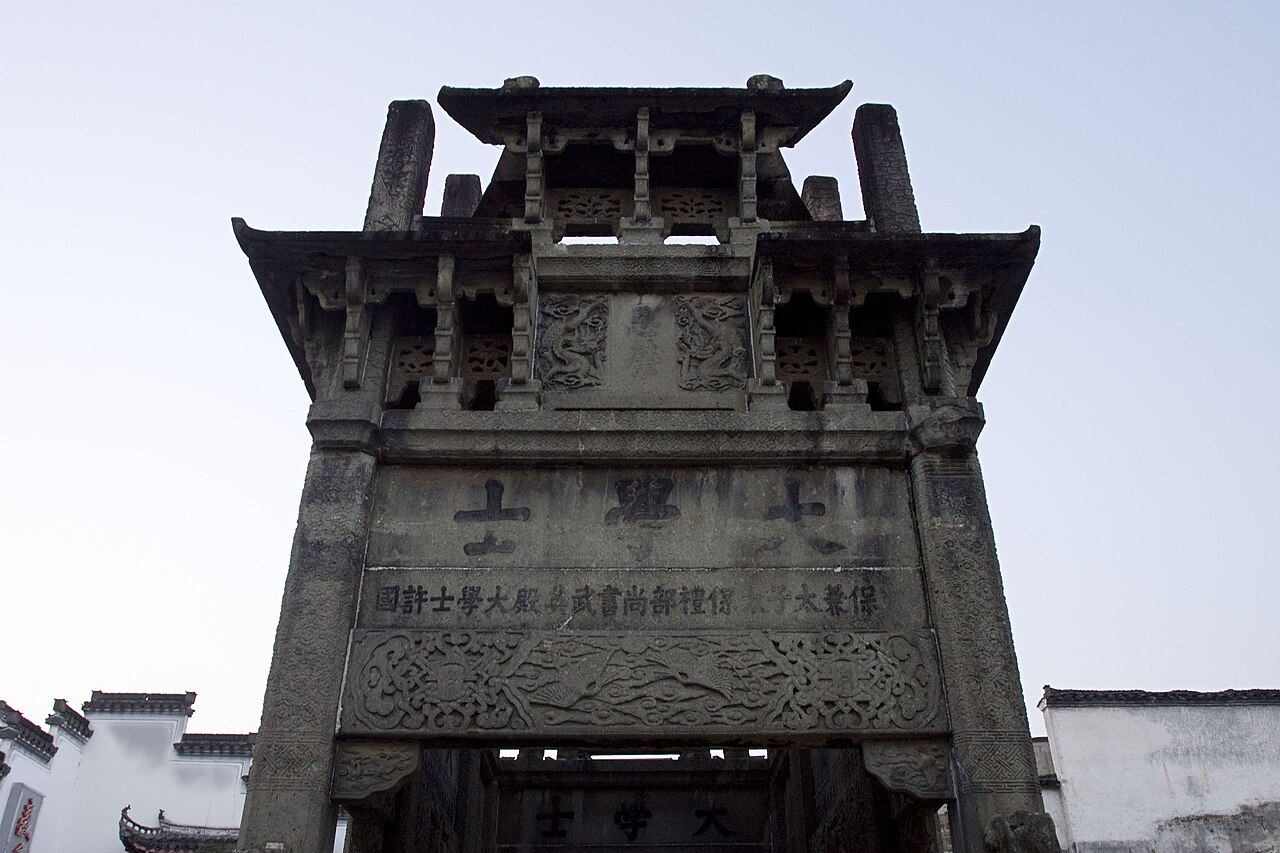
Start at the Xuguo Stone Arch
The arch was built in 1584, in the Wanli reign, for Xu Guo, a Shexian man who rose to be a grand secretary at the Ming court. Most Chinese memorial arches are flat screens across a road. This one has eight legs: two three-bay arches front and back, joined by two single-bay arches at the sides, enclosing a square of street. Chinese Wikipedia gives its size as 11.54 by 6.77 metres and 11.4 metres high. It is built of a hard local blue-grey stone, some blocks weighing four to five tonnes.
Every beam is carved. Twelve stone lions sit on the bases. The carvings work as visual puns on Xu Guo's career: on one inner face, dancing eagles, wuying in Chinese, play on his title as grand secretary of the Wuying Hall, and leopards and magpies stand for his three promotions. The calligraphy is attributed to the Ming painter Dong Qichang. The arch has been a national protected monument since 1988.
Come early. The crossroads is quiet before tour groups arrive, and the morning light shows the carving well. You can see it at any hour for free; recent combo tickets include an exhibition inside the enclosure.
Doushan Street
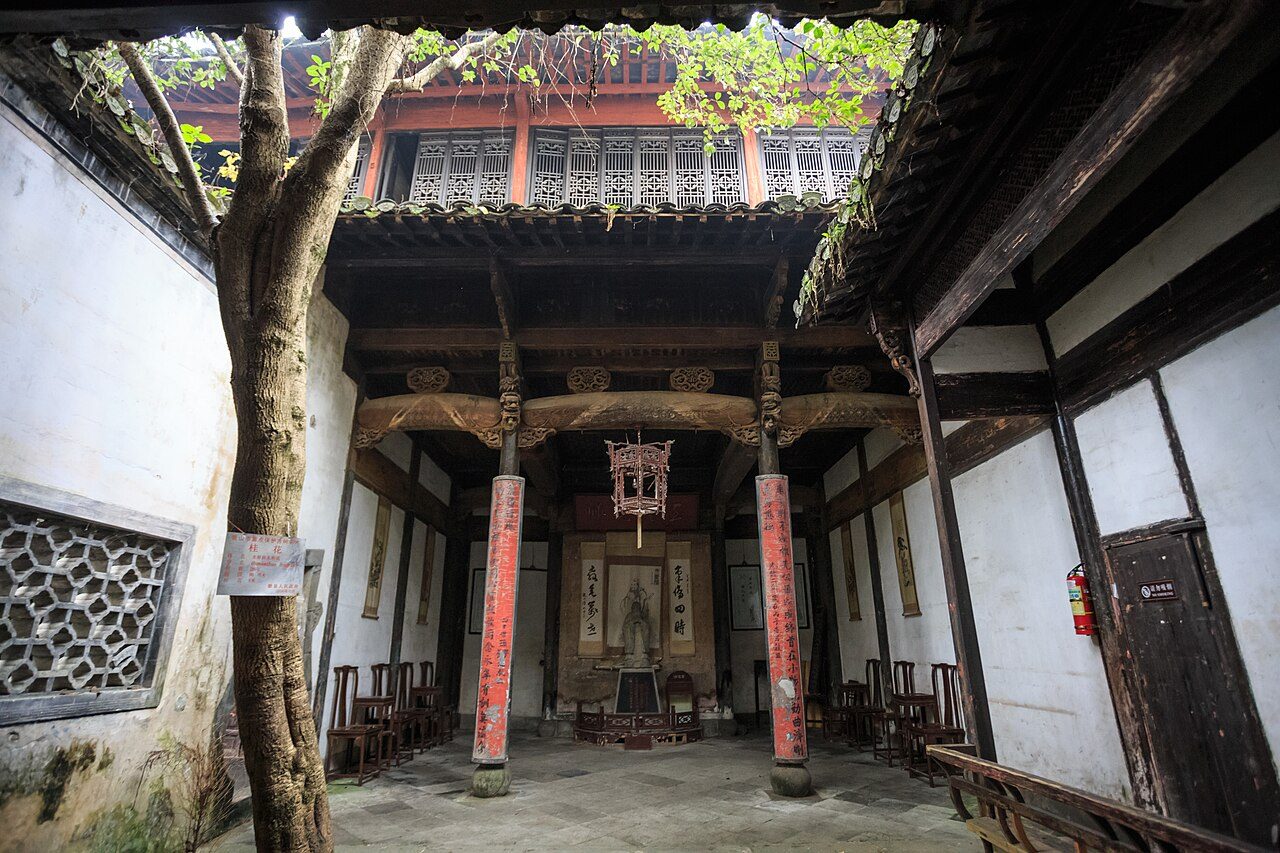
A few minutes' walk away, Doushan Street is a flagstone lane a few hundred metres long, lined with the high side walls and gateways of Qing merchant and official families. Horse-head gables rise above the lane, and most of it is quiet. Several houses are protected at county or city level, including the Yang and Xu family halls, and an old well on the street is said to date from the Tang. Step inside the open halls to see the carved wood behind the plain white walls, the same contrast you find in the villages.
The Yamen, the walls and the museum
The Huizhou government office, or Yamen, is a reconstruction of the prefectural headquarters, with gates, courtrooms and red walls, and recent visitor notes mention staged courtroom performances. It is the most touristy stop in town. Skip it if you are short of time, or go for the performance if you are travelling with children. Sections of the old wall and gate towers also survive. The free Huizhou Museum is a useful first stop for background if you arrive with no knowledge of the region.
Yuliang Dam at the end of the day
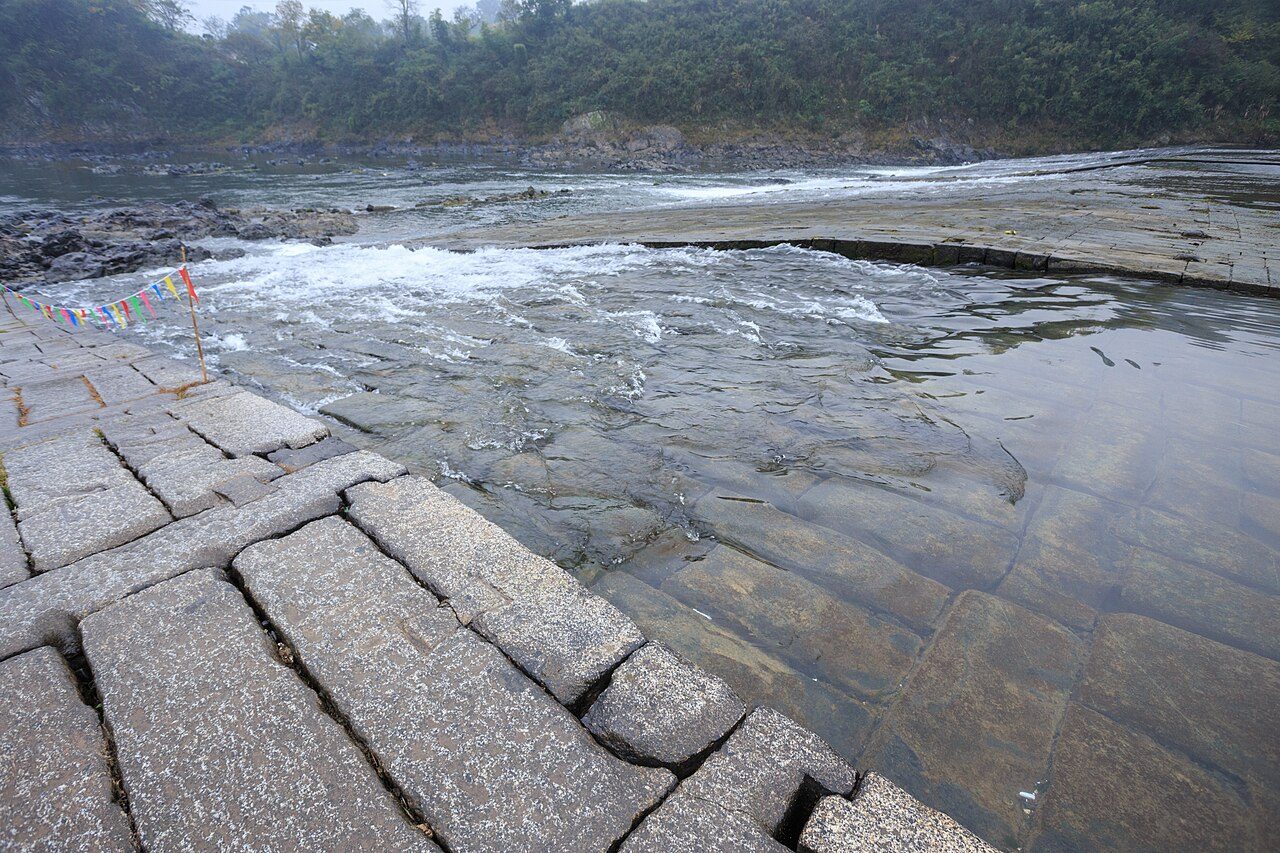
About a kilometre south of the town, Yuliang Dam crosses the Lian River, a tributary of the Xin'an. It began in the Tang and was rebuilt in 1605. The dam is about 140 metres long, 27 metres wide at the base and four metres across the top, built of stone blocks over a tonne each, locked together with stone ties. It held water upstream and made the river navigable below. The village of Yuliang beside it was the main departure wharf for Huizhou merchants heading down the Xin'an toward Zhejiang and Jiangsu.
Walk along the pebble-paved Yuliang Street on the bank, then down to the Ming-era Ziyang Bridge, built high so masted boats could pass under it. The dam is a national protected site and is at its best at sunset, when water pours over the stone in the low light.
Tickets and hours
- Free: the main streets and the exterior of the Xuguo Arch.
- Combo ticket: visitor notes from 2026 describe a ticket covering about six sites, including the Yamen, the Xuguo Arch enclosure, Doushan Street and Yuliang Dam, at around 95 to 100 yuan with small online discounts.
- Single tickets: about 48 yuan for the Yamen and 30 yuan for Yuliang Dam in the same notes.
- Hours: paid sites usually about 08:00 to 17:00.
The combo is worth it only if you plan to enter at least three paid sites. Prices and inclusions change, so check the official account or the visitor centre on the day.
Getting there
- From Tunxi: forty minutes to an hour by taxi, or take an intercity bus to Shexian and a local bus to the old town.
- By high-speed train: Shexian North station, then local bus 6002 or a short taxi ride. Shexian North and Huangshan North are different stations, so check your ticket.
- With a car: add the arch cluster at Tangyue village, a few kilometres west.
A half-day plan
- Morning: the Xuguo Arch at the quiet crossroads.
- Doushan Street and its open halls.
- The Huizhou Museum or the Yamen, as you prefer.
- Late afternoon: walk or take a taxi to Yuliang Dam for the light.
- Evening: back to Tunxi for a Hui cuisine dinner on the old street.
With a full day, add Tangyue's arches and the museum.
Things to confirm before you go
- The current combo price and what it includes.
- Opening hours for the Yamen and Yuliang Dam.
- Which station your train uses, Shexian North or Huangshan North.
- Return transport to Tunxi in the evening.
Frequently asked questions
Is the Huizhou Ancient City free?
The streets and the outside of the Xuguo Arch are free. The Yamen, Yuliang Dam and some houses charge, separately or on a combo ticket.
How far is it from Tunxi?
About twenty-five kilometres, forty minutes to an hour by road.
What makes the Xuguo Arch special?
It has eight legs and encloses a square, where most Chinese memorial arches are single screens. It dates from 1584.
Can I combine it with Tunxi Old Street?
Yes. Shexian by day and Tunxi Old Street in the evening is the usual pairing.
Sources
Facts in this article were checked against the following sources, retrieved 6 October 2026.
- 许国石坊, Chinese Wikipedia
- 渔梁坝, Chinese Wikipedia
- 斗山街, Chinese Wikipedia
- She County, Anhui, English Wikipedia
- Huizhou Ancient City, Travel China Guide
Photos are from Wikimedia Commons under the licences shown in each caption.