Nanxun Ancient Town
Nanxun is a canal town in the east of Huzhou, close to the Jiangsu border and Lake Tai. Of the big Jiangnan water towns it is the one where the money shows most. Its silk merchants were among the richest people in late Qing China, and they spent their fortunes on mansions, gardens, ancestral temples and one of the largest private libraries the country has known. The streets are free to walk, the canals are quieter than Wuzhen's, and since a new high speed station opened in December 2024 it is an easy trip from Shanghai.
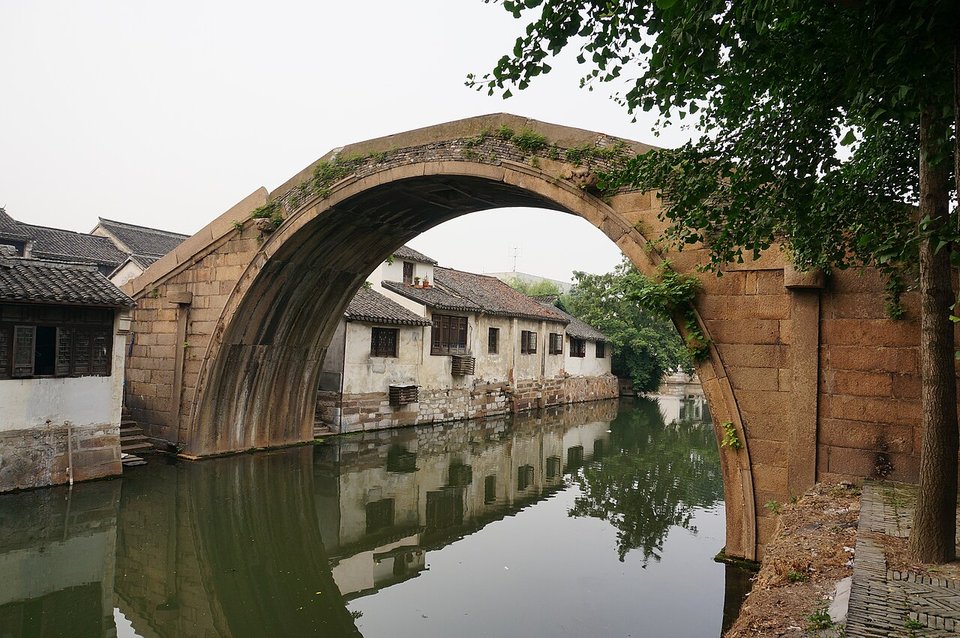
How silk made Nanxun
The town took its name in the Southern Song. Chinese Wikipedia dates the formal founding of the town to 1252, when the names of two older settlements, Nanlin and Xunxi, were combined. Mulberry farming and home silk reeling grew through the Ming, and villagers at nearby Qili improved the reeling methods until Qili silk, known in trade as Tsatlee, became a byword for quality.
The boom came after 1842, when Shanghai opened to foreign trade. Nanxun's merchants took their silk to the new port and sold it to foreign buyers. Chinese Wikipedia cites figures showing that in 1847 Nanxun silk made up 13,426 of the 21,176 bales exported through Shanghai, a share of about 63 percent. Local people ranked the richest families with a saying about four elephants, eight bulls and seventy two golden dogs, the elephants being the very largest fortunes. Another saying held that the whole city of Huzhou was worth less than half of Nanxun.
The town is laid out like a cross, where the Shi River running north to south meets the old canal running east to west. English Wikipedia counts about 4.5 kilometres of waterways, 3 kilometres of stone streets and 15 old bridges from the Song to the Qing.
Little Lotus Manor
Liu Yong (1826 to 1899) headed the four elephants, and his family garden is the town's showpiece. Little Lotus Manor, also called the Liu Garden, was begun in 1885 and finished by his grandson Liu Chenggan in 1924, forty years later. It combines a garden, a family temple and a charitable estate on about 27 mu, and it is named after the Lotus Manor of the Yuan painter Zhao Mengfu in Huzhou.
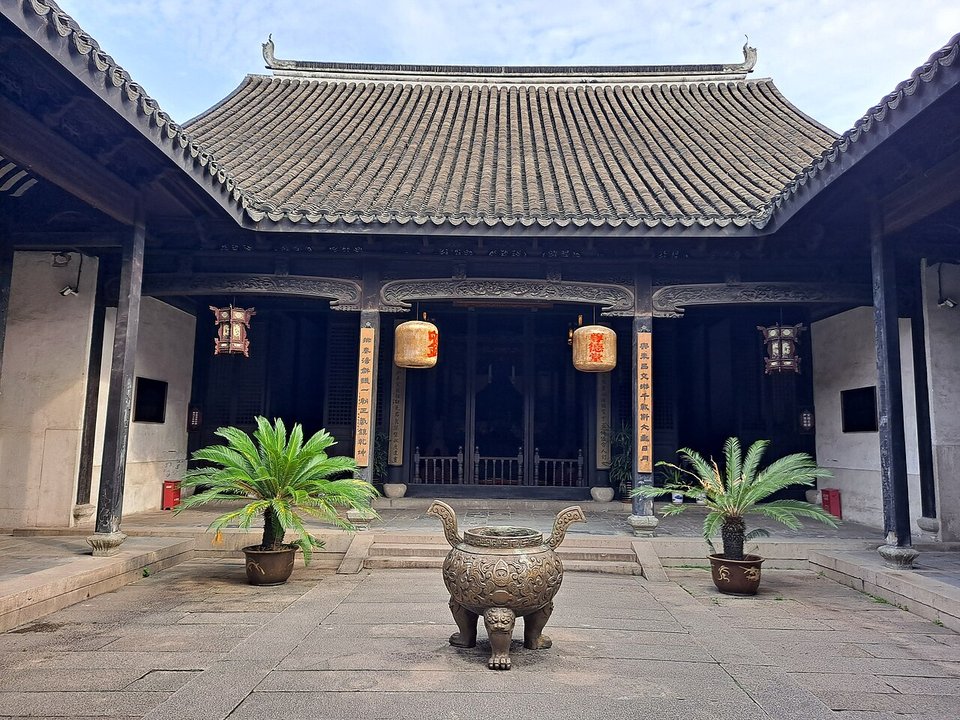
The outer garden is built around a lotus pond of about ten mu, at its best from early summer. On its edge stands the Dongsheng Pavilion of the 1920s, a mix of French and Chinese design that people called the young ladies' tower because the women of the family liked to gather there. Along the pond a corridor of carved steles includes calligraphy in every script. The Jingxiang poetry hall of 1897 has two unusual coffered ceilings, one shaped like a grain measure and one like its larger cousin, which Chinese Wikipedia says may be unique.
The Jiaye Hall library
Right beside the garden, across a stream, is the Jiaye Hall library, built by Liu Chenggan between 1920 and 1924. It takes its name from a gold plaque given by the last emperor Puyi. At its peak, from 1925 to 1932, it was said to hold 600,000 juan in about 160,000 volumes, and Liu also printed books from carved woodblocks. He gave it to the state in 1951 and it became part of the Zhejiang Library.
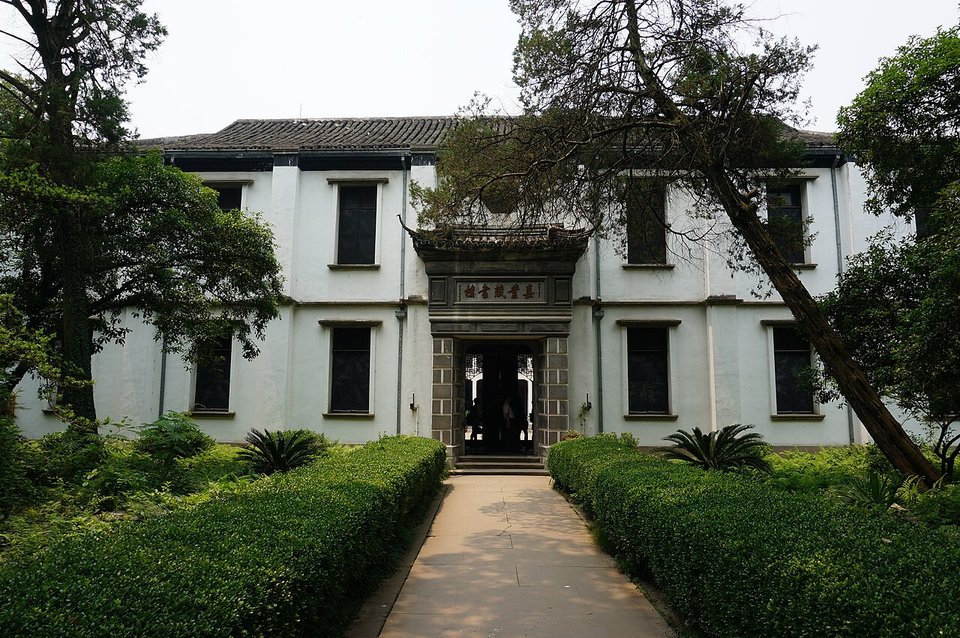
The building is a two storey square around a stone paved courtyard, 52 rooms in all. The courtyard paving was meant for spreading books out to dry in summer. A lotus pond and rockery garden lie to the south.
Mansions and Baijian Lou
Zhang Shiming's residence, the Yide Tang, is the grandest house in town, with Chinese halls in front and Western rooms behind, including a ballroom with coloured glass. The Liu family's Tihao, called the Red House, is a red brick villa in European style. The former home of Zhang Jingjiang, the revolutionary financier who became a senior figure in the Nationalist party, is a traditional Qing mansion. North of the centre, Baijian Lou is a row of Ming era houses along the water, about 400 metres long and still lived in, at its best in the early morning and at dusk.
Tickets and hours
The streets and canals of the old town are free. The main sights are covered by one combined ticket. Recent listings give the gate price as 100 yuan and online prices of about 75 to 85 yuan, and say the ticket covers Little Lotus Manor, the Jiaye Hall library, Zhang Shiming's residence, the Liu family Red House and Zhang Jingjiang's former residence. One 2026 listing says the Yiyuan garden left the combined ticket in February 2026 and is now sold separately for 10 yuan. Treat these as guides and check the day's notice.
Huzhou Bendibao lists the paid sights as open 8:00 to 17:30 from 1 April to 31 October and 8:00 to 16:30 from 1 November to 31 March. Children up to 1.2 metres or age 6 and people aged 70 and over enter free with ID, and students and people aged 60 to 69 get a discount.
Getting there
Huzhou Nanxun station on the high speed line from Shanghai opened in December 2024, about 6 kilometres from the old town, and the fastest trains take around 43 minutes from Shanghai Hongqiao. Take a taxi or bus from the station. Long distance buses also run to Nanxun from Shanghai, Hangzhou and Suzhou.
Pairing it
Nanxun works well as a night stop. Combine it with Moganshan for hills and bamboo, or compare it with Wuzhen, a short drive away across the border in Jiaxing prefecture.
Frequently asked questions
Is Nanxun free?
The streets are. The gardens, library and mansions need the combined ticket.
Nanxun or Wuzhen?
Nanxun for quieter streets and merchant mansions, Wuzhen for a polished night scene.
How long should I spend?
A full day for the paid sights and Baijian Lou, better with one night.
Sources
Facts in this article were checked against the following sources, retrieved 22 October 2026.
- 南浔镇, Chinese Wikipedia
- 小莲庄, Chinese Wikipedia
- 嘉业堂藏书楼, Chinese Wikipedia
- Nanxun District, English Wikipedia
- Huzhou Bendibao, Nanxun ancient town listing
- Qunar, Nanxun travel notes, July 2026
- Greentour Asia, Nanxun ancient town notes
- Huzhou travel guide on this site
Photos are from Wikimedia Commons under the licences shown in each caption.