Jiayuguan Travel Guide: The Fortress at the End of the Ming Great Wall
Jiayuguan exists because of two things: a Ming fortress and a steel mill. The fortress, Jiayu Pass, was built from 1372 at the narrowest point of the Hexi Corridor in Gansu, between the Qilian Mountains and the Black Mountains, and marked the western end of the Ming Great Wall; beyond it lay the desert road to Central Asia. The modern city grew up around the Jiuquan Iron and Steel works and became a city in 1965. One full day covers the fort and a nearby section of wall; add a second for the tomb paintings or a glacier.
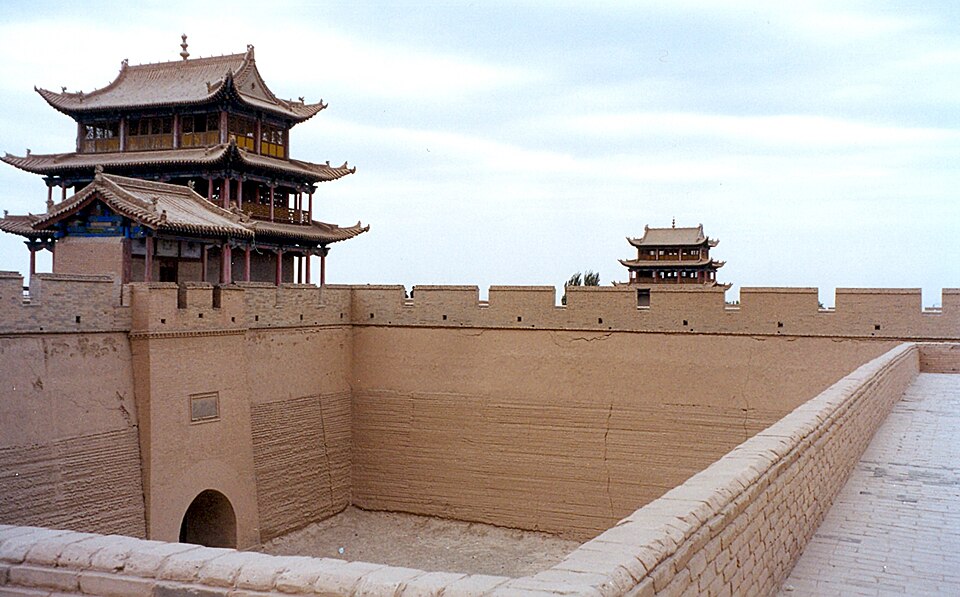
Jiayu Pass fort
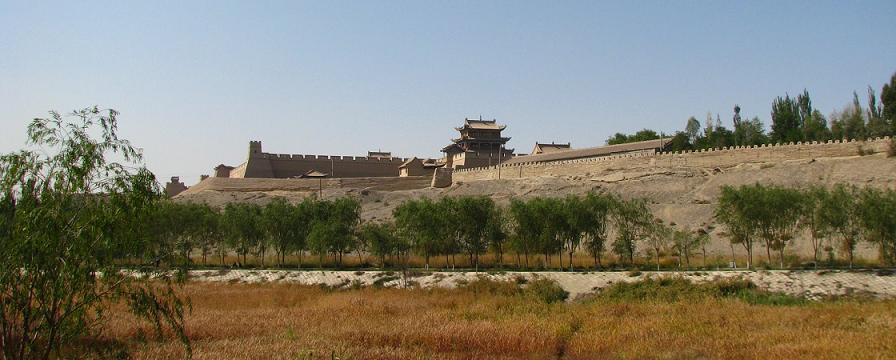
The fort sits about 6 km southwest of the city. Its inner walls form a trapezoid 733 metres around and 11 metres high, with gate towers east and west, corner turrets and ramps up to the walls. Around the inner fort runs an outer wall and a moat, and the Great Wall itself ran north and south from the fort across the plain.
Going in, start at the museum near the entrance for the story of the frontier, then walk through the outer gate into the inner fort, climb onto the walls and walk the circuit. From the west gate, travellers and exiles once left China proper, and the British missionary Mildred Cable described passing through in 1923. A popular legend is the "spare brick" above one gate: the builder supposedly calculated the number of bricks needed so precisely that only one was left over.
Allow two to three hours. Go early in the morning or late afternoon for softer light; at midday the sun on the open courtyards is fierce. Check current opening times and ticket arrangements on the official notice.
Overhanging Great Wall or First Beacon?
Overhanging Great Wall, about 8 km north of the fort, is a restored section of rammed-earth wall climbing steeply up a ridge of the Black Mountains. The climb is short but steep, with wide views over the desert and the fort.
First Beacon Tower, about 7 km south of the fort, is the first watchtower of the Ming wall, perched on the cliff edge above the Taolai River gorge. A suspension bridge and viewing platforms overlook the canyon.
Both take one to two hours including transfers. Choose the Overhanging Wall for a climb and panorama, the First Beacon for the canyon setting. Most people do one of them in the afternoon after the fort.
Further afield
- Wei-Jin tombs (Xincheng): about 20 km east of the city, these 3rd–4th-century tombs have painted bricks showing everyday life: farming, herding, feasting and a mounted courier, an image later used on a Chinese stamp. Only one or two tombs are usually open.
- July 1st Glacier: high in the Qilian Mountains, a few hours' drive southwest, one of the more accessible glaciers in China. The walk is at high altitude, and the road can close in bad weather; it's best arranged with a driver in summer.
- Jiuquan: the neighbouring city, about 20 km east, has its own old drum tower and the Jiuquan spring park.
When to come to Jiayuguan
May to October is the season. Summer days are hot and the sun is strong, but evenings are cool. Spring and autumn are comfortable, and autumn colours the poplars gold. Winter is cold and windy but dry; the fort is quiet. Dust storms can come in spring. Bring sunscreen, a hat and water.
Getting in and where to stay
Jiayuguan South is on the Lanzhou–Xinjiang high-speed line, with trains from Lanzhou and Zhangye; conventional trains stop at Jiayuguan station. Jiayuguan Jiuquan Airport has domestic flights. Taxis reach the fort easily; for the wall sections and tombs, hire a taxi or car for a half day.
Stay downtown for restaurants. One night is usually enough before moving on to Dunhuang.
Eating in Jiayuguan
Hexi Corridor food: hand-pulled noodles, lamb skewers and stews, and big plates of stir-fried noodles. Jiayuguan's night markets serve grilled meats. Choices are simpler than in Lanzhou, but portions are generous. Carry water on the walls.
How to arrange the route
Day 1: Jiayu Pass fort in the morning; Overhanging Great Wall or First Beacon in the late afternoon.
Day 2 (optional): Wei-Jin tombs and Jiuquan, or the July 1st Glacier in summer; train on to Dunhuang.
What to cut if short on time
With half a day, do the fort only. With a full day, the fort and one wall section.
Things to confirm before you go
- Opening times and tickets for Jiayu Pass, the wall sections and the Wei-Jin tombs; no 2026 prices are quoted here.
- Road and weather conditions for the July 1st Glacier.
- Train times and station names (Jiayuguan vs Jiayuguan South).
Frequently asked questions
How long do I need at Jiayu Pass?
Two to three hours for the fort; a full day with one wall section.
Is Jiayuguan worth a stop between Zhangye and Dunhuang?
Yes, if you're interested in the Great Wall; the fort is one of the best preserved on the Silk Road.
What's the difference between the Overhanging Great Wall and the First Beacon?
The Overhanging Wall is a climb up a ridge; the First Beacon is a watchtower on a canyon edge.
Sources
The facts in this article were checked against the following Wikipedia and encyclopedia entries, retrieved September 18, 2026, and rechecked on October 17, 2026.
- Jiayuguan City https://en.wikipedia.org/wiki/Jiayuguan_City
- Jiayu Pass https://en.wikipedia.org/wiki/Jiayu_Pass
- Jiayuguan (Chinese) https://zh.wikipedia.org/wiki/嘉峪关市
- Jiayu Pass (Chinese) https://zh.wikipedia.org/wiki/嘉峪关
Fort tickets change; this article does not invent yuan amounts.
All photos are from Wikimedia Commons, used under CC licenses; re-use requires attribution.
- jiayuguan-fort.jpg from File:JiayuguanFort.jpg, by User:Doron, CC BY-SA 3.0
- jiayuguan-fort-2.jpg from File:Jiayuguan Fort.JPG, by Aine Hickey / Pinkfluffybrick, CC BY 3.0
- jiayuguan-shrine.jpg from File:Jiayuguan-ShrineInsideFort.jpg, by ArishG, CC BY-SA 3.0