Shuanglin Temple: Pingyao's Painted Clay Sculptures
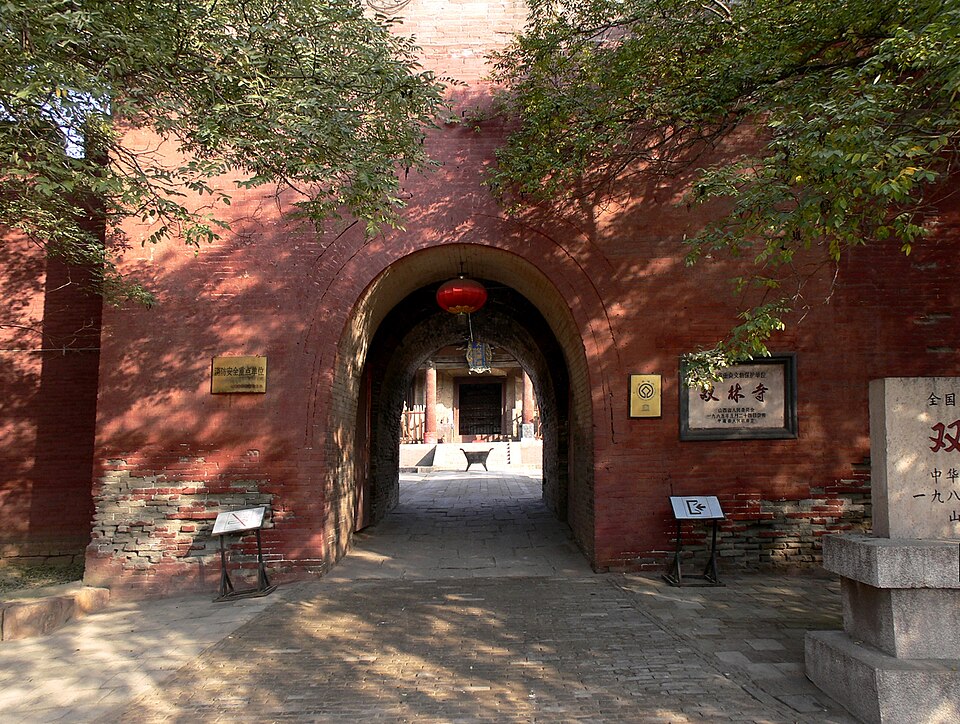
Shuanglin Temple stands in the fields at Qiaotou village, about six kilometres southwest of Pingyao Ancient City. From outside it looks like a small fort, with a rammed-earth wall and battlements around three courtyards. Inside, ten halls hold one of the largest surviving collections of painted clay sculpture in China, about 2,052 figures by Chinese Wikipedia's count, most of them from the Ming. With the walled town and Zhenguo Temple, it forms the Ancient City of Ping Yao World Heritage site inscribed in 1997. For anyone interested in Chinese sculpture it is the strongest half-day in Jinzhong.
History
The temple's first name was Zhongdu Temple, and its founding date is not recorded. A stele of 1011 in the temple says Zhongdu Temple was rebuilt in 571, the second year of the Wuping reign of the Northern Qi, which is why many sources give 571. In the Song it was renamed Shuanglin, twin groves, after the pair of sal trees under which the Buddha is said to have entered nirvana. The buildings and most of the sculpture were renewed in the Ming and Qing.
The complex covers about 15,000 square metres and faces south. The temple courtyards lie on the west, with a meditation compound on the east. The earth wall around it dates from the Ming.
Why the sculptures are special
Chinese Wikipedia counts 2,052 figures, of which 1,566 are intact; English Wikipedia gives 1,650 surviving. They range from about 30 centimetres to 3.5 metres and include Buddhas, bodhisattvas, arhats, guardian kings and ordinary people, set in high relief, in the round and on modelled cloud and wave backgrounds that make some halls feel like caves. They were made of a sticky local red clay, sealed, whitened and painted with mineral colours, and many have glass eyes. Several were stolen or damaged during the Cultural Revolution, and many now stand behind grilles.
Hall by hall
The Hall of the Heavenly Kings comes first. Four guardian figures about three metres tall stand under its front eaves, and inside a crowned Maitreya about 2.2 metres high sits between Indra and Brahma.
The Sakyamuni Hall behind it has a seated Buddha about five metres tall with Manjusri and Samantabhadra. Around the walls, 48 relief scenes from the life of the Buddha fill three tiers, with more than two hundred small figures between 20 and 40 centimetres high. Behind the main image is a Guanyin about 3.4 metres tall standing on a single leaf over the waves, surrounded by arhats.
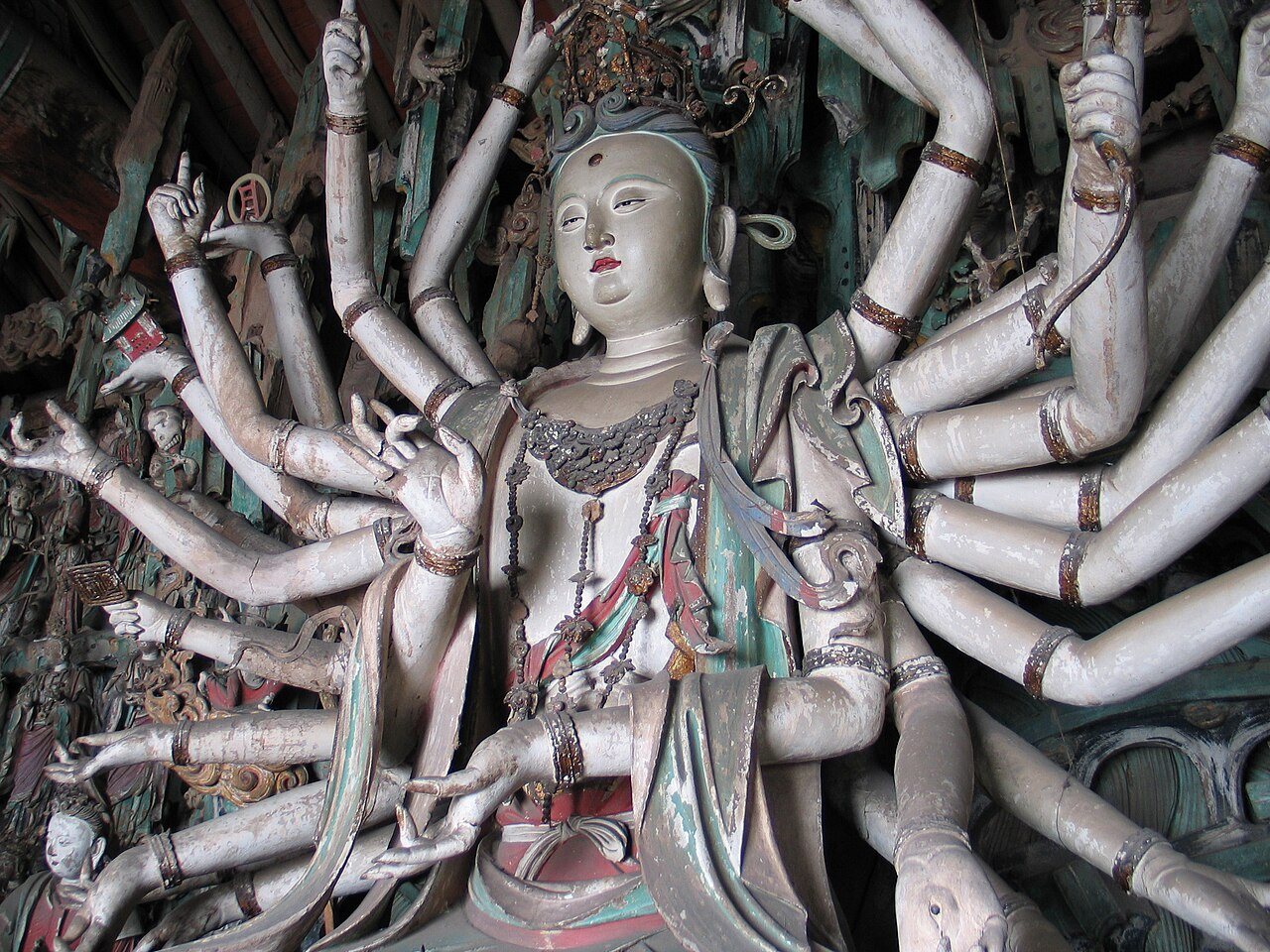
Two facing side halls are the reason most specialists come. The Thousand Buddha Hall has about five hundred small bodhisattvas modelled on its walls in five or six tiers, each between 69 and 82 centimetres high, riding clouds or beasts, and a figure of the guardian Weituo that English Wikipedia describes as a masterpiece of Ming sculpture. Facing it, the Bodhisattva Hall is built around a 26-armed Guanyin 3.45 metres tall, with more than four hundred bodhisattvas modelled around the walls. The outer corridors of both halls keep some Ming murals painted in 1461, showing the pilgrim Sudhana's visits to his spiritual teachers.
The Mahavira Hall, the largest building, was rebuilt early in the Ming and holds the three bodies of the Buddha. The Arhat Hall has eighteen arhats with individual faces. A hall to the goddess Niangniang closes the main axis, and smaller side halls are dedicated to Ksitigarbha, the Earth God and the temple's guardian.
Tickets and hours
Shuanglin is not on the Pingyao through ticket. Local listings in 2026 give 35 yuan full price and 15 yuan half price; some booking sites show a slightly lower figure, so check at purchase. Hours reported for 2026 are 08:00 to 18:30 from May to December and 08:00 to 18:00 from January to April, with entry ending about 15 minutes before closing. Visitors aged 60 and over have been admitted free with ID, as at the town's sites.
Getting there
The temple is a short drive from the town walls. Most visitors take a taxi or a car arranged by their guesthouse and ask the driver to wait or come back, because Qiaotou is a village and you should not count on finding a ride there. Zhenguo Temple, about ten kilometres from Pingyao, has a main hall built in 963 under the Northern Han, one of the oldest timber buildings in China, and the two temples make a full sculpture and architecture day by car.
How long and when
Allow one and a half to two hours, longer if you want to look closely at the Thousand Buddha and Bodhisattva halls. The halls are dim, so a small torch helps where it is allowed. The temple is usually far quieter than the walled town.
Things to confirm before you go
- The ticket price and season hours on the day.
- A return car from Qiaotou village.
- Photo rules inside the halls, which can change.
Frequently asked questions
Is Shuanglin Temple included in the Pingyao ticket?
No. It has its own ticket, listed at about 35 yuan.
How far is Shuanglin Temple from Pingyao?
About six kilometres southwest of the walls, a short taxi ride.
Is it worth it if I am not into temples?
It is a sculpture museum more than a working temple. If painted figures do not interest you, use the time for the Qiao Family Compound or more of the town.
Can I combine it with Zhenguo Temple?
Yes, by taxi or hired car, in a half-day to a full day.
Sources
Facts in this article were checked against the following sources, retrieved 7 October 2026.
- Shuanglin Temple, English Wikipedia
- 双林寺 (平遥), Chinese Wikipedia
- Zhenguo Temple, English Wikipedia
- Pingyao through ticket, Shuanglin and Zhenguo prices, Taiyuan Bendibao
- UNESCO World Heritage Centre, Ancient City of Ping Yao
Photos are from Wikimedia Commons under the licences shown in each caption.