Pingyao Ancient City: Wall, Market Tower and the Through Ticket
Pingyao is a walled county town in central Shanxi, about 100 kilometres south of Taiyuan, on the east bank of the Fen River. It belongs to Pingyao County in the prefecture of Jinzhong. What makes it rare is how much survives in place. The Ming wall still runs the full circuit, the street plan is intact, and Chinese Wikipedia counts 3,798 old dwellings and 1,075 registered heritage sites in and around the town. More than 20,000 people still live inside the walls. UNESCO inscribed the town together with Shuanglin and Zhenguo temples outside it in 1997.
How the town came to look like this
There was a walled settlement here by the reign of King Xuan of Zhou in the ninth century BCE, and the name Pingyao dates from 424 under the Northern Wei. The wall you see was rebuilt on a much larger scale in 1370, the third year of the Ming Hongwu reign, and patched dozens of times afterwards.
The town's wealth came later. From the early nineteenth century, Shanxi merchants based in Pingyao and the neighbouring counties ran a network of draft banks, the piaohao, that moved silver across the empire by letter instead of by armed escort. By the late Qing more than twenty of them had head offices inside these walls, and Chinese sources often call the town the Wall Street of old China. The first and best known, Rishengchang, has its own page on Rishengchang Exchange House. The banks failed after the 1911 revolution, and a common explanation for the town's survival is that it then had little money to rebuild. It was named a national historic city in 1986.
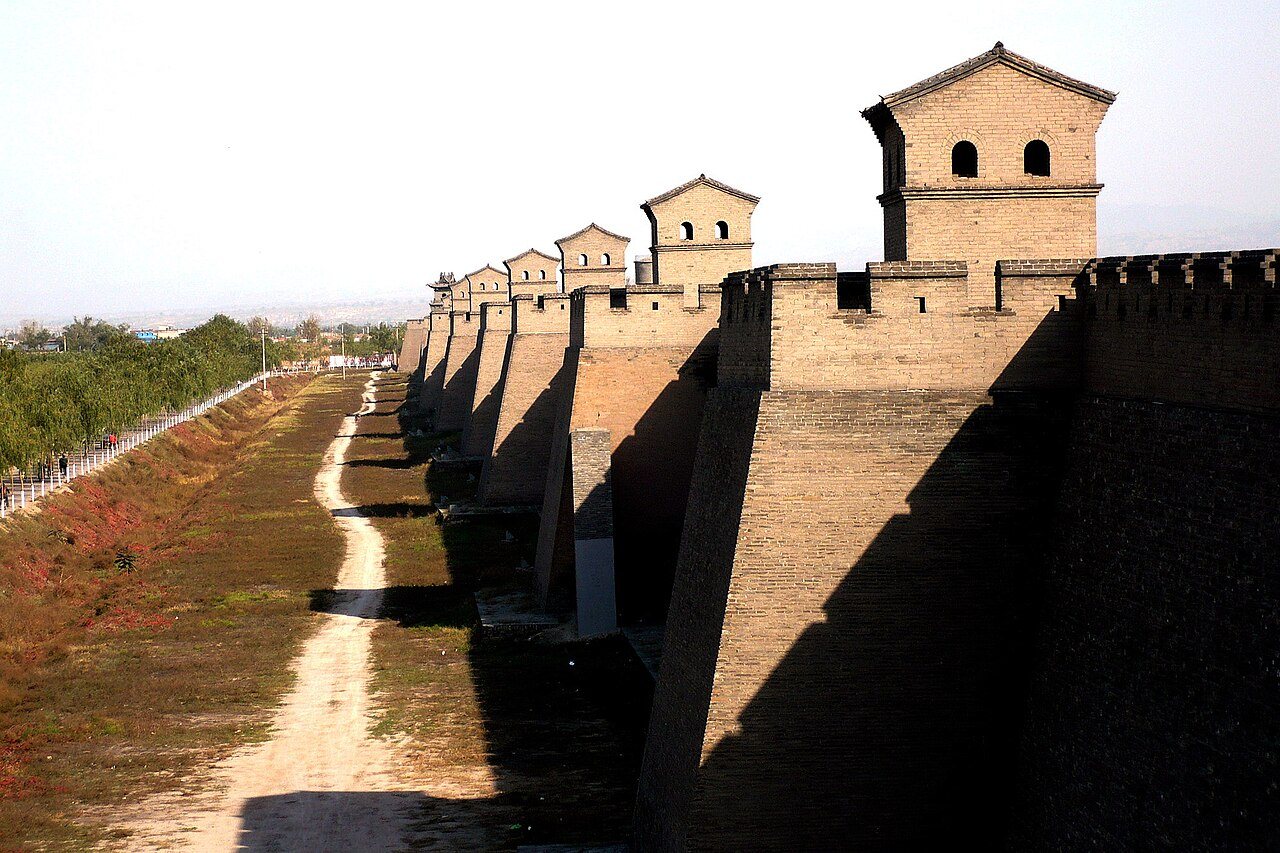
The wall
The wall is about 12 metres high. English Wikipedia gives the circuit as 6,163 metres; Chinese Wikipedia rounds it to 6.4 kilometres. It has six gates, one each in the north and south walls and two each in the east and west, every one with a barbican. Locals call Pingyao the Turtle City because the south and north gates are the head and tail and the four side gates the legs. There are four corner towers, 72 watchtowers and about 3,000 crenels, numbers traditionally matched to the 72 sages and 3,000 disciples of Confucius.
Part of the south wall collapsed in 2004 and was rebuilt in 2005; the rest is largely original Ming work with later repairs. The top is open on the through ticket. Walking a stretch near the South Gate, Yingxun Gate, gives the roofscape view of grey tiles and courtyards. A full circuit takes a few hours and is exposed in summer.
Streets, the Market Tower and the yamen
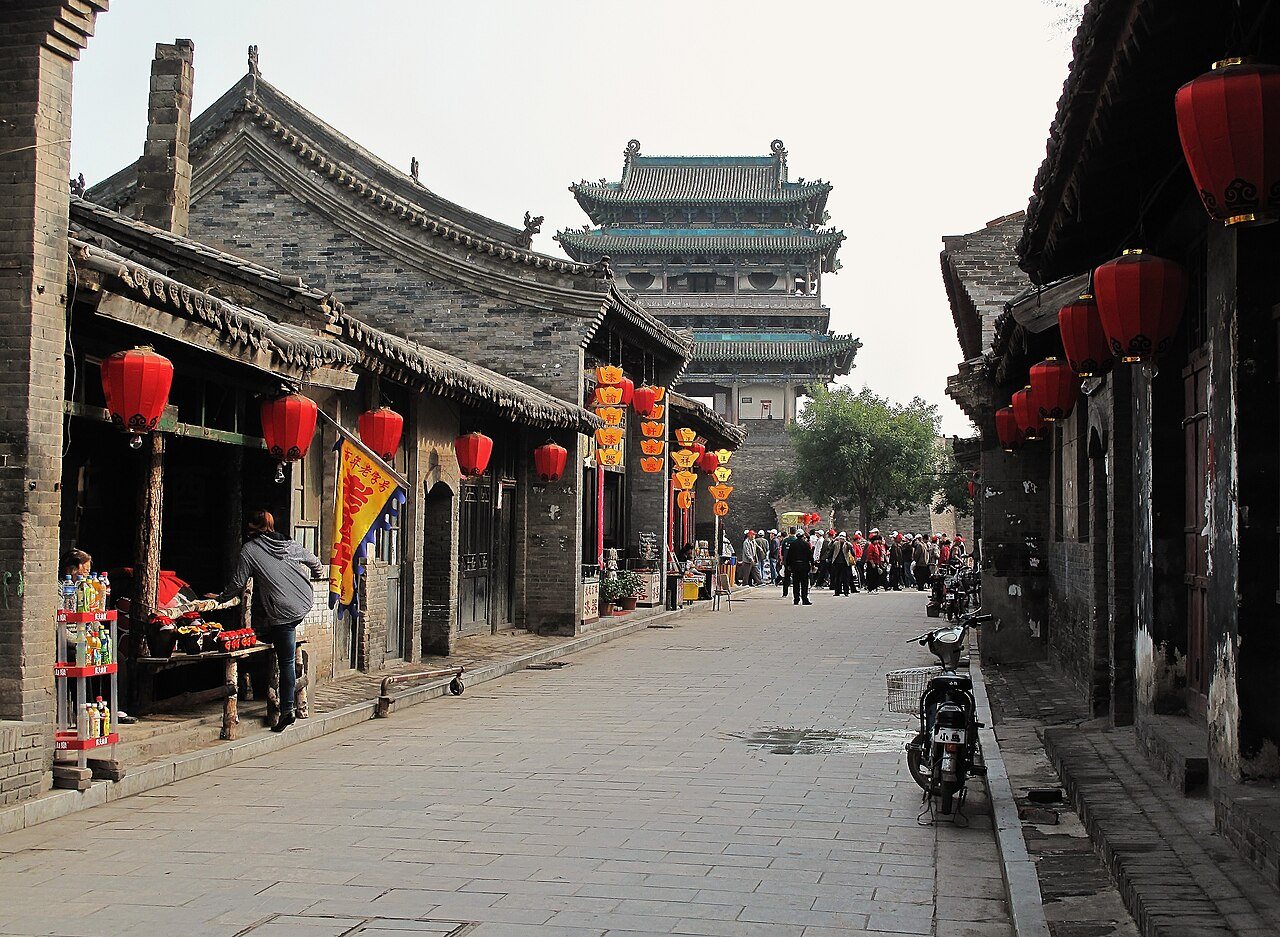
Chinese sources describe the plan as four main streets, eight small streets and seventy-two lanes, with South Street as the axis. The Market Tower straddles South Street in the middle of town. It is a three-eaved timber tower 18.5 metres high, rebuilt in 1688, with yellow and green glazed tiles; a well beside it, said to have golden water, gives it its other name, Golden Well Tower.
The layout is symmetrical in the Ming manner. The county yamen is on the west side and the City God Temple on the east. The Confucian Temple sits in the southeast corner; its Dacheng Hall was rebuilt in 1163, and Chinese Wikipedia describes it as the only Jin-dynasty building among the country's Confucian temples. The yamen stages re-enacted court hearings several times a day. West Street, by contrast, is the bankers' street, where Rishengchang and its neighbours stand.
Tickets and hours
Walking the streets is free. The 22 paid sites inside the town, including the wall, Rishengchang, the yamen and the Confucian Temple, are covered by one through ticket, listed in 2026 at 125 yuan full price and 65 yuan half price, and valid for three days. Local listings say visitors aged 60 and over enter free with ID. Shuanglin Temple and Zhenguo Temple outside the walls are ticketed separately. Buy through the scenic area's official site or WeChat account, pingyao888.cn, or a major platform.
The sites keep daytime hours. A spring 2026 notice set 08:00 to 18:00 with ticket checks stopping 15 minutes before closing, and summer hours have run to 18:30. The streets, shops and restaurants stay busy into the evening, which is when the lantern-lit town looks its best. An evening light show has been projected on the South Gate on some nights, and the immersive show Encore Pingyao runs outside the walls on its own ticket.
Getting there
High-speed trains stop at Pingyao Gucheng station, about ten kilometres from the walls; Bus 108 runs from the station square toward the gates, and a taxi takes about twenty minutes. The older Pingyao station on the conventional line is closer to town. Cars cannot drive inside the walls, so ask your guesthouse which gate to use.
How long and when
Plan two nights if you can. A first afternoon and evening on the streets and a stretch of wall, a full day for Rishengchang, the yamen, the Confucian Temple and the Market Tower, and a half-day for Shuanglin Temple or the Qiao Family Compound. Spring and autumn are best. Summer afternoons on the wall are hot, and the national holidays fill the town far beyond its capacity; English Wikipedia notes visitor numbers on Golden Week days reaching two and a half times the planned maximum. The Pingyao International Film Festival and Photography Festival bring their own crowds.
Things to confirm before you go
- Through-ticket hours for your dates and which sites are open.
- Whether your guesthouse is inside the walls and which gate is nearest.
- Evening show dates if you want to see one.
- Separate tickets and transport for Shuanglin and the merchant compounds.
Frequently asked questions
Do I need a ticket to enter Pingyao?
No. The streets are free. The wall, Rishengchang and the other 22 sites need the 125-yuan through ticket, valid for three days.
How long should I stay in Pingyao?
Two nights is comfortable. One night covers the main streets and wall but rushes the sites.
Can I walk the whole city wall?
The top is open on the through ticket, and a full circuit takes a few hours. Most people walk a stretch near the South Gate.
What should I eat?
Pingyao beef, wantuo noodles in bowls, and Shanxi noodles in general. The town is also known for polished tuiguang lacquerware.
Sources
Facts in this article were checked against the following sources, retrieved 7 October 2026.
- Pingyao, English Wikipedia
- 平遥古城, Chinese Wikipedia
- 平遥城墙, Chinese Wikipedia
- 平遥市楼 and 平遥文庙, Chinese Wikipedia
- Pingyao through ticket and hours, Taiyuan Bendibao
- UNESCO World Heritage Centre, Ancient City of Ping Yao
Photos are from Wikimedia Commons under the licences shown in each caption.