Zhongshan Bridge and the First Iron Crossing of the Yellow River
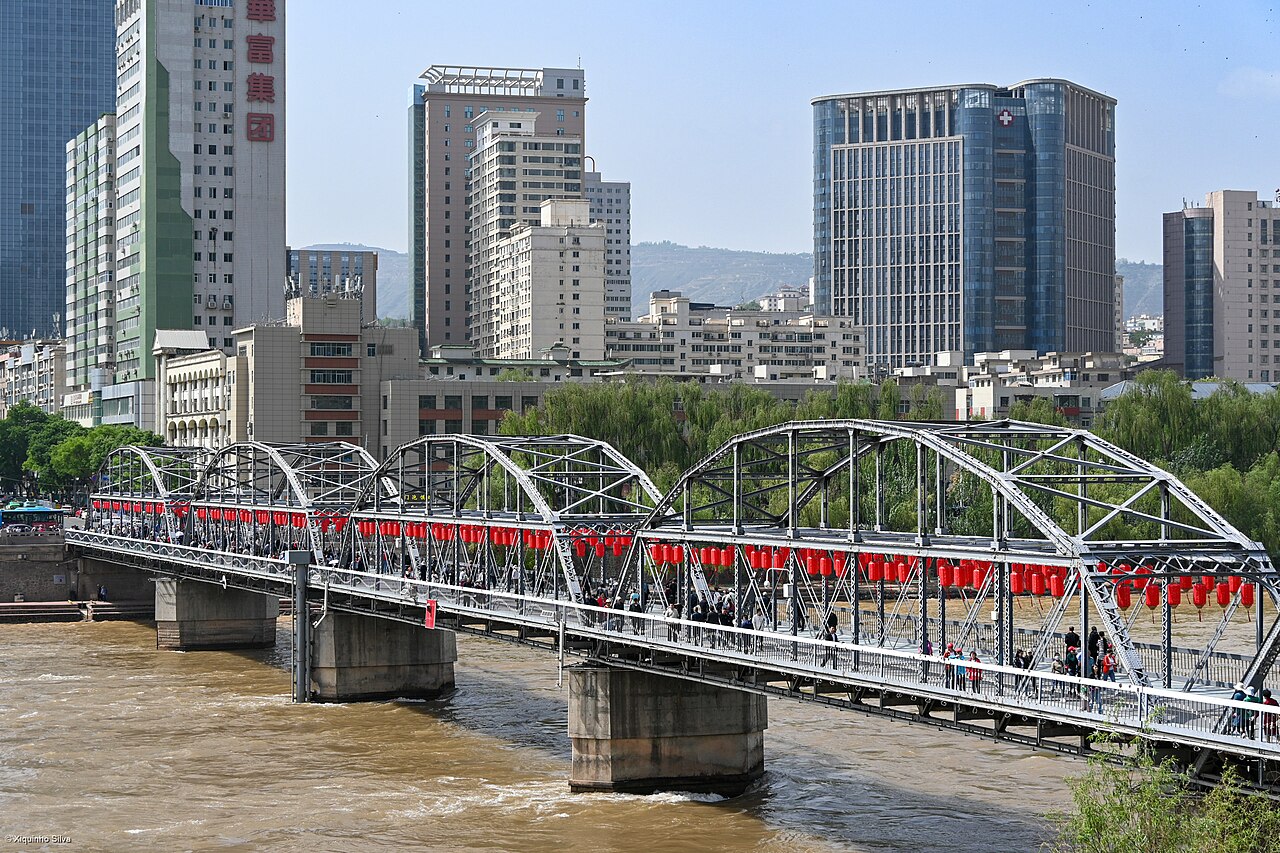
Zhongshan Bridge crosses the Yellow River in Chengguan District of Lanzhou, at the foot of White Pagoda Hill. It opened to traffic on 19 August 1909 and was the first permanent bridge the city ever had across the river, which is why its older name is simply the First Bridge. Local people also call it the Yellow River Iron Bridge. Cars were banned from it in 2013, so today it is a footbridge, free to walk at any hour, and the most photographed structure in the city.
Five centuries of boats before the bridge
The crossing point is older than the iron. Chinese Wikipedia, drawing on Ming records, says that in 1385 a Lanzhou garrison officer named Yang Lian moved a pontoon bridge to this spot below White Pagoda Hill, because the current ran a little slower here and the site was easier to defend. It was called the Zhenyuan floating bridge and was made of boats tied together with iron cables. Those cables were anchored to cast iron posts on each bank, later known as the general posts. One of them survives in a small pavilion at the southern end of the present bridge, a column 5.8 metres tall.
The pontoon bridge worked, but badly. Summer floods broke it and winter ice crushed it, so it had to be taken apart every winter and put back every spring. Records cited in the same article say it was wrecked twice in six years in the 1730s. Zuo Zongtang, the Qing governor-general, looked into an iron bridge in the 1860s and dropped the idea when a German merchant quoted 630,000 taels of silver. When floods broke the pontoons again in 1904, the case for something permanent became hard to ignore.
A German contract and a year of building
In October 1906 Gansu's foreign affairs bureau signed a contract with the Tianjin branch of the German firm Telge & Schroeter. The price was 165,000 taels for an 18-month job, and the firm guaranteed the bridge for eighty years. An American bridge company did the design. Steel, cement and machinery were shipped from Germany to Tianjin in 1907, carried by rail to Xinxiang in Henan, and then hauled by cart through Xi'an to Lanzhou. That overland haul took 21 months and moved about 2.28 million jin of material.
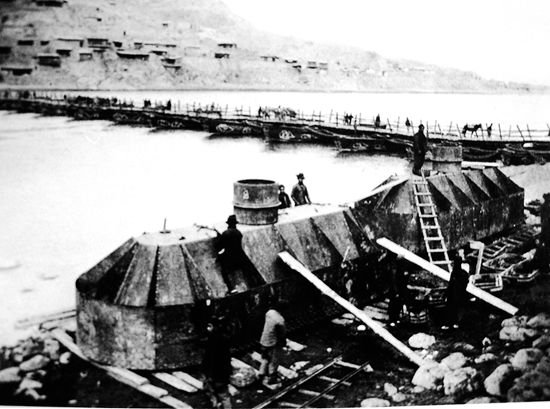
Work started on 9 May 1908. An American engineer and a German engineer ran the site with sixty-odd foreign and Chinese craftsmen, plus local smiths, carpenters, masons and more than a hundred labourers. The old pontoon bridge served as their walkway and supply line while the four piers went down to bedrock. The finished bridge had five spans of 45.9 metres, a total length of 233.5 metres and a design load of 8 tonnes, enough for horse carts. Once the shipping and extra costs were added in, the whole project came to just over 306,000 taels.
Why the bridge is grey
In 1928 the provincial governor Liu Yufen hung a plaque reading Zhongshan Bridge, after Sun Yat-sen, and the new name stuck. The colour came later. During the war with Japan, Lanzhou was a rear base and a transit point for aid, and Japanese aircraft raided the city repeatedly between 1937 and 1943. The bridge was a prime target, so its orange-red paint was covered with lead grey, and it has stayed grey ever since. On the night of 25 August 1949, during the battle for Lanzhou, a burning ammunition truck destroyed two wooden deck spans. Crews repaired it in eight days and nine nights.
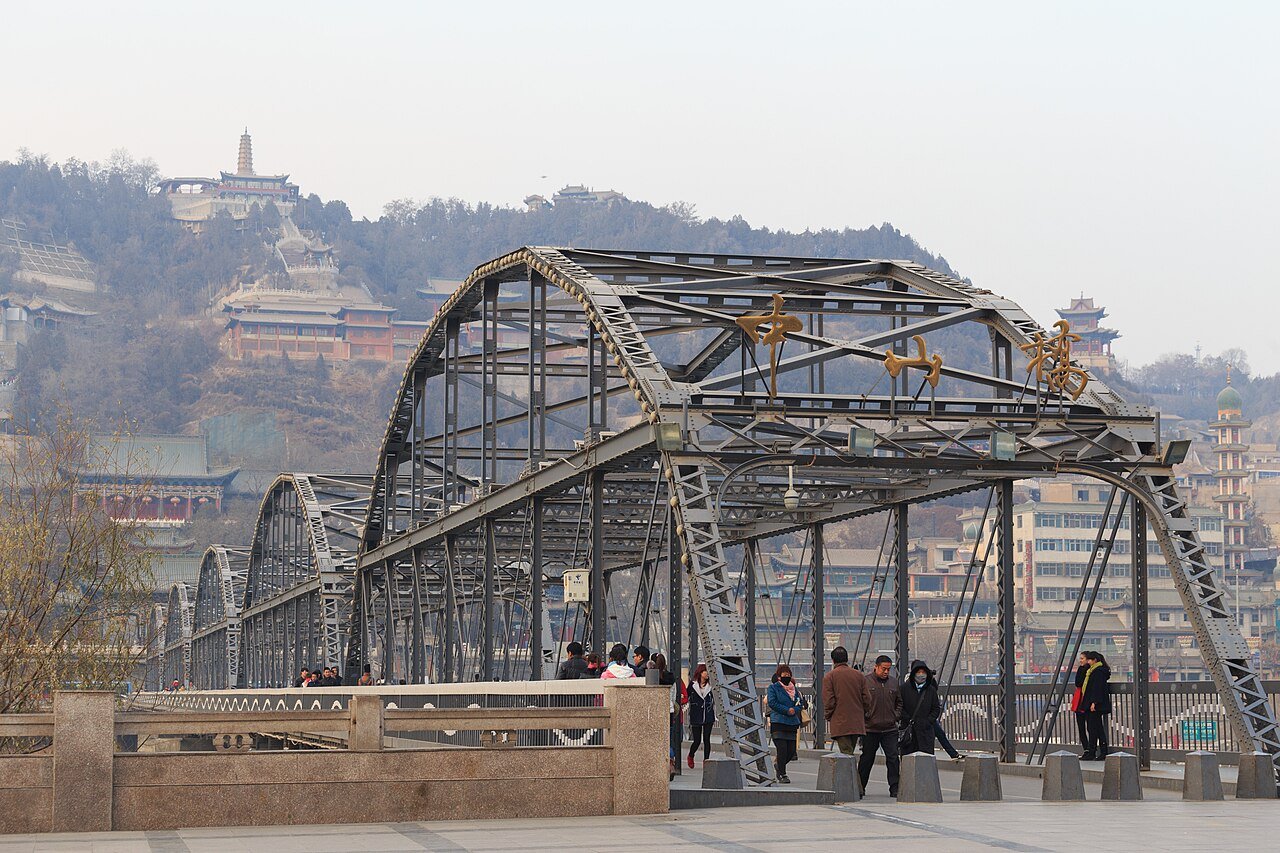
The arches that now define the bridge's silhouette are an addition. In 1954 engineers added arched steel beams above the original flat trusses so that it could carry heavier trucks, raising the load limit to 10 tonnes. Later repairs widened the walkways, and a 2010 and 2011 overhaul lifted the structure from 3.6 to 4.8 metres for flood clearance. The State Council listed it as a nationally protected heritage site in 2006.
Walking it today
The bridge takes only a few minutes to cross, so the time goes on the approaches. At the south end you can look for the surviving Ming iron post and the stone stele carved in 1992 with the words First Bridge of the Yellow River. A centenary monument went up in 2009, cut from a 50-tonne block of Qinghai river stone. From the north end, paths climb straight into White Pagoda Hill Park, and the view back down over the trusses is the classic shot of the city.
Evening is the popular time. The structure is lit after dark, and the riverside promenades on both banks fill up with walkers. The Yellow River runs fast and muddy here, so take the railings seriously. Sheepskin raft rides leave from wharves near the bridge. The Lanzhou guide covers them along with the Waterwheel Garden and the Yellow River Mother sculpture farther west.
Getting there
Lanzhou Metro Line 1 stops at Xiguan. Local transport guides say to take exit A or B and walk north for about 600 metres to reach the southern end of the bridge. Several city buses also stop at a Zhongshan Bridge stop on Binhe Road. The bridge is free and has no gate. Motor vehicles have been barred since March 2013, so the deck belongs to pedestrians.
A practical half-day combines the bridge with White Pagoda Hill on the north bank. The Gansu Provincial Museum lies farther west on the same Line 1, at Qilihe or Xizhan Shizi, so you can put the museum in the morning and the bridge at dusk.
Before you go
- Come late afternoon if you want both daylight on the hill and the lights on the bridge.
- The riverbank is windy and cool after sunset, even in summer.
- Lanzhou beef noodle shops near the old town tend to close by early afternoon, so eat before you walk.
- Check the day's notice if a festival or repair work is on, since the approaches are sometimes fenced off.
Frequently asked questions
Is Zhongshan Bridge free?
Yes. It is a public footbridge with no ticket and no gate.
When was it built?
Work began on 9 May 1908 and the bridge opened on 19 August 1909. The arched beams on top were added in 1954.
Can cars still cross?
No. Lanzhou's police barred all motor vehicles, including motorbikes, from 30 March 2013.
What is the nearest metro station?
Xiguan on Line 1. The bridge is roughly 600 metres north of exits A and B.
Sources
Facts in this article were checked against the following sources, retrieved 11 October 2026.
Photos are from Wikimedia Commons under the licences shown in each caption.