Gansu Provincial Museum and the Horse That Became China's Tourism Symbol
The Gansu Provincial Museum stands at 3 Xijin West Road in Qilihe District, Lanzhou, close to the south bank of the Yellow River. It holds more than 350,000 objects and specimens, sixteen of them classed as national treasures, and its best-known piece is a small Eastern Han bronze horse that most Chinese travellers already know from the national tourism logo. Entry is free with a timed booking. The museum is open Tuesday to Sunday and closes on Mondays, apart from public holidays.
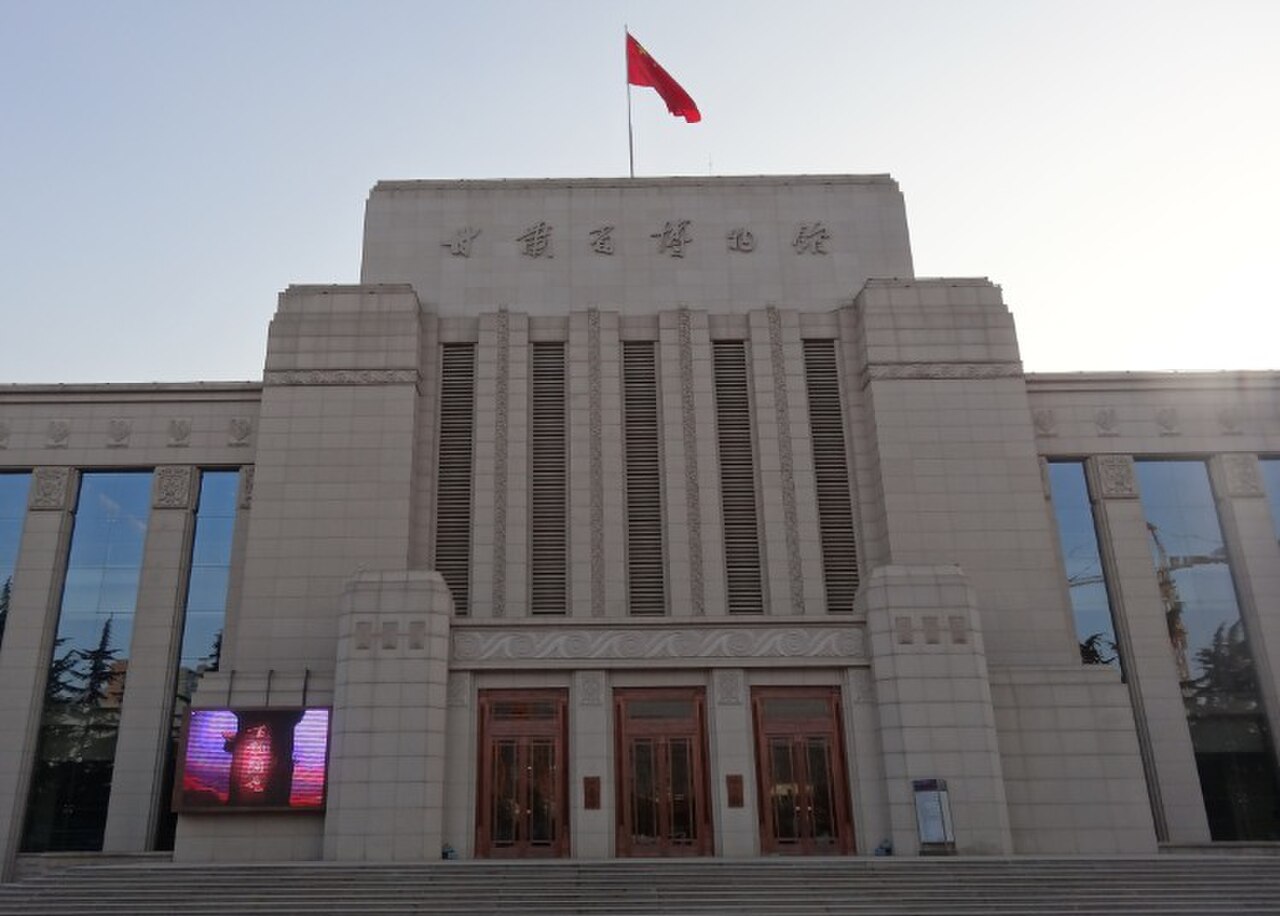
From a 1939 science institute to a first-class museum
The museum traces itself to the Gansu Science Education Institute, set up in 1939, which makes it one of the earliest regional museums in western China. It became the national Gansu science education institute in 1945, the Northwest People's Science Museum in 1950, and the Gansu Provincial Museum in 1956. It moved into a new building in 1958. A rebuild approved by the province in 1999 cost about 150 million yuan, and the present exhibition building opened on 26 December 2006 with 18 galleries in roughly 28,000 square metres. In 2012 the State Administration of Cultural Heritage named it a first-class national museum. Admission has been free since 28 March 2008.
The bronze galloping horse
The horse was found by accident. In the autumn of 1969, commune members digging an air-raid shelter at Leitai in Wuwei broke into a Han tomb and found a procession of bronze chariots, horses and figures. English Wikipedia says the group numbered over 200 pieces. They took the bronzes away before anyone recognised their value. A worker at the Wuwei cultural centre reported the find that October, and the bronzes went to the provincial museum the following year. Later study linked the tomb to the family of a General Zhang.
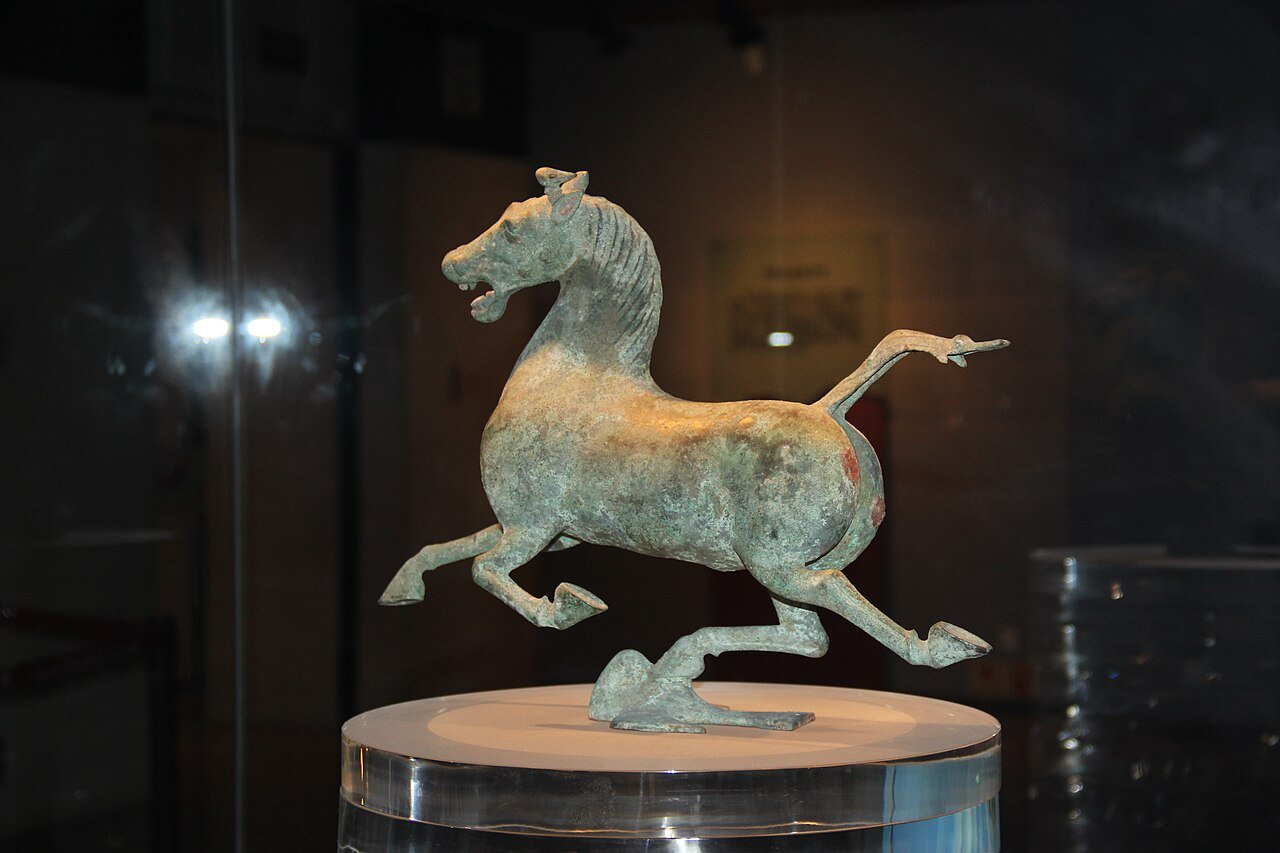
The piece is 34.5 centimetres high and 45 centimetres long. Three hooves are in the air, and the right rear hoof rests on the back of a bird that turns its head as if startled. The whole weight sits on that one small point, which is the part visitors tend to stare at. Guo Moruo saw it in Lanzhou in 1971 while escorting foreign guests and gave it the name Horse Treading on a Flying Swallow. Scholars have argued since then that the bird's tail is not forked like a swallow's, so it may be a falcon or a mythical wind spirit. The museum calls it the bronze galloping horse. It toured Britain and France in 1973 and later many other countries, became the emblem of Chinese tourism in 1983, and in 2002 was put on the first list of 64 relics that may not leave mainland China for exhibition.
The other galleries
The horse can take ten minutes, and most of the building's real value lies in the rest. The museum runs five permanent exhibitions. Gansu Painted Pottery covers the Neolithic cultures of the upper Yellow River, and it is one of the strongest painted pottery displays in the country. Gansu Silk Road Civilisation follows the Hexi Corridor from the Han garrisons to the Tang, and the Leitai chariot procession is displayed there. The Buddhist art exhibition draws on the cave temples of the province. A palaeontology hall shows fossils found in Gansu, and a fifth exhibition covers the Communist Party's history in the province up to 1949. Two of these exhibitions won national awards for museum displays, in 2007 and 2011.
Chinese Wikipedia picks out several objects beyond the horse. They include the Han bamboo slips of the Book of Etiquette from the Mozuizi tombs at Wuwei, Han medical slips from Hantanpo, a gold reliquary coffin from the Tang Dayun Temple at Jingchuan, and a silk painting from the Dunhuang library cave dated to 991. If you are heading west along the corridor, the slips and the Buddhist rooms make good background for the Giant Buddha Temple in Zhangye and for Dunhuang.
Hours and booking in 2026
The museum's site and 2026 holiday notices give opening hours of 9:00 to 17:00, Tuesday to Sunday. Booking for the day stops at 16:00 and entry stops at 16:30. Mondays are closed except on national public holidays. The museum stayed open on Monday 5 October during the 2026 National Day break, for example.
Tickets are free but must be booked under your real name. Lanzhou Bendibao, summarising the museum's rules in August 2026, says individual visitors book up to three days ahead through the museum's WeChat accounts, called Gansu Provincial Museum and Zheli Shi Ganbo. The daily cap is 12,000 visitors across four entry slots, 9:00 to 11:00, 11:00 to 13:00, 13:00 to 15:00 and 15:00 to 16:00, and new tickets are released at 17:00 each day. Each ID can book once per day and at most twice in any seven days. Groups of ten or more use a separate system. Foreign visitors should bring the passport they booked with. Rules change, so check the day's notice before you set out.
Chinese Wikipedia also mentions two free guided tours a day, starting at 9:30 and 15:00 from the service desk on the west side of the ground-floor hall, along with paid guides and audio sets. Confirm on arrival whether those times still hold.
Getting there
Take Lanzhou Metro Line 1 to Qilihe or Xizhan Shizi and use exit C or D, then walk. Buses stopping at Qilihe Bridge also work. The museum is on the same metro line as Xiguan, the stop for Zhongshan Bridge, so you can see the galleries in the morning and still be at the river for sunset.
Before you go
- Book on WeChat a day or two ahead, and earlier for weekends and school holidays.
- Plan a Tuesday to Sunday visit, since Mondays are closed outside public holidays.
- Allow at least three hours if you want the pottery and Silk Road rooms as well as the horse.
- The horse gallery is busiest in late morning, so going straight there at opening helps.
Frequently asked questions
Is the Gansu Provincial Museum free?
Yes. Entry is free, but you need a real-name timed booking made in advance.
Is the Flying Horse of Gansu the original?
The museum displays the original bronze from Leitai. Full-size copies stand in public spaces elsewhere, including one given to the United Nations Office in Geneva in 1987.
When is the museum closed?
It closes on Mondays, except when a national public holiday falls on a Monday.
How long should I allow?
Three to four hours covers the horse, the painted pottery and the Silk Road galleries without rushing.
Sources
Facts in this article were checked against the following sources, retrieved 11 October 2026.
- 甘肃省博物馆, Chinese Wikipedia
- 铜奔马, Chinese Wikipedia
- Flying Horse of Gansu, English Wikipedia
- Gansu Provincial Museum official site
- 甘肃省博物馆开放时间与预约 2026, Lanzhou Bendibao
- 甘肃省博物馆地铁指南, Lanzhou Bendibao
Photos are from Wikimedia Commons under the licences shown in each caption.