Lijiang Travel Guide: Six Places Worth Visiting (with a Four-Day Itinerary)
Lijiang sits in the northwest of Yunnan Province, where the Hengduan Mountains meet the Yunnan-Guizhou Plateau. The prefecture-level city was established in 2002; it covers more than 20,000 square kilometers and is home to about 1.25 million people, more than half of them from ethnic minorities. The Old Town of Lijiang was listed as a UNESCO World Heritage Site in 1997, Jade Dragon Snow Mountain is the sacred mountain of the Naxi people, and the Jinsha River cuts between two snow mountains at Tiger Leaping Gorge. The city was once a staging post on the Ancient Tea Horse Road. The Naxi have their own pictographic script, Dongba, widely described as the only living pictographic writing system still in use, and the Michelin travel guide gives Lijiang its highest three-star recommendation.
Planning a short Lijiang stay
Protect one mountain or gorge day and one buffer for altitude and transport. Cut Lugu Lake first on a short stay; keep Old Town mornings and Jade Dragon only if tickets exist.
When to come to Lijiang
The Lijiang basin sits at about 2,400 meters above sea level with a low-latitude plateau climate, no bitter winters, no scorching summers, so any season works. January, the coldest month, averages 6°C, and June, the warmest, averages 18.4°C, which makes summer a fine escape from the heat. Rain concentrates from June to September; the rest of the year is sunny and dry. Spring and autumn are the most comfortable and less crowded than summer. Winter brings clear skies, the clearest views of the snow mountain, and flocks of wintering birds on Lashihai Lake. The plateau sun is strong and days swing between warm and cold, so carry a jacket.
Sights in the city worth a visit
Old Town of Lijiang
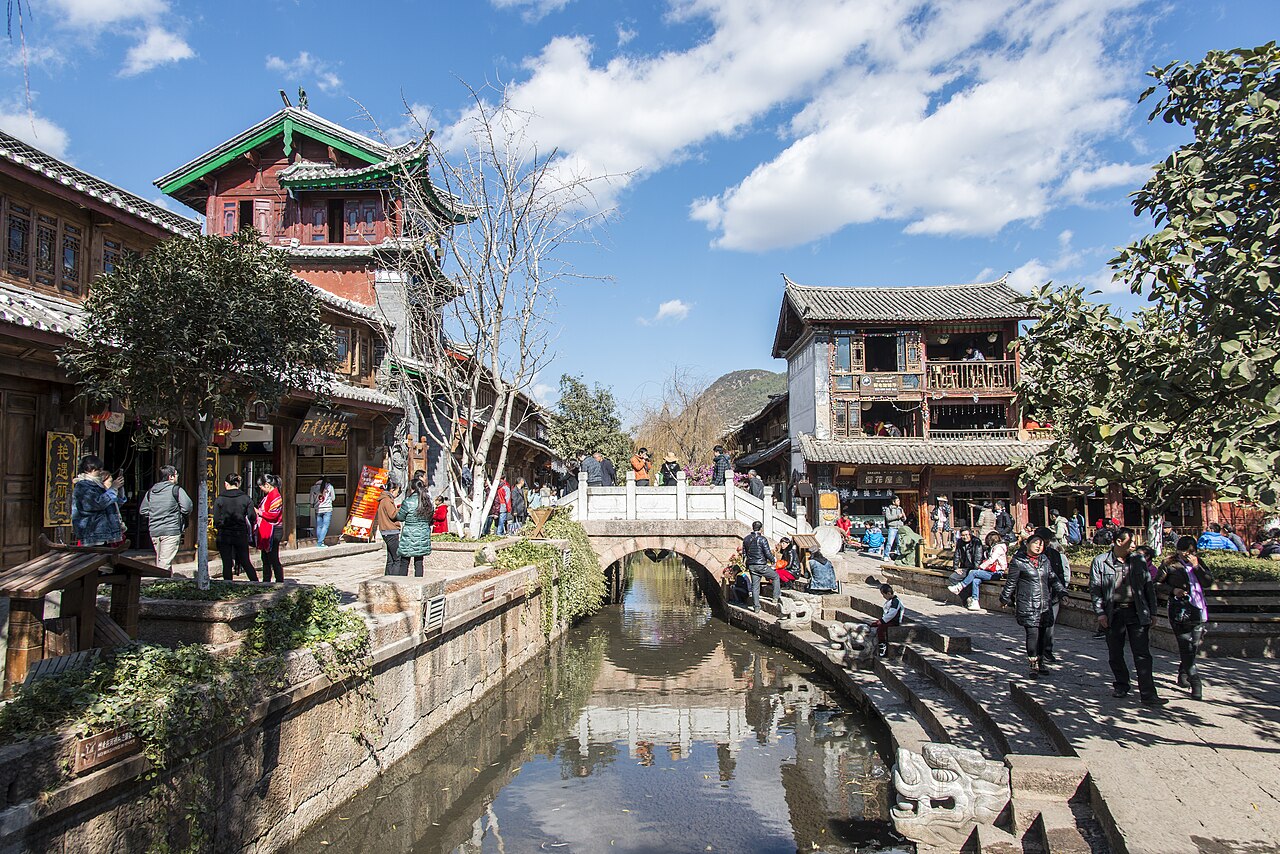
The Old Town of Lijiang, also called Dayan, was founded in the late Dali Kingdom and early Yuan dynasty, more than eight hundred years ago, and was inscribed on the UNESCO World Heritage List on December 4, 1997. The heritage site covers three parts. Dayan Old Town, the Baisha residential cluster, and the Shuhe residential cluster. It is the only one among China's historic and cultural cities that has no city wall. A popular story says the local ruler's family name Mu (wood) made a wall unthinkable, since a wall around "wood" forms the character for "trapped"; the eighteenth-century Lijiang Prefecture Gazetteer only records that the old prefecture had no wall, and the tale has no documentary basis.
The old town sits at about 2,400 meters above sea level. Its Naxi name, Gongbenzhi, means a granary and market town. The Mu family palace stands inside the town, and the Ming traveler Xu Xiake wrote in his travel diary that its halls were "as splendid as a king's". A magnitude-7 earthquake struck Lijiang on February 3, 1996, and the restored old town kept the essence of Naxi culture. The old town itself is free, but since 2001 the city has collected an Old Town maintenance fee. 80 yuan per person from 2007, cut to 50 yuan in 2017, and still 50 yuan per visit under the rules issued in July 2025, valid for 365 days after payment, with eight categories of people exempt, per the official notice. Sifang (Square) Street is the center; the Mu Mansion and Lion Hill are worth the walk, and the bar streets are liveliest at night. The Old Town of Lijiang page expands the maintenance fee and a lane-walking order.
Jade Dragon Snow Mountain
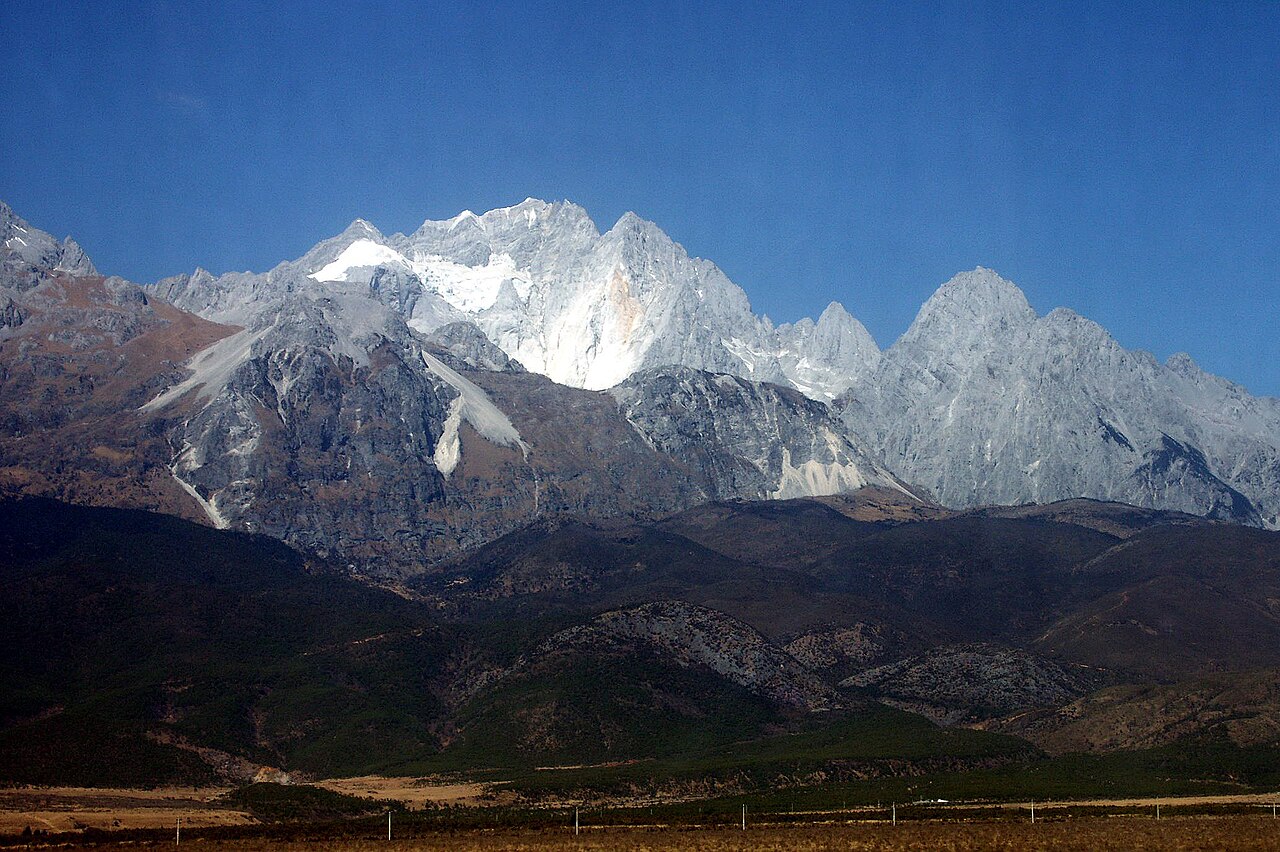
Jade Dragon Snow Mountain rises north of Lijiang and is the sacred mountain of the Naxi, whose name for it, Oulu, means "silver rock". The range runs 35 kilometers north to south; its main peak, Shanzidou, reaches 5,596 meters, the southernmost permanently snow-capped mountain in China and in all of Eurasia. In 1988 the mountain was grouped with the Old Town, Tiger Leaping Gorge, and Lugu Lake into the second batch of national scenic areas, and in 2007 it became a 5A scenic area. Nineteen glaciers remain on the mountain, and the slopes climb through the full sequence of vegetation belts from subtropical to alpine, sheltering animals such as the Yunnan snub-nosed monkey and the clouded leopard.
The main sights are the Glacier Park, Blue Moon Valley, Spruce Meadow, Yak Meadow, and Ganhaizi, linked by three cable car lines. Ganhaizi is an open meadow at about 2,900 meters on the east side, the best spot for the full panorama of the mountain. Spruce Meadow at 3,240 meters is a sacred place for the Naxi; the Dongba scriptures say it leads to the "Third Kingdom of Yulong". Blue Moon Valley is the old Baishui River, where the water runs blue on clear days, fed by glacier melt from four or five thousand meters up. Tickets for the Glacier Park cable car are capped daily and sell out in high season, so book ahead; prices follow the official notice. Up on the mountain it is windy and cold, dress warmly and watch for altitude sickness. See Jade Dragon Snow Mountain for booking shape, Ganhaizi, and Blue Moon Valley pacing.
Tiger Leaping Gorge
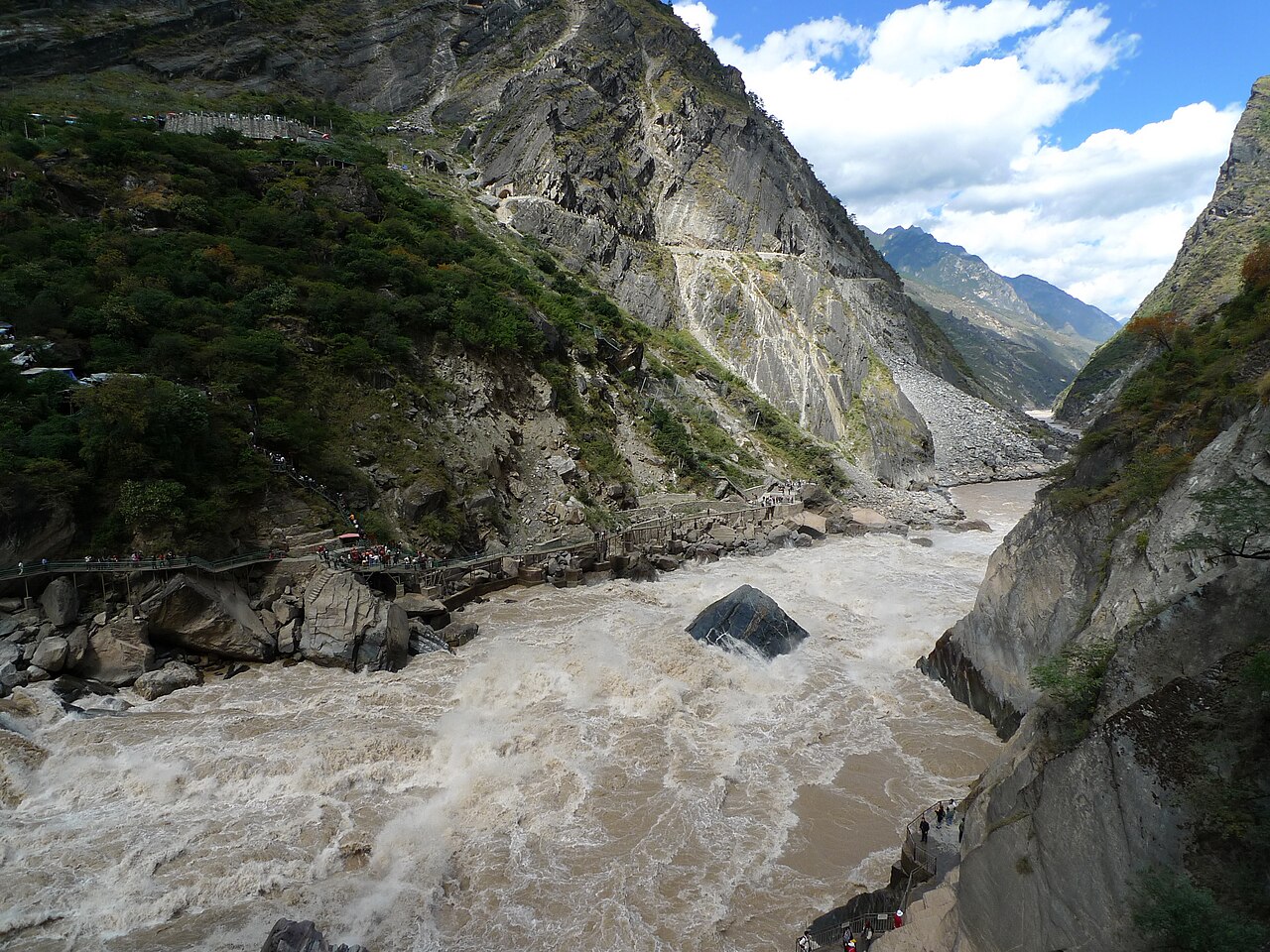
Tiger Leaping Gorge lies on the main stream of the Jinsha River between Jade Dragon Snow Mountain and Haba Snow Mountain, part of the Three Parallel Rivers World Natural Heritage site. Legend has it that in low water a tiger leapt across the river off a midstream rock, which is why the rock is called the Tiger Leaping Rock. The gorge runs about 16 kilometers and splits into Upper, Middle, and Lower sections; the narrowest point is roughly 30 meters wide, the river drops more than 200 meters along the way, and the walls rise 3,790 meters from river to summit. The cliffs are schist and marble, and the river thrashes through the canyon in a tremendous roar.
From Lijiang, Tiger Leaping Gorge is a day trip, the road loops around the Jinsha valley, so count on a full day there and back. Most visitors walk the boardwalk at Upper Tiger Leaping and call it done; hikers push on to the Middle section or the whole gorge on one of the world's classic trekking routes. In the rainy season the river runs high and the sound and fury grow, but the trail demands care and rockfalls are common after rain. The Tiger Leaping Gorge page covers Upper day-trip logistics and why Mid gorge river-level paths need a current closure check.
Shuhe Old Town
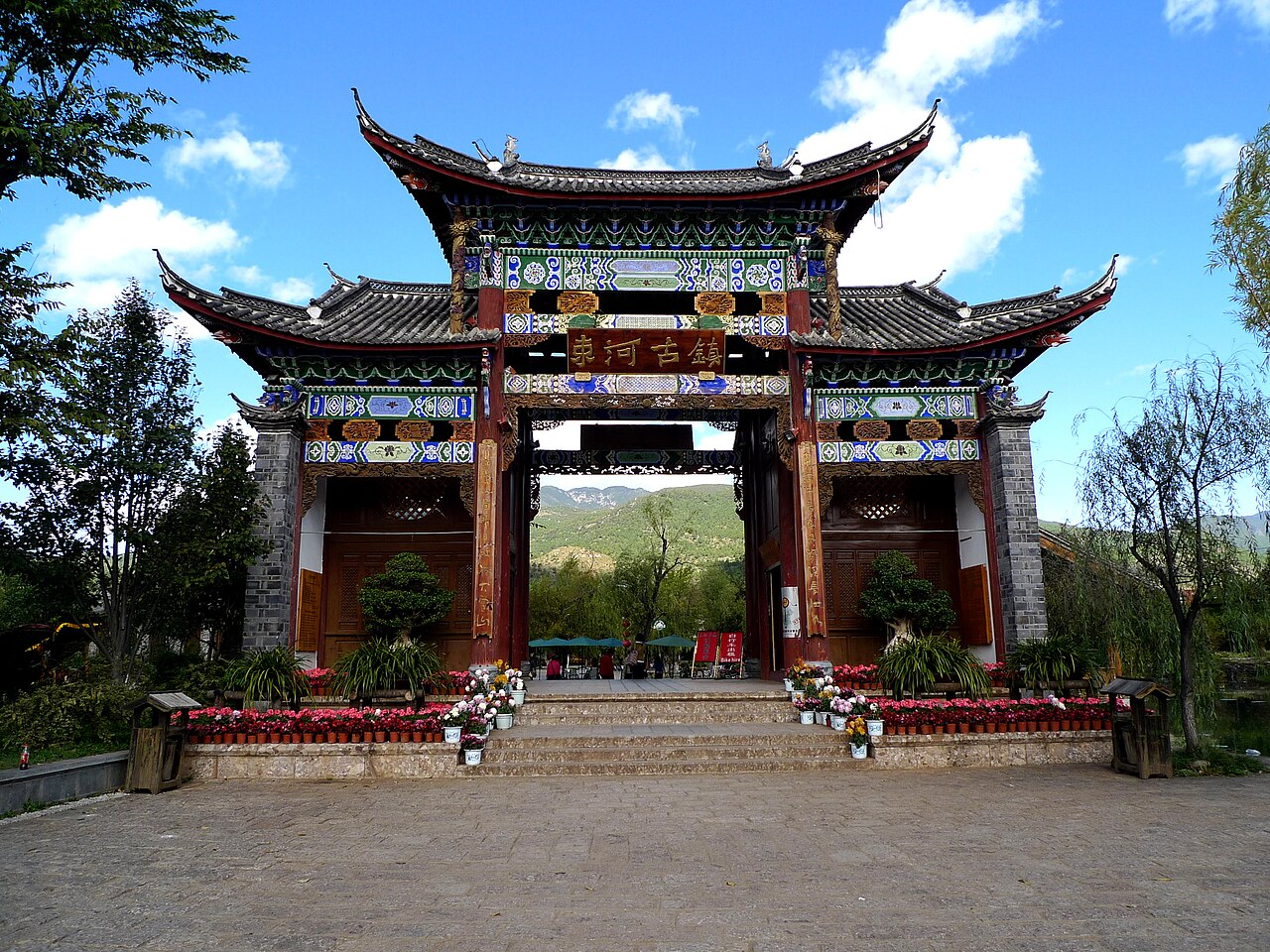
Shuhe Old Town sits about four kilometers north of the Old Town of Lijiang. Its Naxi name, Shaowu, means "the village below the high peak", and it is one of the earliest Naxi settlements in the area, as well as the best-preserved market town on the Tea Horse Road. From the Ming dynasty onward, leather workers and other artisans gathered here, and Shuhe grew into a key town on the route. Together with Dayan and Baisha it makes up the Old Town of Lijiang World Heritage site. The Qinglong Bridge in the town dates to the Ming dynasty, and local lore says a master once stepped from the bridge straight onto Jade Dragon Snow Mountain; the waters of Nine Cauldron Dragon Pool are so clear that the snow mountain mirrors in them.
Shuhe is quieter than Dayan, with tea houses and cafés strung along the Qinglong River. The Ming-era Dajue Palace and the Qing-era Sansheng Temple keep their murals and architecture, and the temple even houses a shrine to Sun Bin, patron of leatherworkers. Shuhe is a 4A scenic area; admission follows the official notice. The Shuhe Old Town page compares it with Dayan and outlines a quiet morning loop.
Black Dragon Pool
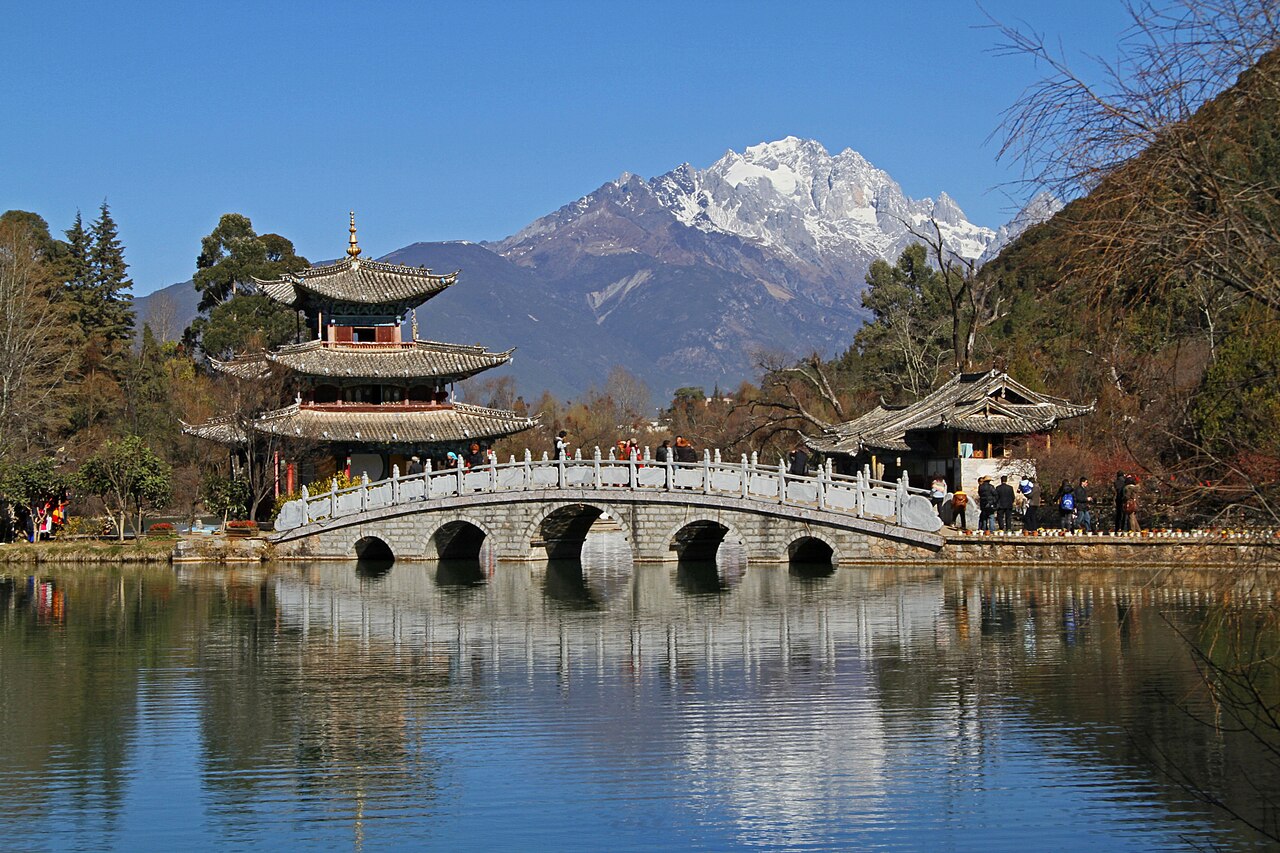
Black Dragon Pool Park, also called Jade Spring Park, lies at the north end of the old town at 2,419 meters above sea level and forms part of the Old Town of Lijiang World Heritage site. The pool is fed by springs at the foot of Elephant Hill and drains south through the Yu River into the old town, the main water source for the old town's canals. The classical buildings around the pool (the Moon Embracing Pavilion, the Five Phoenix Tower, the Wenming Archway, and others) were begun in the second year of the Qianlong reign (1737), and in 2006 the group was listed as a Major Historical and Cultural Site Protected at the National Level. The Five Phoenix Tower was moved here from Fuguo Temple and is the best-known building in the group.
The classic view is the Moon Embracing Pavilion with Jade Dragon Snow Mountain reflected in the pool, the water like a mirror on a fine day. The park became a 4A scenic area in 2009. One word of caution: the pool has dried up repeatedly over the years (from January 2012 to April 2014 it was dry for 809 consecutive days, the longest on record) so check recent water conditions before you go. See Black Dragon Pool for fee checks and reflection timing.
Lugu Lake
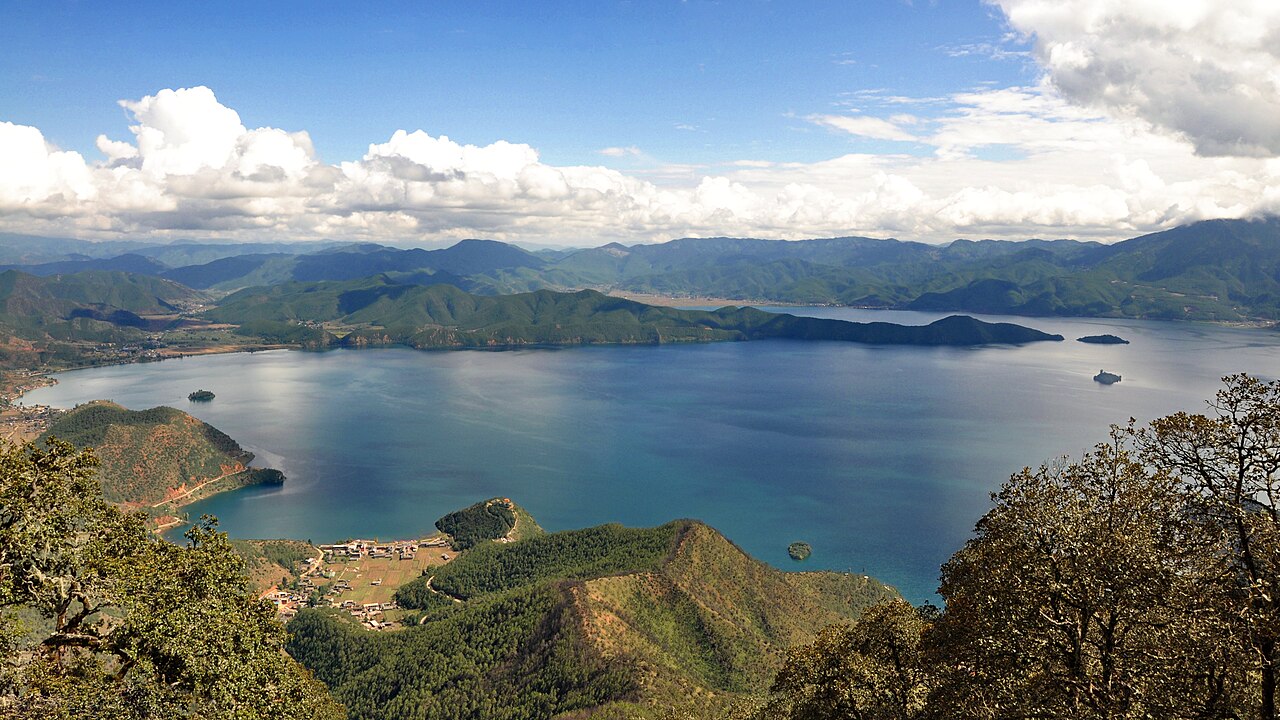
Lugu Lake straddles the Yunnan-Sichuan border, with the west shore in Ninglang, Lijiang, and the east shore in Yanyuan, Sichuan. The lake surface sits at 2,690 meters, covers 48.45 square kilometers, averages 40 meters deep with a maximum of 93.5 meters, and its water is rated Class I in China, clear enough that you can see twelve meters down. The American geographer Joseph Rock wrote in National Geographic that it was the most beautiful lake in all of Yunnan. The Mosuo people around the shore keep a matrilineal society and the "walking marriage" custom, and their traditional homes are log houses. The Grass Sea wetland at the southeast corner hosts wintering black-necked cranes, and the old pig-trough boats still ply the water.
Lugu Lake is about 200 kilometers from central Lijiang, and the road twists over steep passes (the famous "Eighteen Bends" lie on this route) so the drive takes most of half a day. Stay a night and take it slow. A loop of the lake takes in Lige, the Grass Sea, and the Walking Marriage Bridge, and Mount Gemu is the sacred mountain of the Mosuo. If time is short, fly to Lugu Lake Airport, about 25 kilometers from the shore. The Lugu Lake page explains why an overnight stay beats a rushed day trip.
Eating in Lijiang
The most famous Lijiang snack is jidou liangfen, a jelly made from the local chickpea-like jidou pea grown in the cold highlands, served cold with vinegar and chili for a sour-spicy kick, or pan-fried until crisp outside and soft inside. Lijiang baba is a butter-baked flatbread, available sweet or savory. Cured pork rib hotpot, Naxi grilled fish, Dongba roast meat, rice sausage, and blown liver are local staples, and butter tea with baba is the traditional breakfast. Shuiyanghua, a water plant gathered from the lakes, stir-fries crisp and fresh when in season. Snack stalls cluster around Sifang Street in the old town, and the new town has plenty of long-running restaurants. Prices at restaurants vary widely, so ask how the bill is counted before you order.
How to arrange the route
Three days for the core sights, five if you add Lugu Lake.
Day one, arrive and walk the old town (Sifang Street, the Mu Mansion, Lion Hill) then head to Black Dragon Pool toward evening for the snow mountain reflection, and back to the old town's bar streets at night.
Day two belongs to Jade Dragon Snow Mountain: the panorama at Ganhaizi, the cable car up to the Glacier Park, Blue Moon Valley on the way down, Spruce Meadow if you still have energy. Buy the cable car tickets in advance.
Day three, Shuhe Old Town in the morning, then Baisha village, where Dabaoji Palace and Liuli Hall keep the famous Ming-dynasty murals; in the afternoon go to the Lashihai wetland to watch the birds (most numerous in winter) with the snow mountain mirrored in the lake.
Days four and five, Lugu Lake: leave in the morning, arrive around noon, circle the lake, stay lakeside for sunrise; the next morning walk the Grass Sea and the Walking Marriage Bridge, then drive back to Lijiang in the afternoon.
The usual way in is from Dali along the old tea-horse corridor, after a few days in Kunming first.
Things to confirm before you go
- Lijiang sits above 2,400 meters and the snow mountain is higher still; take it easy on arrival and dress warmly.
- The Jade Dragon cable car sells out in high season, and the Glacier Park line is capped daily, book through official channels ahead of time.
- The Old Town maintenance fee is 50 yuan per person, per the official notice; under the July 2025 rules one payment is valid for 365 days and some people are exempt.
- The Lugu Lake road is long and can be hit by landslides in the rainy season (check road conditions; Black Dragon Pool may be dry) check recent water levels.
- The plateau sun is intense; bring sunscreen, sunglasses, and a hat, plus a jacket for the cool mornings and evenings.
Frequently asked questions
How many days for Lijiang?
Three days cover the core sights, one for the old town, one for the snow mountain, one for Shuhe and Lashihai. Add two more for Lugu Lake, and stay at the lake for a night.
Does the Old Town of Lijiang charge admission?
No entrance ticket, but visitors pay a 50 yuan maintenance fee, per the official notice; one payment is valid for 365 days.
Is Jade Dragon Snow Mountain worth it?
Yes. It is the Naxi sacred mountain, with glaciers, Blue Moon Valley, and Spruce Meadow each worth seeing. Book the main cable car in advance, in peak season it rarely sells same-day.
When is Lijiang best?
Spring and autumn are the most comfortable; winter brings clear skies, crisp views of the snow mountain, and birds on Lashihai; summer is cool but rainy. Every season has its own draw.
Tiger Leaping Gorge or Lugu Lake?
Short on time, choose Tiger Leaping Gorge, a day trip with the thrill of the canyon. With time to spare, go to Lugu Lake; the lake scenery and Mosuo culture deserve an overnight stay.
Sources
The facts in this article were checked against the following Chinese Wikipedia entries, retrieved August 27, 2026.
- Lijiang (city) https://zh.wikipedia.org/wiki/丽江市
- Old Town of Lijiang https://zh.wikipedia.org/wiki/丽江古城
- Jade Dragon Snow Mountain https://zh.wikipedia.org/wiki/玉龙雪山
- Tiger Leaping Gorge https://zh.wikipedia.org/wiki/虎跳峡
- Shuhe Old Town https://zh.wikipedia.org/wiki/束河古镇
- Black Dragon Pool, Lijiang https://zh.wikipedia.org/wiki/丽江黑龙潭
- Lugu Lake https://zh.wikipedia.org/wiki/泸沽湖
- Lashihai https://zh.wikipedia.org/wiki/拉市海
The Chinese Wikipedia titles "白沙壁画" (Baisha Murals), "黑龙潭 (丽江)", and "大宝积宫" do not yet have independent articles. The claim that Baisha's Dabaoji Palace and Liuli Hall are Ming-dynasty buildings holding the Baisha murals was cross-checked against Baidu Baike and Chinese Cultural Relics News reports; local dishes were cross-checked against multiple travel sites.
All photos are from Wikimedia Commons, used under CC licenses; re-use requires attribution.
- lijiang-oldtown.jpg from File 1 lijiang old town 2012a.jpg, by chensiyuan, taken 2012, CC BY-SA 4.0
- lijiang-yulong.jpg from File Yulong mount.jpg, by Munford, taken January 2006, CC BY-SA 3.0
- lijiang-tiger.jpg from File 虎跳峡.JPG, by Gisling, taken 2011, CC BY-SA 3.0
- lijiang-shuhe.jpg from File 丽江束河古镇.JPG, by Gisling, taken October 2009, CC BY 3.0
- lijiang-heilongtan.jpg from File Black Dragon 黑龙潭 (5496141333).jpg, by Miltos Gikas, taken February 6, 2011, CC BY 2.0
- lijiang-lugu.jpg from File Overlooking Lugu Lake.jpg, by Shi Ai (石瑷), taken October 5, 2015, CC BY-SA 4.0