Xiandu
Xiandu means the capital of immortals, and the name fits the view that made it famous. A single stone spire, Dinghu Peak, rises from the bank of the Haoxi River in Jinyun County, in the north of Lishui prefecture, and on still mornings mist lies on the water around it. Chinese Wikipedia says the scenic area centred on the peak lies about seven kilometres north of Jinyun town and covers 76 square kilometres in the upper Ou River basin, at the northern foot of the Kuocang Mountains. In January 2020 it became the first national 5A scenic area in Lishui.
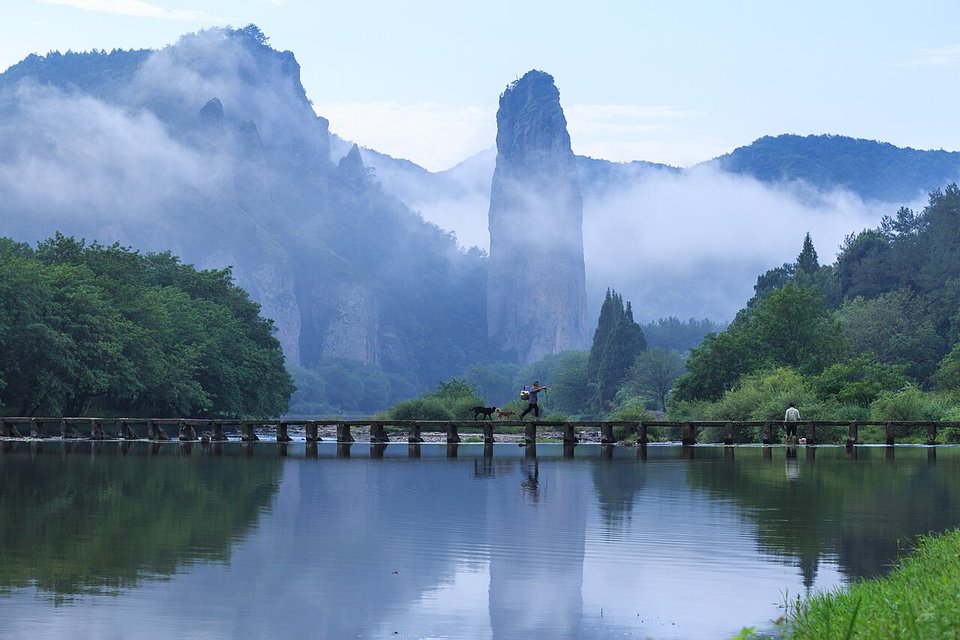
Dinghu Peak and the Yellow Emperor
Chinese Wikipedia gives Dinghu Peak a height of 170.8 metres and compares its shape to a spring bamboo shoot; local people simply call it the stone shoot. Its old name was Mount Jinyun. The legend says the Yellow Emperor, the mythical ancestor of the Chinese, refined an elixir of immortality on its summit and rose to heaven on a dragon, and the cauldron he left behind sank to form a lake, which gives the peak its name, cauldron lake peak. Jinyun people add that their famous baked flatbread was first made from the leftover ingredients.
The religious history is real enough. Chinese Wikipedia records that the peak was listed among the famous mountains of the Jiangnan circuit in 627, renamed Xiandu Mountain by imperial order in 748 with a shrine to the Yellow Emperor, and that the shrine became the Yuxu Palace in the Song. In Taoist tradition the place is one of the thirty six lesser grotto heavens. Bai Juyi wrote a poem on Dinghu Peak, and later poets including Yuan Mei followed.
Since 1998 a public ceremony to the Yellow Emperor has been held here each year at the Qingming festival in spring and the Double Ninth festival in autumn, drawing clan associations, overseas Chinese and visitors from Taiwan. The Jinyun ceremony was added to the national intangible heritage list in 2011. Locals pair the shrine with the Yellow Emperor's mausoleum in Shaanxi, calling them the tomb in the north and the shrine in the south.
Other sights in the valley
Chinese Wikipedia lists 72 peaks and 18 historic sites, and the scenic area's own ticket covers five main stops along the river.
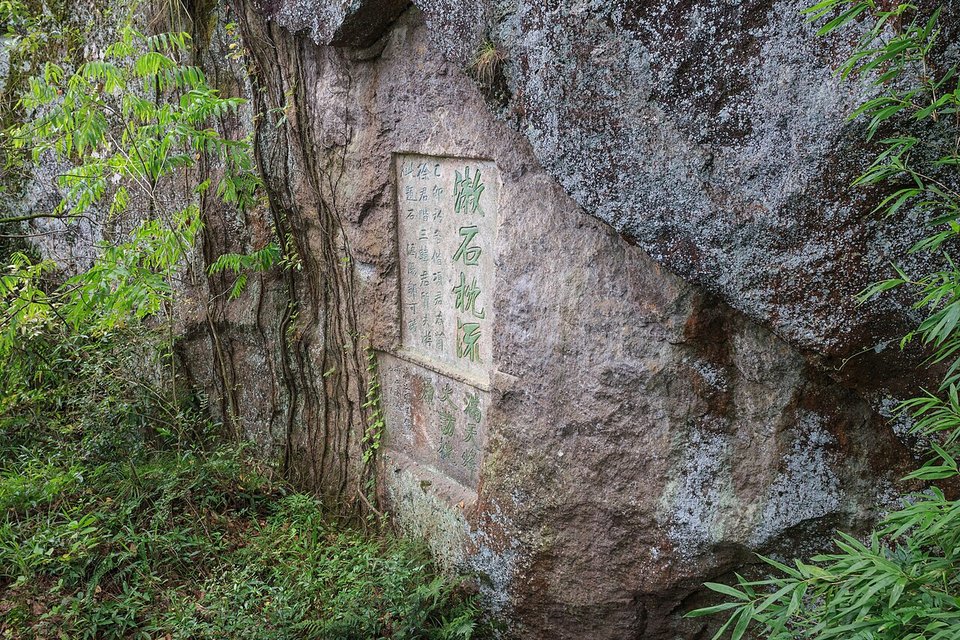
Niweng Cave holds the densest group of cliff inscriptions in Xiandu and is a major national protected site. Nearby is the site of Dufeng Academy. In 1182 the Neo Confucian philosopher Zhu Xi came to Jinyun from Taizhou, stayed at Xiandu and taught here, and the academy was founded in his memory in the early 13th century.
Furong Gorge is a narrow ravine that Li Bai mentioned in a line about the difficult valleys of Jinyun, in which he says the stone gate is the finest sight. Zhutan Mountain, whose pool is said to take its name from Zhu Xi, has a willow lined embankment along the water and is the usual place to photograph Dinghu Peak across the river. Xiao Chibi, the little red cliff, is a red rock face above the river with a walkway along it.
Xiandu is also a popular film location. Chinese Wikipedia says that by the end of March 2020 some 500 films and TV series had been shot here, among them Monk Comes Down the Mountain and The Journey of Flower.
When to go
Mist is the thing to see. It forms most often on calm mornings, especially in spring and after rain, so the best plan is to stay overnight in the guesthouses near the peak and be out early. Autumn brings clear air and colour. Summer is hot and humid with plenty of mosquitoes, and holidays bring crowds and full car parks by late morning.
Tickets and hours
The official Xiandu site lists the entrance ticket at 90 yuan, valid for two days. Half price applies to children from 1.2 to 1.5 metres, people aged 60 to 69, minors over 6 and full time students, and free entry to people aged 70 and over, children 6 and under or below 1.2 metres, people with disabilities, soldiers and veterans. The shuttle bus ticket is 20 yuan, valid for two days with unlimited rides, and it runs from 7:30 to 17:30 between 29 April and 31 October and from 8:00 to 17:00 between 1 November and 28 April. Qunar and Ctrip give the same times as the opening hours, so expect the earlier closing from 1 November. The ropeway up Buxu Mountain beside Dinghu Peak costs 25 yuan one way or 40 return.
The scenic area has published a letter explaining that one ticket covers all five main sights, that tickets had in practice been checked only at Dinghu Peak, and that it would restore checks at the other sights. A 2026 travel site reports a reduced ticket while the Yellow Emperor shrine was under works in summer 2026. Check the day's notice. The ticket line is 0578 3120301.
Getting there
Jinyun West Station is on the high speed line, and a taxi to the scenic area takes around twenty minutes. Visitors who drive normally park at the visitor centre and switch to the shuttle; guesthouse guests inside the area can usually register their car to drive in. Allow at least half a day for Dinghu Peak and one or two other stops, and a full day for all five.
Within Lishui, the Yunhe Terraces and the Tongji Weir and Ancient Weir Painting Village make good companions on a three day trip.
Frequently asked questions
Can I just see Dinghu Peak?
Yes. Many visitors head straight for the peak and Zhutan Mountain, which takes two or three hours.
Is the ticket valid for two days?
The official site says both the entrance ticket and the shuttle ticket are valid for two days.
What should I eat?
Jinyun baked flatbread, filled with pork and preserved vegetables and baked in a barrel oven, is sold all around the scenic area.
Sources
Facts in this article were checked against the following sources, retrieved 23 October 2026.
- 仙都, Chinese Wikipedia
- Xiandu official site, ticket information
- Qunar, Dinghu Peak hours
- Ctrip, Dinghu Peak listing
- Tide News, letter from the Xiandu scenic area
- Zhunaqu, Xiandu travel guide, 2026
- Lishui travel guide on this site
Photos are from Wikimedia Commons under the licences shown in each caption.