Guanlin: The Tomb and Temple of Guan Yu's Head
Guanlin lies about seven kilometres south of central Luoyang, in Luolong District on the road toward the Longmen Grottoes. Tradition holds that the head of Guan Yu, the Three Kingdoms general later worshipped as a god of loyalty and war, is buried here. The complex combines a tomb, a temple and a grove of old cypresses, and it is one of the most important Guan Yu sites in China. It is a national protected monument and it is part of two Chinese World Heritage bids, one for Guan Yu heritage sites and one for the Tea Road. In the Luoyang plan it takes the afternoon of day one after Longmen.
How a head came to Luoyang
In 219 Guan Yu, then commanding Liu Bei's forces in Jing Province, marched north and besieged Fancheng. Cao Cao drew Sun Quan into the war, Wu troops took Guan Yu's rear, and his army broke. He retreated to Maicheng with a few hundred riders, tried to break out, and was captured and beheaded by Wu forces around the turn of 220. Sun Quan sent the head to Cao Cao in Luoyang. Cao Cao, the story goes, buried it south of the city with the rites due to a prince and built a shrine.
Chinese Wikipedia is careful on this point. Surviving records from before the Ming do not give a precise burial place for the head. By the Wanli reign of the Ming, steles on the site already describe it as the tomb of Guan Yu's head with a temple going back to the Han, so the identification is at least four centuries old.
From tomb to "lin"
The site grew with Guan Yu's status. Ming emperors raised his titles step by step. From 1582 they included the word di, emperor, and from 1605 he was also called a sheng, a sage, after which the tomb was known as a mausoleum. In 1666 the Kangxi Emperor's government granted the tomb the word lin, a term otherwise reserved for Kong Lin, the cemetery of Confucius at Qufu. That pairing of the sage of letters with the sage of arms is why the name Guanlin carries so much weight. Chinese Wikipedia notes it is the only one of the tens of thousands of Guan Yu temples allowed to use the word.
The present buildings date mostly from a rebuilding in 1592, in the Wanli reign, with later Qing work. A Ming stele of 1596 records restoration of the "tomb and temple of Lord Guan".
Walking the axis
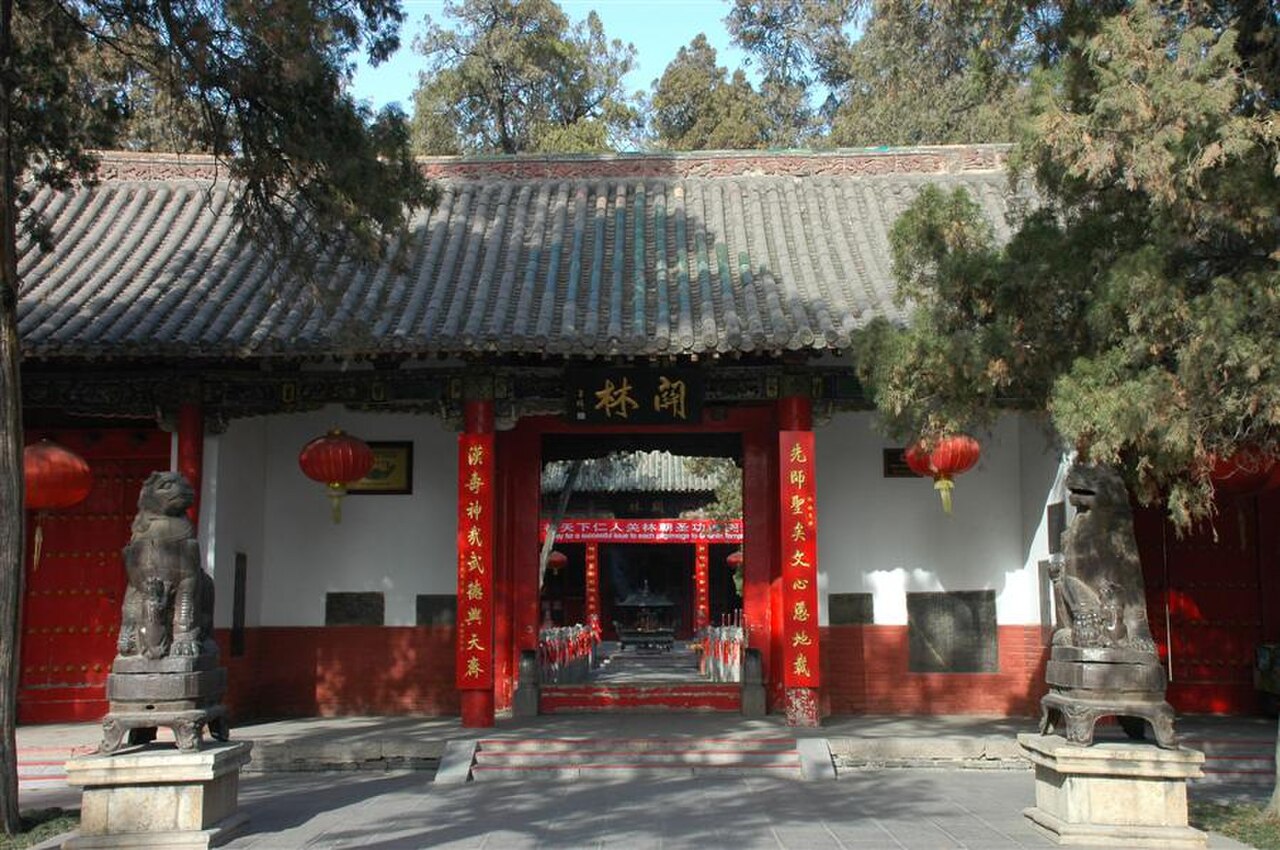
The complex runs north along a single axis. In front is the opera stage, where performances were once given for the god. Then come the main gate, the Gate of Rites, and a sequence of halls, including the main hall with a seated Guan Yu, the second hall and the rear hall. Stone lions line the approach; the courtyards are full of old cypresses and stelae, and incense smoke rarely clears. Beyond the halls a stone archway leads to the tomb itself, an octagonal mound with a stele in front.
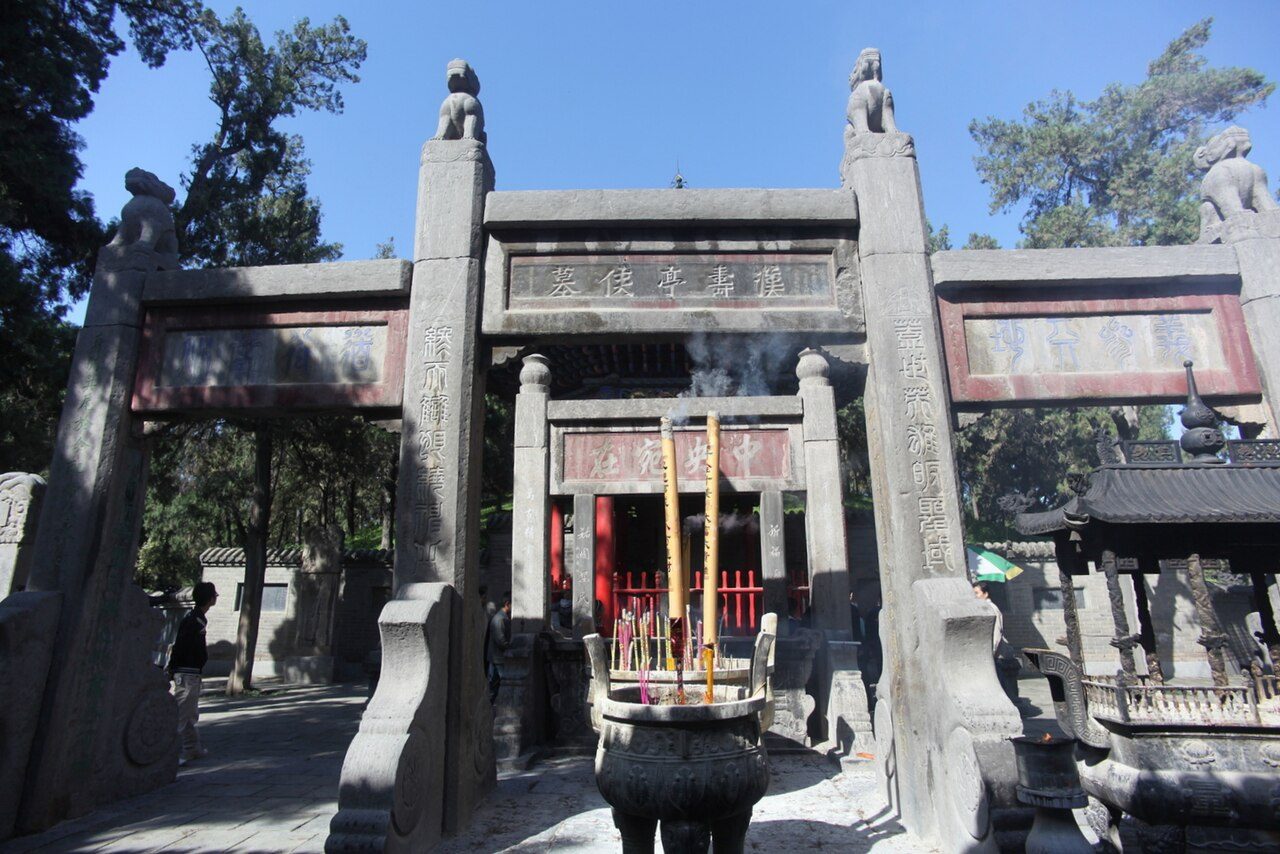
Guan Yu never held office in Luoyang while he lived, yet his cult has had one of its strongest centres here for centuries.
Tickets and hours
The China International Travel Service page for Guanlin lists the ticket at 40 yuan and hours of 08:00 to 18:30, and other 2026 visitor guides give the same price. Local festivals for Guan Yu, especially around his traditional birthday, draw large crowds and may bring special arrangements. Check the official notice on the day.
Getting there
Guanlin is about seven kilometres south of the city. Buses 81 and 55 from Luoyang railway station have been listed as stopping nearby, and a taxi from the old town or from Longmen is short. It fits naturally on the way back from the grottoes. The Luoyang Museum, which started life in Guanlin's halls in 1958, is also in the southern districts.
How long and who it suits
An hour or two covers the halls and the tomb. Anyone who knows the Romance of the Three Kingdoms, or who has seen Guan Yu's red face in temples and restaurants around Asia, will get the most from it. For others, the cypress courtyards and the stelae still make a calm hour after the steps of Longmen.
Things to confirm before you go
- Ticket price and hours on the day.
- Whether a festival or ceremony is scheduled, which changes crowds and access.
- Your route back to the city from Longmen if you combine the two.
Frequently asked questions
Is Guan Yu really buried at Guanlin?
Tradition says his head is buried here. Records before the Ming do not confirm the exact site. The identification goes back at least to the sixteenth century.
Why is it called Guanlin?
In 1666 the Qing court granted the tomb the word lin, used otherwise for the cemetery of Confucius. The name puts Guan Yu on a level with Confucius.
How much is the ticket?
Listings give 40 yuan. Confirm on the day.
Can I visit Guanlin and Longmen on the same day?
Yes. Guanlin is on the road between Longmen and the city, so the two fit into one day.
Sources
Facts in this article were checked against the following sources, retrieved 6 October 2026.
- 关林, Chinese Wikipedia
- Guanlin Temple, China International Travel Service
- Luoyang travel guide for foreign visitors, Zhengzhou Travel
Photos are from Wikimedia Commons under the licences shown in each caption.