Longmen Grottoes: Fengxian Temple, Binyang Caves, Tickets and Night Tour
The Longmen Grottoes line both banks of the Yi River about twelve kilometres south of central Luoyang, cut into the limestone of Longmen Hill on the west bank and Xiangshan on the east. The two hills pinch the river like a gateway, which is where the old name Yique, the Gate of the Yi, and the later name Dragon Gate both come from. Carving began after the Northern Wei moved its capital from Pingcheng, today's Datong, to Luoyang in 494, and it continued, with long pauses, for more than four hundred years into the Northern Song. Chinese Wikipedia counts more than 2,100 caves and niches, over 100,000 statues and more than 3,600 inscriptions; UNESCO's figures are of the same order. Longmen was inscribed as a World Heritage site in 2000, and it is day one in the Luoyang plan.
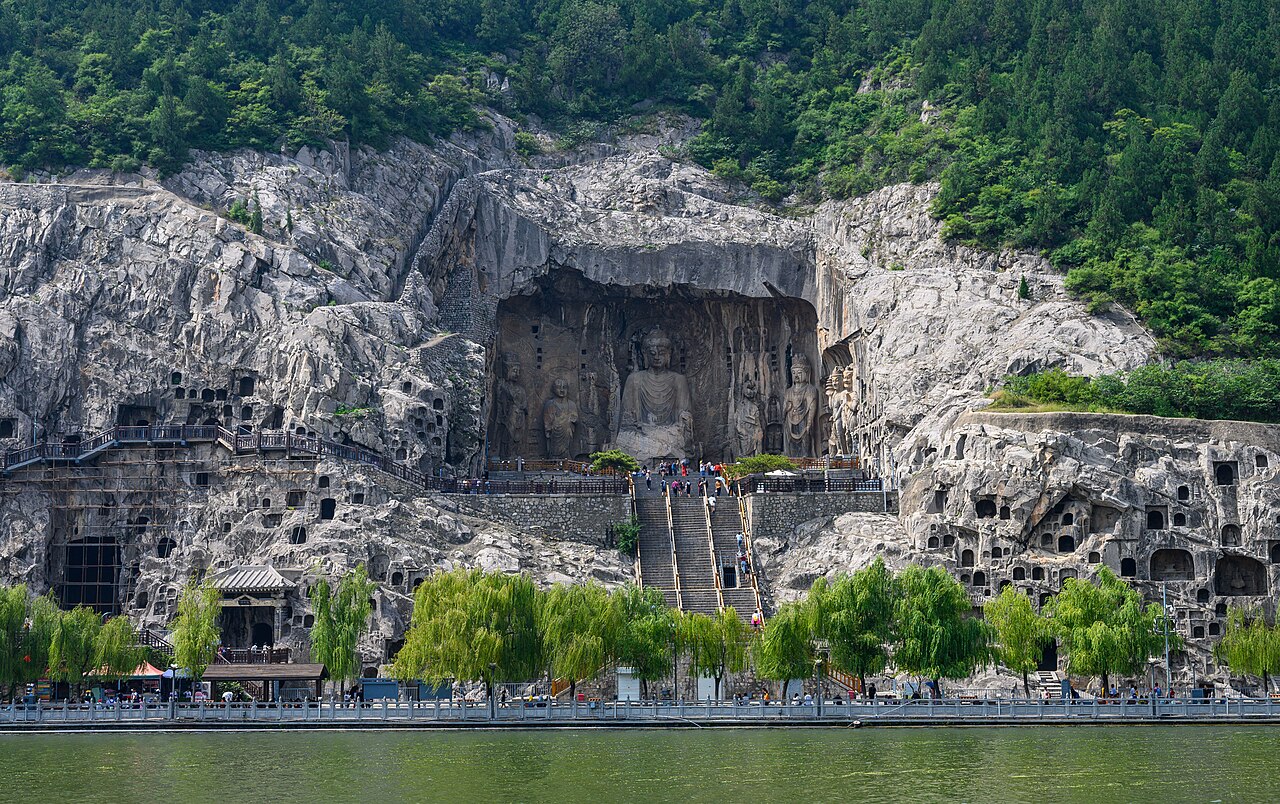
Two great periods of carving
Two dynasties did most of the work. The Northern Wei court began cave building here around the turn of the sixth century, and roughly a third of what you see dates from that phase. The Tang, from 626 to 755, produced about sixty per cent, at its peak when Emperor Gaozong and Empress Wu Zetian ruled from Luoyang. The styles differ in ways you can see without a guidebook. Northern Wei figures are slender, with long faces and stiff pleated robes. Tang figures are fuller, rounder and more relaxed.
The site also suffered. Many heads and reliefs were cut away in the 1930s and 1940s and sold abroad. The best-known loss is a pair of Northern Wei reliefs of the emperor's and empress's processions from the Middle Binyang Cave; the emperor's procession is now in the Metropolitan Museum of Art in New York and much of the empress's in the Nelson-Atkins Museum in Kansas City. Further damage came during the Cultural Revolution.
Fengxian Temple and the Vairocana Buddha
The largest open-air niche on the West Hill is Fengxian Temple, carved between 672 and 675 with support from Wu Zetian, who is recorded as donating twenty thousand strings of cash from her cosmetics allowance. The seated Vairocana Buddha at its centre is 17.14 metres high, with ears about two metres long. The serene, full face has long been linked to Wu Zetian herself, although that is tradition and not a recorded fact. Disciples, bodhisattvas, a heavenly king and a guardian stand on either side, each carved with its own expression.
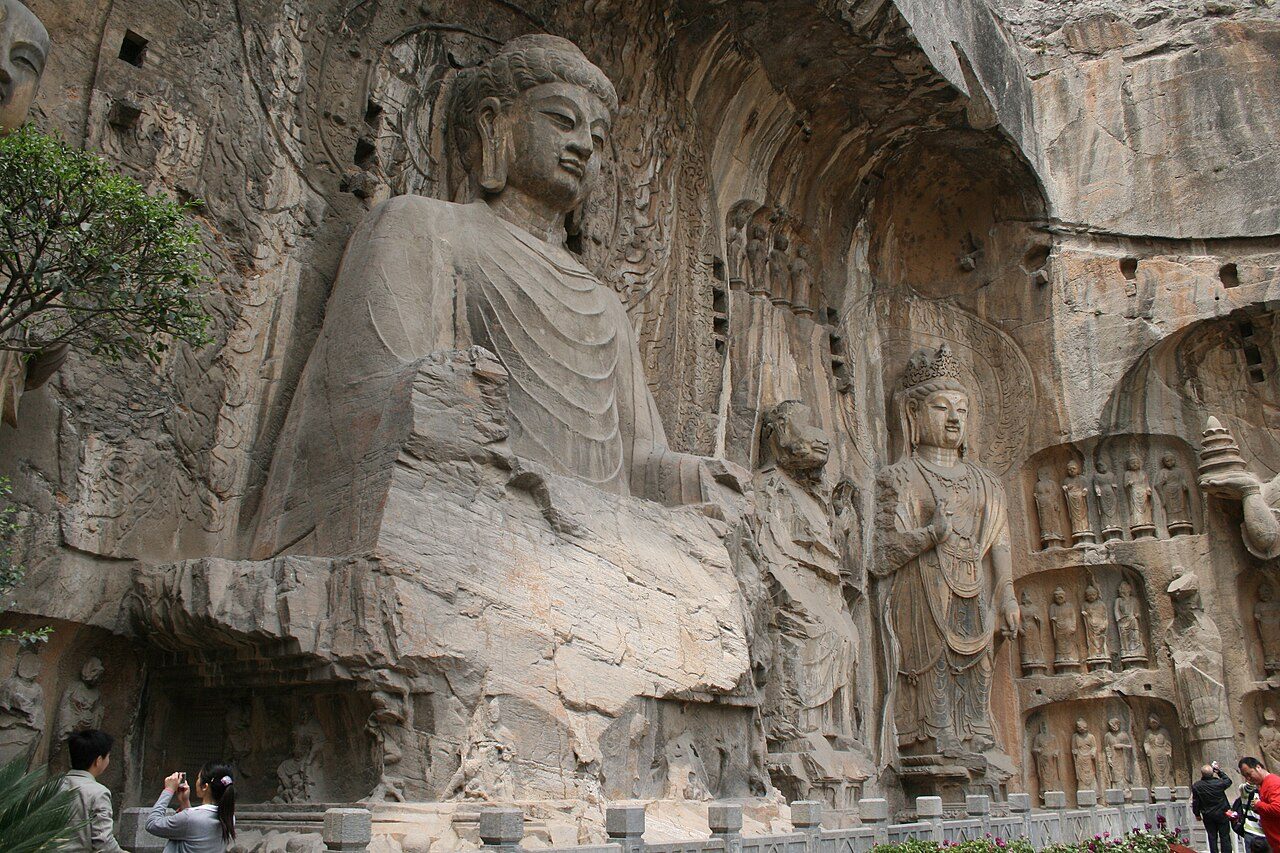
Steep stairs climb to the platform in front of the niche. Major conservation work on the rock and water seepage here was completed in 2022.
Guyang, Binyang and the calligraphy
North of Fengxian, the Binyang caves are the oldest large group. Emperor Xuanwu ordered them for his parents, and the Middle Binyang Cave took from 500 to 523; its main wall holds five large Northern Wei figures under a lotus ceiling. The South Binyang Cave was finished in 641 by Li Tai, a son of Tang Taizong, in memory of his mother, so you can compare two dynasties side by side.
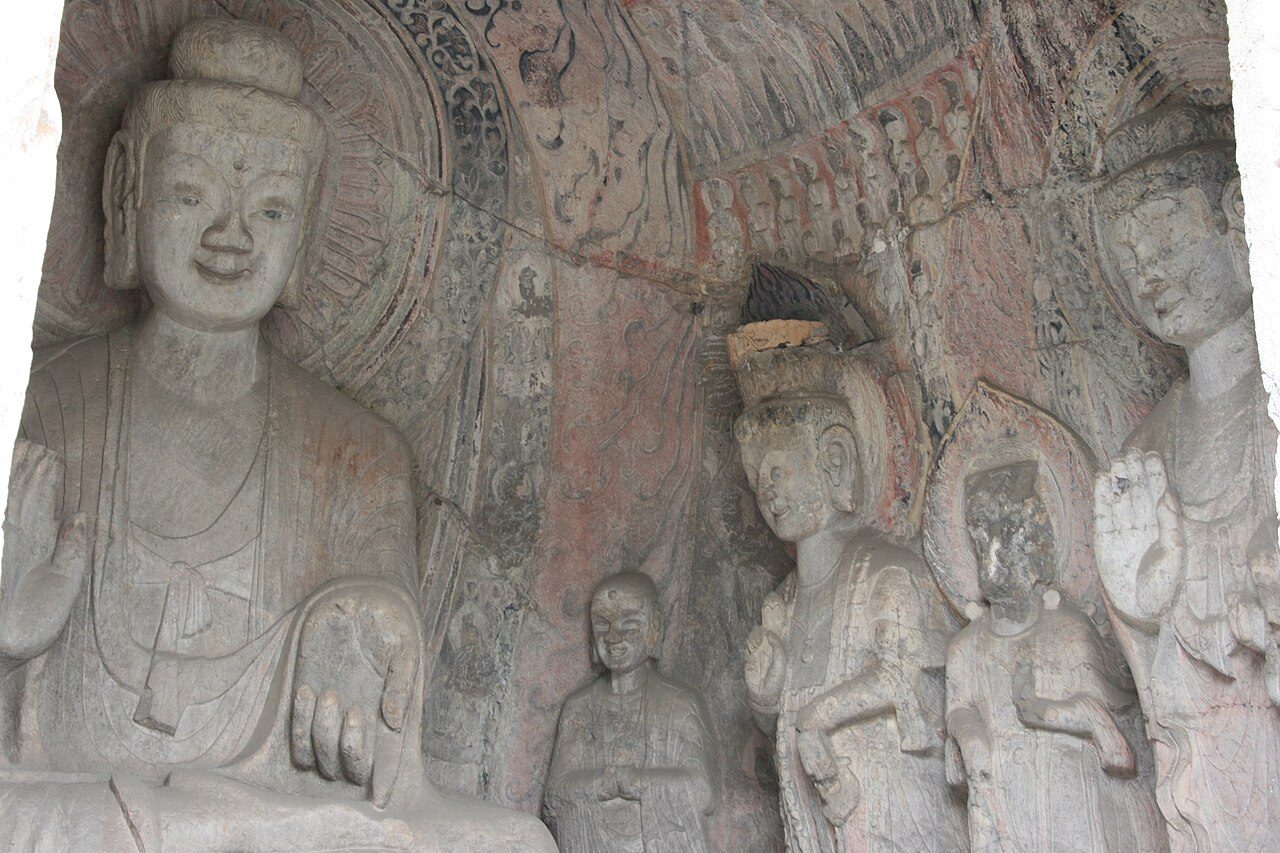
Guyang Cave, farther south on the West Hill, is among the earliest and is covered in donor inscriptions. Many of the Longmen Twenty, the most admired examples of Northern Wei inscription calligraphy, come from this cave. If you study the brush, this is the reason to come. The Wanfo, or Ten Thousand Buddhas, Cave and the Lotus Cave are also on the West Hill route.
East Hill, Xiangshan Temple and Bai Garden
A footbridge crosses the Yi to the East Hill, where carving is mostly Tang and later. Xiangshan Temple on the slope above has views back across the river to the West Hill, which is the best way to see the full spread of caves. Bai Garden holds the tomb of the Tang poet Bai Juyi, who spent his last years in Luoyang. Many people skip the east bank; it is quieter and gives the view the cliffs were made for.
Tickets, booking and night tour
The scenic area's official site lists the full-price ticket at 90 yuan, covering the West Hill, East Hill, Xiangshan Temple and Bai Garden, with half-price tickets for eligible groups. Daytime hours are about 08:00 to 18:00 from March to October and 08:00 to 17:00 in winter, with ticket sales closing earlier. Several 2026 guides report that booking is now online and real-name through the official WeChat accounts or major platforms, with passports accepted, and that slots open several days ahead. A night tour reopened on 30 March 2026 on a separate ticket, covering only the West Hill and Xiangshan Temple, with admission in the early evening. Check the day's notice for prices, booking windows and night-tour dates.
Getting there
Luoyang Longmen high-speed station is about four kilometres from the site. Bus 71 runs from the station, and a taxi takes ten to fifteen minutes. Buses 81 and others run from the old Luoyang railway station in the city. Inside, a shuttle cart links the northeast service area to the ticket gate; the northwest service centre is closer to the gate.
How long and when
Two to four hours covers the West Hill highlights, the bridge and the East Hill view. Go at opening to reach Fengxian before tour groups. Summer is hot on the exposed cliff path, so carry water and sun protection. Guanlin lies on the road back to the city and fits into the same afternoon, and the Luoyang Museum fills in the Northern Wei and Tang background.
Things to confirm before you go
- Your online booking and the opening hours for your date.
- Whether the night tour is running and what it covers.
- Bus or taxi times back from the site, especially after the night tour.
- Stair access at Fengxian Temple if anyone in your group has limited mobility.
Frequently asked questions
How much is the Longmen Grottoes ticket?
The official site lists 90 yuan full price, covering both hills, Xiangshan Temple and Bai Garden. The night tour is a separate ticket. Confirm on the official notice.
How long should I spend at Longmen?
Two to four hours for the West Hill, Fengxian Temple and a walk across to the East Hill.
Do I need to book in advance?
Yes. Several 2026 guides report real-name online booking with little or nothing sold on site. Book through the official channels or a major platform.
Is the night tour worth it?
It covers only part of the site and costs about as much as the day ticket. It is best as a second visit to see Fengxian lit up.
Sources
Facts in this article were checked against the following sources, retrieved 6 October 2026.
- Longmen Grottoes official site
- Longmen Grottoes, English Wikipedia
- 龙门石窟, Chinese Wikipedia
- UNESCO World Heritage Centre, Longmen Grottoes
- Longmen booking and night-tour notes, MyChina Guide
Photos are from Wikimedia Commons under the licences shown in each caption.