White Horse Temple: China's First Buddhist Temple, Halls and Pagoda
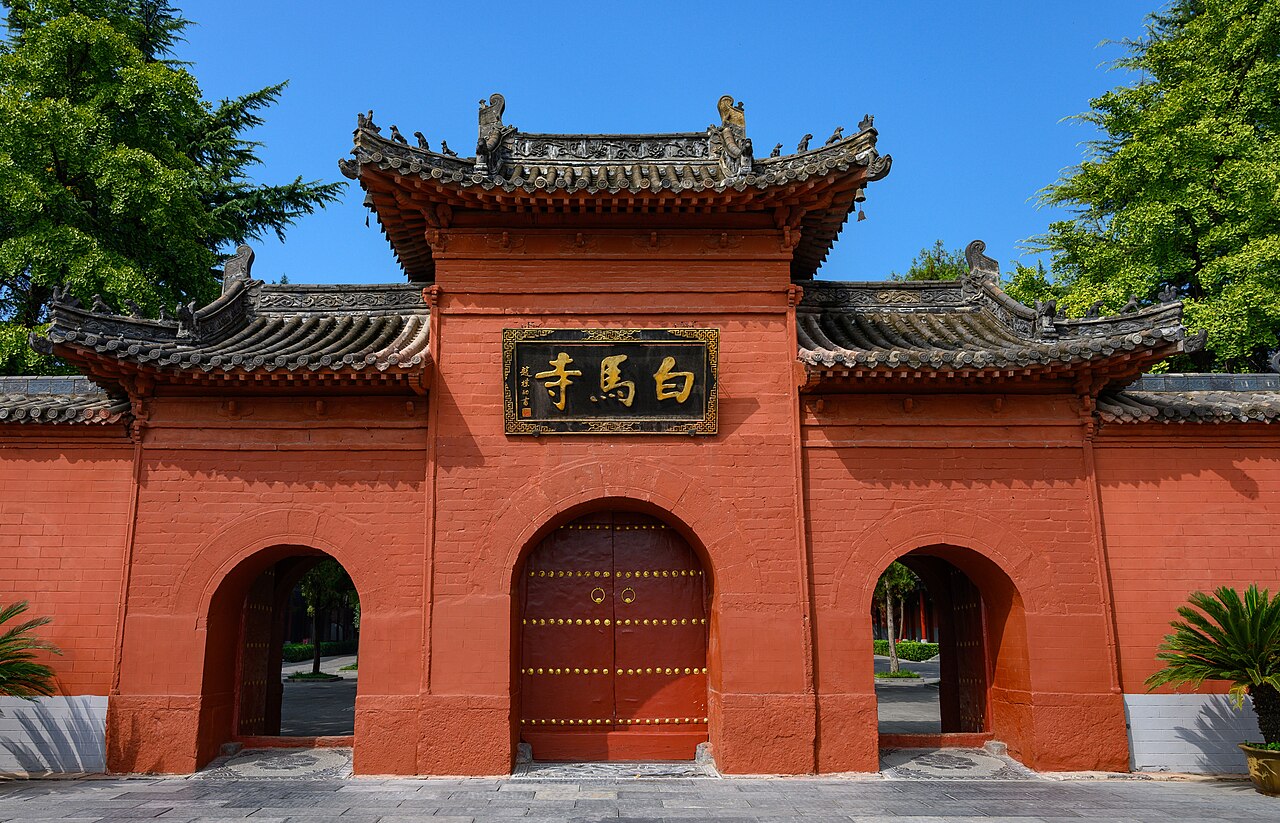
White Horse Temple stands east of Luoyang's old city, with the Mang Hills to the north and the Luo River to the south. Tradition dates it to AD 68, the eleventh year of the Yongping reign of Emperor Ming of the Eastern Han, which makes it the first Buddhist temple in China and the reason Chinese Buddhists call it the ancestral court and source of their faith. The temple is now a working monastery as well as a visitor site, and it was listed among China's first national protected monuments in 1961. It is the afternoon stop on day two of the Luoyang plan, after the Luoyang Museum.
The founding story
The story goes that Emperor Ming dreamed of a tall golden figure with light around his head. An adviser told him it was the Buddha of the West, and the emperor sent envoys to find out more. In the land of the Yuezhi they met two Indian monks, known in Chinese as Shemoteng and Zhu Falan (Kasyapa Matanga and Dharmaratna), who returned with them to Luoyang around 67, bringing scriptures and images on white horses. The emperor had a residence built for them outside the capital's gate. It took the word si from the name of the government guest office where they first stayed, and from then on si became the general word for a Buddhist monastery in Chinese. The horses gave the temple its name.
The monks are credited with translating the Sutra in Forty-two Sections, traditionally the first Buddhist scripture in Chinese, and they are said to be buried in the temple grounds. Historians treat the story with caution. The English Wikipedia article notes that contemporary records do not mention the temple before 289, and that other early temples carried the same name. What is certain is that Buddhism took root in Luoyang early and that this site has carried the founding story for a very long time.
The halls and their statues
The present buildings were largely set out in Ming and Qing rebuildings, notably in 1555 and 1713, and were restored again in the twentieth century. Five main halls stand one behind another on the north-south axis, the Hall of Heavenly Kings, the Hall of the Great Buddha, the Mahavira Hall, the Hall of Welcoming and the Vairocana Pavilion on Qingliang Terrace at the rear. The Mahavira Hall holds the temple's best treasure, a set of Yuan dynasty dry-lacquer figures including the Buddhas of the Three Ages, two heavenly generals and the eighteen arhats. Dry lacquer is built up from layers of cloth and lacquer over a core, and few Yuan examples survive.
Stone horses stand by the gate, and the tombs of the two monks are in the first courtyard. Local tradition counts six sights, including Qingliang Terrace, the monks' tombs, the Qiyun Pagoda, the platform where Buddhist and Daoist texts were supposedly tested by fire, a broken stele and the midnight bell.
The Qiyun Pagoda
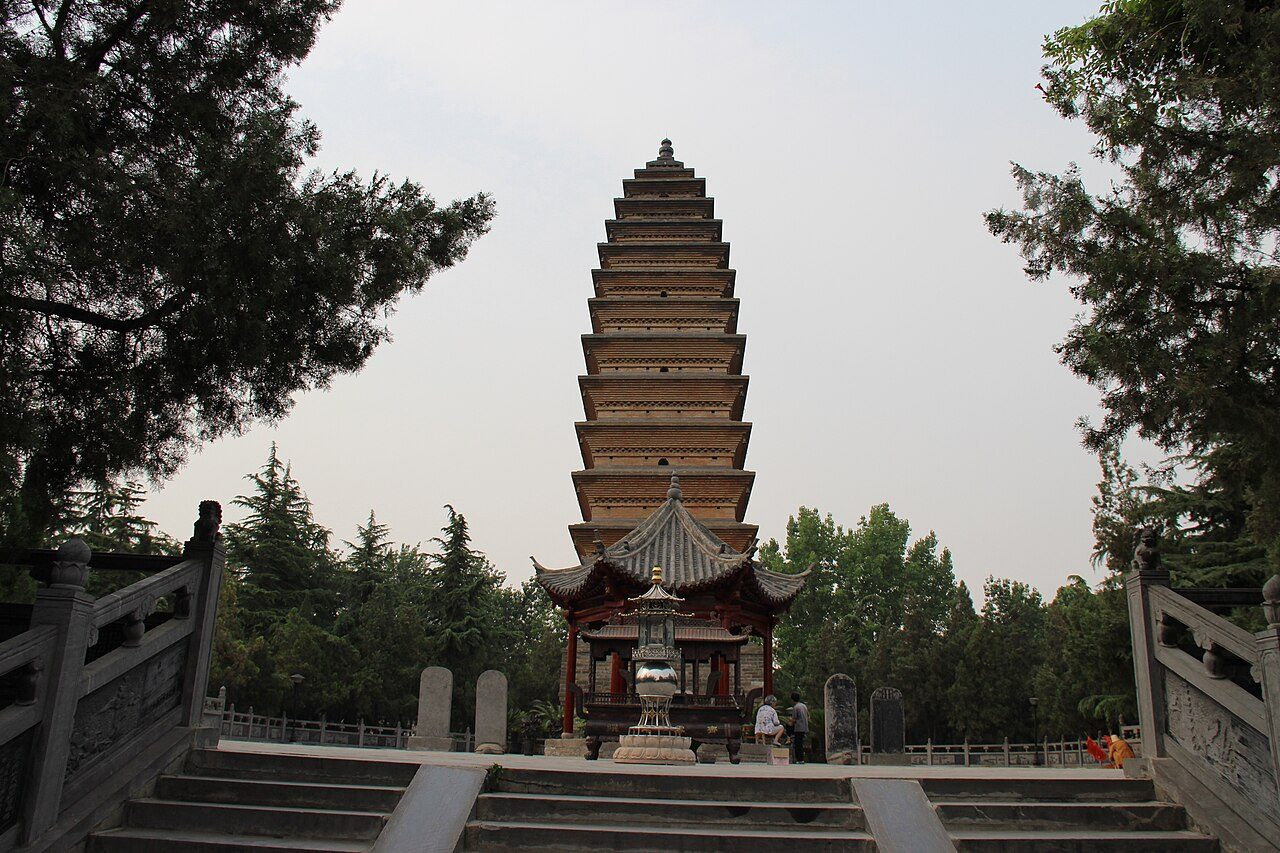
Just east of the main compound stands the Qiyun Pagoda, a square brick tower of thirteen storeys built in 1175 under the Jin dynasty, which makes it one of the oldest standing structures in the area. It sits in its own walled precinct, part of the temple's nunnery, and is a quiet place compared with the main axis.
The international halls
West of the main temple, a newer area holds Buddhist halls built with other Asian countries. An Indian-style hall modelled on the Sanchi stupa and Sarnath Buddha was completed in a project with India in 2008, and Thai and Myanmar-style halls stand nearby. They make an odd and interesting contrast, two thousand years after monks came from the west on horseback.
Tickets and hours
The Chanhe district government lists the ticket at 35 yuan, with summer hours from 07:40 to 18:30 and winter hours from 08:00 to 17:30. Local listings say entry runs on timed, real-name online booking through the temple's official account, opened several days ahead, and that visitors should not come without a booking. Ask about access to the Qiyun Pagoda precinct and the international halls on the day, since rules vary. Check the official notice for your date.
Getting there
The temple is about twelve kilometres east of the city centre. Bus 56 from Luoyang railway station takes forty to sixty minutes. A taxi or ride-hail from the centre takes about half an hour. White Horse Temple sits on the opposite side of the city from Longmen and Guanlin, so do not try to fit all three into one day.
Etiquette
This is an active monastery. Keep voices low in the halls, follow posted rules on photography inside, and do not step on raised thresholds. Monks and lay worshippers have right of way at altars. Modest clothing is appropriate.
Things to confirm before you go
- Your timed booking and the season's hours.
- Whether the pagoda precinct and the international halls are open.
- Bus 56 departure point at Luoyang station and the last bus back.
Frequently asked questions
Is White Horse Temple really the first Buddhist temple in China?
Tradition dates it to AD 68 and calls it the first. Historians note that the earliest contemporary records of the temple are later, but it remains the traditional founding site.
How much is the White Horse Temple ticket?
The local government lists 35 yuan full price. Confirm on the official notice, and book a timed slot in advance.
How long should I spend here?
Two to three hours covers the main axis, the pagoda and the international halls.
How do I get to White Horse Temple?
Bus 56 from Luoyang railway station, or a taxi of about half an hour from the city centre.
Sources
Facts in this article were checked against the following sources, retrieved 6 October 2026.
- 白马寺, Chinese Wikipedia
- White Horse Temple, English Wikipedia
- Chanhe Hui District government, scenic area ticket policy
- Luoyang Bendibao, White Horse Temple booking notes
Photos are from Wikimedia Commons under the licences shown in each caption.