Badaguan, Qingdao: A Walking Route Through the Villa District
Badaguan is the best place in Qingdao for an unhurried walk. It is a quiet grid of villas, lawns and tree-lined streets on the coast between the No. 1 and No. 3 bathing beaches, free and open all day. A loop of two to three hours covers it. Start from the No. 1 Beach side, walk a few of the planted roads, and finish at Huashi Lou, the stone "flower-stone building" on the shore, which is one of the few houses you can go inside. Spring blossom and autumn leaves are the best seasons. Summer brings beach crowds and wedding shoots on every corner. The name means "eight great passes", because the streets are named after the famous fortified passes of ancient China, from Jiayuguan in the far west to Shanhaiguan on the Bohai coast. The Qingdao travel guide puts Badaguan on the first afternoon, after Zhanqiao Pier.
Which street, which season
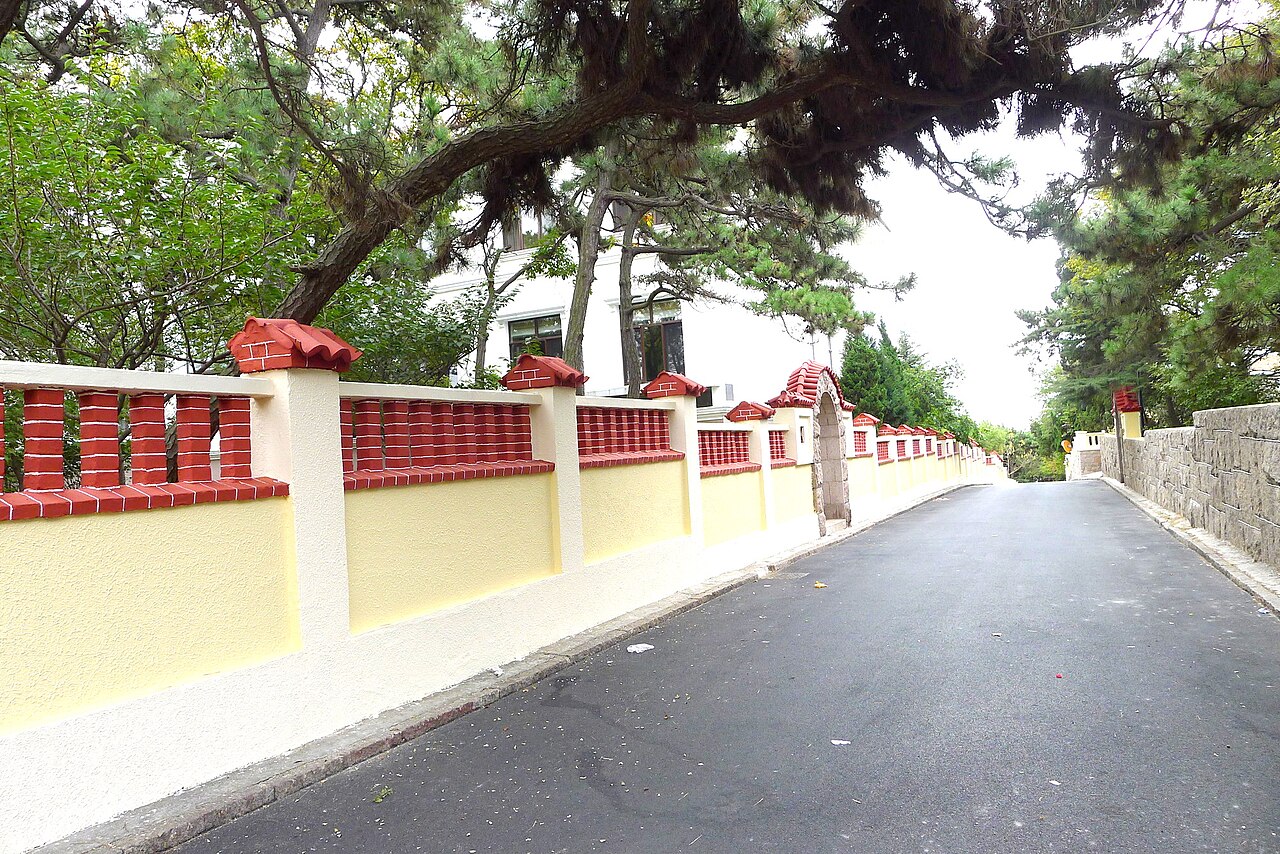
Despite the name there are ten roads, not eight. Three run north to south (Zijingguan, Ningwuguan and Shaoguan) and seven east to west (Wushengguan, Jiayuguan, Hanguguan, Zhengyangguan, Linhuaiguan, Juyongguan and Shanhaiguan). Each was planted with its own species, so the season decides which streets to walk:
| Season | Street | Tree |
|---|---|---|
| Spring | Shaoguan Road | Flowering peach |
| Spring | Ningwuguan Road | Crabapple |
| Summer | Zhengyangguan Road | Crape myrtle |
| Autumn | Juyongguan Road | Maple |
| All year | Zijingguan Road | Cedar |
Chinese writers call Badaguan a "street of flowers" because something is in bloom from early spring to late autumn. Autumn, when the maples turn and the summer crowds have gone, is often recommended as the best time of all.
A two-to-three-hour loop
- Enter from the No. 1 Bathing Beach side in the west, coming along the coast from Zhanqiao or by bus or taxi to the beach.
- Walk north up one of the planted roads, Shaoguan in spring, and zigzag through two or three of the east-west streets.
- Cut east along Juyongguan Road past the Princess Building at No. 10.
- Drop south down Zijingguan Road under the cedars to the sea.
- Finish at Huashi Lou on Huanghai Road, beside the No. 2 Bathing Beach. From there the coast path continues east toward Taiping Cape.
The streets have little traffic. Some roads are used by official vehicles and guests, and certain gates are closed to the public, so keep to the open streets and respect "no entry" signs. Wedding photographers are everywhere in fine weather, and you will sometimes need to wait for a shoot to finish at the popular corners.
Huashi Lou
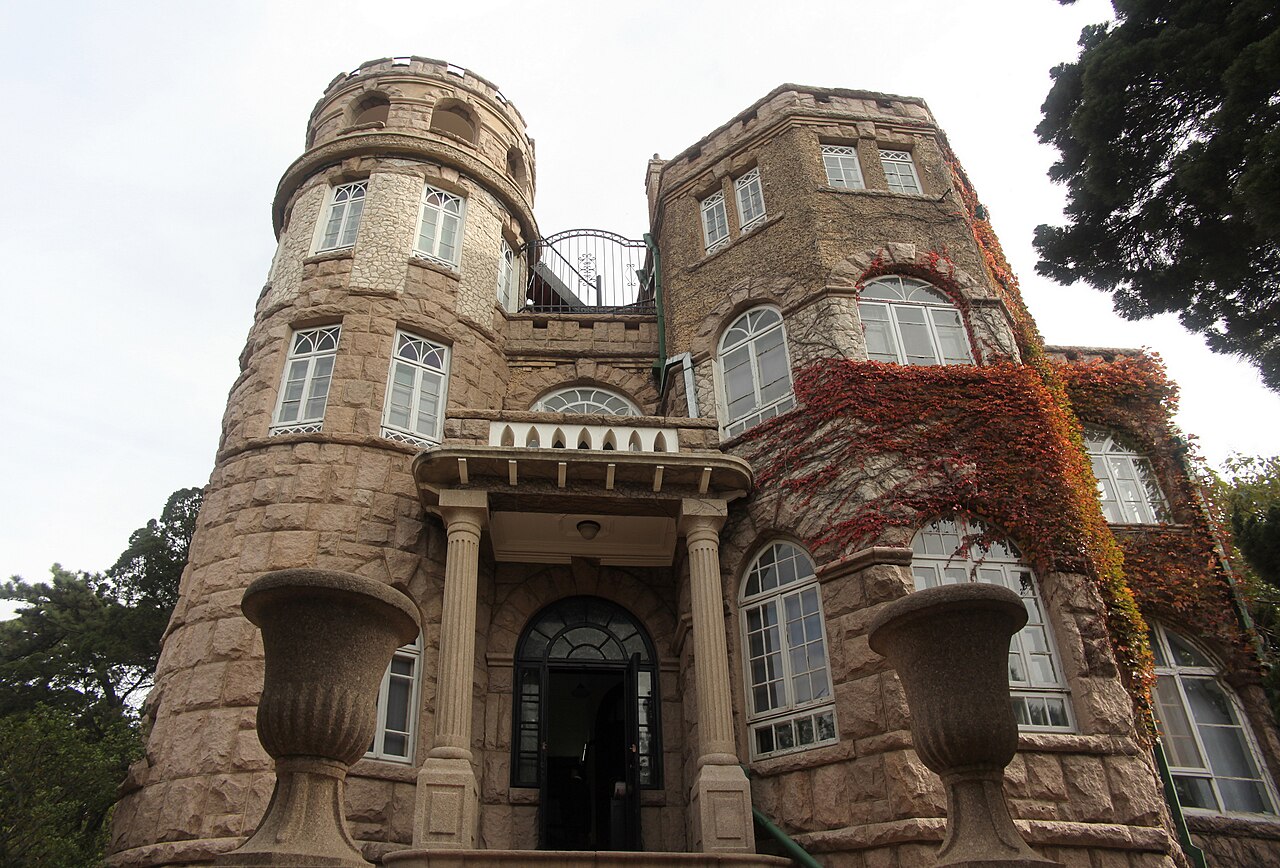
The best-known building in the district stands at the seaward end of Zijingguan Road. Huashi Lou was built in 1932 for a Russian merchant and designed by Liu Yaochen in a mix of Gothic and Russian styles, with walls of different coloured stone that give it its name. It later passed to British owners and served as the residence of the British consul-general, and Chiang Kai-shek stayed here in the late 1940s.
Recent guides list a ticket of 8.5 yuan and hours of about 08:30 to 17:30, closing earlier in winter, with sales stopping an hour before closing. The upper windows look over the beach and the bay, and it is the one interior worth paying for if you only choose one.
The Princess Building and other interiors
The Princess Building at 10 Juyongguan Road got its name from a story that it was built to receive a Danish princess. In fact it was a German merchant's villa, but the name stuck. Recent listings give a 20-yuan ticket, or a combined ticket of about 50 yuan that adds the Butterfly Building and a nearby Spanish-style house. Hours shift by season, so check on the day. Most other villas are government guesthouses, offices or private homes, and you see them from the street.
How the district was made
A few of the houses date from the German period of 1897 to 1914, but most were built in the 1930s. Between 1931 and 1937, under mayor Shen Honglie, the city marked out the land east of Rongcheng Road as a special building zone with strict rules. Building density was kept under 50 percent, green space was protected, and fences had to be see-through instead of solid walls. Those rules are why the district still feels open, with gardens visible from the street. More than 200 houses in the styles of over twenty countries stand in about 66 hectares. In 2001 the district's modern buildings were listed as a nationally protected site, and in 2005 a Chinese National Geography poll named it one of China's most beautiful urban districts.
Getting there and what comes next
Many city buses stop along the coast roads at the edge of the district, and taxis drop off at the beaches. From Zhanqiao Pier the coast walk east passes Lu Xun Park and the No. 1 Beach before reaching Badaguan. It is long but rewarding in cool weather. Carry on east past the No. 3 Beach and you are heading toward May Fourth Square for the evening. Keep the Tsingtao Beer Museum and Mount Lao for other days.
Frequently asked questions
Is Badaguan free?
Yes. The streets are free. Only a few villas, such as Huashi Lou and the Princess Building, charge for entry.
How long should I spend in Badaguan?
Two to three hours for a relaxed loop that includes Huashi Lou. Half a day if you add the beaches.
When is the best time to visit Badaguan?
Spring for blossom and autumn for coloured leaves and fewer people. Summer is busy because of the beaches.
Why are there ten roads if the name means eight passes?
"Eight passes" is the traditional name, not a count. Ten roads carry the names of passes: three running north to south and seven east to west.