May Fourth Square, Qingdao: Wind of May and the Fushan Bay Light Show
Come to May Fourth Square at dusk. The open plaza on Fushan Bay is a wide, shadeless expanse of paving at midday, but as the light fades the towers around the bay come on. On show nights they run a coordinated light display across their facades, with the 30-metre red steel spiral "Wind of May" in the foreground. Take Metro Line 2 or 3 to May Fourth Square station, walk the seafront east to the Olympic Sailing Center breakwater as the sun goes down, and come back for the show. The square is free and open around the clock. It covers about ten hectares from the city government building down to the sea, and it anchors the eastern business district the way Zhanqiao Pier anchors the old town. The Qingdao travel guide gives it the second evening.
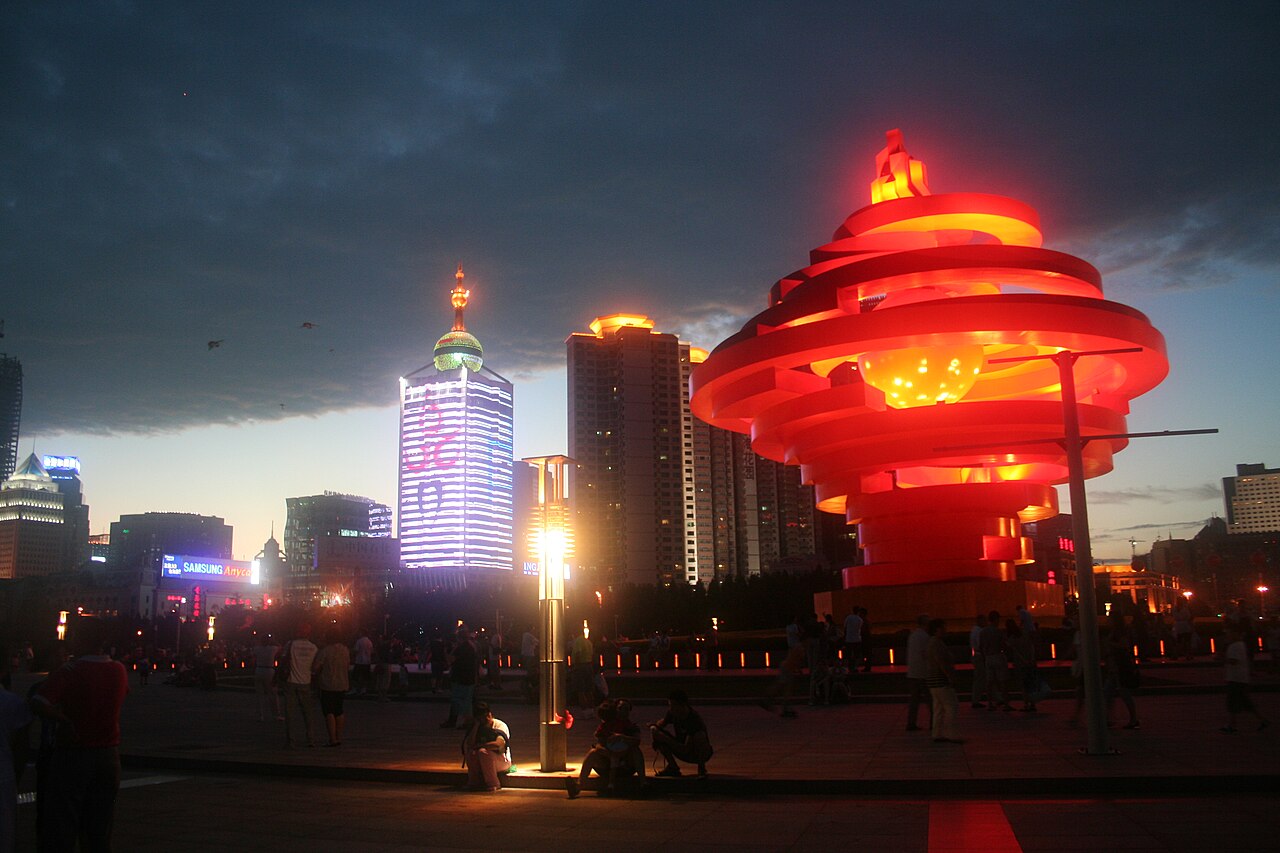
The light show: when it runs
The buildings around Fushan Bay are wired as one enormous screen. Schedules change with the season and occasion, and they are the main thing to check before you plan an evening here. For the 2026 National Day holiday, the city announced a themed programme every night from 30 September to 7 October, 18:30 to 22:00. Outside holidays the show may run on fewer nights or for a shorter window. Look for the official Qingdao announcements for your dates.
The square itself is the obvious viewing spot, and the busiest. Local guides suggest the breakwater at the Olympic Sailing Center and the No. 3 Bathing Beach for more space. On big holiday nights, parts of the square may be fenced off for crowd control, and traffic on the surrounding roads is heavy. Sea fog, common in early summer, can hide the towers completely.
Why it is called May Fourth
The May Fourth Movement of 1919 began over Qingdao. Germany had held Jiaozhou Bay since 1897, and Japan took it in 1914 during the First World War. At the Paris Peace Conference, China, which had joined the Allies, asked for Shandong back. Instead, Article 156 of the Treaty of Versailles transferred Germany's rights in Shandong, Qingdao included, to Japan. On 4 May 1919 students marched in Beijing in protest. It was the start of a nationwide movement that pushed the Chinese delegation into refusing to sign the treaty. Qingdao came back under Chinese administration in 1922.
The square was built in the late 1990s, as the city moved east to a new business district, and named to commemorate that defence of Qingdao's sovereignty. Donghai West Road divides it. The northern half faces the government building. The southern half, where the sculpture stands, is on land reclaimed from the sea in 1994.
Wind of May
The sculpture by Huang Zhen is meant to suggest a whirlwind rising from the ground, the energy of the movement. It is 30 metres high and 27 metres across and weighs over 500 tonnes, which Chinese sources cite as the largest steel urban sculpture in the country. Up close it is a stack of twisting red bands. From the seawall or a boat it reads as a single swirl.
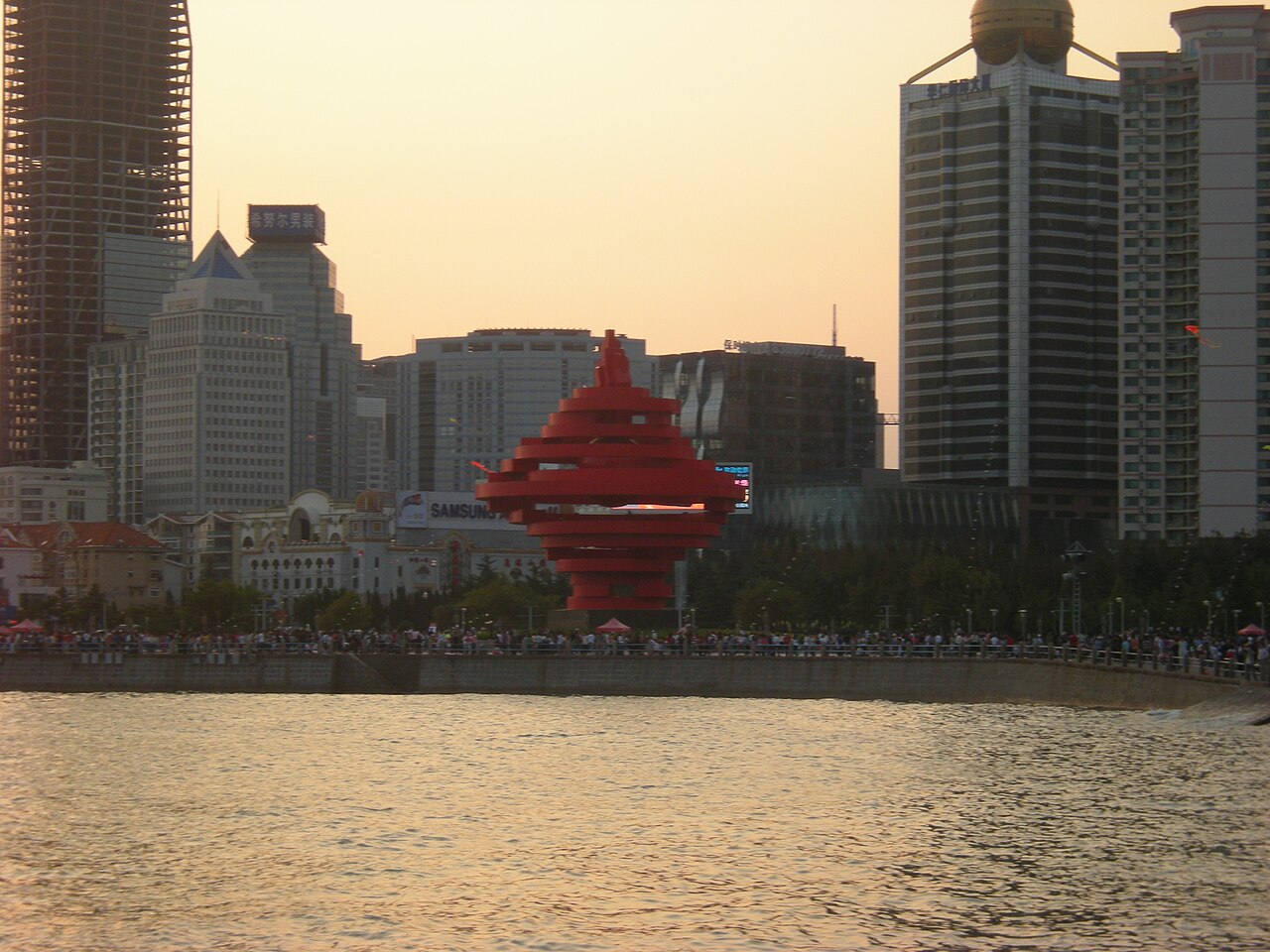
A second, smaller monument went up in 2018 for the Shanghai Cooperation Organisation summit held in Qingdao on 9 and 10 June that year. On clear weekends, kite flyers and families fill the square.
The Olympic Sailing Center
The sailing events of the 2008 Beijing Olympics were held in the waters off the square. The marina built for them, the Qingdao Olympic Sailing Center, sits just east along the promenade and is now a public waterfront with yachts, cafes and a long breakwater. Walking from the sculpture to the end of the breakwater and back takes about an hour and is the best part of an evening here. Short harbour cruises and sailing taster sessions are sold at the marina. Prices and departures belong to the operators, so check on the day.
Getting there
- Metro: Lines 2 and 3 meet at May Fourth Square station, at the northwest corner of the square, and local guides point to Exit C. Line 3 runs straight here from Qingdao station in the old town.
- Bus: many routes stop on Donghai West Road and Hong Kong Middle Road.
- Taxi: drop-offs are on the surrounding roads, but expect slow traffic on show nights.
Timing an evening
- Late afternoon: arrive and look at the sculpture while there is still daylight on the red steel.
- Sunset: walk the seafront east to the sailing centre breakwater.
- Show time: stay on the breakwater or walk back to the square.
- Dinner: the malls along Hong Kong Middle Road, just inland, are the practical choice.
On a summer day, avoid the middle hours, because there is almost no shade. Badaguan and the bathing beaches lie between the old town and here, so you can link them on a long coastal walk. The Tsingtao Beer Museum is across town in Shibei, and Mount Lao needs a full day of its own.
Frequently asked questions
Is May Fourth Square free?
Yes. The square, the seawall and the light show are all free to see.
What time is the Qingdao light show?
It varies. During the 2026 National Day holiday it ran from 18:30 to 22:00 every night. On ordinary dates, check the official Qingdao announcements.
What is the nearest metro station to May Fourth Square?
May Fourth Square station, where Lines 2 and 3 meet. Exit C is the usual one for the square.
How long should I spend at May Fourth Square?
Thirty minutes for the sculpture, or about two hours with the walk to the Olympic Sailing Center and the light show.