Zhanqiao Pier, Qingdao: Huilan Pavilion and the Old Iron Pier
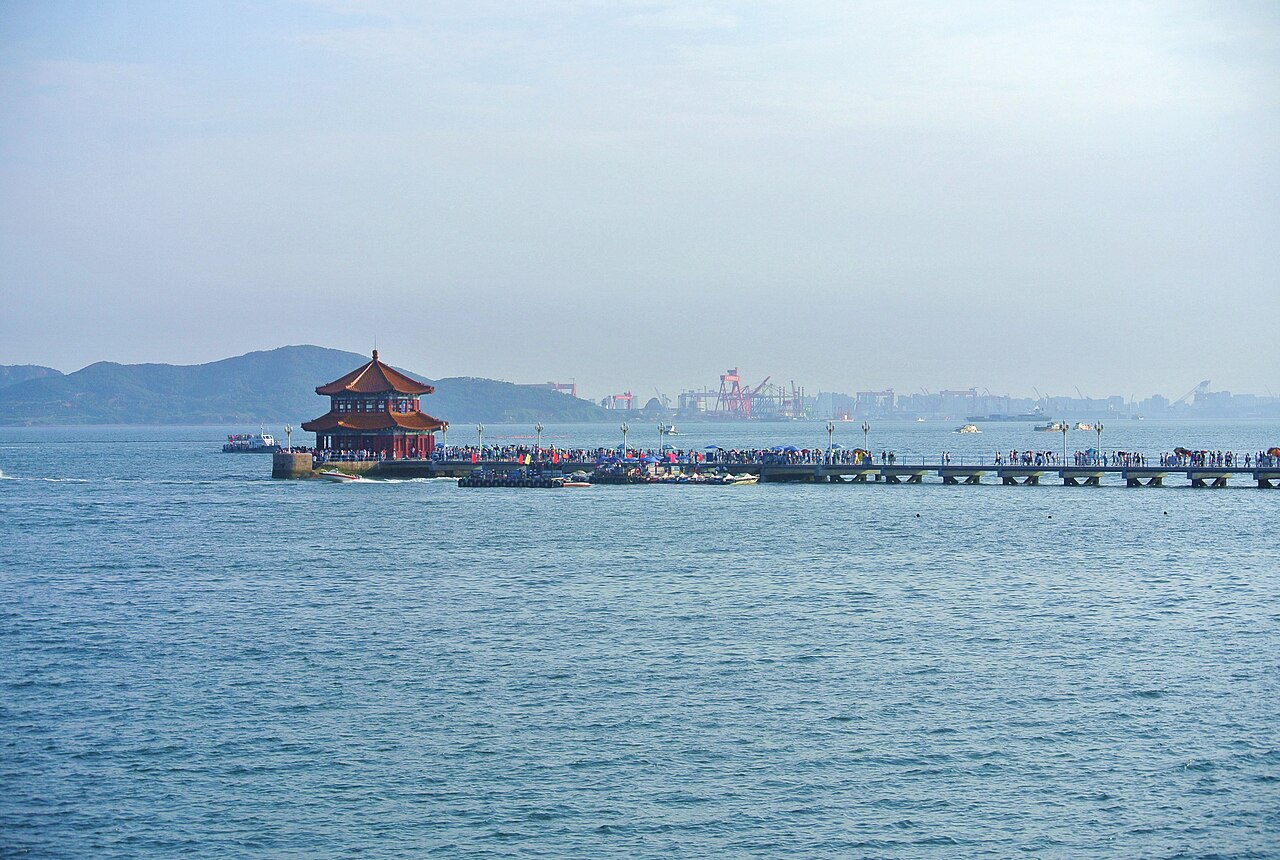
Zhanqiao Pier is the stone-and-steel pier reaching into Qingdao Bay from the old town, with the octagonal Huilan Pavilion at its tip. It is the building on every Tsingtao beer label. The pier is free and open at all hours, and walking out and back takes half an hour. The entrance on Taiping Road is a few minutes on foot from Qingdao station, the terminus of Metro Line 3. Come early in the morning for space, after dark for the floodlights, or in winter for the gulls. Most first visits to Qingdao start here, and the Qingdao travel guide builds the first day around it.
When to go
The pier changes more with the season and the hour than most sights.
- Early morning is the calmest time. By mid-morning, tour groups from the station area arrive, and on holidays the pavilion island becomes a crush.
- Summer, especially July and August, brings the heaviest crowds. The shore beside the pier fills with paddlers, and the walkway is packed into the evening.
- Winter brings large flocks of gulls into Qingdao Bay, and feeding them from the pier is a local winter habit.
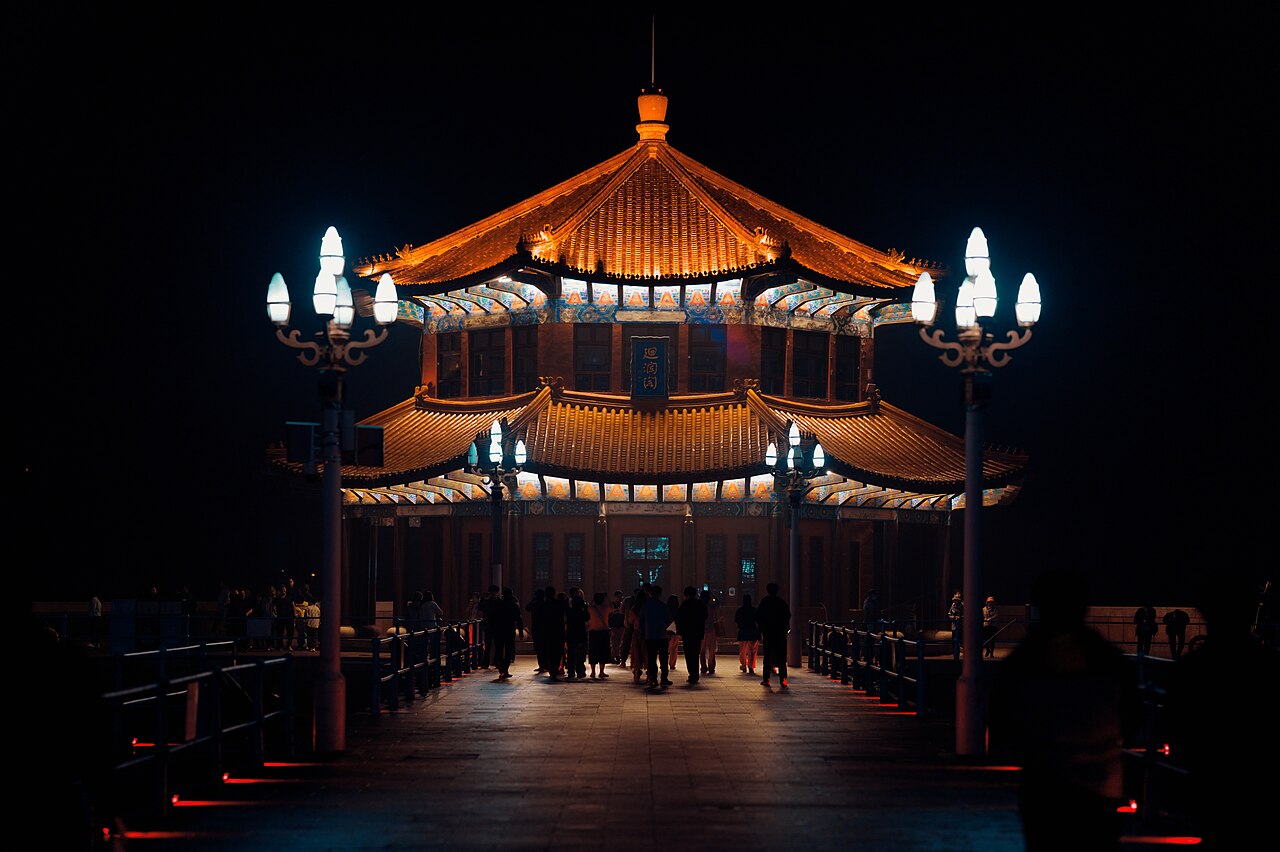
- Night: the pavilion and the waterfront buildings are floodlit. On the walk back you see the old town's red roofs and church spires lit up behind the bay.
Wind and spray can make the open trestle unpleasant, and storms sometimes close it. On holiday peaks the walkway narrows to single file.
A pier older than the city
Qingdao dates its founding to 14 June 1891, when the Qing court approved new coastal defences at Jiaozhou Bay. The next year the Dengzhou garrison commander Zhang Gaoyuan arrived with four battalions and began building, and the pier was one of his projects. Qing documents called it the "Iron Pier". Research by Qingdao historians suggests construction began in 1892 or 1893 and was finished only around 1899, after Germany had seized the bay in November 1897. Its steel sections were made at the Chinese naval yard at Lüshun (Port Arthur) and assembled by Chinese engineers, as a German official recalled in a 1910 lecture on the city's history.
The Germans called it the Tsingtau-Brücke or Landungsbrücke, the landing bridge. The name "Zhanqiao" arrived with Japanese documents after Japan took Qingdao in 1914. In the early 1930s the pier was rebuilt and Huilan Pavilion was added at the end. From then on it was the city's symbol.
How long it really is
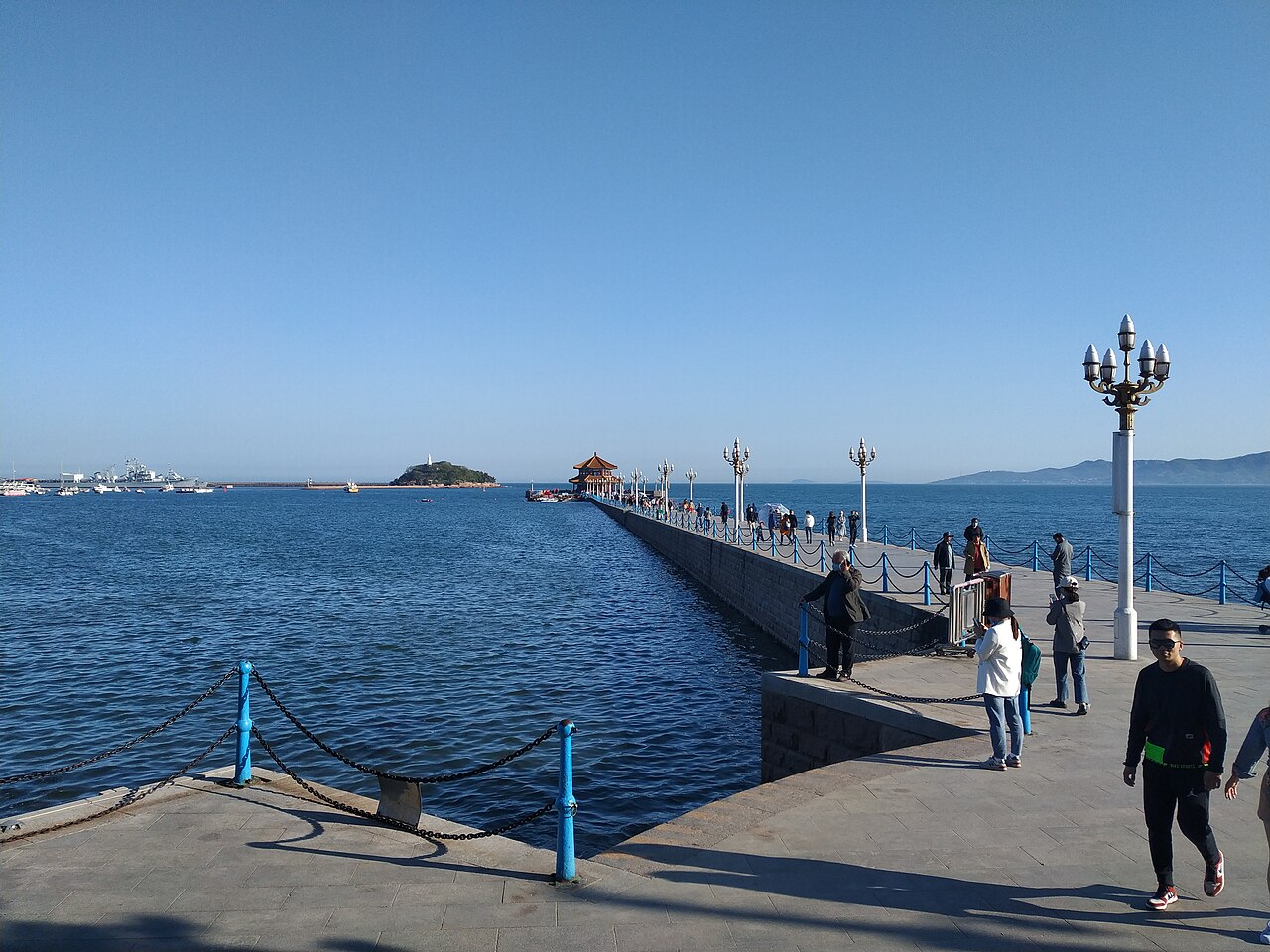
You will see several lengths quoted. A GPS survey in November 2012 measured it precisely: a solid embankment 216 metres long and 8 metres wide, then an open trestle of 147.3 metres, ending at a small artificial island 27.2 metres long that carries the pavilion. That makes 390.5 metres in all. Older and English-language sources often give longer figures, including 440 metres, from before the survey.
Huilan Pavilion is an eight-sided building with flying eaves and blue glazed tiles, ringed by 24 round columns. Inside, a spiral staircase of 34 steps leads to the upper floor. Whether the interior is open, and whether it is hosting an exhibition, has varied over the years, so check on the day.
Getting there
Walk from Qingdao station, the terminus of Metro Line 3, which also links Qingdao North station and May Fourth Square. Many city buses stop along Taiping Road. Driving is a poor idea in summer, because parking around the old town is scarce. By taxi, ask for Zhanqiao (栈桥). The drop-off along Taiping Road is busy, so get out where the driver can stop safely and walk the last stretch. If you arrive by train at Qingdao station, the pier is close enough to visit before you check in, as long as you are not dragging a large suitcase through the holiday crowds.
A half-day around the pier
The pier takes half an hour. These nearby stops turn it into a morning:
- Zhongshan Road. Laid out in 1897 as the German Friedrichstrasse, it runs inland from the pier into the old commercial district. Walk up it to St. Michael's Cathedral on the hill above.
- The coast east. Follow the shore past the China Navy Museum toward Little Qingdao, the small island with the white lighthouse you can see from the pier.
- On to the beaches. Keep going east and you reach Lu Xun Park, the No. 1 Bathing Beach and the villa streets of Badaguan, a good afternoon after a morning here.
The Tsingtao Beer Museum is a short ride north, the obvious follow-up once you have seen the pavilion on the label. For the modern city, May Fourth Square on Fushan Bay is the evening counterpart, a direct ride on Line 3. Keep Mount Lao for a separate day.
Frequently asked questions
Is Zhanqiao Pier free?
Yes. The pier and the promenade are free and open at all hours.
How long do I need at Zhanqiao Pier?
Thirty to forty-five minutes for the pier. Combine it with Zhongshan Road and the coast walk for a half day.
Is this the pier on the Tsingtao beer label?
Yes. The label shows Huilan Pavilion at the end of Zhanqiao.
How long is Zhanqiao Pier?
A 2012 survey measured it at 390.5 metres, including the 216-metre embankment, the trestle and the pavilion island.