Mount Lao (Laoshan): Qingdao Day Trip, Zones and Booking
Mount Lao is a full day out from Qingdao, and it has to be planned in two steps. First book a real-name ticket for one specific zone, up to seven days ahead. Then reach that zone's transfer centre and board the scenic shuttle buses. For a first visit, choose one of two zones on the south line. The Taiqing line covers the great Daoist temple by the sea with little climbing. The Jufeng line climbs to the summit area for mountain and sea in one view, best on a clear day. Both start from Metro Line 4's Dahedong station, about an hour from central Qingdao. The mountain rises straight out of the Yellow Sea about 30 kilometres east of the city centre. Its main peak, Jufeng, reaches 1,132.7 metres, and because the granite falls almost directly into the water it is often called the highest coastal mountain in China. An old Shandong saying ranks it above Mount Tai: "Tai may be high, but it is no match for Lao by the Eastern Sea." The city plan is in the Qingdao travel guide.
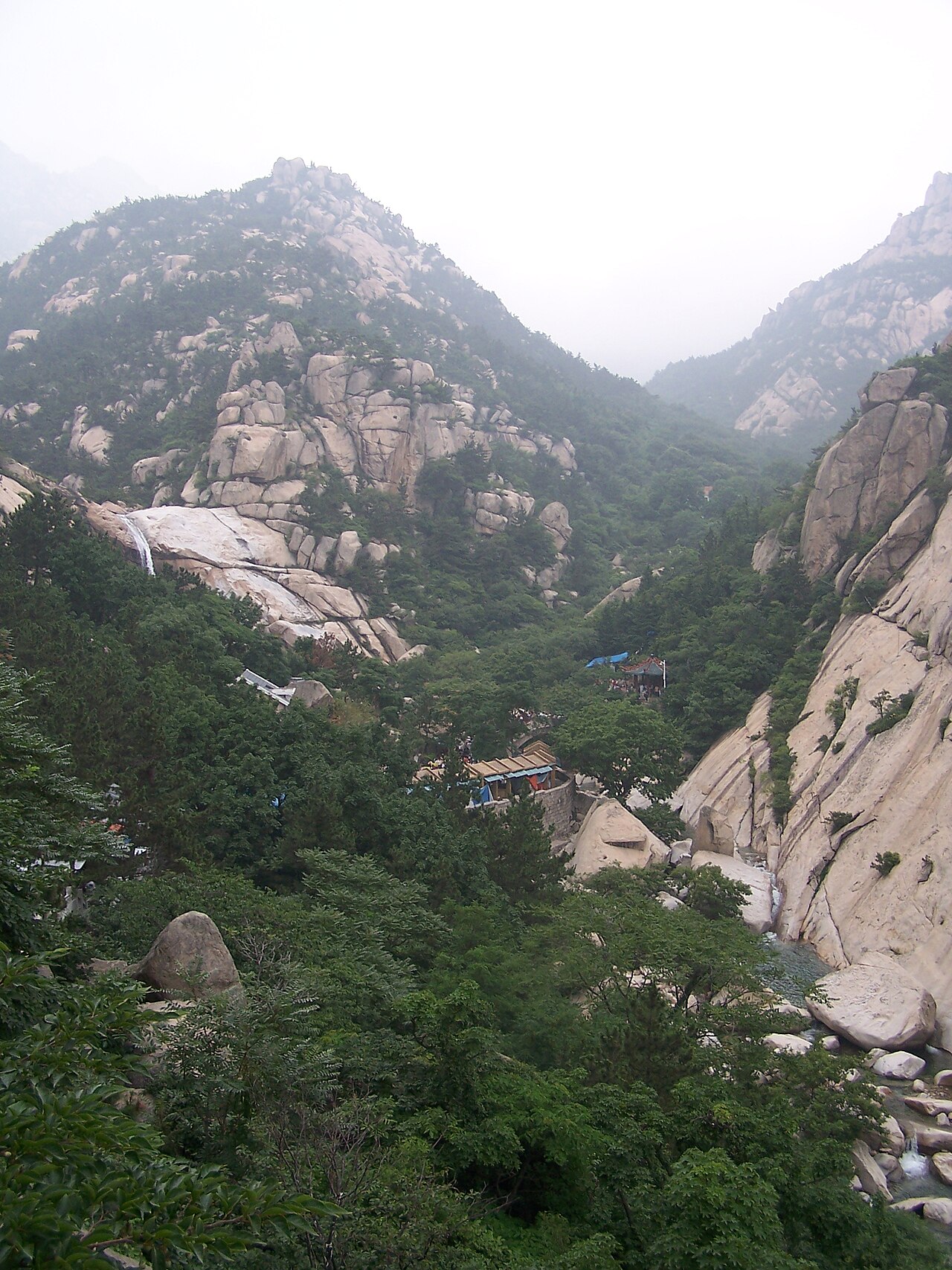
The zones
The scenic area is divided into separate zones, each with its own shuttle buses and its own ticket:
| Zone | What you get | Best for |
|---|---|---|
| South line: Taiqing | Taiqing Palace and the sea coves; a cable car serves the hills above | First visits, temples, less climbing |
| South line: Jufeng | The summit area of the main peak, widest mountain-and-sea views | Clear days, more walking |
| North line: Jiushui and Hualou | Valleys with streams, pools and waterfalls | Summer, when it is cooler |
| East line: Yangkou and Huayan | Rock formations, a Buddhist temple, long coastline | A second visit |
The shuttle network lets you combine zones, but time on buses and in queues adds up fast. For one day, pick Taiqing or Jufeng, not both.
Getting there in 2026
The scenic area's spring 2026 notice gives these public-transport routes:
- South line (Taiqing and Jufeng): Metro Line 4 to Dahedong station, Exit A, which leads to the Dahedong visitor centre. Scenic shuttles run from there to both zones.
- North line (Jiushui and Hualou): the Langu express line to Beijiushui station, Exit B, for the Jiushui transfer centre.
- East line (Yangkou and Huayan): the Langu express line to Puli station, Exit A, then bus 620 or 926 to Yangkou.
Allow about an hour each way from central Qingdao. Drivers generally park at the transfer centres and change to the scenic shuttle, so the shuttle is part of the plan whichever way you come. Before you set off up the mountain, find out when the last shuttle goes back to Dahedong or Beijiushui.
Booking, tickets and hours
Entry is real-name and must be booked online. Booking opens seven days ahead on the official WeChat accounts or the major travel platforms. Each zone has a daily cap, and once it is reached there are no more tickets, which happens on holidays. Tickets are zone-specific, so book the zone you will actually visit.
The 2026 opening hours are:
- April to June and September to November: 07:00 to 17:30
- July and August: 06:00 to 19:00
- December: 07:30 to 17:00
Prices differ by zone and season. Peak season runs from 1 April to 31 October, and shuttle buses and cable cars cost extra. Third-party listings for 2026 put peak-season entry to the Jufeng zone around 80 yuan, lower off-season, but the official notice publishes prices only as an image. Check the official account for your zone and date.
Taiqing Palace
Taiqing Palace, also called the Lower Palace, is the largest and best-known temple on the mountain, set in a cove at the southern foot close to the sea. Its records trace it to a shrine founded in 140 BC. It was rebuilt around 980, and in 1983 it was named one of China's key Daoist temples. In the late sixteenth century the Buddhist master Hanshan built a monastery in front of it, which started a long property dispute. In 1600 the Ming court ordered the monastery destroyed and the Daoists restored. The present layout of three separate courtyards, for the Three Officials, the Three Pure Ones and the Three Emperors, dates from 1622.
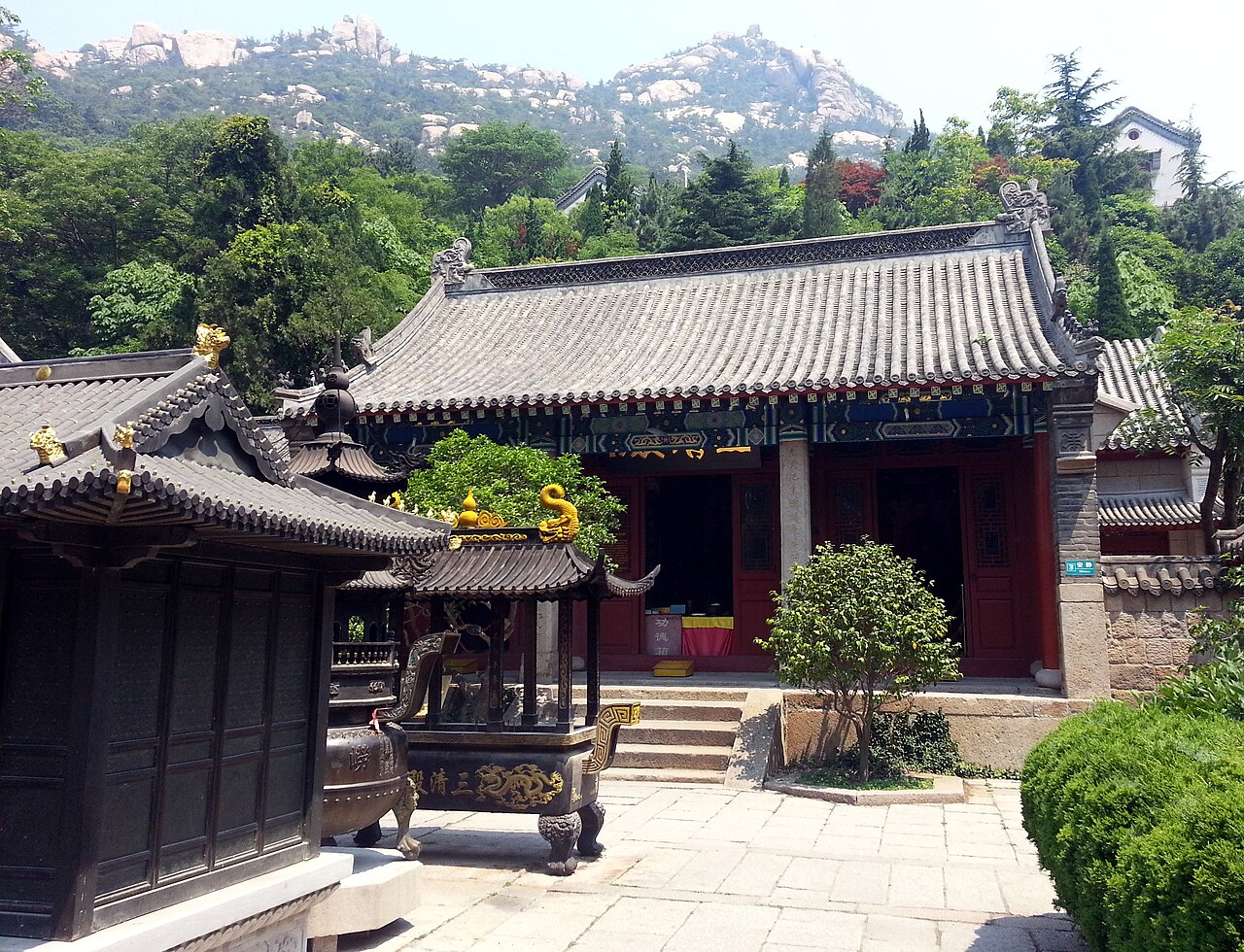
Look at the old trees as well as the halls. Two cypresses in front of the Three Emperors Hall are said to date from the Han. In the courtyard of the Three Officials Hall grows a camellia more than 500 years old. The Qing writer Pu Songling turned it into a flower spirit in his story "Xiangyu", one of two Laoshan tales in Strange Stories from a Chinese Studio. The other, "The Taoist Priest of Laoshan", is the one most Chinese readers remember from school. The temple also has the Shenshui spring, and a tall bronze Laozi stands on the hill behind.
A Daoist mountain
By temple tradition, Daoist hermits were on the mountain by the Western Han, when Zhang Lianfu came to teach. Several lineages took root over the following centuries. The Quanzhen school, which still dominates, arrived in force in the Jin and Yuan periods. Its patriarch Qiu Chuji came to the mountain three times and left inscriptions on its rocks. A local count of "nine palaces, eight temples and seventy-two hermitages" gives a sense of how crowded with shrines the mountain once was. Many are gone, but in 2013 the surviving Daoist buildings, including Taiqing, Shangqing and Taiping, were listed together as a nationally protected site.
There is a smaller Buddhist presence too. The pilgrim monk Faxian is recorded as landing on this coast in 412 on his way home from India. The reformer Kang Youwei, who died in Qingdao in 1927, is buried on the mountain's slopes.
On the mountain
- Start early and plan to be off the mountain by mid to late afternoon.
- Smoking and open flames are banned, and fire risk is taken seriously.
- Drones and pets are not allowed. Do not feed the monkeys or stray animals.
- Keep out of closed areas, riverbeds and reservoirs. The scenic area warns of rockfall and drowning risks.
- Cable cars stop in high wind. On Jufeng, check visibility before you commit to the climb.
- Laoshan green tea, and local cherries in early summer, are sold all around the mountain.
Frequently asked questions
Is Mount Lao worth a day from Qingdao?
Yes if you want sea and mountain together, or Daoist temples. If time is short, the city coast at Badaguan and Zhanqiao Pier gives you the sea without the travel.
Should I choose Taiqing or Jufeng?
Taiqing for temples and coast with less climbing. Jufeng for the summit views on a clear day.
Do I need to book Mount Lao in advance?
Yes. Booking is real-name and zone-specific, opens seven days ahead, and popular zones sell out on holidays.
How do I get to Mount Lao by metro?
Take Line 4 to Dahedong station, Exit A, for the south-line visitor centre and the Taiqing and Jufeng shuttles.
What if I skip the mountain?
Spend the day at the Tsingtao Beer Museum and the evening at May Fourth Square.