Kaiyuan Temple, Quanzhou: Twin Stone Pagodas of a Sea-Trade Port
Most trips to Quanzhou start here. Kaiyuan Temple is free to enter, requires no booking, and opens onto West Street from the moment you walk out — so the temple and the old street work as one visit. It was founded in 686, in the Tang dynasty, on ground a local merchant is said to have given up after a dream, and it grew into the largest Buddhist monastery in Fujian. In 2021 it became one of the 22 sites in Quanzhou's World Heritage listing. Everything below was checked against public sources retrieved in September 2026.
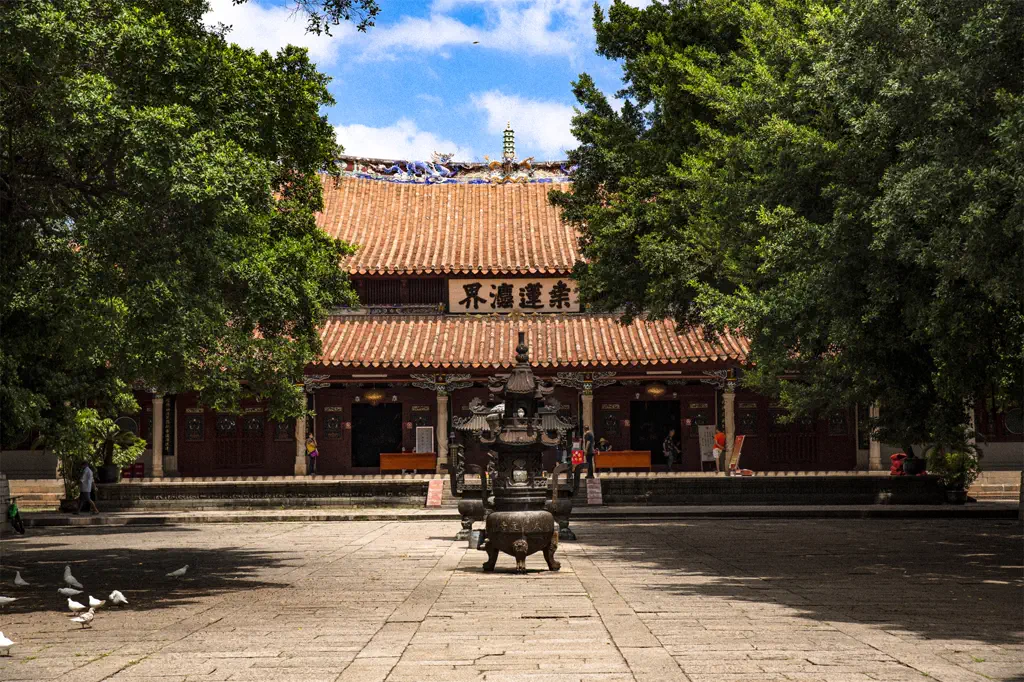
What the temple holds
The axis runs Ziyun Screen, Tianwang Hall, the Baiting courtyard, then the Mahavira Hall. Tianwang Hall doubles as the entrance; the hall standing today dates to a 1925 rebuild, its columns shaped like spindles, and on them hangs the couplet every visitor photographs — "Here of old a land of Buddha; on every street, a sage." The words are attributed to the Song philosopher Zhu Xi; the original brushwork was long gone, and Master Hongyi rewrote the pair in 1938 from an old note. Ten characters, and Quanzhou introduces itself.
Inside the Mahavira Hall, look at the columns before anything else. Down the front edge stand dragon columns carved in the Ming dynasty, coiled and scaled in deep relief. Then walk around behind the hall. Under the rear eaves wait two dark green, sixteen-sided stone columns carved with round reliefs — Shiva, Vishnu riding the bird-man Garuda, scenes from Hindu myth. They came from another building entirely: a Hindu temple locals called the Fanfo Temple, which collapsed centuries ago, its stones folded into this Buddhist site during a 1637 repair. A Buddhist hall carrying Hindu columns has almost no second example in China, and it tells you how this port traded — goods, gods and all.
The twin pagodas
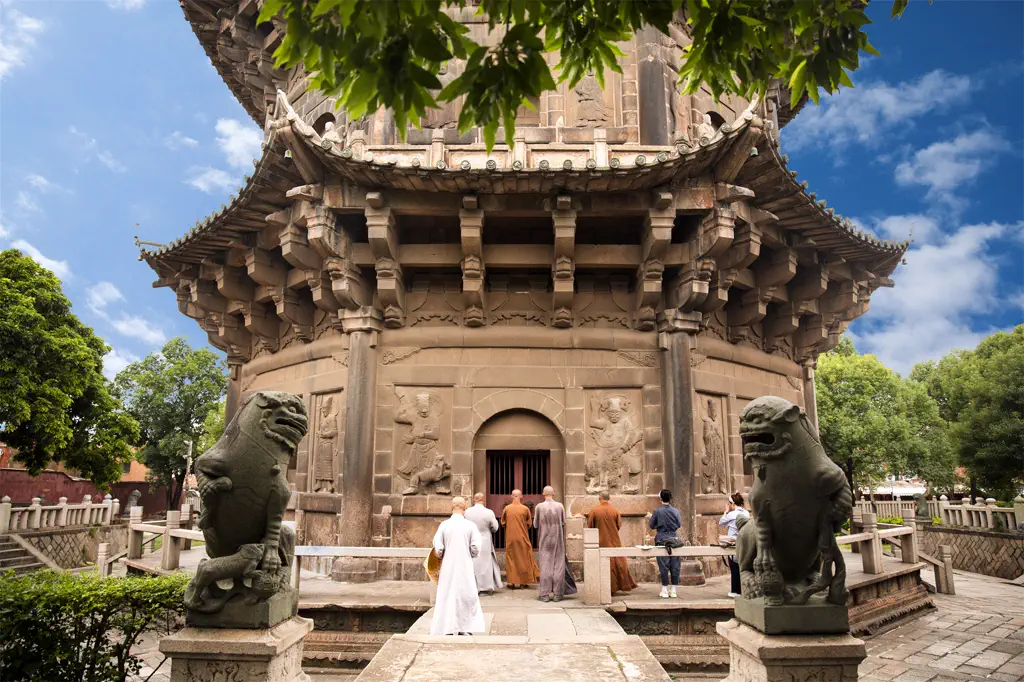
The Zhenguo Pagoda stands east of the courtyard, the Renshou Pagoda west, about two hundred meters apart, facing each other across the Baiting. The east tower rises 48.27 meters, the west 45.06 — a fifteen-story building in stone, five octagonal stories built as a stone copy of timber architecture, brackets and guardian figures and all. The east tower was first raised in 865, the west in the Five Dynasties; the all-stone versions standing today are the result of later rebuilds. Official introductions call them the tallest and largest surviving pair of stone pagodas in China, and someone has even weighed the east tower — around 10,370 tonnes of granite holding its line through typhoons for centuries.
The ancient boat next door
On the temple's east side sits the Quanzhou Bay Ancient Boat Gallery, built around a Song-era seagoing ship dredged from Houzhu harbor in 1974 — a thirteenth-century three-masted trader, over seven hundred years old, that once carried spices and drugs and caused a sensation when it came out of the mud. One caution: the gallery closed for hull conservation a few years back with reopening planned for the end of 2024, and no firm confirmation has surfaced since. Ask before you count on it.
Master Hongyi — the modern monk born Li Shutong, ordained at Hupao Temple in Hangzhou in 1918 — spent his late years in southern Fujian and died in Quanzhou. The memorial hall inside the temple reopened after a refresh in November 2025, with a documentary project announced the same day; it admits visitors from 8:30 and stops entry at 16:30.
Tickets, hours and transport
| Item | Reference |
|---|---|
| Ticket | free, no booking needed |
| Hours | 6:30–17:00, grounds clear at 17:40 |
| Hongyi memorial hall | opens 8:30, last entry 16:30 |
| Address | West Street, Licheng District, west of the Bell Tower |
| Bus | routes 6, 26, 33, 41 to Kaiyuan Temple West Gate stop |
| Phone | 0595-22382582 |
| Time | 1–1.5 hours |
How to fit it in
Stand in the Baiting first and take both pagodas into one view, then work down the axis. The dragon columns sit at the front of the main hall and the Hindu columns hide behind it — circle the hall rather than stopping at the door. The west pagoda is nearest the west gate, so save it for the way out; the street food of West Street starts at the exit. Arriving after 16:00 leaves the temple thin on time, since entry stops at 17:00 sharp. With spare hours, add the boat gallery and read the temple and the ship against each other — the stone and the sea are the two halves of this city.
The street outside gets its own page — West Street — and the monk behind the couplet has his memorial on Qingyuan Mountain. Routes and the wider heritage list live in the Quanzhou guide.
Things to confirm before you go
- Entry is free and booking-free on current listings, but the ancient boat gallery's reopening is unconfirmed — call ahead if the ship is the reason you come.
- Grounds clear at 17:40 and entry stops at 17:00; the memorial hall runs its own shorter day.
- Weekends fill the Baiting by late morning; early entry is the calm one.
Frequently asked questions
Does Kaiyuan Temple charge admission?
No. The temple is free and requires no reservation on current listings. The memorial hall inside keeps its own hours, 8:30 to 16:30.
What are the twin pagodas?
The Zhenguo and Renshou pagodas, east and west of the main courtyard — 48.27 and 45.06 meters, five stories, built entirely of local granite in imitation of timber construction, and the tallest surviving pair of stone pagodas in China.
Is the temple worth it if I skip the museums?
Yes. The pagodas, the dragon columns and the Hindu reliefs behind the main hall carry the visit on their own, and the exit drops you straight into West Street.