Luoyang Bridge, Quanzhou: the Song Bridge That Grew Oysters
Give Luoyang Bridge the half day it deserves. The bridge crosses the mouth of the Luoyang River northeast of Quanzhou, where the water is river at low tide and sea at high, and work on it ran from 1053 to 1059 under Cai Xiang, then prefect of the city. Its first name was the Wan'an Bridge — "ten thousand safeties" — and Cai Xiang brushed the Wan'an Bridge Record himself; the name Luoyang came later, borrowed from the river, which emigrants from the north are said to have named for the Luoyang they left behind. Figures below were cross-checked against several official accounts in September 2026.
Why the bridge matters
One sentence covers its standing: the oldest surviving sea-crossing beam bridge in China, called by the old phrase "first bridge within the seas," and counted among the country's four great ancient bridges alongside Zhaozhou, Lugou and Guangji. Before it stood, crossing meant ferry boats that waited out the weather, with people and goods stacking up at the river mouth. Quanzhou's sea trade was climbing toward its Song-Yuan peak, and the bridge sat on the northeast throat of the city — the obstacle had to go.
Three inventions in granite
The Song builders ran out of answers and made their own. The piers were shaped like boat prows, pointed at both ends, to split the tide — the raft foundation. Stone bedded in seawater will not hold, so the builders seeded the bridge base with oysters, whose shells generation after generation grow fast into the gaps and weld loose stone into one mass — oyster-seeded foundations, a fisherman's trick turned into engineering. And the beams themselves, slabs weighing tonnes, were floated on barges at high tide and dropped into place as the water fell — pontoon launching. None of it looks clever on paper and all of it worked for a thousand years.
What you see today
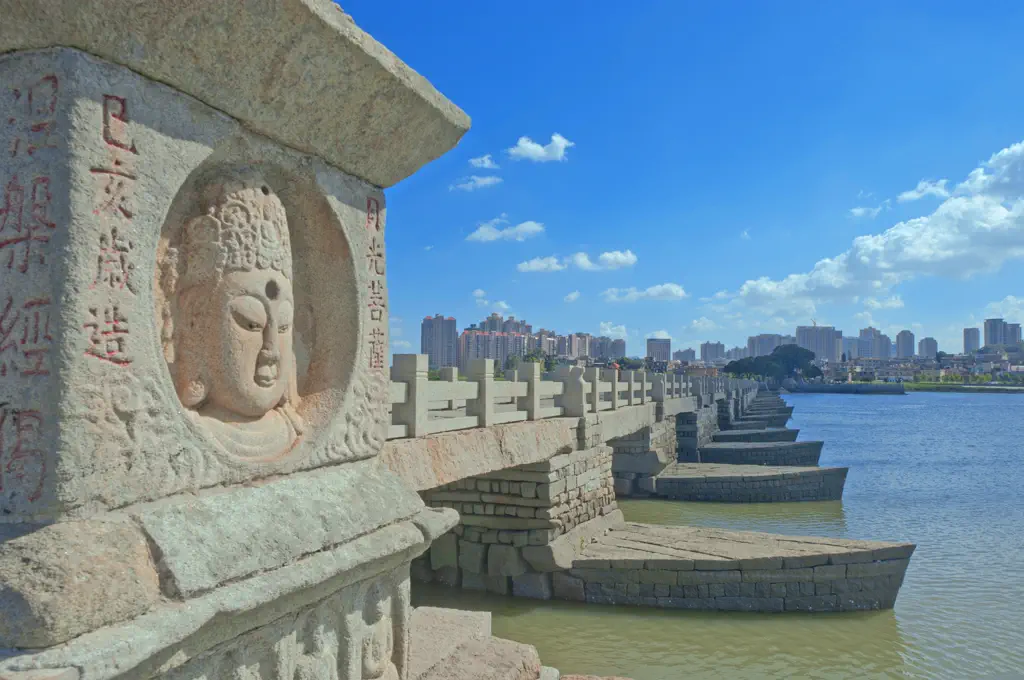
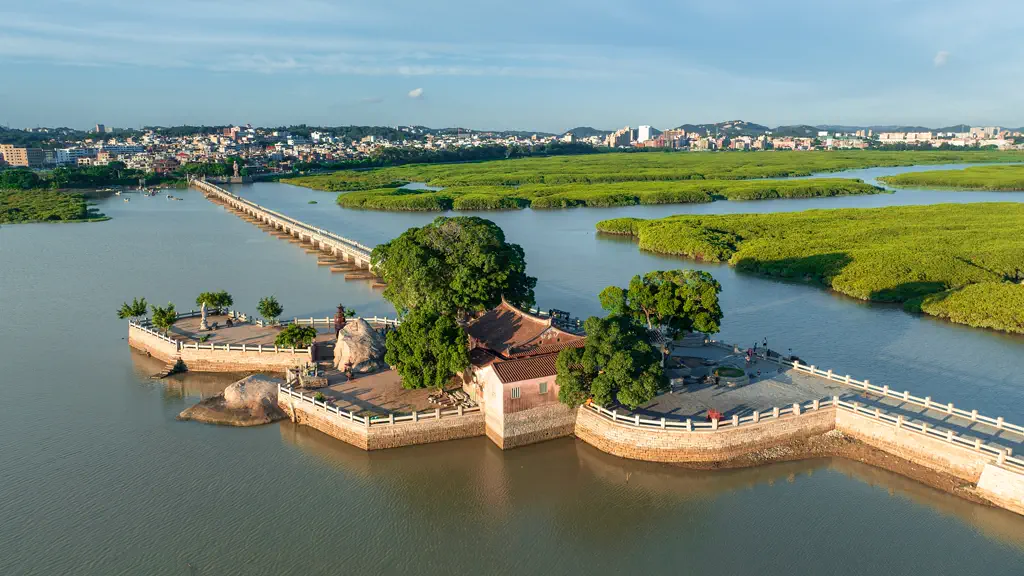
The bridge standing now is hard granite end to end — about 731 meters long and 4.5 meters wide, room for two or three carts abreast, riding on 45 boat-shaped piers through 47 spans. The deck is laid from more than three hundred giant stone slabs, the longest 11 meters, each weighing tonnes. The first bridge ran nearer 1,200 meters; a millennium of silt, storms and repairs trimmed it to today's span. In Southern Song times worshippers added Buddhist and fengshui pagodas along the parapets, and stone pagodas still stand at the ends, with a statue of Cai Xiang at the bridgehead — remembered half for the bridge, half for the brush, since his name completes the Song "Su, Huang, Mi, Cai" quartet of calligraphers.
Walk it slowly — half an hour one way. Watch the boat prows of the piers and let the tide change your view; at low water the base work shows best, and the tide turns twice a day, so check a tide table if the foundations are the point. Wind sweeps the deck with no shelter, so in summer go early or late and hold your hat. On a still day the bridge lies whole in the water; in morning fog it shows a stretch and hides the rest. This is one of Quanzhou's 22 heritage sites, and among temples and tombs it is the pure piece of engineering — proof that the port's real trade ran on works like this as much as on incense.
Tickets, hours and transport
| Item | Reference |
|---|---|
| Ticket | free |
| Hours | open all day |
| Address | Caixiang Road, Luojiang District, at the Luoyang River mouth |
| Bus | route 19 |
| Time | 1.5–2 hours |
Either end works for a start; the south side has the fuller services and most visitors enter there. Photographers do best at dusk, shooting backlit arches and water. With older travelers or children, walk half and turn — under two kilometers round trip, and the middle stretch has the widest view. From the city, bus 19 runs direct, or take a taxi; with a free afternoon, pair the bridge in the morning with Qingyuan Mountain and the day balances stone and slope. The heritage context sits in the Quanzhou guide.
Things to confirm before you go
- The bridge is free and always open, but the deck is exposed — wind, rain and sun are the planning factors, not tickets.
- Tide height changes what you can see of the piers and base; tide tables are published daily.
- The stone slabs turn slick in rain; walk the middle line and mind the edges.
Frequently asked questions
How long is Luoyang Bridge?
The surviving bridge runs about 731 meters on 45 boat-shaped piers; the original Song bridge was nearer 1,200 meters before centuries of silting and rebuilding trimmed it.
Why are there oysters on a bridge?
The builders seeded the underwater foundations with oysters on purpose. The shells grow into the stone gaps and cement the loose rocks into one solid base — the earliest known use of biology in bridge engineering.
Is Luoyang Bridge worth visiting?
Yes, especially if you have seen the temples. It is the engineering face of Quanzhou's World Heritage listing, free to walk, and the hour by the river mouth changes how the whole city reads.