Tianhou Temple and Deji Gate, Quanzhou: Mazu by the Old Harbor
South of Quanzhou's old town runs Tianhou Road, and across it from each other sit two things a port city cannot do without — a temple for the safety of sailors and a gate for the safety of the town. The Tianhou Temple was founded in 1196, in the Southern Song, first named Shunji Temple for the sea goddess Mazu; the Deji Gate ruins opposite are the southern gate of the Song-Yuan city. Both are free, both are World Heritage points, and both were checked against public sources retrieved in September 2026.
The Mazu temple that others copied
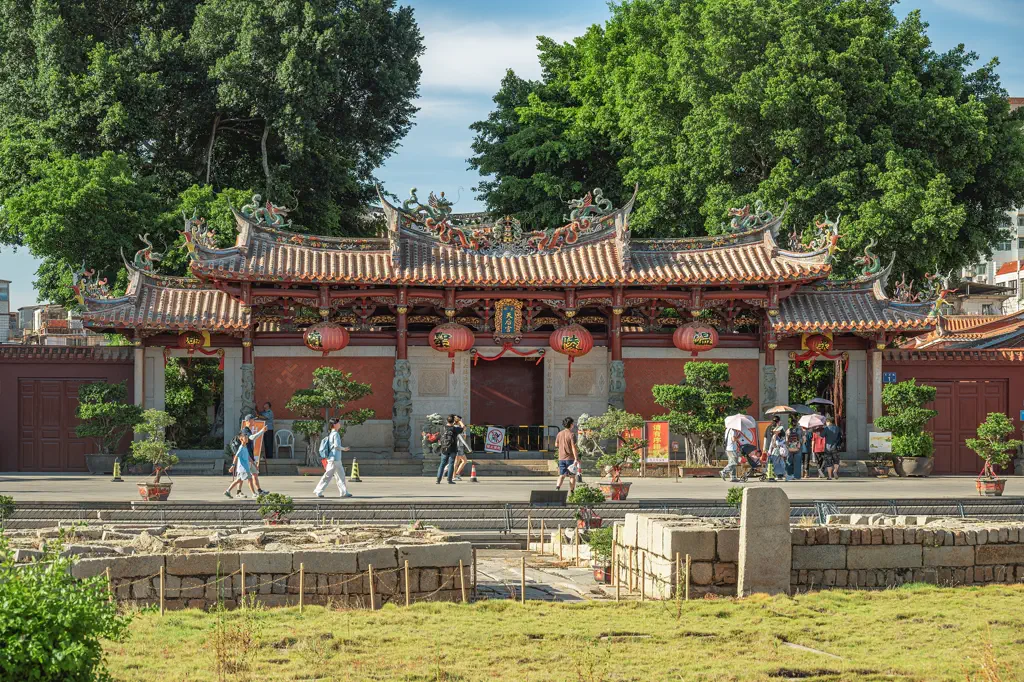
Quanzhou's trade passed in front of this temple's incense. In Song and Yuan times ships bowed to Mazu before sailing and thanked her on return, the court heaped titles on the goddess era by era — Tianhou, the Empress of Heaven, among them — and the temple's name followed the rank. Official introductions list it among the oldest and largest Mazu establishments in China, and many Mazu temples across Fujian and beyond took its buildings as their model. The temple stands at the southern tip of the old town, facing the Jinjiang River and the old harbor — a ship making port saw this roofline first, so the site itself is a catalogue of the city's seafaring centuries. Building the temple beside the gate put the sailors and the gatekeepers in sight of each other; Quanzhou arranged its faiths practically.
The incense has not stopped. Locals come to ask safe passage, visitors to ask for nothing in particular, and the courtyard flags stay warm with sun. The halls have been repaired era after era but the layout holds, and the timber, the stone carving and the roof-edge decoration reward a slow walk — nothing here is careless. If you cannot name what you are looking at, walk the outer circuit anyway; the details are in the eaves.
The gate below the temple
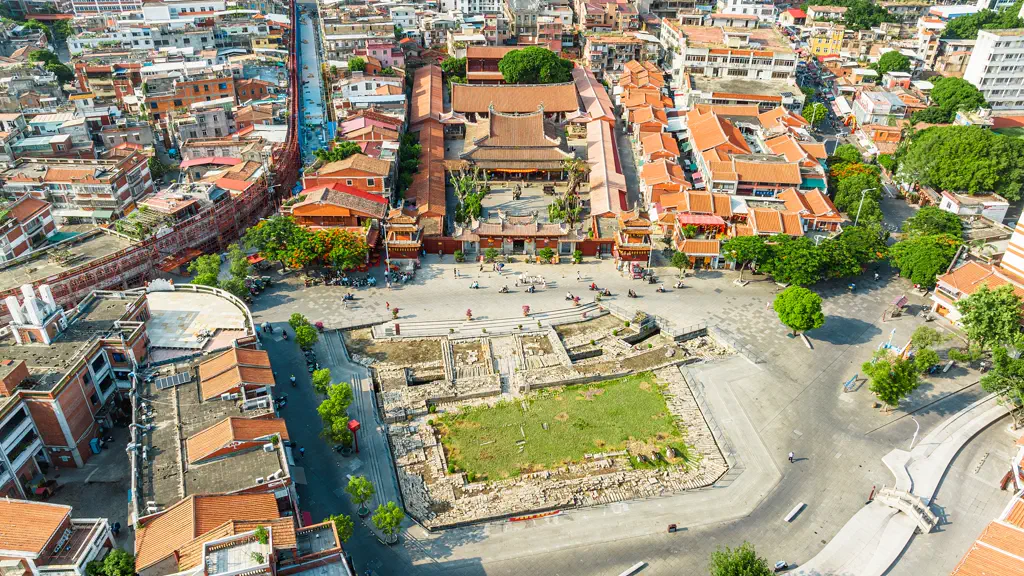
Across the road lie the Deji Gate ruins — the southern gate of the Song-Yuan city, its standing form first built in 1230, in Southern Song's Shaoding era. Excavation around 2000 lifted it out of the ground, and since 2004 it has been an open, free site with designed entrances. Nearly two thousand square meters of remains stack up: city walls of Song, Yuan, Ming and Qing, inner and outer moats, an arched bridge, the Barbican — the small walled pocket outside the gate that an attacker had to survive after the first gate fell. Of the seven gates of old Quanzhou this is the only one brought up by archaeology, and it is introduced as the longest-used and largest stone city-gate site in the country.
The ruins answer a question the temples cannot — how the city grew. The gate's position tracks Song-Yuan Quanzhou expanding southward, and the district beyond it was the commercial quarter. Finds from the dig, building stones and foreign carvings among them, back up how busy that quarter was. From the railing you can still trace the moat line, with signboards dating each layer. Ten minutes on foot covers it; squat down at the profile and the stones in the soil belong to different centuries.
Temple and gate have leaned on each other for hundreds of years — one watching people leave, one watching ships come in.
Tickets, hours and transport
| Item | Reference |
|---|---|
| Ticket | both free |
| Hours | temple 7:00–17:00, entry stops 16:30; gate site open-air |
| Address | Tianhou Road, Licheng District — temple and gate face each other |
| Time | 1.5–2 hours |
See the temple first and the gate second — the order hardly matters at this distance. The temple hours follow a 2022 Bendibao notice, so glance at the board on the day; the gate site has had archaeology closures before, including one noted in 2023, so confirm if the schedule is tight. The lanes south of town are narrow — park farther out and walk in, or take a taxi to Tianhou Road.
After the two stops, keep walking. Tianhou Road runs toward the river through lanes as dense as the old core, and a day line strings itself together — Bell Tower, West Street, Zhongshan Road, Tumen Street with the Qingjing Mosque and the Guandi Temple, the Confucius Temple, then south to finish here. Several of Quanzhou's heritage points sit inside a few kilometers of this route, and West Street makes the natural morning half of it. The three-day frame is in the Quanzhou guide.
Things to confirm before you go
- Temple hours are 7:00–17:00 with last entry 16:30 on the 2022 listing; check the posted notice on the day.
- The Deji Gate site is open-air with no shade — midday sun in summer is the constraint, and rain leaves the stone slick.
- Archaeology or maintenance can close parts of the ruin without much notice.
Frequently asked questions
Are Tianhou Temple and Deji Gate free?
Both are free. The temple stops entry at 16:30; the gate site is an open plaza you can read in fifteen minutes, longer if you work the signboards.
Who is Mazu?
The sea goddess of the Fujian coast, a deified Song-era woman said to protect sailors. Quanzhou's temple is among the oldest and largest of her establishments, and its buildings served as the model for Mazu temples across the region.
Is this worth it if I only have half a day in the old town?
Yes — it is the southern anchor. Kaiyuan Temple and West Street own the morning; this pair closes the day, and the walk between them is through the continuous old town.