Hulishan Fortress, Xiamen: The Krupp Gun on the Coast Road
Hulishan Fortress is an hour's stop on Xiamen's coast road. Its reason for existing is a 280-millimetre Krupp coastal gun, made in Germany in 1887, still on its mounting and described as the largest surviving nineteenth-century coastal gun in the world. Adult tickets are published at 25 yuan. If you want the costumed drill show, arrive just before 10:00 or 16:00. Otherwise come at opening for a quiet look at the gun. The fort stands on a headland at the southeast tip of Xiamen Island with the sea on three sides, a short walk east of Xiamen University's Baicheng gate, directly on Huandao Road. It went up between 1894 and 1896, when the late Qing was rearming the coast with Western weapons. It fits easily into a coast day from the Xiamen travel guide.
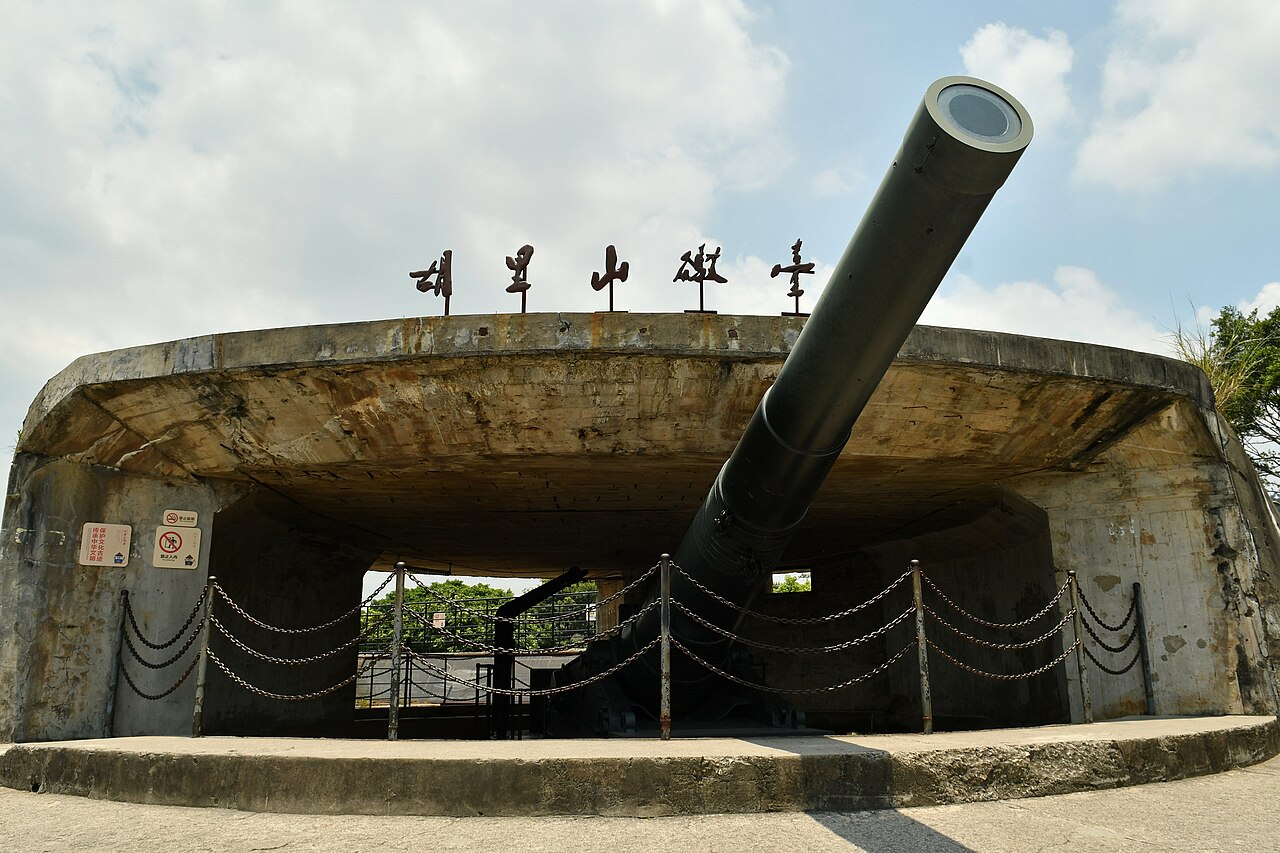
The gun
The Qing bought four 280-millimetre coastal guns from Krupp. Two went to a battery at the mouth of the Min River near Fuzhou, where neither survives, and two came to Hulishan. The surviving east gun is marked "28 cm K.L/40 C/87": 28 centimetres calibre, K for Küste (coast), a barrel forty calibres long, and 1887 for the model year. Its west twin, from 1886, was broken up for scrap in 1958 during the Great Leap Forward. Two smaller 150-millimetre guns that once stood beside them were taken away by the Japanese army after it occupied Xiamen in May 1938. The surviving gun entered the Guinness records in 2000.
Up close, the barrel is long enough that it is hard to fit the whole gun into one photograph. Look at the mounting, which shows how the crew could traverse the gun across the approaches to the harbour.
Why a fort here
Xiamen had been beaten before. In 1841 the governor-general Yan Botao built a granite "stone-wall battery" about 1,667 metres long along this shore and mounted a hundred guns on it. The British took Xiamen anyway in the First Opium War, and the wall was destroyed. Half a century later the Qing tried again with modern weapons. The Fujian naval commander Peng Chuhan and the governor-general Bian Baodi won approval for a new battery. Work started in the spring of 1894 and finished in late 1896, after two years and eight months.
The site was chosen carefully. Guns on the headland could support the Baishi battery about 4.5 kilometres to the east and the Panshi battery about 5 kilometres to the west, and they crossed fire with the Yuzaiwei battery on the far side of the harbour mouth to close the shipping channel. The fort stayed in military hands after 1949, was handed to the city in 1984, and became a nationally protected site in 1996.
Walking the fort
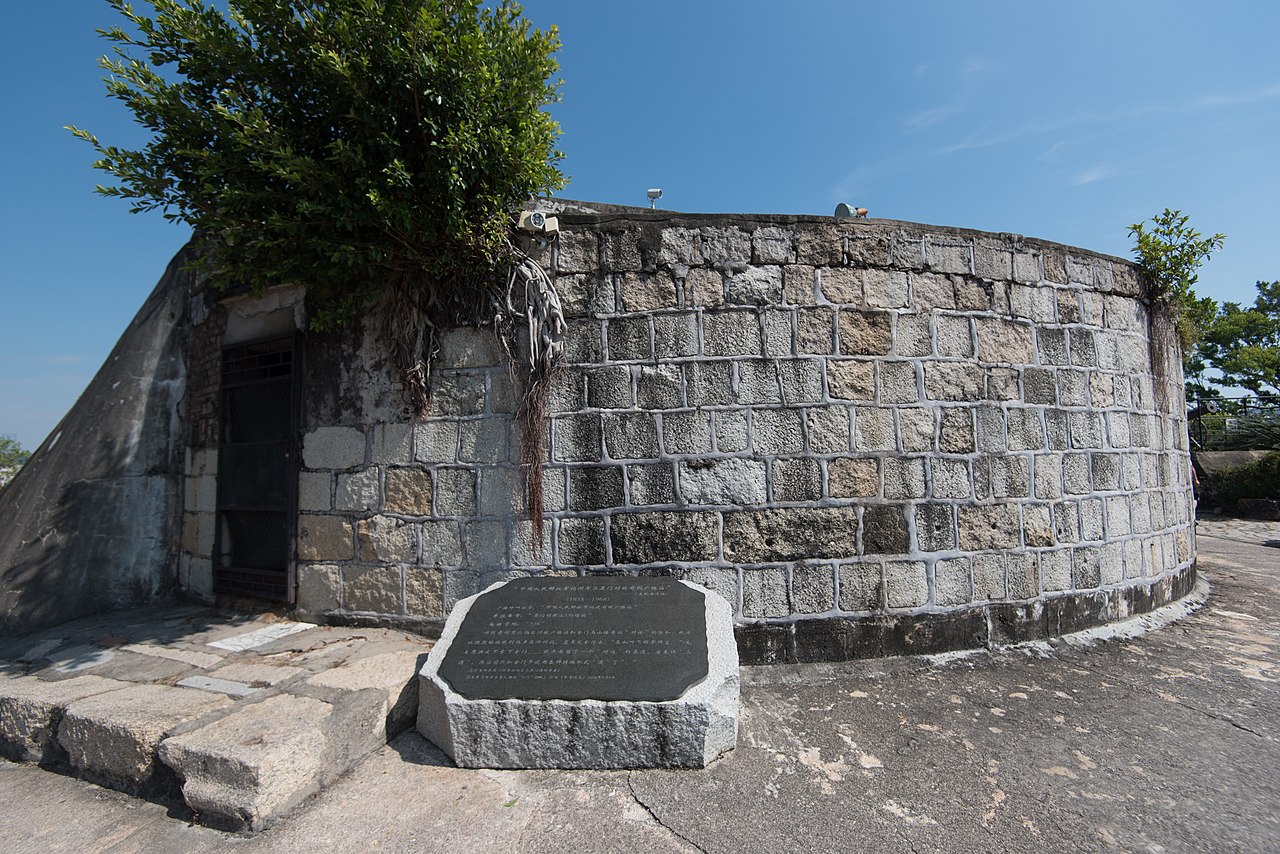
The whole site covers more than 70,000 square metres, with a fortified core of about 13,000. It is half bunker and half rampart, mixing European fortress design with the Chinese tradition of walled defences. There are three zones: the gun platforms, the barracks and the rear hill. Inside you find tunnels, a moat, the ammunition magazine, barrack rooms, an officers' hall and an observation post on the hilltop. The builders used a mortar of camphor-tree sap, brown sugar, glutinous rice, sand and lime for the foundations, which partly explains how well it has lasted.
The displays add guns brought from other Xiamen batteries and a group of Ming and Qing iron cannons dug up during road widening in the city. A separate private collection on site, put together by a Singapore collector, shows stones, old swords and firearms. Whether it is worth your time depends on your patience for glass cases.
From the observation terraces you look out toward Kinmen, the Taiwan-administered islands a few kilometres offshore. The guns were built to face enemy fleets. The view now takes in a political border.
The drill show
A costumed show re-enacts a Qing artillery crew loading and firing an old muzzle-loading cannon. It runs twice a day, at 10:00 and 16:00, for about eighteen minutes, in the rear hill zone, and is cancelled in bad weather. Ticket sites have also advertised a newer immersive performance in the same slots. Check the board at the entrance for the day's programme.
Tickets and hours
- Prices: 25 yuan for adults, 12 yuan for students and 10 yuan for seniors, with free entry for some groups on proof of eligibility.
- Hours: 08:00 to 17:30 from October to May and 08:00 to 18:00 from June to September, with last entry fifteen minutes before closing. Day tickets are valid only during daytime opening.
- Address: 2 Zengcuo'an Road.
These are the published figures. Confirm on the fort's notice or ticket channel before you go. Exposed coastal sites can close when typhoon warnings are raised between July and September.
Getting there and what to pair it with
City buses stop at Hulishan Paotai, the fort's stop on the coast road. On foot it is a short shoreline walk from the Baicheng side of Xiamen University. The usual pairing is the morning at Nanputuo Temple and the campus, the fort around midday or for the 16:00 show, then east along Huandao Road to Zengcuo'an for food and the beaches beyond. If military history leaves you cold, skip the ticket and enjoy the same sea view from the coast road outside.
Frequently asked questions
Is Hulishan Fortress worth visiting?
Yes if you are interested in military or late-Qing history. The gun is the real thing and the site is compact.
How long does a visit take?
About an hour, or ninety minutes with the drill show.
Can you see Kinmen from Hulishan?
On a clear day, yes, from the observation terraces.
What time is the drill show?
At 10:00 and 16:00, about eighteen minutes long, weather permitting.