Nanputuo Temple, Xiamen: Visiting the Guanyin Temple
Nanputuo is free to enter, it hands every visitor a stick of incense at the gate, and it takes about ninety minutes to see properly. Add an hour or two if you climb the Wulao Peaks behind it. Reserve through the temple's own WeChat booking platform on weekends, holidays and festival days. On quiet weekdays visitors often book on the spot at the entrance. The route runs in through the East Gate and out through the West Gate. The temple sits at the foot of the Wulao Peaks on the southeast side of Xiamen Island, facing the bay, and shares a wall with Xiamen University. That is why most people do the two in one morning, as the Xiamen travel guide suggests. It is the best-known Buddhist temple in Xiamen and one of the most influential in southern Fujian and among the Chinese communities of Southeast Asia.
Entry, booking and etiquette
Entry is free. The temple runs a real-name booking system through its WeChat mini-program, 南普陀寺预约服务平台, which it describes as its only official channel. It warns against anyone selling paid "reservations". Recent sources give opening hours of roughly 08:00 to 18:00, with last entry around 17:30, but published hours vary, so check the temple's notice, especially around Guanyin festival days, when crowds are heavy.
Incense is provided free at the entrance and you may not bring your own; burn it at the burners in front of the Hall of the Heavenly Kings. Dress modestly and keep your voice down in the halls. Do not photograph monks or worshippers at close range without asking.
Walking the halls
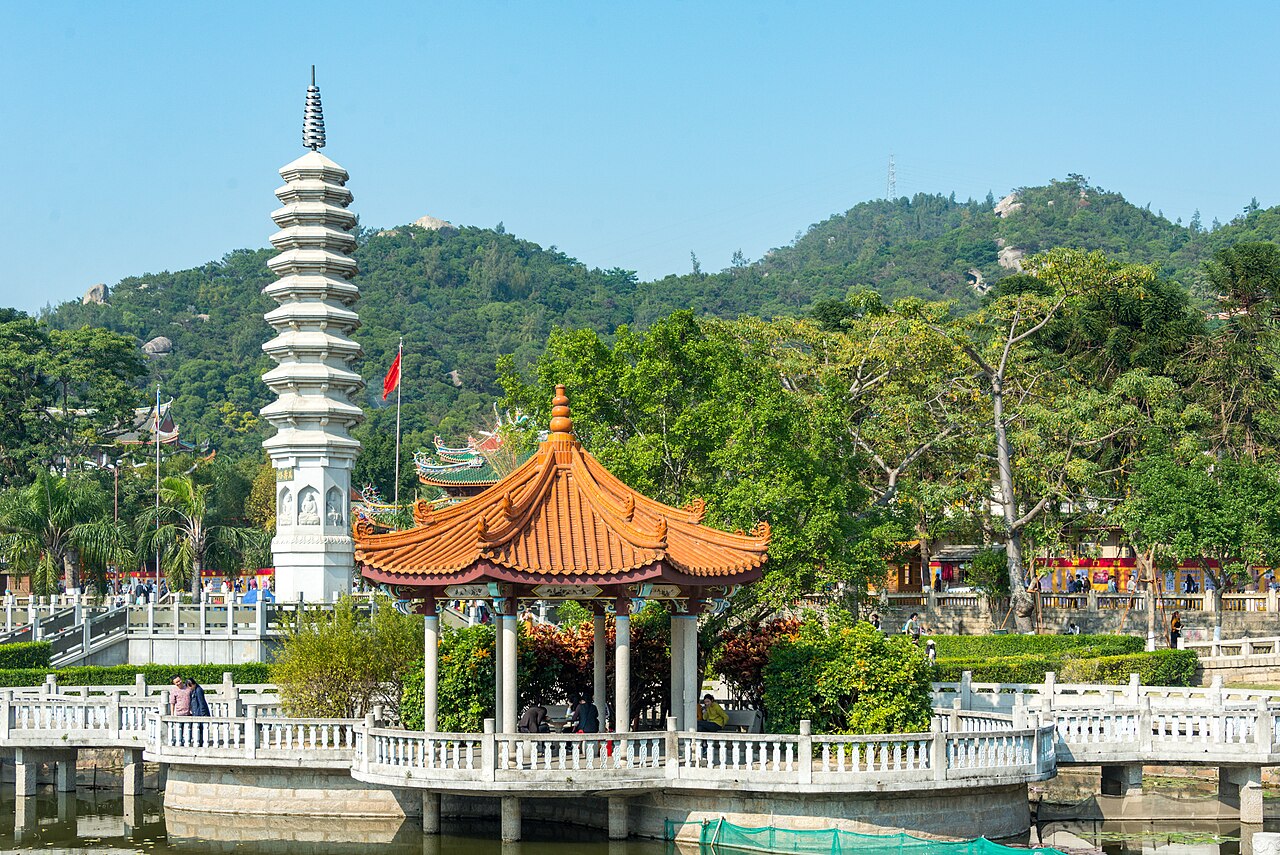
The grounds cover more than 30,000 square metres and climb the slope from south to north. At the front are a square release pond about thirty metres on a side and a much larger lotus pond, enclosed by a low wall with matching gateways. The inscription "Famous Mountain of Egret Island" on the gate is in the hand of Zhao Puchu, a former head of the Buddhist Association of China.
Then the halls rise in sequence along the central axis:
- Hall of the Heavenly Kings (rebuilt 1925), with Maitreya, Weituo and the four guardian kings.
- Mahavira Hall (rebuilt 1932), double-eaved with green tiles and stone columns, enshrining the Buddhas of the three ages.
- Great Compassion Hall, an octagonal pavilion of 1930, rebuilt in reinforced concrete in 1962 and dedicated to Guanyin. This is the hall pilgrims come for.
- Sutra Library at the top of the axis.
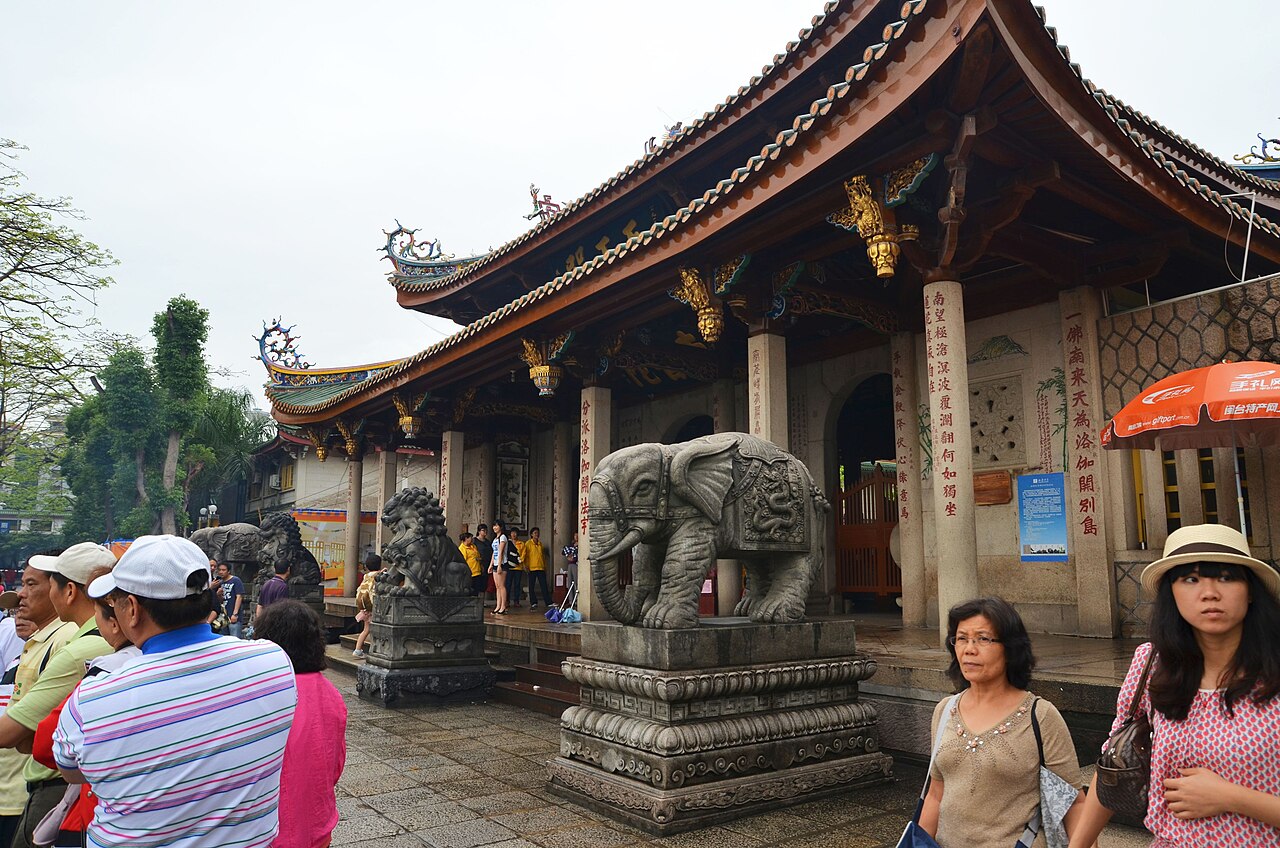
Side buildings hold the bell and drum towers, an arhat hall and the Taixu Library. Look up at the roof ridges. They carry the crowded, colourful Minnan decoration of cut porcelain and painted figures that marks Fujian temples out from those further north.
A temple rebuilt many times
A temple stood here by the late Tang, when it was called Sizhou Temple. A Northern Song monk named Wencui rebuilt it as Wujin Yan. It fell out of use under the Yuan, and in the Ming it was rebuilt again on the present site as Puzhao Temple. War in the early Qing left it in ruins once more. The version that gave the temple its modern name came in the 1680s. The Qing admiral Shi Lang, newly made Marquis Jinghai for taking Taiwan, paid for its restoration and added a pavilion to Guanyin. The island of Putuo in Zhejiang is China's great Guanyin site, and this temple lies far to its south, so it became Nanputuo, "Southern Putuo".
The twentieth century made it a centre of learning. In 1924 it became a public monastery open to monks of any lineage, and in 1925 it founded the Minnan Buddhist College. The reformer Taixu became abbot in 1927. The monk Hongyi, one of the most admired figures in modern Chinese Buddhism, stayed and taught here many times between 1928 and 1942. The Cultural Revolution wrecked the halls, and a metalworking factory was set up on the east side. Restoration began in 1976, and the temple returned to electing its abbots in 1989.
Climbing the Wulao Peaks
A signposted path from inside the temple climbs the Wulao (Five Old Men) Peaks behind it. "Wulao soaring into the clouds" is one of Xiamen's traditional scenic views. It is stone steps all the way, and most people reach the top viewpoints in under an hour. From there you look down over Xiamen University, the coast road and the water toward Gulangyu. One recent guide gives trail hours as roughly 08:00 to 16:00. Do not start late, because the path is steep and unlit. If you lost the university lottery, this is the best way to see the campus anyway.
Vegetarian pastries and lunch
Nanputuo's vegetarian pastries are small flaky cakes in flavours such as mung bean, pumpkin and coconut, sold at the temple's own shop and widely bought as gifts. They keep for only a couple of weeks, and fresh batches can sell out by the afternoon. The vegetarian restaurant serves set meals and noodles at lunch, with queues on busy days.
Getting there
The address is 515 Siming South Road. Metro Line 1 ends at Zhenhai Road station, ten to fifteen minutes' walk away. Several buses stop at the Xiamen University (Nanputuo) stop on Siming South Road.
A full day can continue from the temple into the university for your booked window, then down to Baicheng beach and east along Huandao Road toward Hulishan Fortress.
Frequently asked questions
Is Nanputuo Temple free?
Yes. Entry and incense are free. Only food, pastries and donations cost money.
Do I need to reserve Nanputuo Temple?
Reserve through the temple's official WeChat platform on weekends, holidays and festival days. On quiet weekdays you can often book at the gate.
How long should I spend at Nanputuo?
About ninety minutes for the halls and ponds, and one to two hours more for the Wulao Peaks.
Which gate do I use?
Enter by the East Gate and leave by the West Gate, following the one-way visitor route.