Big Wild Goose Pagoda, Xi'an: Temple, Climb and Fountain Show
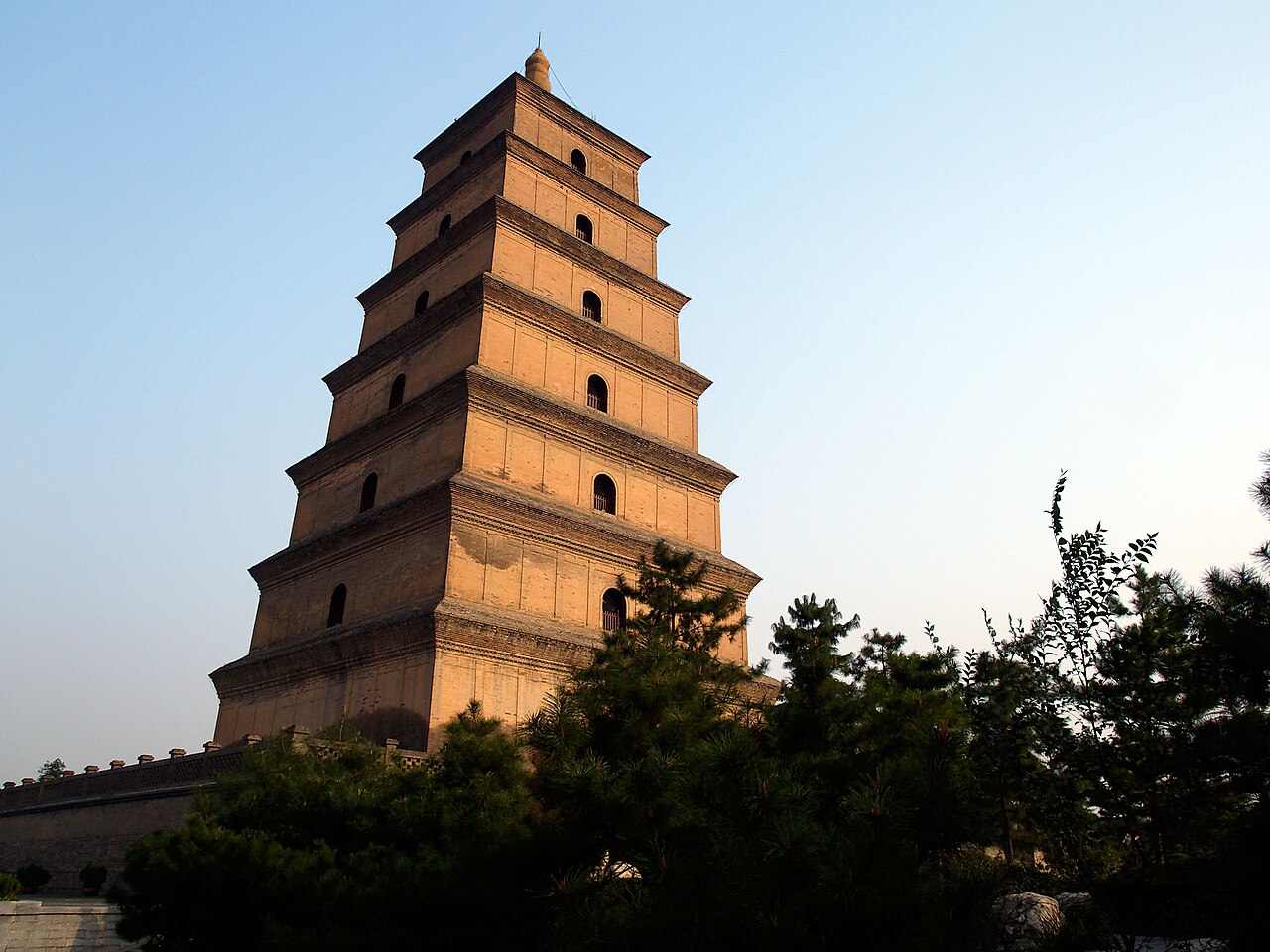
The Big Wild Goose Pagoda (Dayanta) is the seven-storey Tang brick tower inside Da Ci'en Temple in southern Xi'an, built to store the scriptures the monk Xuanzang brought back from India. Plan it for an afternoon running into evening. Temple entry is 10 yuan (cut from 40 yuan in September 2025) and climbing the pagoda costs 25 yuan more, paid on site. The free musical fountain on the North Square plays at 12:00, 16:00, 19:00 and 21:00. After dark the pedestrian street south of the temple fills with lights and street performers. Dayanta station on metro Lines 3 and 4 is beside it. Foreign guidebooks also call it the Giant Wild Goose Pagoda.
The Xi'an travel guide shows where it fits in a three-day trip.
Tickets and hours
| Item | Detail |
|---|---|
| Temple entry | 10 yuan (listings since September 2025) |
| Pagoda climb | 25 yuan extra, bought at the pagoda entrance |
| Half price | Temple entry 5 yuan for minors aged 6 to 18 and students |
| Hours, 1 March to 14 October | 08:30 to 18:00, entry stops at 17:00 |
| Hours, winter | Closes earlier, around 17:30 |
| Metro | Dayanta, Lines 3 and 4. Exit B for the North Square, Exit C for the South Square and the temple's south gate |
Buy temple tickets at the counter or in advance on the Da Ci'en Temple WeChat mini-program. The climb ticket is sold only on site, and sales end around 17:00. The 10-yuan price is a recent cut, so check it at the gate.
Inside the temple and up the pagoda
Enter by the south gate, opposite the bronze statue of Xuanzang on the South Square, and walk north through the temple halls to the pagoda.
At the base, the south doorway holds two stone tablets set into the brickwork in Tang times. They carry the Preface to the Sacred Teachings written by Emperor Taizong and a companion text by Emperor Gaozong, both in the calligraphy of Chu Suiliang, and are among the most valued Tang inscriptions to survive. Above the west doorway, a carved lintel shows a Tang Buddhist hall, one of the best sources for what the temples of Tang Chang'an looked like.
Climbing up, the stairs are narrow, steep and one-way in places, and there is no lift. On the fourth floor, two leaves of palm-leaf Sanskrit scripture, about 40 centimetres long, show the kind of text Xuanzang carried. From the windows at the top you look straight down the temple axis and across the city. Skip the climb with very young children or if the staircase is jammed on a holiday afternoon.
After the climb, visit the Xuanzang Sanzang Courtyard at the back of the temple. A relic venerated as part of Xuanzang's skull is kept there, beside a seated statue of him, not in the pagoda.
The story behind it
In 652, Xuanzang returned from a journey of seventeen years to India and needed somewhere to keep the 657 Buddhist texts he had brought back. The first pagoda had five storeys. It was rebuilt taller in the reign of Empress Wu Zetian, and later repairs, the last major ones in the Ming dynasty, gave it the brick shell and seven-storey outline you see today, about 64.5 metres tall. In 2014 it joined the World Heritage list as part of the Silk Roads: Chang'an-Tianshan Corridor.
In the Tang dynasty, new graduates of the imperial exams climbed the pagoda and wrote their names on its walls. The poet Bai Juyi did so after passing, and wrote that he was the youngest of the seventeen names that year.
The fountain on the North Square
Leave the temple by the north side for the North Square, a long rectangle of fountains with the pagoda at the top of the axis. This is the best place to photograph the tower. The free musical fountain show usually runs four times a day:
- 12:00 and 16:00. Daytime shows, not held on Tuesdays (maintenance).
- 19:00 and 21:00. Evening shows with the pagoda lit behind.
Each lasts about ten minutes. When the square opened at the end of 2003 it was promoted as Asia's largest musical fountain. Arrive fifteen minutes early and stand on the central axis, not at the side, for the full effect. Bring a raincoat or keep your distance if it's windy, because the spray carries.
The Tang street at night
The South Square, with the Xuanzang statue, marks the start of Datang Everbright City, often translated as the Tang Dynasty Never-Sleeps City. It is a 2.1-kilometre car-free street of lit buildings, sculptures and stages running south from the temple. It is free and open all the time. The lights come on between 18:30 and 19:00, and until about 22:30 there are many short free performances along the street, from costumed Tang guards to dancers and musicians. The crowd is thickest at the pagoda end. Paid extras such as costume rental and indoor shows are optional.
It is lively and very photogenic, and on holiday evenings it can be overwhelmingly crowded. Treat it as an evening stroll, not a substitute for the city's historic sights.
A good afternoon and evening
- 15:00 Arrive at the south gate, see the temple and climb the pagoda before ticket sales stop.
- 17:00 Xuanzang courtyard, then out to the South Square at dusk.
- 19:00 Walk to the North Square for the evening fountain.
- Afterwards Dinner, then the Tang street, or the 21:00 fountain.
The Shaanxi History Museum is a short walk west of the pagoda along Xiaozhai East Road, so a museum morning and a pagoda afternoon make a good day. The city wall also pairs well if you ride it in the morning. Keep the Terracotta Army for a separate day.
Things to confirm before you go
- The current temple ticket price and the climb's last sale time.
- Fountain show times for your date, including the Tuesday daytime break.
- Holiday crowd management at Dayanta station, where exits can become one-way.
- Winter closing time, which is earlier than in summer.
Frequently asked questions
How much does the Big Wild Goose Pagoda cost?
Temple entry is 10 yuan (since September 2025), and climbing the pagoda is 25 yuan extra, paid on site. The squares, fountain show and Tang street are free.
Is it worth climbing the Big Wild Goose Pagoda?
If you like history, yes: the Tang inscriptions at the base, the palm-leaf scriptures on the fourth floor and the view down the temple axis justify the 25 yuan. For photos of the tower itself, the North Square is better.
What time is the Big Wild Goose Pagoda fountain show?
Usually 12:00, 16:00, 19:00 and 21:00, about ten minutes each. The daytime shows are skipped on Tuesdays. The evening ones are the best.
Which metro exit is best for the Big Wild Goose Pagoda?
Dayanta station on Lines 3 and 4. Exit B for the North Square fountain, Exit C for the South Square and the temple entrance.