Kumbum Monastery, Built Around a Stupa at Tsongkhapa's Birthplace
Kumbum Monastery, called Ta'er Si in Chinese, spreads across eight folds of Lotus Hill in Lushar town, Huangzhong District, a short drive southwest of central Xining. It marks the birthplace of Tsongkhapa, who founded the Gelug school of Tibetan Buddhism in the fourteenth century, and it is counted among the six great Gelug monasteries. Chinese Wikipedia puts the complex at about 200,000 square metres of land with more than 9,300 rooms. It is a working monastery with resident monks, so many visitors see the halls and pilgrims at the same time.
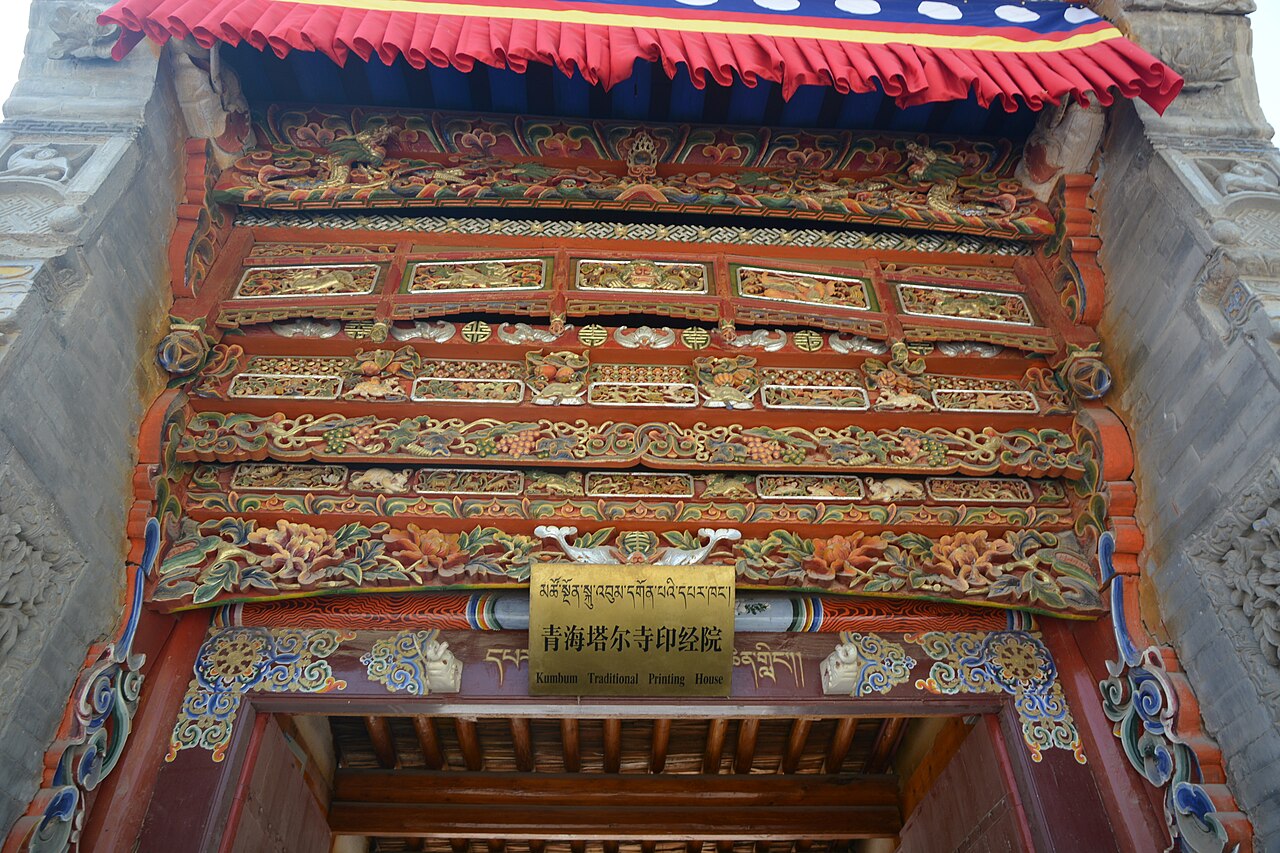
A stupa first, then a monastery
Kumbum grew in the opposite order to most monasteries. Tsongkhapa was born nearby in 1357 and left for central Tibet as a young man. Chinese Wikipedia says that in 1379, unable to come home, he suggested that his mother build a stupa at his birthplace around a sandalwood tree, with a hundred thousand images of the Buddha inside. The Tibetan name Kumbum means a hundred thousand images, and Ta'er, tower, comes from the same stupa.
A meditator named Tsöndrü Gyeltsen built a small retreat beside it in 1560, with seven monks at first. English Wikipedia describes how the future Third Dalai Lama, travelling to meet the Mongol ruler Altan Khan near Qinghai Lake in the 1570s, stopped at the site and asked for a larger monastery. That was completed in 1583. The Fourth Dalai Lama passed through in 1603 and appointed its first abbot, and a debate college opened in 1612. Halls for Maitreya, Tsongkhapa and Shakyamuni, the assembly hall and the Great Golden Roof Hall went up in the late sixteenth and early seventeenth centuries, all clustered around the original stupa.
Colleges, rebuilding and protection
Qing patronage of the Gelug turned Kumbum into a large teaching monastery. A tantric college was founded in 1649, and later a medical college and a Kalachakra college focused on astronomy and calendar calculation, giving it the four colleges that Chinese Wikipedia describes. Debate students at the main assembly hall followed a course of thirteen grades that took about twenty years to finish.
War in the region in the later nineteenth century burned parts of the monastery, and much of what stands now is rebuilt on the old foundations. The tantric college was rebuilt in 1874 and the assembly hall in 1915, and the Kalachakra stupa was added in 1942. Kumbum was on the first national list of protected heritage sites in March 1961. It suffered heavy damage and closure in the Cultural Revolution. It reopened on 15 February 1979 and admitted foreign visitors from July that year.
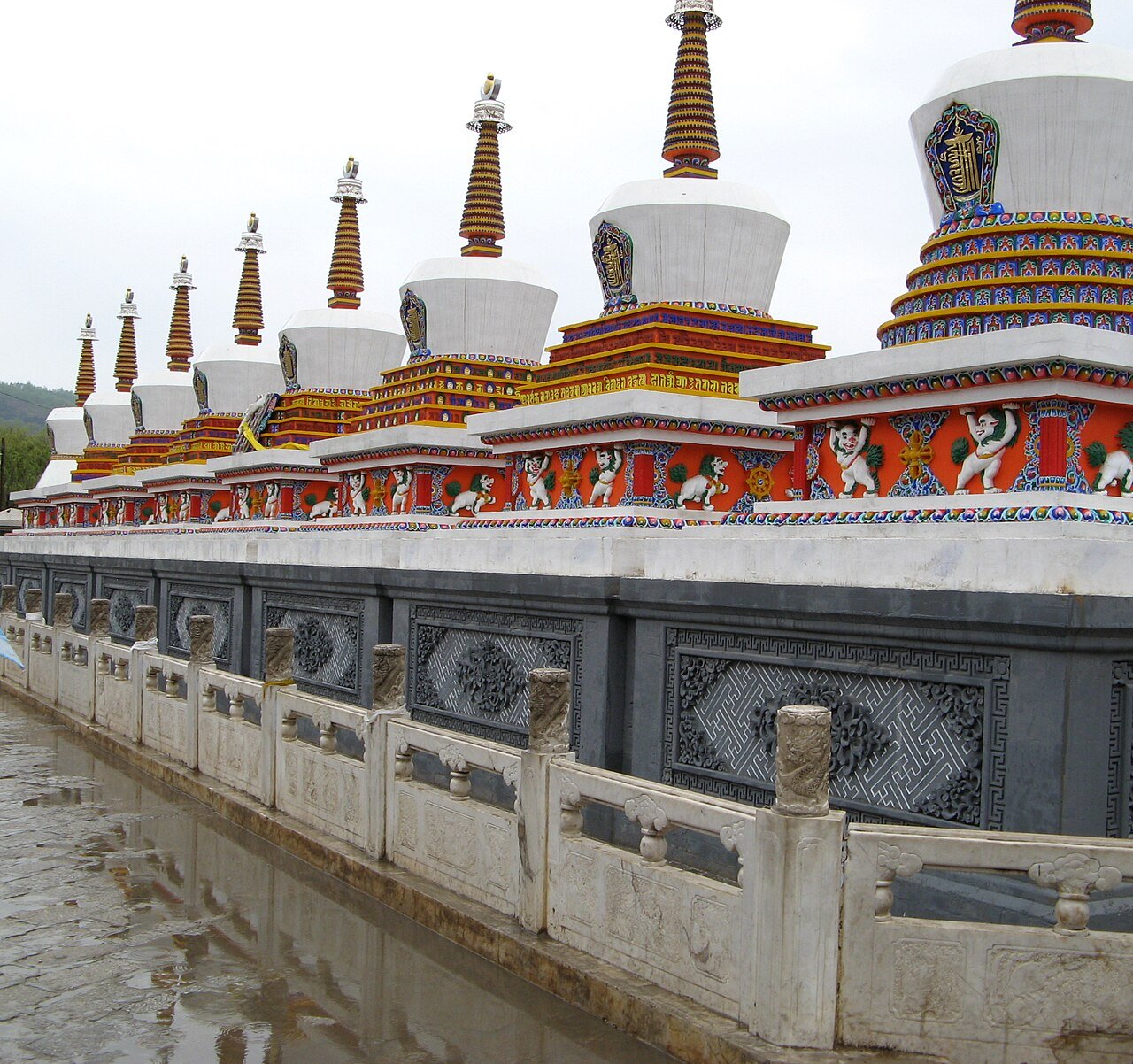
Walking the monastery
There is no full outer wall. The kora path that circles the folds of the hill serves as the boundary, and the halls were added one by one up the slope, so the layout follows the ground. The usual approach from the car park passes the eight stupas, which commemorate events in the Buddha's life. The main group of halls stands in the middle and north of the site. The Great Golden Roof Hall holds the stupa at the birthplace and is the holiest building. Pilgrims prostrate on the wooden boards in front of it, and the boards have worn into grooves over the years.
Kumbum is known for three arts, which Chinese Wikipedia calls its three marvels. The murals cover walls and galleries in the main halls and colleges. The appliqué hangings are layered cloth pictures, some padded with cotton or wool to stand out in relief, and eighteen arhat hangings line the assembly hall. The butter sculptures are modelled in coloured yak butter over a frame of straw and wood. Two separate workshops in the monastery make them each year, starting around the tenth lunar month and finishing for display on the fifteenth day of the first month. They were listed as national intangible heritage in 2006. Displays are kept cool, and outside the festival you can see examples in the butter sculpture hall.
Photography is restricted inside most halls. Walk the kora path clockwise, keep to the side when monks or pilgrims pass, and do not touch images or offerings.
Tickets, hours and getting there
Kumbum charges admission, and you book with real-name ID. 2026 listings quote 70 yuan in the warmer months and 40 yuan in winter, with half price for students and seniors, but these figures come from travel sites and the monastery's own visitor centre account has the final word. Reported hours are longer in summer and shorter in winter, and ticket checks stop earlier in the afternoon. Check the day's notice before you go, especially around festivals.
The monastery is in Lushar, the seat of Huangzhong District. Travel listings mention a direct city bus from Xining and taxis or ride-hailing cars that take about forty minutes. Allow half a day including the journey.
Pairing it with other Xining sights
The Xining guide puts Kumbum on the first full day, since it is the biggest single sight in the area. The Qinghai Tibetan Culture Museum in the city fills in background for the art you will see. With an extra day, the drive west over Riyue Mountain brings you to Qinghai Lake. Remember that Xining is at about 2,200 metres and the monastery a little higher, so take the first day gently if you have just flown in.
Before you go
- Book a real-name ticket and carry the same ID or passport.
- Wear clothes that cover shoulders and knees.
- Expect crowds at the first-month butter lamp festival and in midsummer.
- Check photography rules at each hall, since they differ.
Frequently asked questions
How far is Kumbum Monastery from Xining?
It is in Lushar town, Huangzhong District, and travel listings put it at about forty minutes by car from central Xining.
Why is it called Ta'er Si?
Ta'er means tower, after the stupa built in 1379 at Tsongkhapa's birthplace, around which the monastery grew.
When can I see the butter sculptures?
The new sculptures are displayed for the fifteenth day of the first lunar month. A butter sculpture hall shows work during the rest of the year.
Is it an active monastery?
Yes. Monks live and study there, and pilgrims come to pray and walk the kora.
Sources
Facts in this article were checked against the following sources, retrieved 11 October 2026.
Photos are from Wikimedia Commons under the licences shown in each caption.