The Reclining Buddha of the Western Xia at Zhangye's Giant Buddha Temple
The Giant Buddha Temple (Dafo Si) stands on Dafosi Lane off Minzhu West Street in Ganzhou District, the old core of Zhangye. Its main hall holds a clay reclining Buddha 34.5 metres long, which Chinese sources describe as the largest indoor reclining Buddha in the country. The temple was founded in 1098 under the Western Xia, the Tangut state that held the Hexi Corridor for close to two centuries, and it is one of the few places where that dynasty's work can still be seen at full scale. For most travellers it is the morning that pairs with an evening at the Rainbow Danxia.
Names and dates
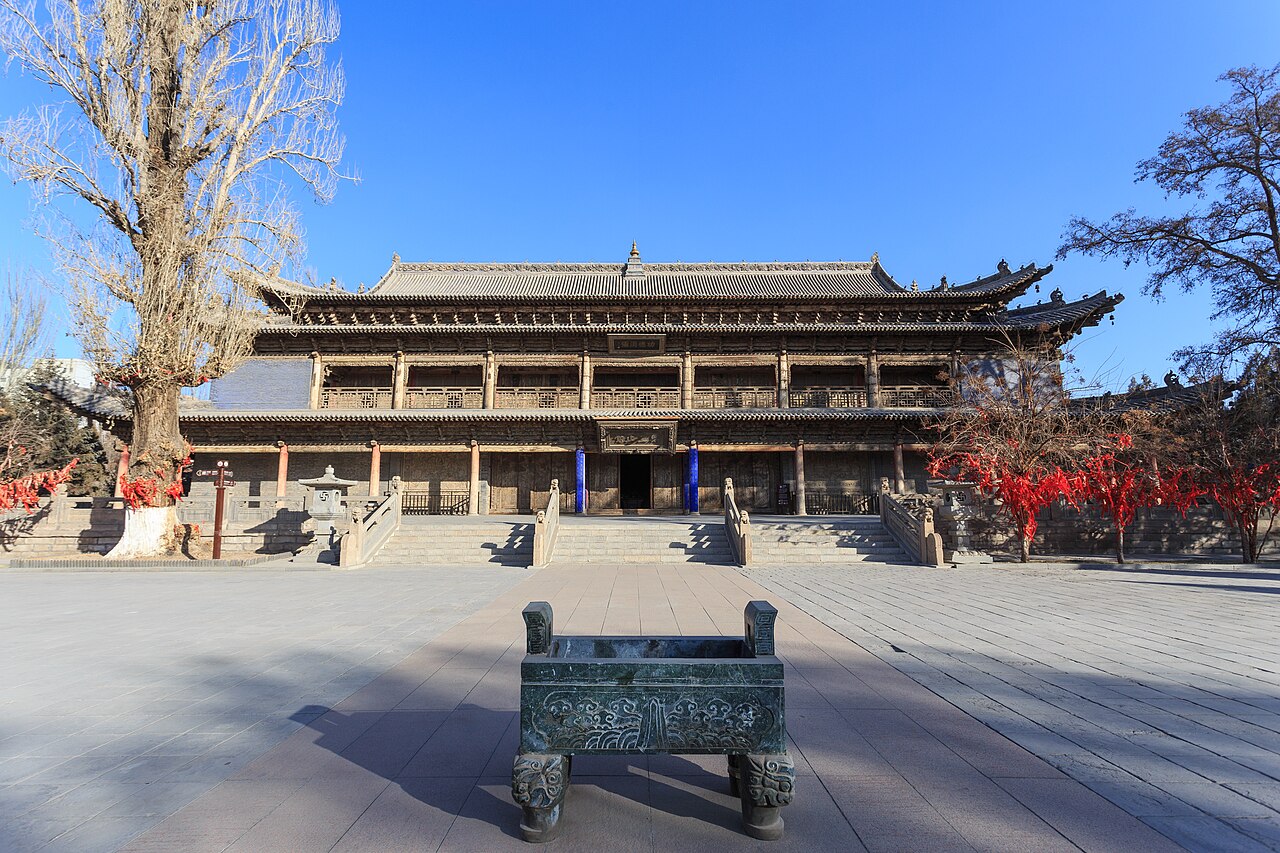
The temple has carried several names. Chinese Wikipedia gives the founding as the first year of the Western Xia Yong'an era (1098), when it was called Kasyapa Tathagata Temple. The Ming Yongle emperor renamed it Baojue Temple in 1411, and the Kangxi emperor changed it to Hongren Temple in 1678. Locals kept calling it the Great Buddha Temple or the Sleeping Buddha Temple after the statue inside. The State Council listed it in the fourth batch of nationally protected sites in November 1996, and the stone heritage marker at the temple carries that date.
The origin story recorded on English Wikipedia says that in 1098 a monk named Sineng saw lights and heard sounds coming from a nearby hill, dug there, found a reclining Buddha image, and set out to build a temple worthy of it. Two other stories attach to the site, that Kublai Khan was born here and that the last Song emperor ended his days here as a monk. The historian Ruth Dunnell reported finding no evidence for either, and treats them as legends that gathered around a famous temple.
The Great Buddha Hall
The compound covers about 23,000 square metres and faces west. What survives on the central axis is the Great Buddha Hall, the Sutra Pavilion and the Earth Stupa. The hall is nine bays wide (48.3 metres) and seven bays deep (24.5 metres), two storeys and 20.2 metres high, with a double-eaved hip-and-gable roof. Carved timber on the beams and eaves is worth a look before you go inside.
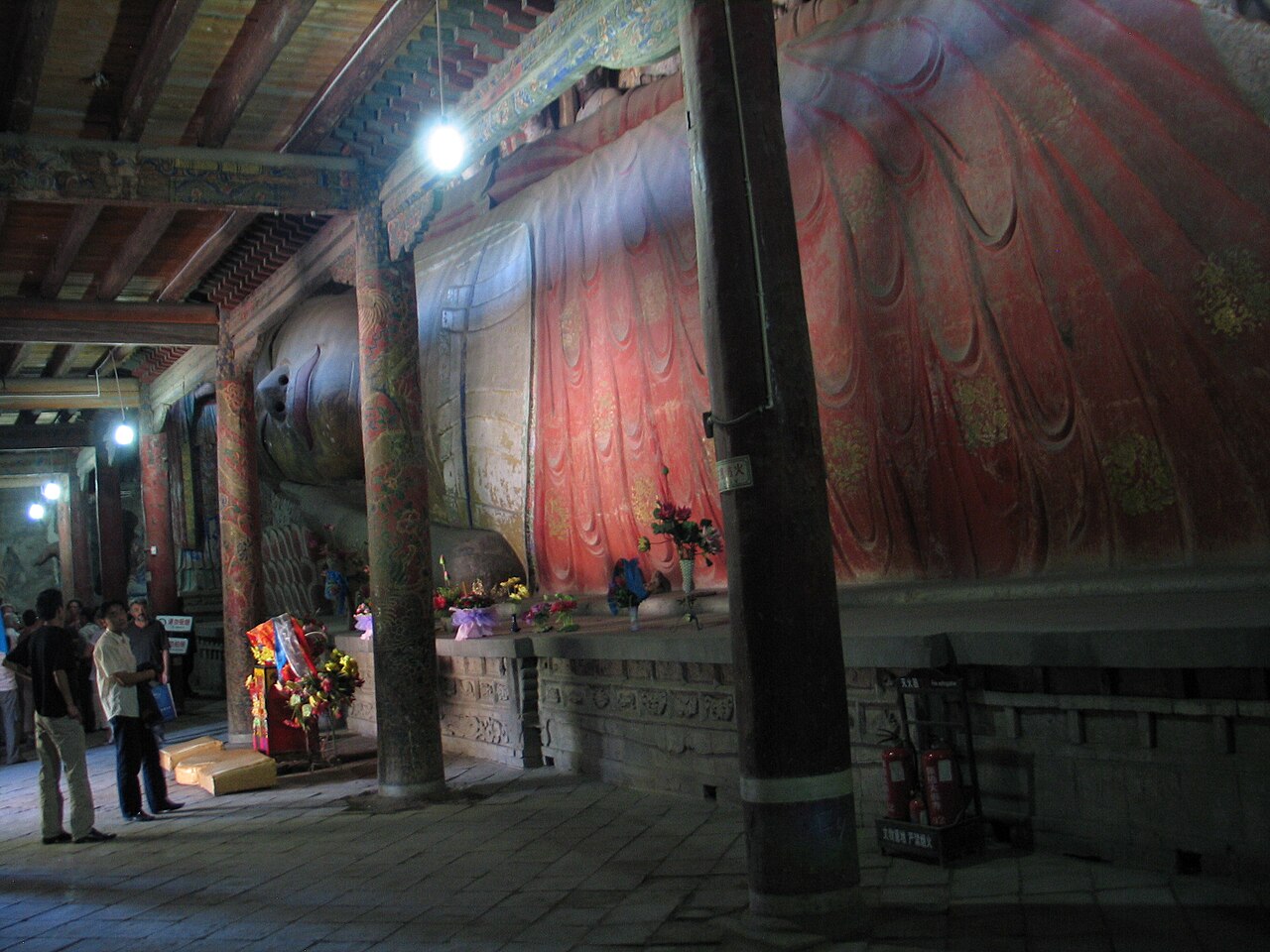
Inside are 31 painted clay figures that Chinese sources date to the Western Xia. The reclining Buddha lies on a raised platform and shows the Buddha's entry into nirvana. China Daily gives the shoulders as 7.5 metres across, and the statue is built of clay over a wooden frame. Behind it stand the ten great disciples, and the side walls hold attendant figures and the eighteen arhats. A China Today feature noted that the face reads differently depending on where you stand, eyes half open near the head and closed when seen from the feet. The hall is dim, so give your eyes a minute to adjust.
Sutra Pavilion and Earth Stupa
Behind the main hall is the Sutra Pavilion, 21.3 metres wide and 10.5 metres deep with a single-eaved hip-and-gable roof. Further back rises the Earth Stupa, originally called the Amitabha Thousand Buddha Stupa. It is a bowl-shaped stupa of the kind associated with Tantric Buddhism, built of mixed brick and earth, and the main tower is 33.37 metres high. Seen from the courtyard it gives the compound a different outline from most Han Chinese temples, which matches Zhangye's position on a corridor where many traditions met.
English Wikipedia notes that the statue suffered decay and repairs over the centuries and was hardest to protect during the Cultural Revolution. A restoration project in 2005 and 2006 preceded today's visitor numbers. Exhibition halls elsewhere in the compound show Buddhist objects, and their contents change.
Visiting
The temple is in town, so a taxi or a walk from a central hotel is usually enough. Allow sixty to ninety minutes for the main hall, the stupa and a look around the courtyards. Tickets, opening hours and any rules about photographing inside the hall follow the site's own notice. Many Chinese temples with fragile clay sculpture restrict photography or flash, so check the signs at the hall door and follow staff instructions. This page does not quote yuan amounts.
The hall is a working sacred space for many visitors. Keep voices low, do not touch the figures, and give way to anyone praying. Winter mornings are cold indoors, and summer afternoons send tour groups through, so an early slot is the calm one.
Fitting it around Danxia
The usual plan is the temple in the morning and the Danxia scenic area in the late afternoon and evening. If you arrive by train in the afternoon, go straight to the Danxia for sunset and keep the temple for the next morning before you move on toward Dunhuang or Lanzhou. Lunch near the temple district is easy, with Hexi noodles and lamb dishes on most menus.
Things to confirm before you go
- Opening hours and ticket price on the day.
- Photography rules inside the Great Buddha Hall.
- Whether any exhibition halls are closed for changeover.
- Your train time, so the temple does not crowd a Danxia sunset.
Frequently asked questions
How big is the reclining Buddha?
Chinese sources give 34.5 metres in length, with shoulders about 7.5 metres across. It is described as China's largest indoor reclining Buddha.
Is the statue original Western Xia work?
Chinese and English Wikipedia both describe the main figures as Western Xia, with later repairs. Restoration work was carried out in 2005 and 2006.
Was Kublai Khan born here?
That is a local legend. The historian Ruth Dunnell found no evidence for it.
How long should I allow?
About an hour for most visitors, a little more if the exhibition halls are open.
Sources
Facts in this article were checked against the following sources, retrieved 10 October 2026.
- 张掖大佛寺, Chinese Wikipedia
- Dafo Temple (Zhangye), English Wikipedia
- Giant Buddha Temple (Zhangye), China Daily
- China Today feature on Zhangye, December 2015
Photos are from Wikimedia Commons under the licences shown in each caption.