St. Sophia Cathedral, Harbin: Square, Tickets and Photo Times
The best of St. Sophia is free. The red-brick cathedral with its great green onion dome stands on an open square in Daoli, a few minutes' walk east of Central Street, and you can photograph the exterior at any hour. The square is floodlit every evening from about 17:00 to 22:00. Going inside costs 20 yuan for adults under the January 2026 price list (15 yuan for students, minors and seniors). The interior is now the Harbin Architecture Art Gallery, an exhibition about how a railway junction became a cosmopolitan city. Allow thirty minutes for the square, or an hour with the interior. The cornerstone was laid in 1907 for the garrison church of a Russian imperial infantry division, and later enlargements produced today's building, often called the largest Orthodox church in the Far East. For the rest of the walking day, see the Harbin travel guide.
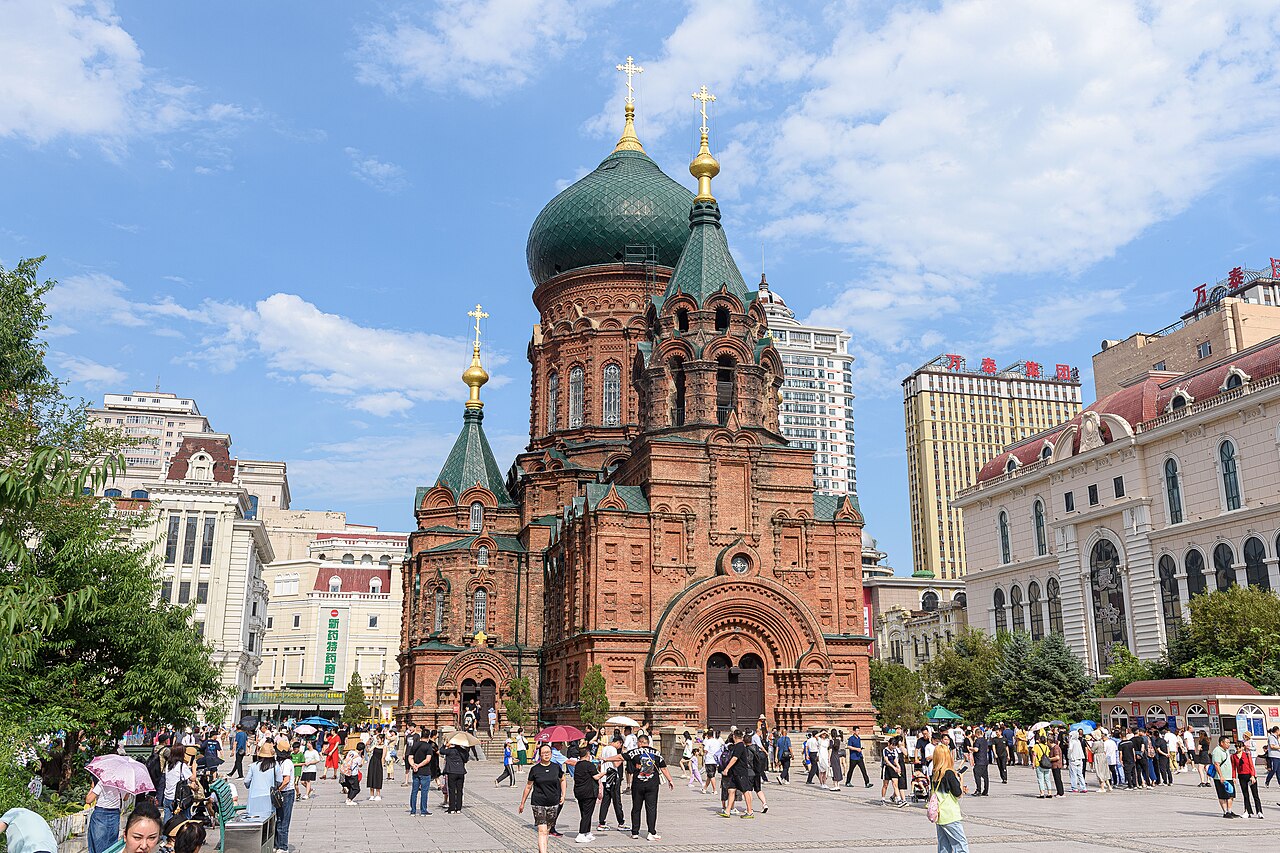
When to photograph it
- Snow, in daylight. Fresh snow on the dome and the square is the image on every Harbin brochure. Arrive early after a snowfall, before footprints cover the foreground.
- Blue hour. In the short time after sunset, the floodlights come on against a still-blue sky. In winter this is early, around 16:00 to 17:00.
- Morning side light. Soft light picks out the brick patterns, and the square is quiet.
- Avoid harsh summer noon, which flattens the brick.
Pigeons are part of the scene. If you feed them, use the feed sold on the square. Tripods are rarely worth it when groups rotate through the same frontal angle, so shoot, step aside and let others have the view. Wedding and influencer crews sometimes take over a corner, and it is quicker to wait than to argue.
In deep winter the wind on the open square cuts harder than the thermometer suggests. Shoot in short bursts and warm up in a nearby cafe between them.
Inside: the architecture gallery
Services ended decades ago, and the building now serves as a civic museum and venue. Under the name Harbin Architecture Art Gallery, the interior shows photographs, panels and models on the city's building history, from the railway town to the Russian and European streets of the 1920s. The brick vaults and the view up into the dome are impressive in their own right. Concerts are sometimes held inside, priced separately, so check the board at the entrance if you would like to hear the acoustics.
Tickets and hours, from local visitor information published in January 2026 (confirm on the day):
- Adult ticket: 20 yuan. Students, minors and seniors pay 15 yuan.
- Free entry: seniors aged 65 and over with ID, children under 1.2 metres, active military, people with disabilities, and some other groups with documents.
- Interior hours: 08:30 to 17:00. The visitor centre is open 08:30 to 19:00.
- Square lighting: about 17:00 to 22:00.
- Booking: tickets are sold at the site or through Meituan.
Some sources report the interior closing on Mondays, so check before planning a Monday visit. If you only want the silhouette that defines Harbin, stay outside and spend the ticket money on a Modern ice cream.
What not to expect
There is no incense, no choir and no active Orthodox parish. The gallery framing is historical and civic. That does not make the visit empty, because the building and the city-history displays reward a ticket if you like urban stories. Go in knowing it is a museum and you will not be disappointed.
A little history
Russia built the Chinese Eastern Railway across Manchuria from 1898, with Harbin as its hub, and stationed troops to guard it. The first St. Sophia, begun in 1907, was a wooden garrison church. As the Russian community grew, the church was rebuilt and enlarged into the present brick building, completed in the early 1930s. It is Neo-Byzantine in style, with a cruciform plan, a large central dome and a bell tower. After the Russian community left, the building fell into disrepair and was hemmed in by later structures. In the 1990s the city cleared the surroundings to create the present square and restored the cathedral as a museum.
Getting there and pairing
The cathedral stands near the junction of Toulong Street and Zhaolin Street in Daoli.
- Metro: Line 2 to Shangzhi Street station, Exit 1, then about 800 metres on foot. Central Street station on the same line is a similar walk.
- Bus: routes 42, 47 and 74 stop at Architecture Art Square (Jianzhu Yishu Guangchang), about 170 metres away.
- On foot from Central Street: five to ten minutes east through the side streets.
The natural route is Central Street, the cathedral, and then north to the Flood Control Monument and the Songhua embankment. Keep Sun Island and Ice and Snow World for another day.
Frequently asked questions
Is St. Sophia Cathedral free?
The square and the exterior are free at any hour. Going inside costs 20 yuan for adults (January 2026 price list).
Do I need to go inside St. Sophia Cathedral?
Only if you are interested in the architecture exhibition and the vaulted interior. The famous view is the outside.
When is St. Sophia Cathedral lit up?
The square lighting runs from about 17:00 to 22:00. In winter, blue hour falls early, around sunset.
Is St. Sophia still a working church?
No. Services ended long ago, and the building is now a museum and occasional concert venue.