Barkhor Street, Lhasa: How to Walk the Pilgrim Circuit
Barkhor Street (八廓街) is the loop of four streets, Barkhor East, South, West and North, that runs a little over a kilometre around the Jokhang Temple in Lhasa's old town. It is free, open at all hours, and you walk it clockwise with the pilgrims. One circuit takes about twenty minutes at their pace; with a teahouse stop, a few shops and the Jokhang square, give it one to two hours. Because it is flat, it is the right first outing on your arrival day, when the altitude of about 3,660 metres is still catching up with you. How it fits a four-day plan is in the Lhasa travel guide.
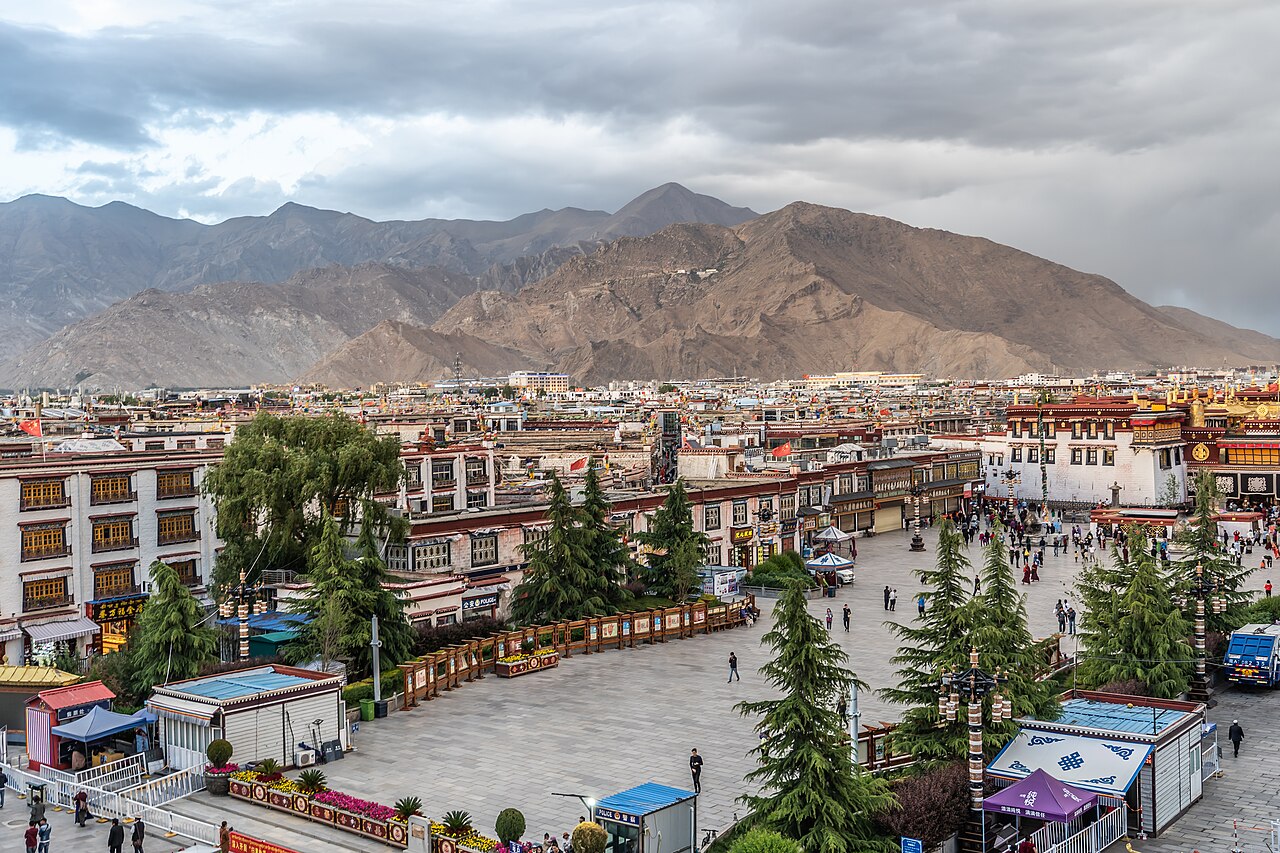
A street made by walking
The Barkhor was not planned as a street. It formed from the seventh century onward as pilgrims walked around the Jokhang, and houses and shops grew up along the path they wore. In Tibetan, kor means a circuit walked in devotion, and the Barkhor is the middle of three such circuits in Lhasa: the Nangkor inside the Jokhang, the Barkhor around its outer walls, and the Lingkor, a long loop around the whole old city that takes in the Potala. Older Chinese maps call it Bajiao Street (八角街), a rendering of the Tibetan sound through Sichuan dialect, and you will still hear taxi drivers use it.
For many Tibetans the circuit is daily practice. Older people walk it every morning and evening with prayer wheels and rosaries, and some pilgrims who have travelled from farther away go round in full-length prostrations, measuring the loop with their bodies. That is the street's real business. The shops came later.
Which way and when
Walk clockwise, the same direction the prayer wheels turn. In practice that means starting from the Jokhang square and keeping the temple on your right. Going the other way is the one mistake everyone notices.
The timing changes what you see:
- Early morning, roughly 7:00 to 9:00, is when locals do their circuits before work. The light is cold and clear, the shops are still shuttered and the juniper smoke from the big incense burners hangs over the square. This is the best time if you want to see the kora as practice rather than as a market.
- Midday is when tour groups arrive and the shops are fully open. The sun is harsh and the square has little shade.
- Late afternoon into dusk brings a second wave of local walkers and warmer light on the whitewashed facades. Photographers prefer this window.
Entrances to the old town have security checkpoints with bag scanners. Carry your ID or passport, and if you are on a permit tour, your guide will handle the formalities. Lines are short outside festival periods.
Etiquette that matters
- Give prostrating pilgrims a wide lane. Never step over someone lying on the stones.
- Step out of the flow to the side of the street before stopping for a photo.
- Ask before photographing people up close, especially older pilgrims and monks. A smile and a gesture at the camera is enough; accept a shake of the head.
- Drones are not allowed over the old town.
- Spin prayer wheels clockwise if you touch them, and do it quietly.
Tea, food and where to sit
Sitting down is part of the visit, and on your first day it is also how you look after yourself at altitude. Guangming Teahouse, just off the Barkhor, is the old-town institution: long benches, thermoses of sweet milk tea poured by the glass, and bowls of Tibetan noodle soup, the city's everyday lunch. Sweet tea is the easy first cup. Butter tea, salty and rich, is the one Tibetans drink at home; try a cup, but don't feel you must finish it.
Makye Ame, at the southeast corner of the Barkhor, is the well-known restaurant with a rooftop terrace. It is busy and priced for visitors. If you would rather sit with locals, any small teahouse down a side alley does the same noodles for less.
For your first two days, eat moderately and skip alcohol. Your body needs time to adjust.
Shopping without regret
The shops along the circuit sell prayer wheels, prayer flags, incense, singing bowls, silver and turquoise jewellery, thangka paintings and a lot of factory-made souvenirs. Some advice:
- Thangkas vary from printed to hand-painted over months. If you are spending real money, buy from a workshop where you can see painters at work and ask about pigments. Ignore "antique" claims unless you know the field.
- Compare a few shops first. Prices on the main circuit are higher than one street in.
- Bargaining is normal at stalls, less so in fixed-price shops. Keep it friendly and walk away if the number doesn't move.
- Sacred objects deserve care. Prayer wheels and malas are devotional items for the people around you. Handle them that way.
Mobile payment is widely accepted, but carry a little cash for small stalls and teahouses.
Making a short day of it
A gentle arrival-day plan looks like this: rest at the hotel after you land, walk out in mid-afternoon, do one slow Barkhor circuit, sit in a teahouse, then visit the Jokhang square at dusk to see the Tang–Tibet Alliance Monument and the old willow said to have been planted by Princess Wencheng. Go to bed early. Save the temple's interior for when you have your booking, and the Potala Palace stairs for day two or later.
If you feel well and want to see more of the old town, the lanes north of the Barkhor lead toward Ramoche Temple. The Lingkor, the long outer circuit, is a good walk for a later day once you have adjusted to the altitude.
Season and festival notes
The circuit runs all year. July to September brings most of Lhasa's rain, mostly at night, so days are often clear. Winter is quieter, sunny by day and very cold after sunset, and in winter months more rural pilgrims come to Lhasa after the harvest. During religious festivals, especially the Saga Dawa month, the circuit gets far busier and slower. Give extra room and expect the loop to take twice as long.
Frequently asked questions
Is Barkhor Street free?
Yes. There is no ticket for the street or the square. The Jokhang Temple charges separately.
Which direction do you walk the Barkhor?
Clockwise, with the Jokhang on your right, the same way as the pilgrims and prayer wheels.
How long does the Barkhor circuit take?
About twenty minutes for one loop at walking pace, one to two hours with stops.
What is the best time to walk it?
Early morning to see locals doing the kora, late afternoon for softer light. Midday is the most crowded.
Sources
- Barkhor Street, Chinese Wikipedia: https://zh.wikipedia.org/wiki/八廓街
- Jokhang Temple, Chinese Wikipedia: https://zh.wikipedia.org/wiki/大昭寺
- Tibet Department of Culture and Tourism, summer booking guide for Lhasa sites, July 2026: https://wlt.xizang.gov.cn/xccx/lytg/202607/t20260720_550689.html