Confucius Temple (Fuzimiao) and the Qinhuai River
The Confucius Temple area, Fuzimiao, is the bend of the Qinhuai River in south Nanjing where a Song-dynasty Confucian temple, the old provincial examination hall and a lantern-lit boat route all sit within a few hundred metres. The streets and riverbanks are free to walk. You pay only if you go inside the temple's Dacheng Hall, the China Imperial Examination Museum, or board a painted boat. Arrive mid-afternoon, do one or both halls, eat, then take the boat after dark. Metro Line 3 stops at Fuzimiao station; Line 1's Sanshanjie is a ten-minute walk west. For the wider trip, see the Nanjing travel guide.
Free streets, three paid extras
Most visitors spend more time in the free part than they expect. The pedestrian streets, the riverbank, Wuyi Lane and the bridges are open from morning to late evening and cost nothing. Three things carry a ticket:
- Dacheng Hall and the temple courtyards. Third-party listings this year put the adult ticket at about CNY 30.
- The China Imperial Examination Museum in the former Jiangnan Examination Hall. Listings show a hall-plus-museum combo at about CNY 72, and wider multi-site combos above that.
- The Qinhuai painted boat. Listings for 2026 run from roughly CNY 60 to 80 for daytime trips and CNY 80 to 120 at night, depending on route and boat type.
Opening times have been listed as late as about 22:00 for both halls, with ticket sales stopping earlier. These are listing figures, not official tables, so check the price board or the official mini-program on the day. During Spring Festival, the summer holidays and other peak periods, the scenic area has required advance reservation just to enter the core streets. If your dates fall in a holiday week, look that up before you set off.
What is inside the paid halls
The temple was founded in 1034, under the Northern Song, on the site of an Eastern Jin academy. In the Yuan it served as the regional school, and in the Ming as the school of Yingtian prefecture. What stands now is largely rebuilt, so come for the layout and the setting rather than old timber. The detail most people miss is across the water: the long screen wall on the south bank, about 110 metres, faces the temple gate. It is one of the longest in China and is best seen from the riverbank, not from inside the hall.
The examination museum is the better of the two halls if you only pay for one. The Jiangnan Examination Hall moved to this site in the Ming Jingtai years. Its watchtower, the Mingyuan Lou, went up in 1534, and by 1873 the compound held 20,644 tiny exam cells where candidates from Jiangsu and Anhui sat for days at a time. The last provincial exam here was held in 1903, two years before the system was abolished. The museum opened in its present form in 2017, and much of it is underground, so it works on a hot or rainy afternoon.
Taking the boat
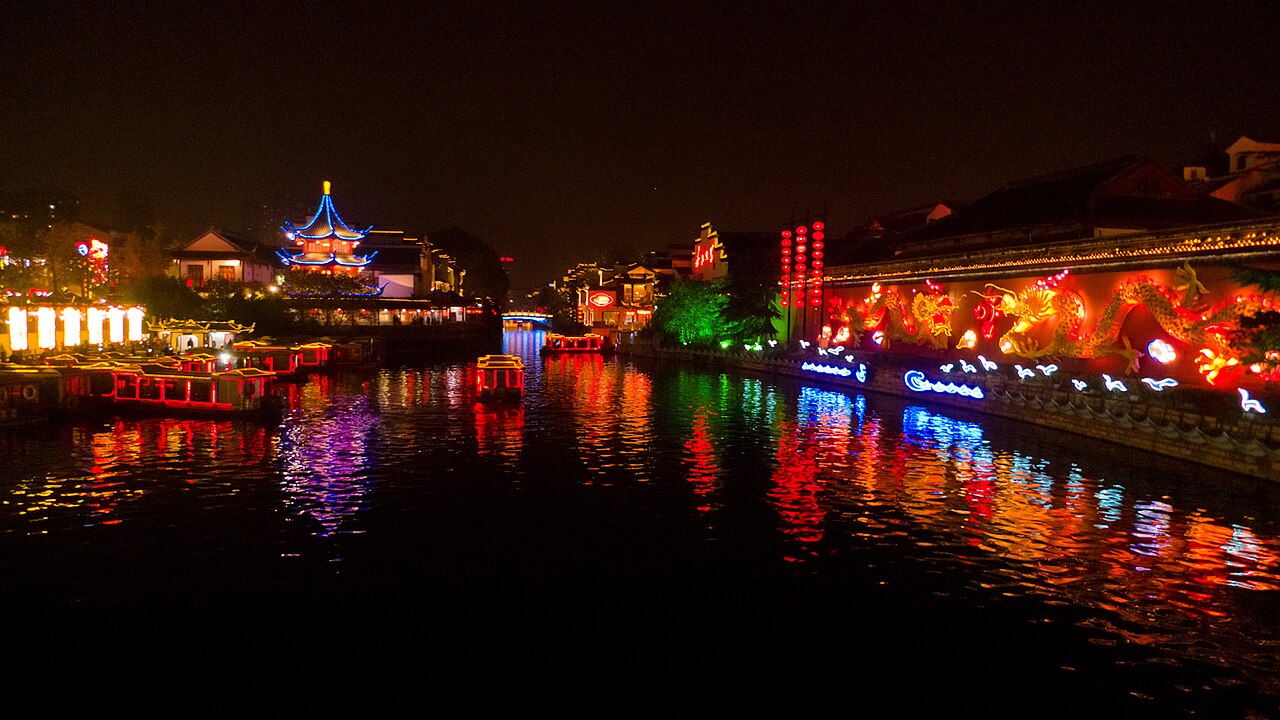
The boats leave from the pier at Panchi, the semicircular pond in front of the temple. The classic loop runs east along the river and back. Expect a short ride, often quoted at around forty minutes for the night route, with commentary in Chinese. At night the queues are worse but the reason to go is the lights; daytime boats are cheaper and calmer, and the river looks like an ordinary canal.
On weekend and holiday evenings the ticket window queue can run past an hour. Buy through the official mini-program as soon as you know your evening, and book a sailing that leaves a margin after dinner. If rain or wind stops the boats, the bridges over the Qinhuai still give you most of the same view for free.
An evening that works
One order that suits most people:
- Mid-afternoon, the examination museum, while legs and attention still work.
- Late afternoon, the temple courtyards and the screen wall from the bank.
- Early dinner on or near Gongyuan Street.
- After dark, the boat. Then walk the bridges while the crowds thin.
If you have a whole day for the south end, do the halls in the morning and spend the afternoon at Old South Gate, about 15 to 20 minutes' walk south, before coming back for the boat.
Eating without grazing all night
The streets around the temple sell every Nanjing snack in the book: duck blood and vermicelli soup, salted duck, small dumplings, sweet osmanthus desserts, and sampler sets sold as the "Qinhuai eight snacks". Prices are higher than elsewhere in the city. Choose one sit-down meal or one focused round of snacks and stop there, or you will reach the boat queue already tired and overfed. Locals often eat somewhere quieter, such as Laomendong, and come here only for the river.
Crowds and holiday weeks
From Spring Festival to the Lantern Festival the area hosts the Qinhuai Lantern Fair, one of the busiest events in the city, and the lanterns go up across the river. It is worth seeing once, but plan for crushes on the bridges, timed entry and sold-out boats. On an ordinary weekday, evenings after about 21:00 are noticeably calmer, and the bridges are easier for photos. Keep valuables zipped away in the packed lanes.
Who can skip what
- Skip the temple hall if time is short; the river and the screen wall carry most of the visual interest.
- Skip the boat on a rainy or windy night and walk the bridges instead.
- Keep the examination museum if you want one paid interior that actually explains something.
Do not skip Fuzimiao entirely on a first visit. Without the river at night, the south end of Nanjing loses its point.
Fitting it into Nanjing
Fuzimiao and Old South Gate make the south-end day. The Presidential Palace and Xuanwu Lake belong to a mid-city day, and the Sun Yat-sen Mausoleum and Ming Xiaoling to a Purple Mountain day. Trying to finish the mountain and still catch an evening boat here is possible by metro, but it makes for a long, hot day in summer.