Ming Xiaoling: Walking the Spirit Way to the Tomb Mound
Ming Xiaoling is the tomb of Zhu Yuanzhang, the first Ming emperor, and Empress Ma, at the southern foot of Purple Mountain in Nanjing. It became part of the UNESCO "Imperial Tombs of the Ming and Qing Dynasties" in 2003, and its plan set the pattern for later Ming and Qing imperial tombs, including those near Beijing. The visit is a walk, about two to three hours: past the pairs of stone animals on the Spirit Way, through the Sifangcheng stele pavilion and the gates, to the walled burial mound. The underground chamber has never been excavated and cannot be visited. Recent scenic-area tables list the ticket at CNY 70. Go the same day as the free Sun Yat-sen Mausoleum next door, as the Nanjing travel guide suggests.
Tickets, hours and the combo question
Zhongshan Scenic Area tables list Ming Xiaoling at CNY 70 for adults, with ticket sales from about 06:30 to 18:30 in the main season and shorter hours in December and January. A four-site combo covering Ming Xiaoling, Linggu Temple area, the Music Stage and Meiling Palace has been listed at CNY 100. It pays off only if you will actually enter three of those four; most first-time visitors manage Xiaoling and one more at most. Buy at the gates, at self-service machines or through the scenic-area mini-program, and carry your passport. Prices and winter hours change, so check the board on the day.
The walk, stage by stage
The full approach is long. The Spirit Way runs about 2.4 kilometres from the Xiama Fang archway to the tomb's main gate, and it does not run straight: it curves around Plum Blossom Hill, where Sun Quan of the Three Kingdoms is buried. Most visitors join partway along.
Xiama Fang and the Great Golden Gate. The stone archway at the start is inscribed with an order for all officials to dismount. The Great Golden Gate beyond it has lost its roof but keeps its three openings. These are optional if you arrive from the scenic-area side.
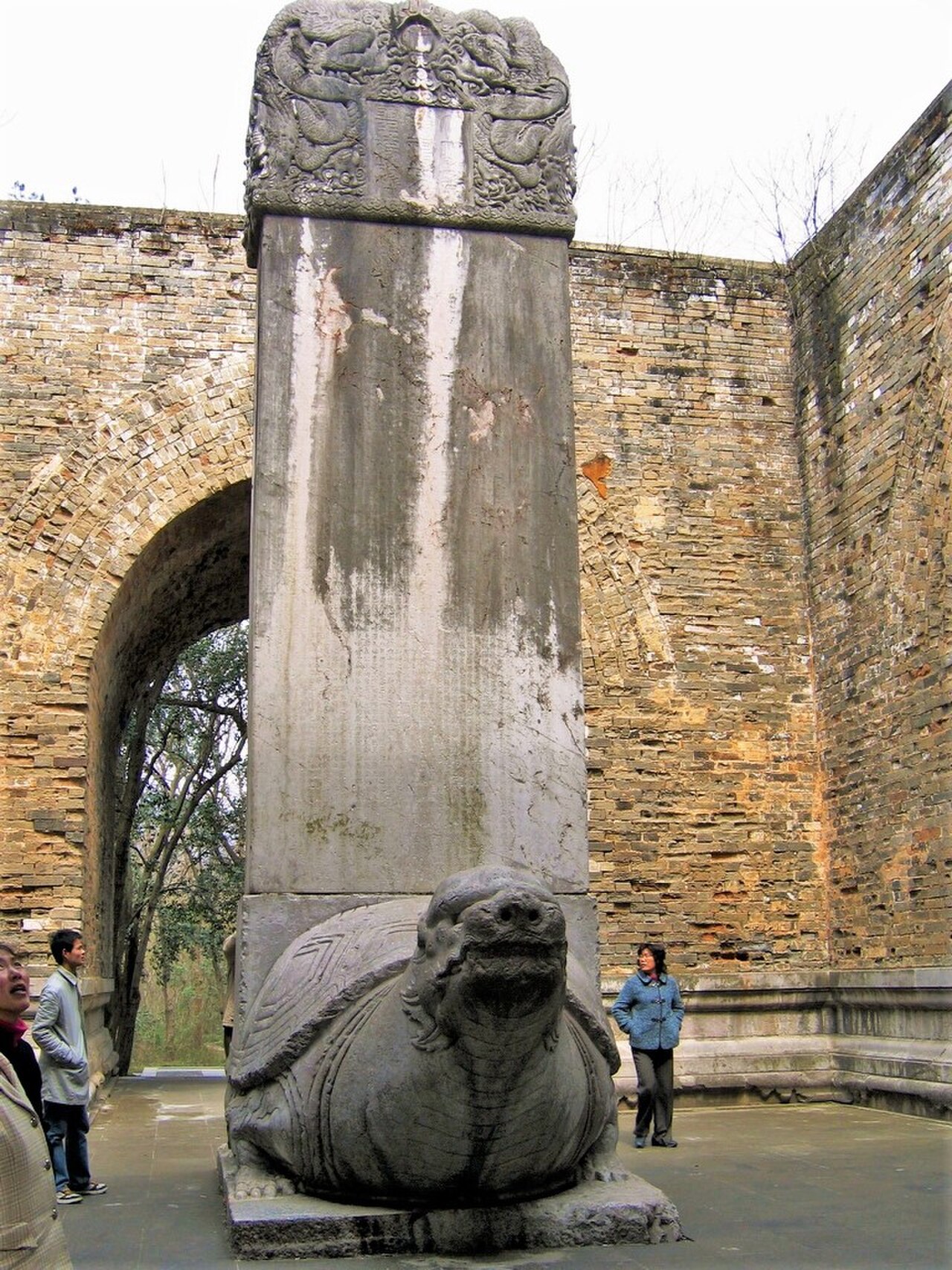
Sifangcheng. The square pavilion was built in 1413 by the Yongle Emperor for his father. Its roof is gone, which leaves the stele open to the sky: the "Stele of Divine Merit and Sagely Virtue" is 6.7 metres tall and stands on a stone tortoise just over 2 metres high. Its scale is easiest to judge with someone standing beside it.
Stone Elephant Road. Past a five-arch bridge, twelve pairs of animals line the road in a fixed order: lions, xiezhi, camels, elephants, qilin and horses, each kind in one resting pair and one standing pair. This is the stretch people photograph. In late October and November, the ginkgo along it turns yellow and the path is packed on weekends; go early.
The Wengzhong path. The road then turns north past a pair of columns and two pairs each of generals and civil officials, before reaching the rebuilt Lingxing Gate.
The tomb precinct. After turning north-east you pass the Golden Water Bridge and the Wenwu gate into the main precinct. The Kangxi Emperor's 1699 stele, carved with four characters praising the Ming founder's rule as greater than Tang and Song, stands in the hall gate; the crack visible in it dates from Taiping fighting in the 1850s, when most of the wooden buildings burned. The main hall survives only as a platform with 56 column bases.
The Ming Tower and the mound. A sloping tunnel of 54 steps runs through the tower base, and on the far side a retaining wall faces the Treasure Mound itself. The tower's roof was rebuilt in 2009. You can walk part of the mound's perimeter, and that is the end of the visit.
Getting there and order of the day
Metro Line 2 stops at Xiamafang and Muxuyuan, both on the edge of the scenic area. Scenic shuttle buses link the mausoleum, Xiaoling and Linggu, and taxis between the main gates are short. The usual order is a reserved early slot at the Sun Yat-sen Mausoleum, lunch, then Xiaoling in the afternoon. On a Monday, when the mausoleum is normally closed for maintenance, reverse the day: Xiaoling first, then a city sight, with the mausoleum moved to Tuesday.
Leave the Presidential Palace and Xuanwu Lake for a separate day in the city centre. The Confucius Temple and Old South Gate are at the opposite end of town and suit an evening.
Seasons and conditions
- Late February to March: Plum Blossom Hill, inside the Xiaoling area, is one of the best-known plum-blossom sites in China. Check whether your ticket covers the blossom zone for that season; arrangements have changed in past years.
- Late June to mid-July: the plum rains make the stone paths slick, and the heat on the open stretches is heavy by midday.
- Late October to November: ginkgo season on Stone Elephant Road. The best weeks of the year and the most crowded.
- Winter: quiet and cold, with shorter hours.
Wear shoes with grip, carry water in summer, and allow time to sit; there is more walking here than the map suggests.
How much to see
If time is tight, enter near Stone Elephant Road, walk the animals and the Wengzhong path, then go straight through the gates to the Ming Tower. That covers the parts people come for in about ninety minutes. Skip the Xiama Fang end and the side paid sites on a first visit. If mobility is limited, the long outdoor walking here is harder than at the mausoleum, which has steps but a shorter route; choose one.