Dali Old Town: Walking Guide to the Gates, Lanes and Evenings
Dali Old Town is free to enter and small enough to cross on foot in about twenty minutes. It is a grid of grey-tiled lanes inside rebuilt Ming gates, with the Cangshan ridge rising directly behind the west wall. Give it half a day for the gates, Wuhua Tower and the side streets, and stay the night inside the walls if you can, because the town is at its best early in the morning and after dark. From Dali railway station in Xiaguan, bus route 8 or the Dali Tourist Express gets you to the gates in well under an hour. The three-day plan that puts it alongside Cangshan and Erhai is in the Dali travel guide.
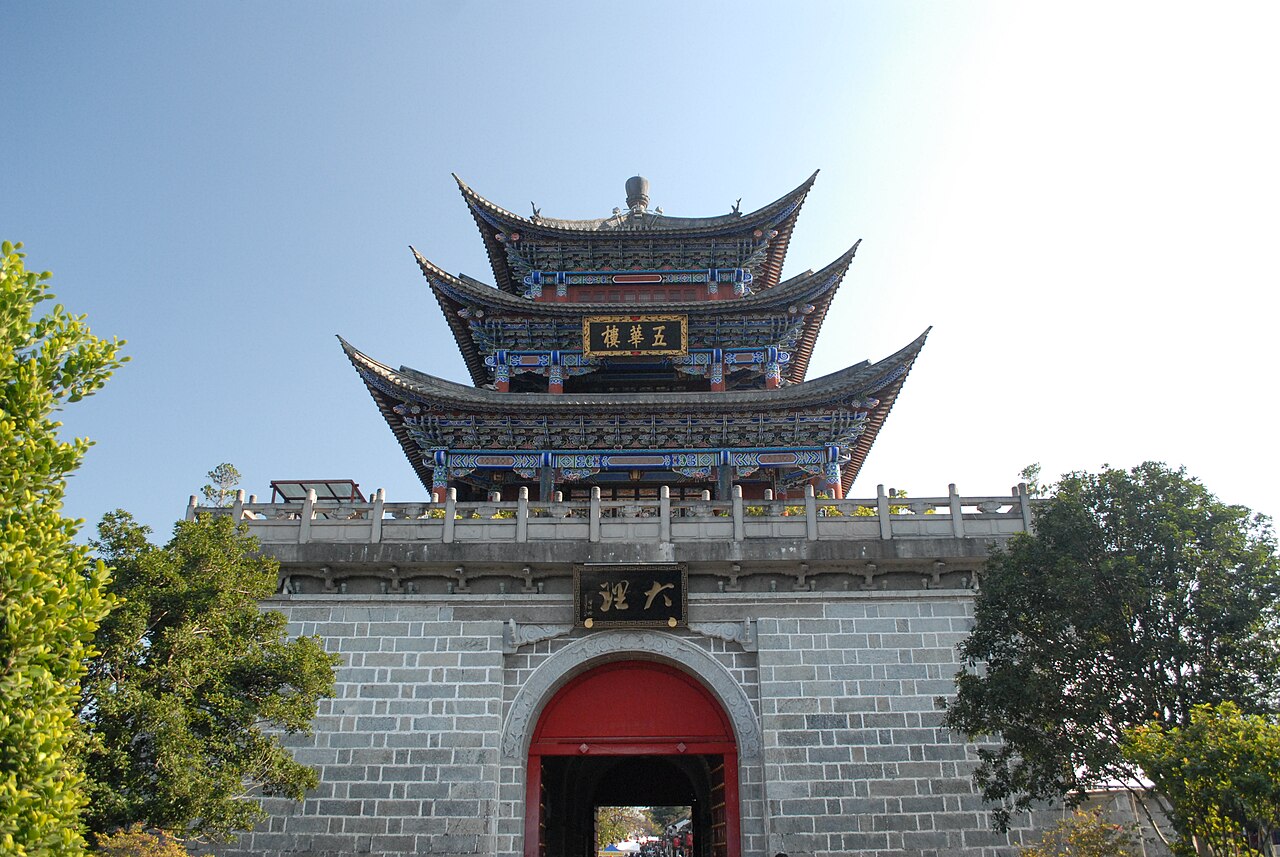
How the town is laid out
This is a Ming prefectural city, built just east of the older Yangjuemie city of the Nanzhao and Dali kingdoms. In 1982 it was in the first batch of China's National Historical and Cultural Cities. The walls measured about 1,850 metres north to south and 1,500 metres east to west, a circuit of 7,248 metres around roughly three square kilometres. Four gates broke the wall: Tonghai Tower on the east, Chengen Tower on the south, Cangshan Tower on the west and Anyuan Tower on the north.
Little of that is original. Only about 300 metres of the old wall survive. The south and north gate towers were rebuilt in 1984, and the west and east towers in 2001 and 2002. The street plan is the real survivor. Fuxing Road runs straight from the south gate to the north gate, with Wuhua Tower, the drum tower, standing across it in the middle. East-west lanes cross it at regular intervals, and channels of Cangshan meltwater run along many of them.
A south-to-north walk
The simplest route is the main axis:
- Start at the South Gate (Chengen Tower). It is the one most visitors arrive at, and it gives you the classic view up Fuxing Road with the mountain behind.
- Walk north up Fuxing Road to Wuhua Tower. This stretch is the most commercial, lined with tie-dye, silver, tea and rushan stalls. Look up at the roofs and gate towers rather than into the shops.
- Turn off the main street at any cross-lane once you are past the tower. Renmin Road, which runs east-west, has the cafes, small bars and street musicians most people picture when they think of Dali. Lanes a block either side of Fuxing Road are quieter and better for photographs of grey roofs against Cangshan.
- Finish at the North Gate (Anyuan Tower). Buses and taxis for the Three Pagodas and the road north to Xizhou leave from this side.
That takes two to three hours at a slow pace with a coffee stop. If cloud hides the mountain, the walk still works; save the Mount Cang cableway for a clearer day.
Foreigners' Street and the evenings
In the northwest of the town, Huguo Road was renamed Foreigners' Street (Yangren Jie). The old Dali No. 2 Guesthouse was here, and it made the street one of the first places in China where foreign backpackers gathered, in the 1980s. Today it is the main bar strip, busy and loud until late, with Western menus and live music. One evening there is enough for most people. If you want sleep before an early cableway, ask for a room away from Huguo and Renmin roads.
The town feels very different at seven in the morning. Shopkeepers are still opening up, locals buy breakfast, and the gate towers catch the first sun. A short walk at that hour with a coffee often beats a planned sunrise trip anywhere else.
Where to stay and which gate to use
A guesthouse inside the walls puts dinner, the tower and the bars all within walking distance. Pick the gate that suits your next move:
- South or east side for the road back to Xiaguan and the railway station.
- West side for the Cangshan cableways, whose lower stations sit just above the town.
- North side for the Three Pagodas, Xizhou and Butterfly Spring.
Inside the walls, the narrowest lanes are easier on foot than in the electric carts that work the edges. Luggage storage is widely offered, which helps if you leave for a night in Shuanglang and come back.
Getting there from Xiaguan
Trains arrive at Dali station in Xiaguan, about 15 kilometres south. Three bus options have served the old town in recent timetables:
- Route 8 runs from the railway station to the old town's north gate bus yard, roughly 06:30 to 21:30.
- The Dali Tourist Express runs from the railway station to the South Gate and West Gate, then on to the Three Pagodas, for a flat 5 yuan. It runs about every 15 minutes during the day.
- Taxi or ride-hail takes about half an hour and is the easy choice with luggage.
Routes are adjusted during festivals such as the Third Month Fair in April, when the area outside the west gate fills with market stalls. Check the stop when you board.
Shopping without regret
Tie-dye cloth, rushan (dried milk sheets), Xiaguan tuocha tea and small silver pieces are what people take home. The same goods repeat from shop to shop, so compare two or three before paying, and ask whether the dye runs. For tie-dye made in the village where it is produced, Zhoucheng on the road north is better than the old-town stalls. Xizhou baba tastes best hot in Xizhou, not as a cold souvenir bag.
For a sit-down Bai meal, clay-pot fish and dishes from the "eight bowls" banquet are on menus around the gates. Two people do not need the full tourist set.
Practical notes
- There is no ticket for walking the streets. Some gate towers and courtyard museums charge small fees for their own grounds.
- At nearly 2,000 metres the UV is strong even on cool days. Wear a hat and sunscreen.
- Tour groups fill Fuxing Road from late morning. Early morning and the parallel lanes are quieter.
Frequently asked questions
Is Dali Old Town free?
Yes. The streets are free and open at all hours. Only individual towers, courtyards and museums charge.
How long do I need in Dali Old Town?
Half a day for the gates, Wuhua Tower and a few lanes. A full day if you add cafes, shopping and an evening out.
Should I stay in the old town or in Xiaguan?
The old town, for the atmosphere and the walk to dinner. Xiaguan makes sense only for a very early train.
What pairs well with the old town?
The Three Pagodas the same afternoon, then Mount Cang and Erhai Lake on the following days.