Xizhou, Dali: Bai Courtyards, Paddies and Baba
Xizhou is the best place near Dali to see Bai merchant houses, and it fills a half day: one or two courtyards, a hot Xizhou baba from a street grill, and a walk out into the rice fields that come right up to the town's white walls. It lies on the west side of the Erhai basin about half an hour north of Dali Old Town, and it fits naturally on a north-road day with the Three Pagodas and Butterfly Spring. Under Nanzhao the town was called Dali City or Shi City and was one of the kingdom's "ten jian" districts. Its later wealth came from trade, and the houses that wealth paid for make up the Xizhou Bai Old Building Complex, a nationally protected site. The wider route is in the Dali travel guide.
Reading a Bai courtyard
Two layouts come up again and again. In "three wings and a screen wall" (sanfang yizhaobi), three two-storey wings surround a courtyard and a large whitewashed screen wall closes the fourth side, throwing reflected light into the yard. In "four-sided compound with five courtyards" (sihe wutianjing), four wings meet at the corners, leaving a main courtyard and four small corner yards. Look for the painted panels and inscriptions on the screen walls, the carved wooden doors and window lattices, and the gate towers with their layered eaves. The wealthier Xizhou merchant families, who traded tea and goods along routes into Burma and Tibet, added Western touches in the early twentieth century: stucco, glass and the occasional European-style balustrade.
Which courtyards to see
Three names come up most often:
- Yan Family Grand Courtyard. The best-known merchant compound, run as a museum with a sequence of linked courtyards. If you only buy one ticket, buy this one.
- Yang Pinxiang Residence. Now home to the Linden Centre, a guesthouse and cultural centre. Non-guests can sometimes visit public areas or join a tour; ask at the gate.
- Hou Family Grand Courtyard. Another merchant house, quieter than the Yan compound.
Ticket prices and opening times vary by house and season, so check on arrival. One or two interiors are plenty. After that the details start to repeat, and your time is better spent on the lanes and fields. Many other courtyards are still family homes. Do not walk in uninvited, and do not climb onto roofs or walls for photographs.
Sifang Street and baba
Sifang Street, the small square at the centre of town, is where everyone ends up. Tea stalls, tie-dye shops and the baba grills are clustered around it. Xizhou baba is a thick round flatbread cooked over charcoal, sold savoury (with pork, scallion and chilli) or sweet (with rose sugar or bean paste). Eat it within a few minutes of it coming off the grill. A cold bag of baba bought in the old town is not the same thing. Rushan, the grilled milk-fan snack, is also sold here.
The paddies
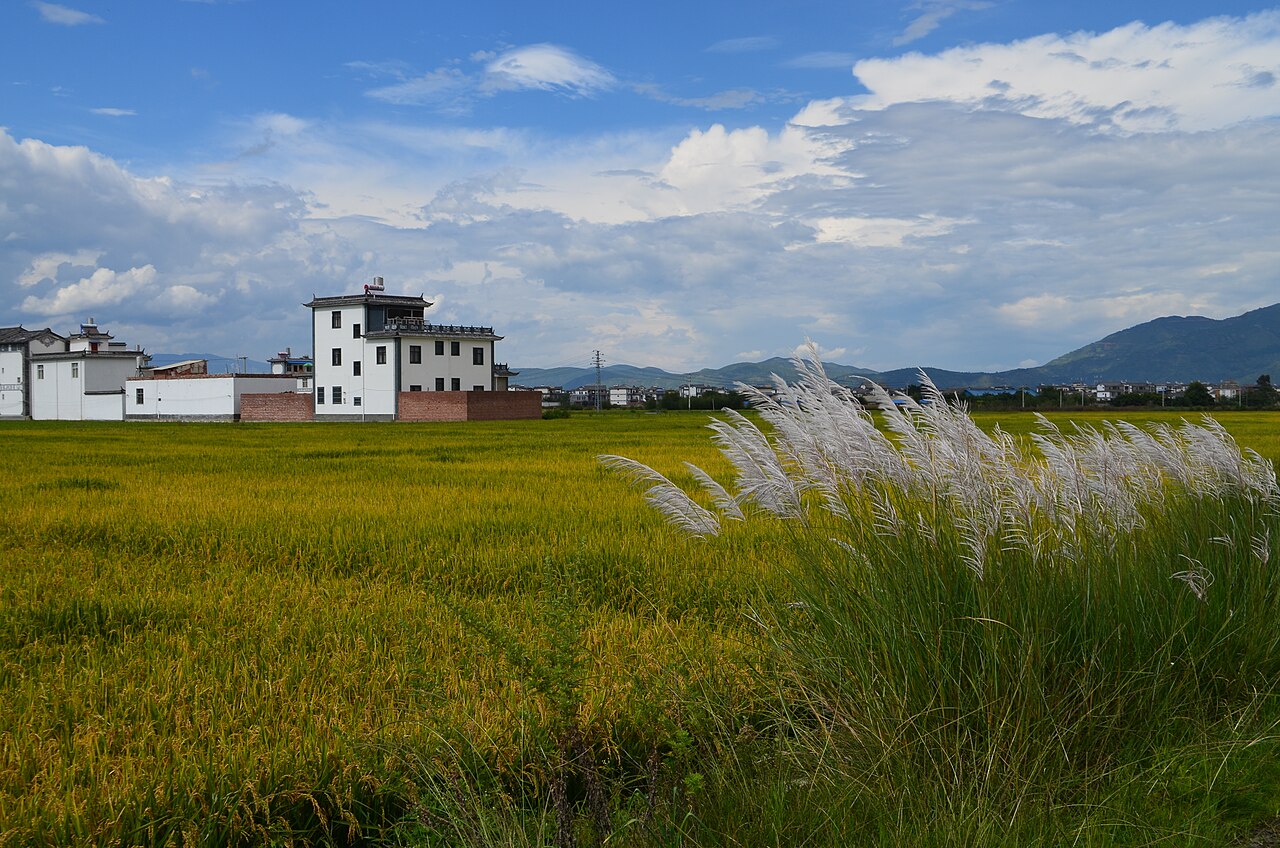
The fields begin at the edge of town and run down toward Erhai. In spring and summer they are bright green, rice is harvested in the autumn, and the gold colour comes just before. The white walls and grey roofs against the fields are the photograph Xizhou is known for. Late afternoon light is the warmest. Paths between the fields are narrow and muddy after rain, so wear shoes you do not mind getting dirty. Drones are often banned over the town; check before flying.
From the fields you can continue to the lake. Haishe Park, on a tongue of land jutting into Erhai near Xizhou, is on the west-shore Erhai cycling corridor, so you can link a bike ride and the town.
A half-day order
- Arrive late morning and walk straight to Sifang Street.
- Visit the Yan Family Grand Courtyard (allow about an hour).
- Eat baba and rest on the square.
- Walk out into the paddies as the light softens.
- Continue north to Zhoucheng's tie-dye workshops and Butterfly Spring, or head back south past the Three Pagodas.
If you want empty fields, reverse it: paddies at opening time, courtyards later.
Getting there
Xizhou is about half an hour north of the old town by taxi or ride-hail, along the old Dali–Lijiang road (National Highway 214). Local buses run north along the same road, and some travellers flag one down outside the Three Pagodas gate. Confident cyclists can ride north along the west-shore corridor and cut inland, which takes most of a morning. Drivers park outside the old core and walk in, because the lanes are narrow.
A taxi or hired driver for the whole north road (Three Pagodas, Xizhou, Zhoucheng and Butterfly Spring) is the simplest arrangement if you want all four in one day.
Is it too touristy?
The main street around Sifang Street is busy, especially at weekends. Walk one block away and the town quietens quickly. Xizhou is used to visitors, and that is part of why its old houses are kept up and open. If you are after untouched village life, you will not find it here. If you want to understand what a Bai courtyard looks like and how a Dali merchant family lived, nowhere near the old town does it better.
Frequently asked questions
How long should I spend in Xizhou?
Two to four hours covers a courtyard, Sifang Street, baba and the paddies. Allow a full afternoon if you want to photograph the fields slowly or cycle there along the lake.
Which Xizhou courtyard is best?
The Yan Family Grand Courtyard is the most complete and the easiest to visit. Add the Hou Family courtyard if you want a second, quieter one.
How do I get from Dali Old Town to Xizhou?
Take a taxi or ride-hail north along National Highway 214, about half an hour, or a local bus heading north on the same road.
What pairs well with Xizhou?
The Three Pagodas in the morning and Butterfly Spring after, or a ride on the west shore of Erhai Lake.