Dongqian Lake, Ningbo: Zhejiang's Largest Natural Freshwater Lake
Dongqian Lake sits about fifteen kilometres southeast of Ningbo, nearly twenty square kilometres of water averaging just over two metres deep — the largest natural freshwater lake in Zhejiang — and in 2015 the Dongqian Lake resort entered the first batch of seventeen national-level tourism resorts. The way to take it is the loop: a causeway, an old street and Southern Song stone carvings strung around the shore, by bike or in car segments. Practicalities below were checked against public sources retrieved in September 2026; sub-ticket prices move often, so treat them as talking points.
What the lake offers
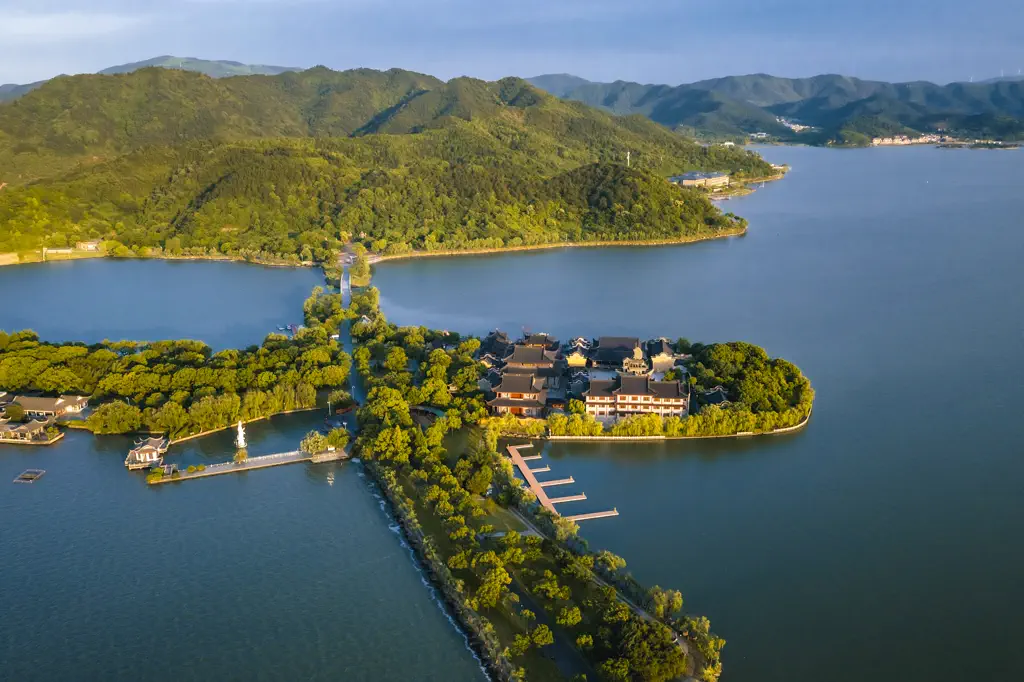
The shoreline itself is free, and the best of it comes in three parts. Xiaoputuo — Xiayu Isle — is crossed by the two-kilometre Taogong Causeway, with the Xiayu Chan Temple and a water Guanyin along it; the Putuo Cave below is said to be a Guanyin sanctuary cut for the mother of Shi Hao, the Southern Song chancellor, and the grotto survives intact. Hanling Old Street stands on the south shore, some twenty kilometres from the city centre, hills on three sides and the lake on the fourth, billed as the first old street of East Zhejiang — meals and tea in old houses. The Southern Song Stone Carving Park on the western slopes is nationally protected, and the Shi family tomb-way carvings there fill the Southern Song gap in China's tomb-sculpture record.
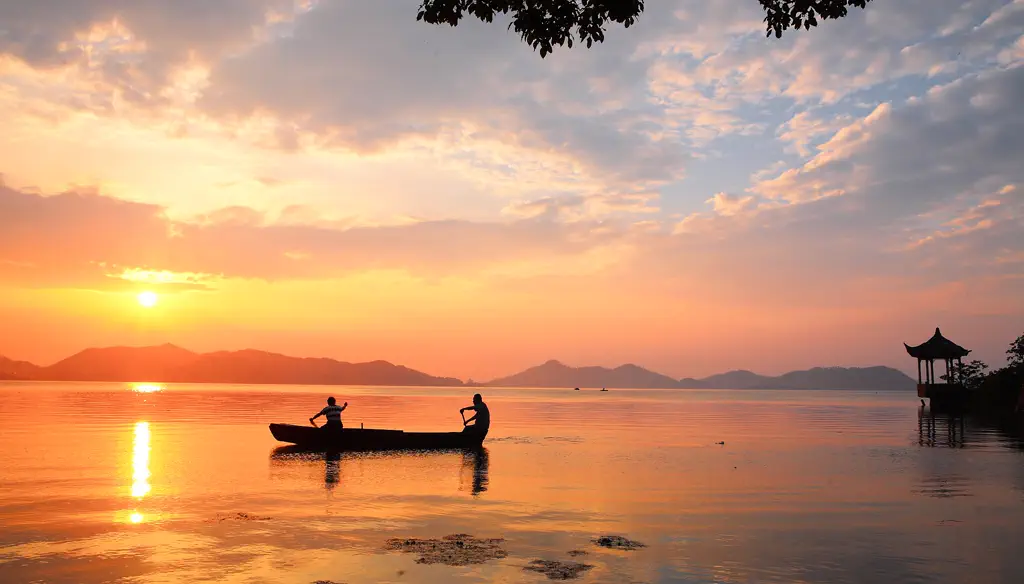
Cyclists give the loop its own half day — about forty-five kilometres around, better in segments. Families have the Ningbo Wildlife Park on the shore. The lakeside villages reward sitting still: pick one, wait for the sunset, skip the checklist. Eat at Hanling — the noodle shops and snacks cover a proper meal, the lake fish is seasonal, and the price should be asked before ordering.
On the causeway the old scenic names come in a string — Mist on the Causeway, Taogong Angler, Osmanthus Breeze, Bright Moon over Still Water, Er Ling in the Distance — old names for a view you earn step by step. The causeway ends at Xiayu Chan Temple; incense optional, the open water is the same either way.
The lake and the stones
Dongqian is a lagoon left by coastal silting, named already in a letter by the Western Jin writer Lu Yun. In 744, the third year of Tang Tianbao, the magistrate Lu Nanjin diked the northwest shallows and fixed the lake's irrigation role; Wang Anshi rebuilt the waterworks as magistrate of Yin in the Northern Song. When the Southern Song court settled in Hangzhou, the Shi family buried its dead in the hills by the lake, and the tomb-way carvings survived — the reason for the saying that the north has the Terracotta Army and the south has the Qianhu carvings. The weight of these stones is in the record: China's tomb-way sculpture runs unbroken until the Southern Song, where surviving pieces go scarce, and the Shi family carvings fill exactly that gap. Watch the arrangement of the figures and the drapery lines; that is where they show their class. The resort's drawing power is not new either — 2014 alone counted more than 3.8 million visitors.
Tickets, hours and transport
| Item | Reference |
|---|---|
| Ticket | lakeshore free; Xiaoputuo 30 yuan; Stone Carving Park 55 yuan per Wikipedia, unconfirmed |
| Hours | shore all day; Xiaoputuo and the park keep their own posted hours |
| Address | Dongqianhu town, Yinzhou District |
| Metro | Line 4 to Dongqian Lake station; the transport hub beside it shuttles to the sights |
| Bus | route 966 and shuttles for Xiaoputuo and Hanling; 960, 966-1 for Hanling Old Street |
| Time | half a day to a day; the cycle loop is extra |
Xiaoputuo's 30 yuan has two listings behind it; the park's 55 yuan rests on one stale-looking source; whether Hanling charges is unknown — all three sit on the to-confirm list.
How to arrange it
Line 4 to Dongqian Lake station, shuttle to Xiaoputuo from the hub, then walk the causeway out and back — two kilometres, easy. Lunch at Hanling, then the Stone Carving Park, or stay by the water for sunset. Cyclists should give the loop its own half day; the full forty-five kilometres wants legs. On the way back, Tiantong Temple and its pine approach hang near the road. The shore is a national resort with hotels through guesthouses, and peak-weekend prices and rooms need early booking.
The Ningbo guide pairs the lake with Tiantong in one day, after a morning at Moon Lake or the pavilion; Xuedou Mountain sits far west and wants its own.
Things to confirm before you go
- The lakeshore is free; Xiaoputuo is 30 yuan on recent listings and the Stone Carving Park shows 55 yuan on an older one — recheck both before paying.
- Whether Hanling Old Street charges anything is unconfirmed; treat gate claims as final.
- Shuttle frequencies on routes 960, 966 and 966-1 change with the season and holidays; the hub board has the day's sheet.
- Peak-weekend rooms around the lake sell early; book ahead if a lakeside stay is part of the plan.
Frequently asked questions
Does Dongqian Lake charge?
The lake is free, and the free part fills a day. Xiaoputuo is 30 yuan and the carving park 55 by old listings; the spending goes to boats, buses and gated sights.
How does it compare with West Lake?
Bigger and wilder. Less packaging, more length — the loop, the villages, the room to breathe. The two were never the same proposition: West Lake is a garden in the city, Dongqian is a lake outside it. Pick by mood.
Is half a day enough?
For Xiaoputuo and Hanling, yes. Add the carvings and the loop and it wants a full day. Picnickers can run it to sunset.