Yuantouzhu: The Turtle Head on Taihu
Yuantouzhu is a rocky point that juts into Taihu about fifteen kilometres southwest of central Wuxi. The name means the Islet of the Turtle Head, after the shape of the rock, and the park has long been billed as the finest place on the lake. Most of what you walk through was built by private owners from 1916 onward and turned into a public park after 1950. In March and early April the park is the most famous cherry blossom spot in China, and the crowds match. The rest of the year it is a lake park with old villas, a lighthouse, a temple on the hill and a boat out to an island.
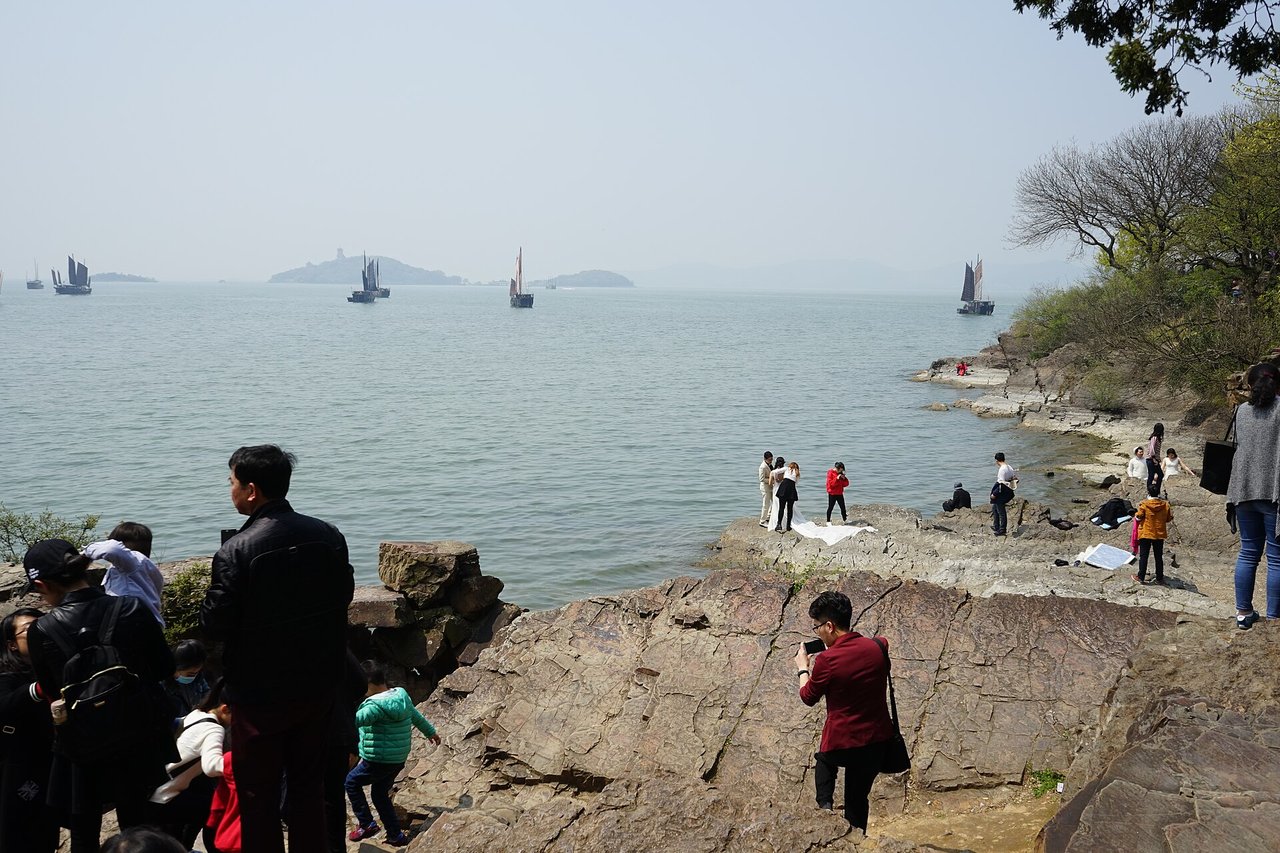
A point with a long literary record
The name first appears in the Ming. Chinese Wikipedia quotes the writer Wang Yongji describing water dashing on old stone and one great rock leaning over the lake "like a turtle's head". The Donglin scholar Gao Panlong lived in retreat nearby and wrote of washing his feet below the point, and a later carving on the cliff marks the place. In 1895 the county magistrate Liao Lun had four large characters cut into the rock face, "Embracing Wu and Yue", a nod to the two ancient states that met on Taihu.
The park itself is a twentieth-century creation. In 1916 the industrialist Yang Hanxi bought about four hectares near Chongshan and spent some twenty years building Hengyun Villa, with pavilions, halls and the Changchun Bridge. Wang Xinru built the neighbouring Taihu Villa with its Seventy-Two Peaks Hall, and other families added their own retreats. Chinese Wikipedia notes that these private gardens were open to the public free of charge. The owners modelled several buildings on imperial gardens in Beijing, which is why some halls and gateways here look northern, unusual for a Jiangnan garden. After 1950 the villas were taken into a single park, which was renamed during the Cultural Revolution and expanded in 1982.
The point and the lighthouse
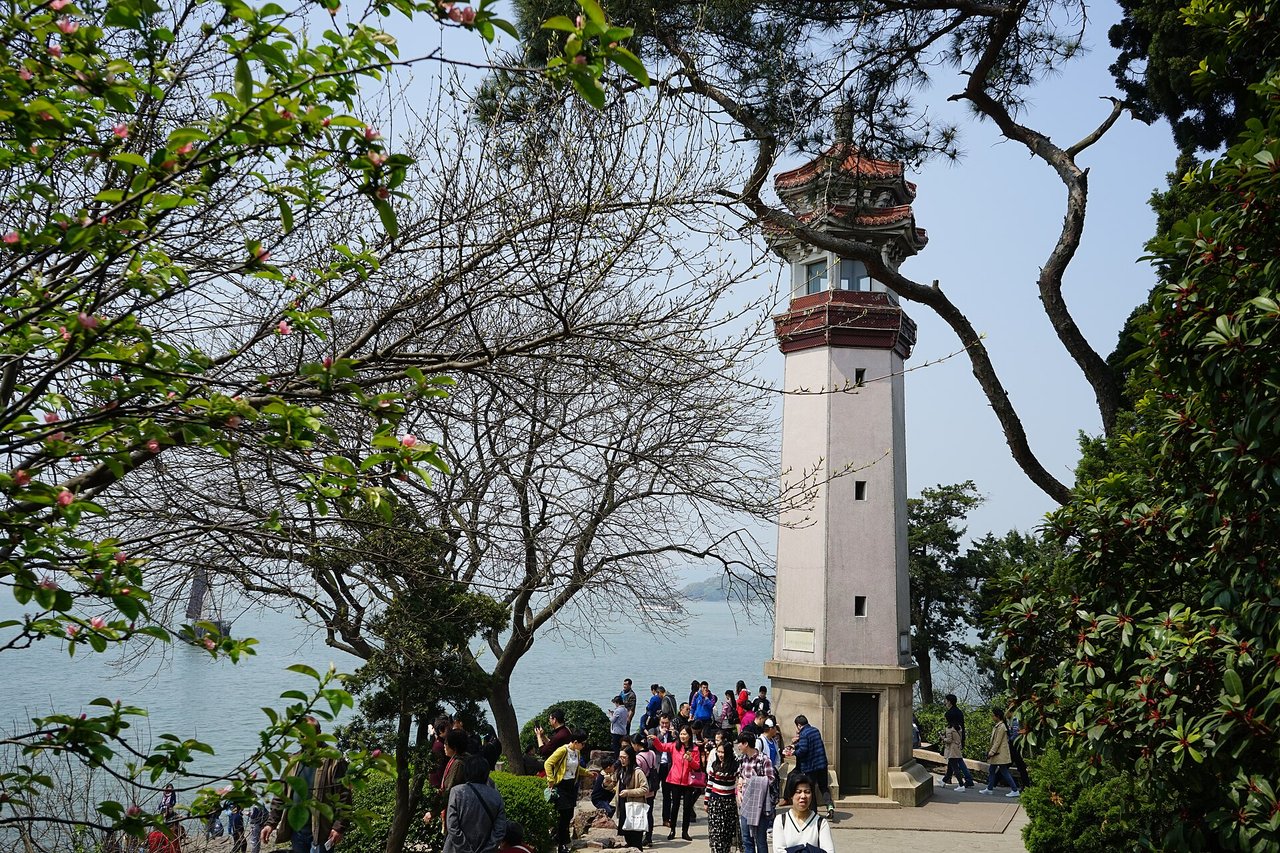
The walk to the tip passes through a gateway inscribed with an old name for Taihu and a garden called Deep Among the Lotus Flowers. At the end stands a small lighthouse, built in 1924 by local subscription to mark a new steamship service and since raised to 13.1 metres. Behind it is a stone carved "Yuantouzhu" on one side and "Spring Waves at the Turtle Head" on the other. The original calligraphy of the second inscription was destroyed in the Cultural Revolution, and the restorers of 1974 assembled the four characters from a couplet by the calligrapher Tang Tuo. From the rock shelf you can see the cliff inscriptions and, on hazy days, very little else. Taihu is large enough that the far shore often disappears.
A path climbs from the point to Guangfu Temple, which Chinese Wikipedia traces to a Liang dynasty temple and which took its present name in 1921. Beside it a pavilion remembers Fan Li, the Yue minister said to have boated off across Taihu after the fall of Wu.
Changchun Bridge and the cherries
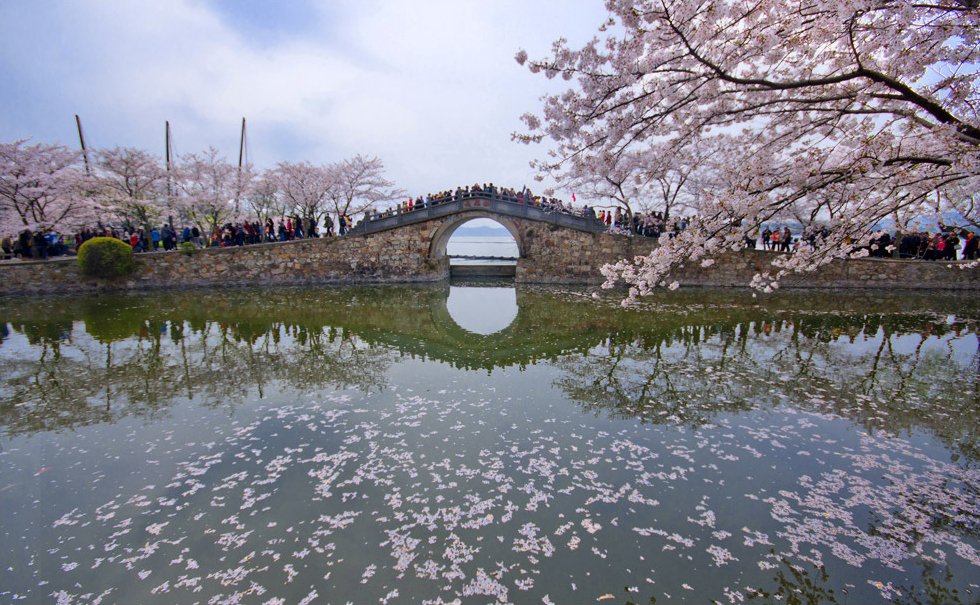
Changchun Bridge, a small humped bridge modelled on the Jade Belt Bridge at the Summer Palace, was built in 1936, and Somei Yoshino cherries were planted on the causeway beside it. From 1988, as part of Wuxi's friendship links with Japan, Japanese visitors planted more trees every year. Chinese Wikipedia counts more than 30,000 cherry trees in the park today. The 2026 festival ran from 1 March to 15 April, and the park said it had added more than thirty late-flowering varieties to stretch the season into mid-April. Late March is usually the peak. Expect long queues at the gates and the bridge on weekends.
The boat to the island
Out in the lake are small islands that read as three hills from the shore. From 1994 they were developed as the Taihu Fairy Island, with Daoist-style halls. Ferries run from the park, and the ride is the easiest way to feel how big Taihu is. Gulls often follow the boats, and visitors feed them from the deck.
Tickets and hours
During the 2026 cherry festival the day ticket was 90 yuan, covering the gate, the park shuttle bus and the island ferry, with half-price tickets for children aged 6 to 18 and students. A separate evening cherry session ran from 20 March to 6 April. Outside the festival, check the official notice for the current price. The park's own site gives hours of 08:30 to 17:00 daily, and the Jiangnan Orchid Garden inside asks for an on-site reservation.
Getting there
The park is at 1 Yuanzhu Road in Binhu District, about 18 kilometres from the centre by the park's own count. It has two main gates, Chongshan and Dushan. Buses run from the city and taxis are easy. Liyuan, the lakeside garden on Li Lake covered in the Wuxi guide, is on the way back into town and pairs well with it. The Lingshan Grand Buddha is further out on the same side of the city.
How long and when
Three to four hours covers the point, the temple and the island. Start at opening, before the tour buses fill the main gate, and keep the day movable in case of rain. Liyuan, a 1920s garden on Li Lake, is closer to town and fits on the way back. Old Wuxi is on the other side of town, at Huishan Ancient Town, Jichang Garden and the Qingming Bridge canal quarter. Spring is cherry season, summer brings lotus and heavy rain, and late autumn is quiet and clear.
Things to confirm before you go
- The ticket price and what it includes outside the cherry festival.
- Ferry times to the Taihu Fairy Island and the last boat back.
- Which gate is closest to your bus or taxi drop-off.
- Weather. Fog and rain can hide the lake completely.
Frequently asked questions
When do the cherries bloom at Yuantouzhu?
Early varieties open in late February, the main bloom is usually late March, and the 2026 festival ran to 15 April.
Is Yuantouzhu an island?
No. It is a point on the shore. The islands reached by ferry are the separate Taihu Fairy Island.
How much is the ticket?
It was 90 yuan during the 2026 festival, including the shuttle and ferry. Other seasons follow the official notice.
Yuantouzhu or Lingshan if I have one day?
Yuantouzhu for Taihu and old gardens, Lingshan for the modern Buddha. The Wuxi guide has both in a three-day plan.
Sources
Facts in this article were checked against the following sources, retrieved 8 October 2026.
- 鼋头渚, Chinese Wikipedia
- Yuantouzhu, English Wikipedia
- 无锡市太湖鼋头渚风景区, official site
- 鼋头渚樱花节周日启幕, Wuxi government, February 2026
- 2026无锡鼋头渚樱花节, Wuxi Bendibao
Photos are from Wikimedia Commons under the licences shown in each caption.