Wuxi Travel Guide: Five Stops on Taihu (with a Three-Day Itinerary)
Wuxi is a prefecture-level city in southern Jiangsu, abbreviated Xi and nicknamed the Pearl of Taihu, a canal and lake city in the middle of the Suzhou–Wuxi–Changzhou belt, 128 kilometers west of Shanghai. The municipality covers about 4,627 square kilometers and held 7.50 million people in 2024. It is a national historic city and one of the first excellent tourist cities listed in 1998. Five places below (Yuantouzhu, the Lingshan Grand Buddha, Jichang Garden, the Qingming Bridge canal quarter, and Liyuan) have all had their origins checked against public sources.
Planning a short Wuxi stay
Protect one signature half-day and one buffer for transport. Cut malls and duplicate viewpoints if the calendar is tight. A cut list beats a checklist when time runs short.
When to come to Wuxi
The city infobox gives a subtropical monsoon climate, annual mean 16.2°C and about 1,122 millimeters of rain. The body of the same page uses 15.5°C and 1,048 millimeters. Either way the year splits into four seasons: January around 3°C, July around 28°C, rain concentrated in summer. April is the cherry window at Yuantouzhu; autumn is the easier stretch for walking the canal and the gardens. Yuantouzhu and Lingshan sit on the Taihu side, Jichang at the foot of Huishan, the Qingming Bridge in the old south of town. Metro, buses and taxis cover most of it; Lingshan wants a half day on its own.
How to get in and where to stay
Use the main airport or high-speed rail station that serves Wuxi, then ride metro, bus, or taxi per posted notices. Stay near the primary visitor cluster if walking matters; treat outlying scenic areas as day trips, not hotel districts.
Places worth visiting
Yuantouzhu
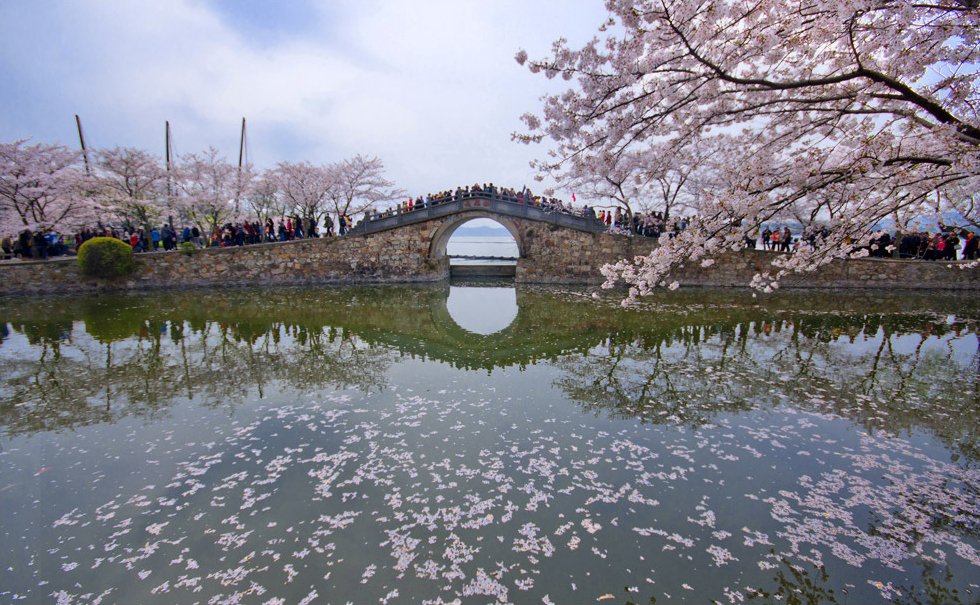
Yuantouzhu, the Islet of the Turtle Head, juts into Taihu some fifteen kilometers southwest of the city, a rocky point named for its shape, called the finest place on the lake since at least the Ming. The name is already in a text by Wang Yongji; Gao Panlong washed his feet here, and in 1895 the county magistrate Liao Lun had "Embracing Wu and Yue" cut into the cliff. From 1916 the industrialist Yang Hanxi bought land and built Hengyun Villa; other private gardens followed. The park was assembled after 1950 and expanded in 1982.
Changchun Bridge, finished in 1936 on the model of the Jade Belt Bridge at the Summer Palace, is the photograph everyone takes in April, when the Somei Yoshino cherries along the causeway come out. The park now holds tens of thousands of cherry trees. The "Finest Place on Taihu" arch went through several names before Li Keran wrote the present plaque in 1979. Boats cross to the Three Hills, developed from 1994 as an island with Daoist halls. Tickets and boat fares follow official notices. Give it a morning; the lake light is better before the tour buses fill the point. The lighthouse, Guangfu Temple, the island ferry and cherry festival tickets are on the Yuantouzhu page.
The Lingshan Grand Buddha
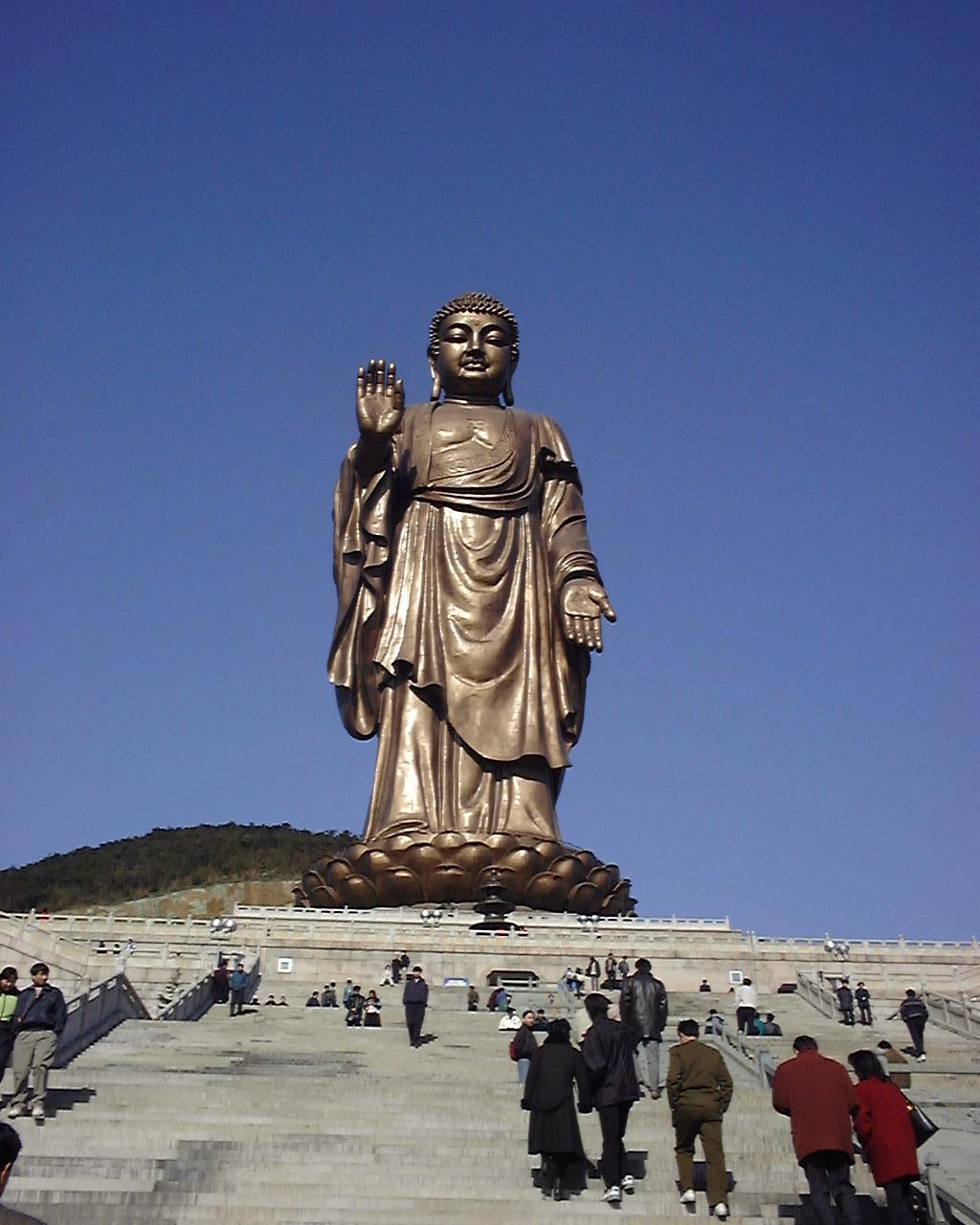
The Lingshan Grand Buddha stands in Binhu District, on the north shore of Taihu at Mashan. The figure is 88 meters of bronze, more than 700 tons, designed by Wu Xianlin of Nanjing's Chenguang group. Ground was broken on 20 April 1994; the head was set on 3 April 1997 and the image consecrated on 15 November. The scenic area is a national 5A site. The project was a temple-and-company partnership, not a donation drive by the faithful, the city page is blunt about that.
Xiangfu Temple sits at the Buddha's feet, tied in local tradition to Xuanzang's journey. The Brahma Palace hosted the opening of the second World Buddhist Forum in 2009, and in 2012 Lingshan was named the forum's permanent site. The statue is a modern landmark, not a medieval one; come for the scale and the lake behind it, and check same-day tickets. A half day from town is enough unless you also want the palace interiors. The Nine Dragons show, the Brahma Palace and the 2026 ticket cut are on the Lingshan Grand Buddha page.
Jichang Garden
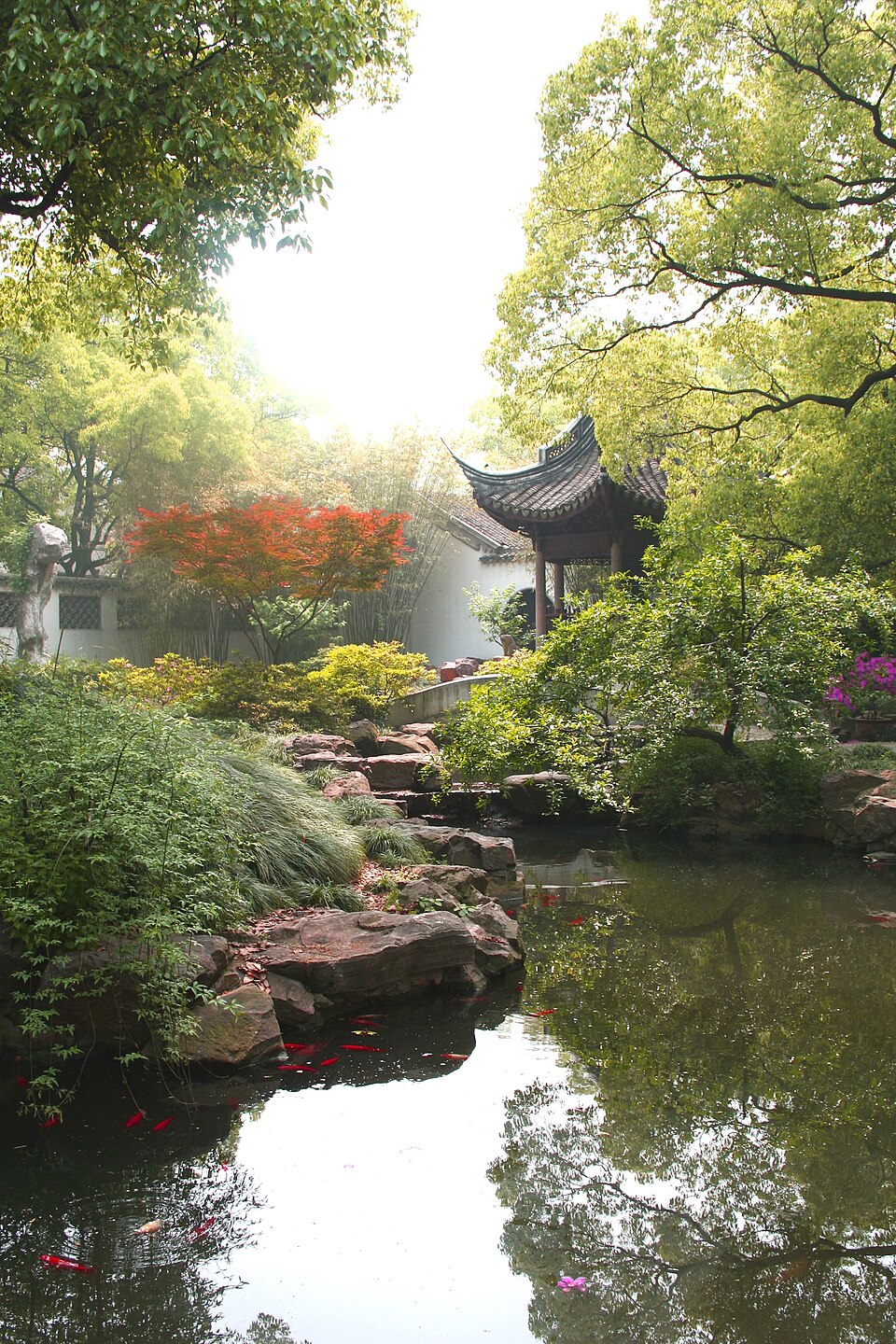
Jichang Garden, also called the Qin Garden, sits at the foot of Huishan. The name is taken from Wang Xizhi's line about lodging one's ease in the shade of hills and water. In the Zhengde years of the Ming, Qin Jin, a Nanjing minister of war, bought two monks' lodges of Huishan Temple and made a villa. A later Qin, Qin Yao, renamed it Jichang after losing office in 1591. Kangxi and Qianlong both stopped here on every southern tour; Qianlong had a copy built at the Summer Palace, today's Garden of Harmonious Interest, and called the Qin garden the oldest of Jiangnan's famous sites. It entered the third batch of nationally protected sites in 1988.
The garden covers 14.85 mu, a long north–south strip with a pool, borrowed views of Huishan and of the pagoda on Xishan, and the Eight-Tone Gully fed by the Second Spring Under Heaven. Most of the Qing buildings burned in the mid-nineteenth-century wars; the Qin descendants gave the garden to the state in 1952, and the old chastity shrine at the southwest corner is now Bingli Hall. Walk it slowly. It is smaller than Suzhou's great gardens and quieter for that. The garden's history and walking order are on the Jichang Garden page, and the shrine streets, the Second Spring and Huishan Temple around it are on the Huishan Ancient Town page.
The Qingming Bridge Canal Quarter
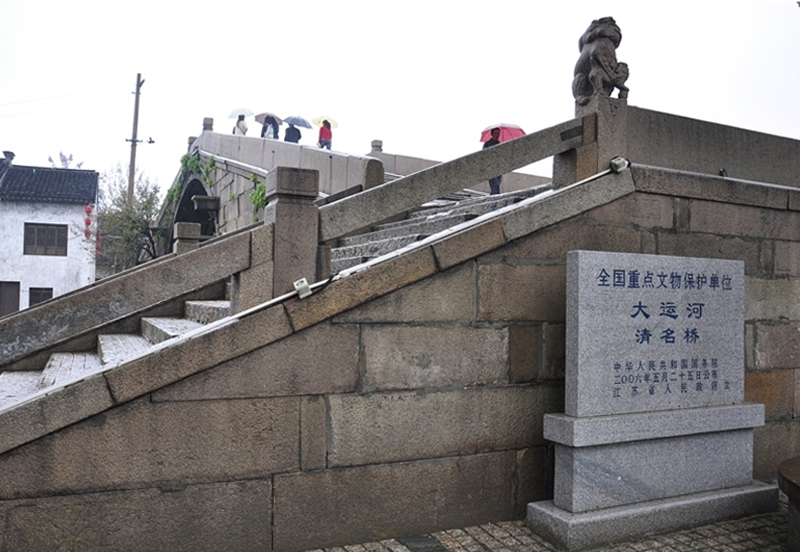
The Qingming Bridge historic quarter lies in Liangxi District along the Wuxi stretch of the Grand Canal. Nanchang Street, the canal, Nanchangtang, the Bo Canal and Kiln Road, 18.78 hectares billed as a Jiangnan water alley. The bridge itself, the marker of the street, was first built in the Ming. On 22 June 2014 the quarter was listed as part of the Grand Canal World Heritage, in the Jiangnan Canal's Wuxi urban section.
Until the Jiajing years the canal ran straight through the city; it was then bent around the walls against wokou raids. Nanchang Street began as a Song postal road parallel to the water, linking Suzhou and Changzhou. Kilns, foundries, silk filatures and rice yards followed. A 1994 widening wiped the stretch from Nanchan Temple to Kuatang Bridge; the 900 meters from there to Qingming Bridge survived, and a conservation plan under Wu Liangyong opened the street in 2011. It is a 4A site. Come at dusk, when the canal lamps are on, and walk the old houses on Nanchangtang rather than only the rebuilt shop front. The kilns, the silk museum, canal boats and the right metro stop are on the Qingming Bridge and Nanchang Street page.
Liyuan
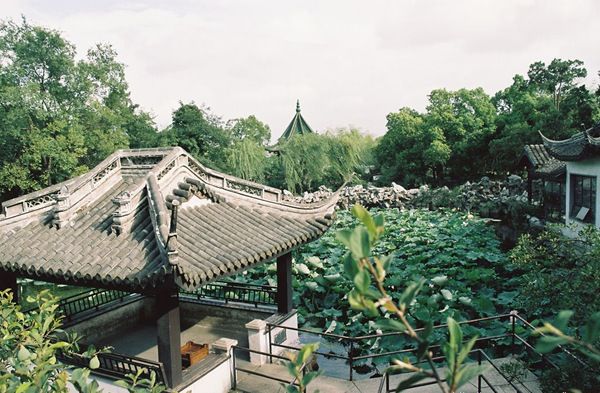
Liyuan sits on the north shore of Li Lake in Binhu District, a national 4A scenic area of 8.2 hectares, 3.5 of them water. The lake takes its name from Fan Li, the Yue minister said to have boated here with Xi Shi after the fall of Wu. In the early Republic the village of Qingqi laid out eight scenes; between 1927 and 1936 Wang Yuqing and his son built Liyuan on that base, and Chen Meifang built a "Fishing Village" to the west. The two gardens were joined in 1952, with a long corridor of about 200 meters.
The Four Seasons Pavilions of 1954 are the usual photograph, plum, oleander, osmanthus and wintersweet by the season. A 289-meter waterside corridor and a small pagoda sit on the east. The garden was listed as a Jiangsu protected site in 2002. It is closer to town than Yuantouzhu and pairs with it on a lake day. Hours follow official notices. A walking loop is on the Liyuan page.
Eating in Wuxi
Wuxi cooking is the sweeter, saltier side of Su-Xi cuisine. Sauce-braised spare ribs, also called Wuxi pork bones, are the city's famous meat, slow-cooked in a sauce that takes about a tenth of its sugar from Cantonese cane sugar; Sanfengqiao and the old Lu Gaojian shops are the names locals argue over. Wuxi xiaolongbao run larger and more heavily filled than the Shanghai kind, juice in a thin skin; Wang Xingji is the old brand, street shops have their own followings. Clear-water fried gluten, hollow and crisp, is the third traditional specialty, stuffed or dropped into soup. Taihu's "three whites" (whitefish, white shrimp and icefish) turn up as lake-boat dishes. Follow the queues on Nanchang Street and around the lake rather than the mall restaurants.
How to arrange the route
Day one stays in town: the Qingming Bridge canal quarter in the morning, sauce ribs nearby for lunch, Jichang Garden and Huishan Ancient Town in the afternoon.
Day two is the lake: Yuantouzhu in the morning for the point and, in April, the cherries; Liyuan in the afternoon on the way back.
Day three goes to Lingshan for the Buddha and, if the timing works, the Brahma Palace. With only two days, keep days one and two and drop Lingshan, or swap Jichang for the Buddha if the statue is the reason you came.
Suzhou is the next garden city east, a short hop on the same high-speed line. Nanjing is west. Yangzhou sits across the river from Nanjing if the trip keeps going north of the Yangtze.
Things to confirm before you go
- Yuantouzhu, Lingshan, Jichang Garden and Liyuan are paid sights; tickets and boat fares follow official notices.
- April cherries at Yuantouzhu mean crowds; start early. Summer rain is heavy; keep a lake day movable.
- The Qingming Bridge street is a mix of conserved houses and later shops, walk Nanchangtang for the older fabric.
- Lingshan is out at Mashan; half a day by metro plus bus or a taxi.
- Spare ribs travel well as a packaged souvenir; xiaolongbao do not.
Frequently asked questions
How many days for Wuxi?
Three days fits the canal, the two lake gardens and Lingshan. Two days covers the canal plus Yuantouzhu. One day is only the canal and Jichang, or only the lake.
Yuantouzhu or Lingshan, if you can only pick one?
Yuantouzhu if you want Taihu itself. Lingshan if you came for the Buddha. They are not substitutes, and they sit on the same side of the city.
Can you combine Wuxi with Suzhou?
Yes. High-speed rail between them is a short ride. Suzhou for the classical gardens, Wuxi for the lake and the canal street, is the usual order.
What must you eat in Wuxi?
Sauce-braised spare ribs, xiaolongbao, and a bowl with fried gluten. Taihu fish if you are at the lake.
Sources
The facts in this article were checked against the following Chinese Wikipedia entries, retrieved September 4, 2026.
- Wuxi (city) https://zh.wikipedia.org/wiki/无锡市
- Yuantouzhu https://zh.wikipedia.org/wiki/鼋头渚
- Lingshan Grand Buddha https://zh.wikipedia.org/wiki/灵山大佛
- Jichang Garden https://zh.wikipedia.org/wiki/寄畅园
- Qingming Bridge canal quarter https://zh.wikipedia.org/wiki/清名桥
- Liyuan https://zh.wikipedia.org/wiki/蠡园
The city page's climate infobox and body disagree on the annual mean and rainfall; both figures are given above. The Lingshan page does not claim the statue is still the world's tallest bronze Buddha, and this article does not either.
All photos are from Wikimedia Commons, used under CC licenses; re-use requires attribution.
- wuxi-yuantouzhu.jpg from File Wuxi_Taihu_lake_Changchun_bridge.jpg, by 藍風攝影, CC BY-SA 3.0
- wuxi-lingshan.jpg from File LinShanDaFo.jpg, by Phoebus, CC BY-SA 3.0
- wuxi-jichang.jpg from File Jichang_Yuan.jpg, by Iwanafish, public domain
- wuxi-qingmingqiao.jpg from File Wuxi_Qingming_Bridge.jpg, by 王波波, CC BY-SA 4.0
- wuxi-liyuan.jpg from File Liyuan_Gardens.jpg, by Synyan, CC BY-SA 3.0
Wuxi sight-page images additionally used:
- wuxi-lingshan-stairs.jpg from File:Mt. Lingshan Grand Buddha Scenic Area (42314970261).jpg, by Emoji English, CC BY 2.0
- wuxi-lingshan-brahma.jpg from File:灵山·梵宫,Brahma Palace,Lingshan - panoramio (1).jpg, by Adazzy.Gonzo, CC BY-SA 3.0
- wuxi-ytz-shore.jpg from File:Yuantouzhu -- Sea Erosion Platform.jpg, by Huanokinhejo, CC BY-SA 4.0
- wuxi-ytz-lighthouse.jpg from File:Yuantouzhu Lighthouse.jpg, by Huanokinhejo, CC BY-SA 4.0
- wuxi-jichang-pond.jpg from File:江苏 无锡 无锡市 惠山古镇 寄畅园 主园.jpg, by 上海道台, CC BY-SA 4.0
- wuxi-jichang-corridor.jpg from File:Jichang garden.jpg, by Muzzleflash, CC0
- wuxi-qingming-canal.jpg from File:清名桥附近.jpg, by Clear Sky C, CC BY-SA 4.0
- wuxi-qingming-bridge.jpg from File:无锡清名桥.jpg, by EditQ, CC BY-SA 4.0
- wuxi-nanchang-street.jpg from File:Nanchang Street, Wuxi 3.jpg, by EditQ, CC BY-SA 4.0
- wuxi-huishan-dongyue.jpg from File:Dongyue Temple in Wuxi Huishan ancient town 2.JPG, by Xuankongshengjing, CC BY-SA 4.0
- wuxi-huishan-zhuxi.jpg from File:Chu Hsi's ancestral temple in Wuxi Huishan ancient town.JPG, by 記小三, CC BY-SA 4.0
- wuxi-huishan-paifang.jpg from File:Qian Ren Bao De Paifang in Wuxi Huishan ancient town.jpg, by 記小三, CC BY-SA 4.0