Qingming Bridge and Nanchang Street: Wuxi's Canal Lane
The Qingming Bridge historic quarter lies on the Grand Canal just south of the old city of Wuxi, in Liangxi District. It covers 18.78 hectares along both banks, taking in Nanchang Street on the west bank, Nanxiatang on the east, the mouth of the Bodu canal and the brick kilns of Dayao Road. The Ming stone bridge in the middle gives the quarter its name. On 22 June 2014 the quarter was inscribed as part of the Grand Canal World Heritage site, in the Wuxi urban section of the Jiangnan Canal. The streets are free to walk, and the canal is at its best at dusk.
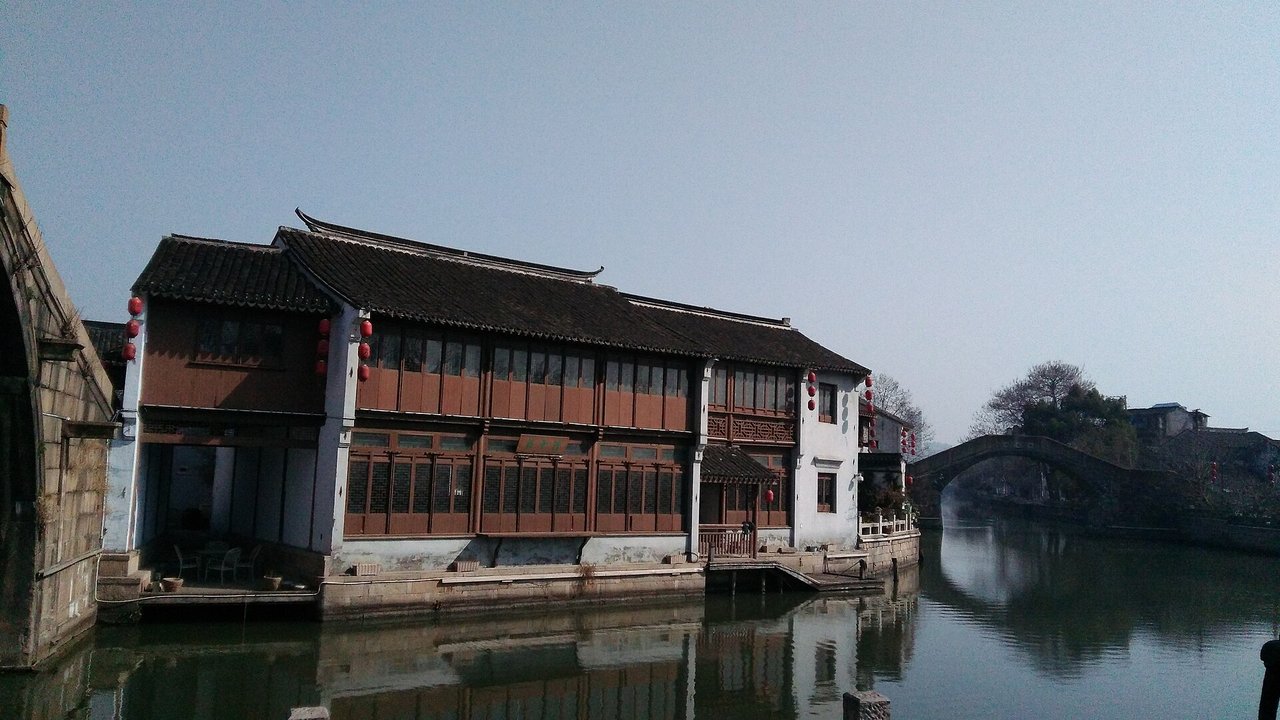
Why the canal bends here
Until the Ming the Grand Canal ran straight through the middle of Wuxi. A Yuan gazetteer quoted by Chinese Wikipedia says boats of seven hundred shi could pass through the city. In the Jiajing years, to defend the walls against the wokou pirates, the canal was rerouted around the city, and this southern stretch outside the south gate became the main line. Locals called the canal tang, and this part was the South Tang. Nanchang Street grew from a Northern Song post road built alongside the water to link Suzhou and Changzhou.
Just south of the bridge the Bodu canal joins from the east. Tradition credits it to Taibo, the Zhou prince said to have founded the state of Wu, and the hydraulic engineer Wu Tongju argued that it was the oldest canal in China. A Tang prefect, Meng Jian, dredged it in 813 for grain transport.
The bridge
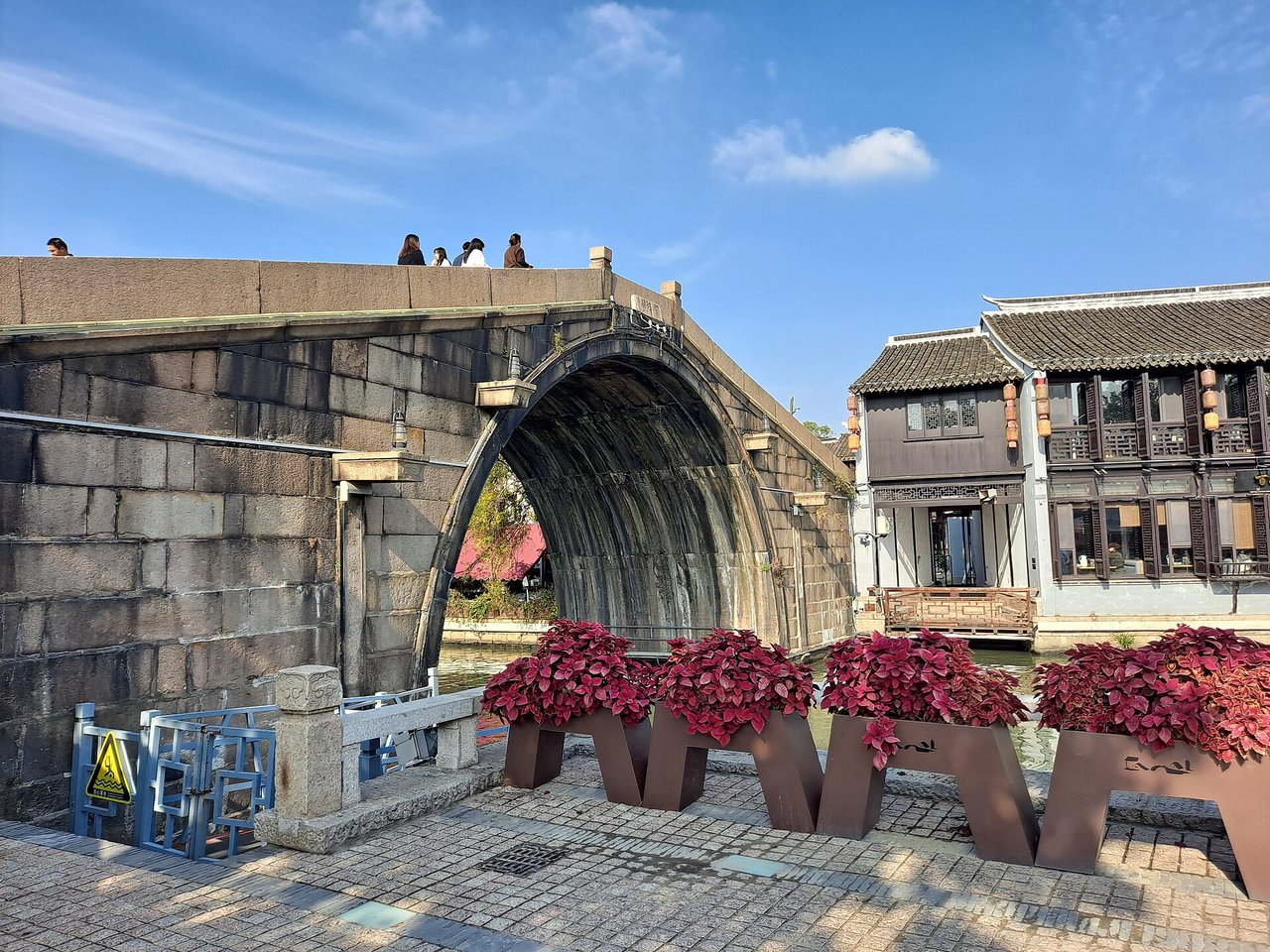
Chinese Wikipedia calls Qingming Bridge the largest surviving old stone arch bridge in urban Wuxi. It was paid for in the Wanli reign by the two sons of Qin Yao, the owner of Jichang Garden, whose names gave it its first name, Qingning Bridge. A county magistrate rebuilt it in the early Kangxi reign. In the Daoguang reign the character ning had to go, because it was part of the emperor's personal name, and the bridge became Qingming. It was destroyed in 1860 during the Taiping war and rebuilt in 1869, and that is the bridge you cross today. The couplets once carved beside the arch were chiselled off in the Cultural Revolution.
A little north is Dagong Bridge, a three-span concrete bridge of 1930. Silk-mill women had to be ferried across the canal to work, and in 1929 a worker from the Zhenyi mill fell in and drowned. The mill owner raised money for a bridge and the industrialist Rong Desheng helped pay for it.
A working quarter
The quarter was industrial for centuries. Kilns, foundries and boatyards lined the banks, with rice and livestock markets beside them, and in the Ming and Qing the area traded cotton and silk cocoons. In the late nineteenth century the Yang brothers opened Wuxi's first modern factory, a cotton mill, nearby. Silk filatures followed. Chinese Wikipedia counts more than sixty factories and 18,000 workers here before 1949.
Two of those sites are now museums. The Yongtai silk filature, moved here from Shanghai in 1926, has housed the China Silk Museum since 2009. On the east bank, Dayao Road was lined with brick kilns that Chinese Wikipedia says number 42 surviving out of about a hundred, strung along about 1.5 kilometres. In the Jiaqing reign they took orders for the gold bricks of the Forbidden City. The kiln group became a national protected site in 2013, and the site now has a small museum. Further south the Nanshuixian Temple honours Wang Qiqin, a Ming magistrate who led the defence against the pirates, and the late Qing house of the industrialist Zhu Dachun stands on the Bodu canal.
Saved by neglect
Chinese Wikipedia tells the quarter's recent history plainly. Foreign visitors and Chinese architects were praising the canal lane by the 1980s, and Wuxi's people's congress passed a conservation resolution in 1983. In 1994 the city widened 560 metres of Nanchang Street, from Nanchan Temple to Kuatang Bridge, to a 30-metre road and rebuilt its frontage. Officials then left the rest alone for years, which is how the 900 metres from Kuatang Bridge to Qingming Bridge survived. Restoration began at the end of 2007 under a plan led by the architect Wu Liangyong. The quarter was named a historic street in 2010, opened in October 2011 and became a 4A scenic area in 2014.
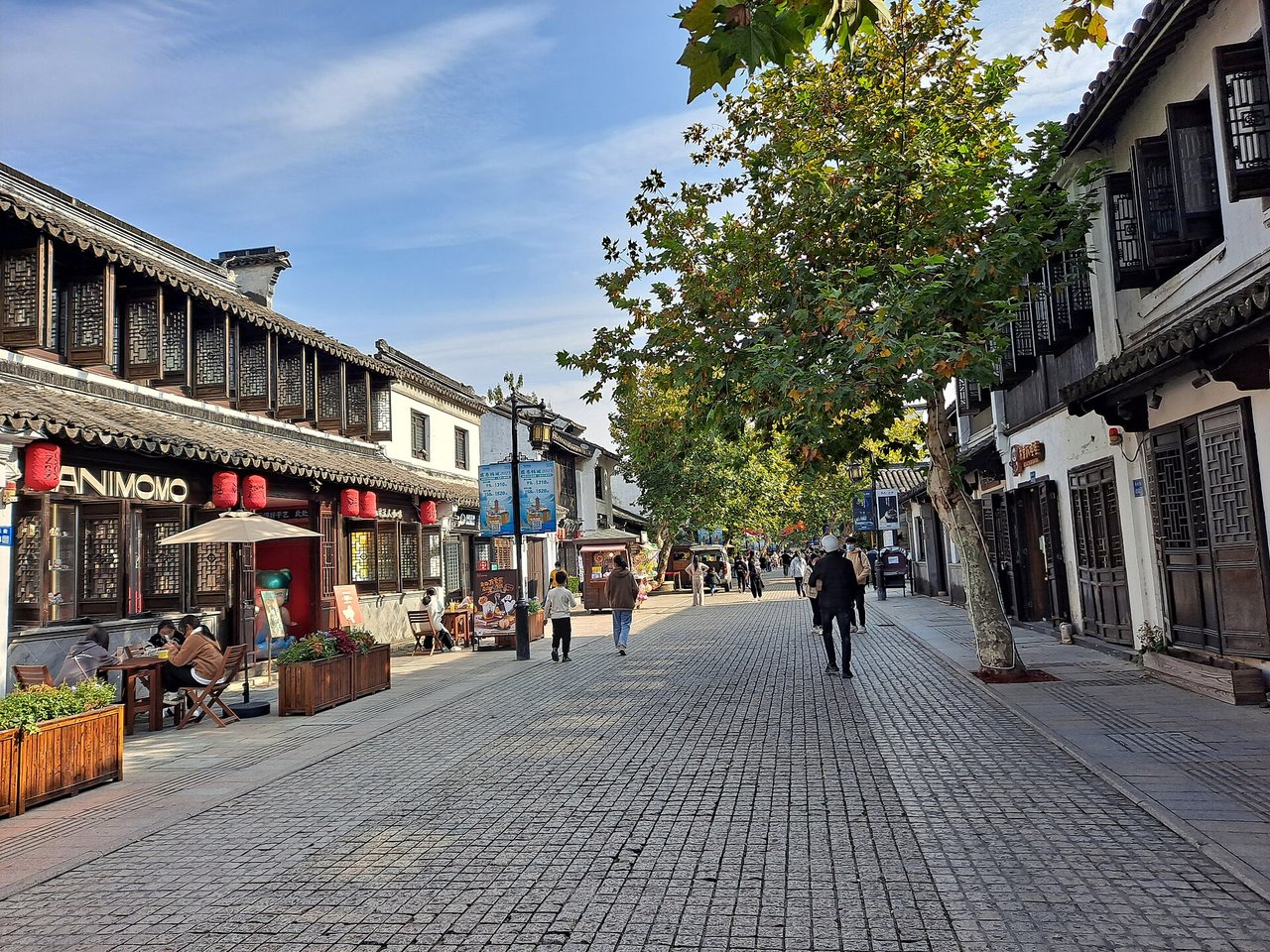
Today Nanchang Street and the canal side of Nanxiatang carry most of the shops and cafes. Dayao Road and the back lanes of Nanxiatang still have ordinary houses, and those are the parts that feel old.
Tickets and hours
The quarter is open and free. Chinese Wikipedia lists the China Silk Museum, the kiln museum and the Zhu Dachun house as paid sites at 20, 10 and 10 yuan, and canal boats from Nanchan Temple stopping along the quarter, with a full-route fare that was 60 yuan by day and 80 yuan at night. Those figures may have changed. Check the day's notice at the boat piers and museum doors.
Getting there
Take Wuxi Metro Line 1 to Nanchan Temple station, use exit 8, cross Nanchang Bridge and walk south along Nanchang Street for about five minutes. Do not get off at Qingmingqiao station on the same line. Chinese Wikipedia warns that it is named for the subdistrict and is about 1.5 kilometres from the historic quarter. Bus stops named Nanchang Street can also be far away, since the road is 5.5 kilometres long.
How long and when
Two to three hours covers the street, the bridge, Nanxiatang and one museum. Come in the late afternoon and stay into the evening, when the canal is lit. A boat ride adds an hour. Huishan Ancient Town and Jichang Garden make a good morning before it, and the Wuxi guide has notes on the city's sauce-braised spare ribs for dinner.
Things to confirm before you go
- Boat times and fares from Nanchan Temple.
- Museum opening days and hours.
- The right metro station, Nanchan Temple, not Qingmingqiao.
Frequently asked questions
Is the Qingming Bridge quarter free?
Yes. The streets and bridges are free. Some museums and the canal boats charge.
How old is Qingming Bridge?
It was first built in the Wanli reign of the Ming. The present bridge dates from its rebuilding in 1869.
Which metro station is closest?
Nanchan Temple on Line 1, exit 8. Qingmingqiao station is about 1.5 kilometres away.
Is it part of the Grand Canal World Heritage site?
Yes, since June 2014, as part of the Wuxi urban section of the Jiangnan Canal. Yangzhou has the main canal museum.
Sources
Facts in this article were checked against the following sources, retrieved 8 October 2026.
Photos are from Wikimedia Commons under the licences shown in each caption.